PROFESSIONAL GUIDE: Understand standardized IQ testing Compare the tests
The complete practical guide
The Wechsler IQ Test
Everything you need to understand WAIS-5, WISC-V and WPPSI-IV: age ranges, index scores, percentiles, history, uses, limitations, test-day preparation and how to read a professional report.
Ages 2:6–90:11 Scores and percentiles Ethical test-use guidance
What is the Wechsler IQ test?
“The Wechsler test” is not one single test. It is a family of individually administered, age-based intelligence scales used by qualified psychologists and other appropriately credentialed professionals. The current major U.S. editions are the WPPSI-IV for young children, WISC-V for school-age children, and WAIS-5 for older adolescents and adults.
A Wechsler assessment produces more than one number. It can provide a Full Scale IQ, index scores describing broad cognitive domains, subtest scaled scores, percentile ranks, confidence intervals, and observations about how the person approached structured tasks. The most useful interpretation connects those results to the reason for referral, developmental and educational history, language, disability, health, behavior, and real-world functioning.
This page explains the tests without reproducing protected questions, answer keys or secure testing materials.
Last updated: August 2026
100Typical composite-score mean
The reference-group average
15Typical composite-score SD
One standard deviation
10Typical subtest scaled-score mean
Subtest SD is commonly 3
3Major age-based test families
WPPSI, WISC and WAIS
WAIS, WISC or WPPSI: which Wechsler test is used?
The examinee’s age sets the starting point, but overlapping age ranges do not make the choice automatic. A psychologist may also consider the referral question, expected ability level, language, attention, motor skills, developmental level, fatigue, prior testing, and the exact requirements of the school, agency or organization that will receive the report.
WPPSI-IV
Preschool and early-primary-age children
Wechsler Preschool and Primary Scale of Intelligence — Fourth Edition
Ages2 years 6 months–7 years 7 months
U.S. edition2012
Developmentally appropriate tasks designed for very young children, with different subtest requirements across the two main age bands.
Typical core time: About 30–60 minutes for core subtests, depending on age
International editions can differ.
Age ranges, publication years, language versions, normative samples and score names may differ outside the United States. Confirm the edition used in your country and the edition accepted by the receiving organization.
What does a Wechsler IQ test measure?
Modern Wechsler interpretation is organized around several broad cognitive domains. The five-domain structure is especially visible in the WISC-V and WAIS-5. The exact subtests and indexes vary by edition and age, and not every administered subtest contributes to the Full Scale IQ.
VCI — Verbal Comprehension
Reasoning with learned language, explaining concepts, understanding verbal relationships, and accessing word knowledge.
May be influenced by language exposure, education, hearing, expressive-language ability, and cultural experience.
VSI — Visual Spatial
Analyzing visual details, understanding part-to-whole relationships, and constructing or mentally organizing spatial information.
Performance may be affected by visual acuity, motor demands, unfamiliarity with materials, or time pressure.
FRI — Fluid Reasoning
Detecting rules, relationships, patterns, and quantitative or conceptual principles in novel problems.
Reflects performance on structured reasoning tasks, not every form of creativity or real-world problem solving.
WMI — Working Memory
Holding information in mind, mentally reorganizing it, and maintaining attention long enough to respond accurately.
Can be affected by attention, anxiety, fatigue, hearing, language, medication, pain, and test-taking conditions.
PSI — Processing Speed
Quickly and accurately scanning, discriminating, and recording simple visual information under time limits.
Motor speed, vision, perfectionism, cautious style, attention, and familiarity with timed work can matter.
What are subtests?
Subtests are shorter task sets that sample a particular kind of performance. Depending on the edition, they may involve explaining verbal relationships, solving visual or quantitative patterns, remembering and reorganizing information, constructing designs, or completing simple visual work efficiently. The examiner follows standardized instructions, timing, start points, reversal rules, discontinue rules and scoring criteria.
Because the materials are secure and copyrighted, responsible educational pages should not publish real items, answers, scoring rules, or close imitations designed to coach examinees.
Test security matters.
Searching for leaked questions or practicing with authentic materials can invalidate results, create unfair advantages, damage future clinical usefulness, and violate professional or publisher rules.
How Wechsler IQ scores, percentiles and standard deviations work
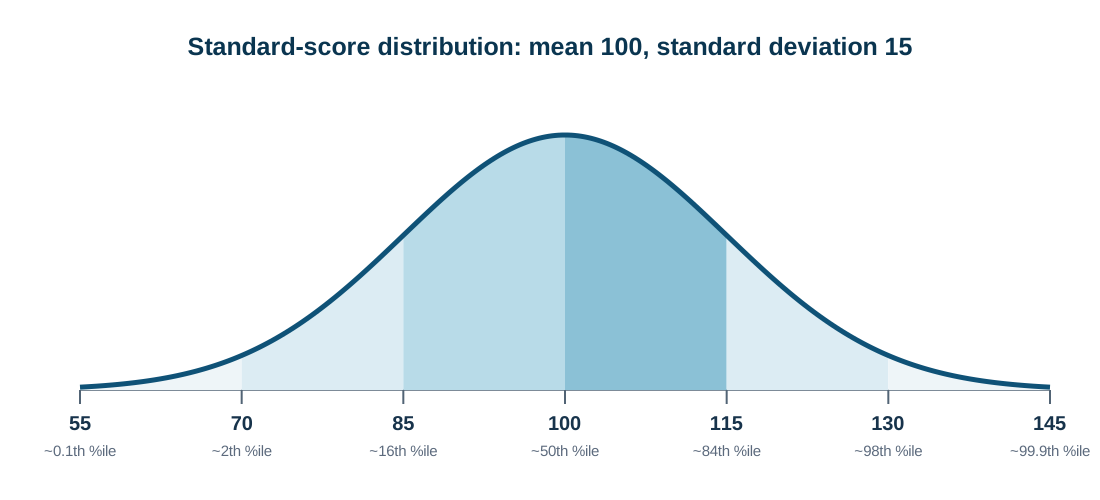
Composite scores are usually standardized so that the normative mean is 100 and the standard deviation is 15. Subtest scaled scores commonly use a mean of 10 and a standard deviation of 3. These transformations allow performance at different ages to be compared on a common scale.
Illustrative normal-curve conversion. Official reports use test-specific normative tables and rounding rules.
Three score languages
Standard score: the converted IQ or index number, such as 100 or 115.
Percentile rank: relative standing in the age-based normative group. The 84th percentile is higher than about 84% of the comparison group.
Confidence interval: a range that communicates measurement uncertainty. A reported score is an estimate, not a perfectly exact quantity.
Example: A composite of 115 is about one standard deviation above the mean and approximately the 84th percentile. It does not mean 115 questions were correct.
Composite score
Approximate z-score
Approximate percentile
Common descriptive wording
130 and above
+2.00 or higher
98th and above
Very high / extremely high
120–129
+1.33 to +1.93
91st–97th
High / very high
110–119
+0.67 to +1.27
75th–90th
High average
90–109
−0.67 to +0.60
25th–73rd
Average
80–89
−1.33 to −0.73
9th–23rd
Low average
70–79
−2.00 to −1.40
2nd–8th
Very low / borderline range
69 and below
Below −2.00
About 2nd and below
Extremely low
Descriptive labels differ across editions, software reports, jurisdictions and professional traditions. Use the terminology printed in the actual report rather than treating this table as a diagnostic classification system.
Why the Full Scale IQ is not always the whole story
The FSIQ summarizes selected subtests, but two people with the same FSIQ can have very different profiles. One may show consistent performance across domains; another may have strong verbal reasoning alongside much lower processing speed or working memory. The clinical meaning depends on the size, rarity and reliability of differences, behavioral observations, functional history and whether the overall score adequately represents the profile.
Additional composites such as a General Ability Index, Cognitive Proficiency Index, nonverbal or motor-reduced indexes may be discussed when supported by the edition, referral question and professional judgment. These scores are not automatic replacements for the FSIQ.
How to read a Wechsler test report
A good report explains the question being answered, not merely a list of numbers. Read the report in layers:
Layer 1
Referral question and background
Why was testing requested? What developmental, educational, medical, language and prior-testing information matters?
Layer 2
Validity and behavior
Was engagement adequate? Were there sensory, motor, attention, anxiety, fatigue, medication or technology issues?
Layer 3
FSIQ and indexes
What broad level and pattern emerged? Is the FSIQ considered representative, and how wide are the confidence intervals?
Layer 4
Subtest pattern
Which specific task families were relatively stronger or weaker, and are differences unusual enough to interpret?
Layer 5
Integration
How do cognitive results fit with achievement, adaptive functioning, attention, memory, language and real-world evidence?
Layer 6
Recommendations
What practical supports, follow-up assessments, accommodations, interventions or educational strategies are justified?
Questions worth asking during feedback
Is the Full Scale IQ considered valid and representative of this person’s overall profile?
Which differences are statistically unusual, and which are common in the normative sample?
How much might attention, language, anxiety, fatigue, pain, medication, vision, hearing or motor demands have affected results?
How do the findings connect to actual school, work and daily-life difficulties?
Which recommendations are highest priority, and who is responsible for implementing them?
What are Wechsler tests used for?
Learning and school planning
Often paired with academic achievement testing to understand strengths, weaknesses, eligibility questions, and instructional needs.
Gifted evaluation
May contribute to gifted-program decisions, but programs differ in accepted tests, cutoffs, date limits, and required documentation.
Neuropsychological assessment
May form one part of a broader battery examining attention, memory, language, executive functioning, motor skills, and emotional factors.
Clinical clarification
Helps describe a cognitive profile when a clinician is evaluating developmental, psychiatric, neurological, or medical concerns.
Disability documentation
Can support documentation when combined with history, functional evidence, achievement or adaptive measures, and the requirements of the receiving organization.
Personal cognitive profile
Adults sometimes seek testing for self-understanding, educational planning, or accepted documentation for an organization.
Broad cognitive functioning and specific domain performance
Relative strengths and weaknesses under standardized conditions
Questions that require more assessment
Educational or clinical recommendations when integrated with other data
It cannot independently prove
ADHD, autism, dyslexia or another learning disorder
Intellectual disability without adaptive-functioning evidence
Future success, character, creativity, wisdom or motivation
A person’s worth or fixed lifelong potential
What happens during a professional Wechsler assessment?
Referral and intake The clinician clarifies the decision the testing must support and reviews relevant history, records and prior assessments.
Test selection The psychologist chooses the correct edition, age range, language, supplemental measures and accommodations.
Standardized testing Tasks are administered individually in a controlled setting, with breaks and behavioral observations as appropriate.
Scoring Raw scores are converted with age-based norms into subtest scaled scores, index scores, percentiles and confidence intervals.
Interpretation The examiner evaluates consistency, meaningful discrepancies, base rates, validity, context and relationships with other data.
Feedback and report Results are explained in practical language, followed by recommendations and documentation suited to the referral purpose.
How to prepare without “studying” the test
Get normal sleep and food; avoid arriving hungry, severely fatigued or rushed.
Bring glasses, hearing devices and other routinely used assistive equipment.
Follow ordinary medication instructions unless the prescribing clinician and examiner agree otherwise.
Tell the examiner about illness, poor sleep, pain, panic, recent trauma, substance use, major language issues or anything else that could affect performance.
For children, describe the visit simply: they will do different thinking activities with a psychologist; some will be easy and some challenging.
Do not promise a reward for obtaining a particular score, and do not expose the person to authentic test items.
History of the Wechsler intelligence scales
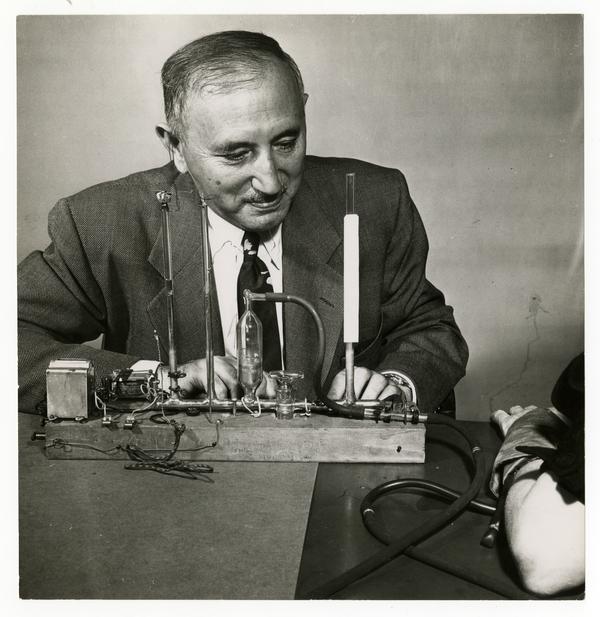
David Wechsler during a testing demonstration, 1955. New York University School of Medicine; image distributed via Wikimedia Commons under CC BY 4.0.
1939
Wechsler–Bellevue Intelligence Scale
David Wechsler introduced an adult battery that combined verbal and nonverbal tasks and compared adults with age-based norms rather than relying only on a mental-age ratio.
1949
First WISC
The Wechsler Intelligence Scale for Children adapted the approach for school-age children.
1955
First WAIS
The Wechsler Adult Intelligence Scale replaced the earlier Bellevue form and became a major adult intelligence measure.
1967
First WPPSI
A preschool and primary scale extended the family to younger children.
1974–2008
Major revisions and updated norms
WISC-R, WISC-III, WISC-IV, WAIS-R, WAIS-III and WAIS-IV updated content, norms, scoring models, and clinical interpretation.
2012
WPPSI-IV
The fourth preschool edition introduced revised age-appropriate tasks and expanded score interpretation.
2014
WISC-V
The fifth child edition organized interpretation around five primary domains: verbal comprehension, visual spatial, fluid reasoning, working memory and processing speed.
2024
WAIS-5
The fifth U.S. adult edition introduced updated norms, five primary index scores, shorter FSIQ administration, and expanded ancillary indexes.
Why Wechsler’s approach was influential
Earlier ratio-IQ approaches compared “mental age” with chronological age. Wechsler emphasized age-referenced deviation scores and a battery that sampled several forms of performance rather than reducing intelligence to one task type. Across later revisions, the scales moved from the older verbal-versus-performance split toward more differentiated index scores and contemporary psychometric models.
Revisions are necessary because language, education, technology, demographic composition, test familiarity and population performance change over time. Updated norms help reduce the risk of interpreting a current examinee with an outdated comparison group.
Fairness, culture, language and disability
No cognitive test is context-free. Professional practice requires attention to validity for the intended use and the specific examinee. That includes language proficiency, educational opportunity, cultural experience, socioeconomic conditions, sensory or motor disability, neurodivergence, health, fatigue, anxiety, trauma, test familiarity and the consequences of the decision being made.
Language and bilingual assessment
Testing in a person’s weaker language can depress performance on verbally mediated tasks and can alter instructions, rapport and response quality across the battery. A competent evaluator considers language history and proficiency, selects appropriate versions when available, and avoids treating an improvised translation as equivalent to a standardized administration.
Disability and accommodations
Some accommodations improve access but change the standard procedure. The report should identify modifications, explain why they were used and state how they affect interpretation. The goal is not to force every person through identical barriers; it is to obtain the most valid answer to the referral question while preserving as much standardization as possible.
A score belongs to an assessment context.
It should not be used to stereotype a person by race, ethnicity, gender, neighborhood, income, disability or nationality. Group statistics cannot substitute for an individual evaluation.
How to choose a qualified examiner
Verify current professional credentials and any required psychology license in your jurisdiction.
Ask how often the clinician evaluates the relevant age group and referral question.
Confirm the exact edition and whether the receiving school, program, court, agency or organization accepts it.
Ask whether the fee includes intake, testing, scoring, feedback, a written report, records review, school consultation and follow-up.
Discuss language, culture, disability access, remote testing, medications, sleep, hearing, vision, motor issues and prior exposure.
Avoid providers who guarantee a target IQ, promise a diagnosis from one score, or issue reports without adequate administration and interpretation.
Cost, insurance and school testing
Cost depends on region, clinician training, test battery, complexity, report length and purpose. A focused intelligence assessment is usually less extensive than a psychoeducational or neuropsychological evaluation. Insurance coverage varies and often depends on medical necessity; gifted testing and personal-interest testing are frequently self-pay.
Public schools may evaluate eligible students under education law, but the school’s evaluation is designed for educational decision-making and may not match a family’s preferred battery or private-report format. Ask what decision must be made and which documentation is actually required before paying for private testing.
Frequently asked questions
Is a Wechsler test the same thing as an IQ test?
A Wechsler scale is a professional intelligence test that produces an overall score commonly called an IQ, plus domain and subtest scores. It is broader and more carefully standardized than a typical online IQ quiz.
Which Wechsler test is used at each age?
In the current U.S. editions, WPPSI-IV covers ages 2:6–7:7, WISC-V covers 6:0–16:11, and WAIS-5 covers 16:0–90:11. Overlapping ages require clinical judgment based on the referral question, ability level, language, attention, and test requirements.
What is the average Wechsler IQ score?
Composite scores are generally standardized with a mean of 100 and a standard deviation of 15. This means most people in the normative sample score near 100, but a score must be interpreted with its confidence interval and the examinee’s full profile.
What does an IQ score of 115 mean?
On a scale with mean 100 and standard deviation 15, 115 is one standard deviation above the mean and is approximately the 84th percentile. The exact percentile and descriptive label should come from the official report.
Can I take the WAIS, WISC, or WPPSI online by myself?
No. These are restricted professional tests administered under standardized conditions by qualified professionals. Remote administration may be possible in some circumstances, but it still requires a trained examiner, secure materials, suitable technology, and clinical judgment.
Can I study for a Wechsler test?
You should not train on protected test content. The best preparation is ordinary: sleep, eat, bring needed glasses or hearing devices, take prescribed medication as directed unless the clinician advises otherwise, and tell the examiner about anything that could affect performance.
Does the test diagnose ADHD, autism, dyslexia, or a learning disability?
Not by itself. A Wechsler test can reveal patterns that inform a broader evaluation, but diagnosis or educational eligibility usually requires interviews, history, observations, achievement testing, behavior ratings, adaptive-functioning information, and other measures.
Can the test diagnose intellectual disability?
An intellectual-disability diagnosis requires evidence of significantly limited intellectual functioning and significantly limited adaptive functioning with onset during the developmental period. An IQ score alone is not sufficient.
Why might the Full Scale IQ be misleading?
When index scores differ substantially, a single overall score can hide meaningful strengths and weaknesses. A psychologist evaluates whether the FSIQ is interpretable and may discuss additional composites or domain scores when appropriate.
What is the difference between a percentile and percent correct?
A percentile is a rank relative to the normative group. The 75th percentile means performance was as high as or higher than about 75% of the comparison group. It does not mean 75% of questions were answered correctly.
How often can someone retake a Wechsler test?
There is no universal interval for every purpose. Repeated testing can create practice effects and must be justified clinically. Schools, agencies, and organizations may set their own recency rules, so ask the evaluator and the receiving organization before retesting.
How long does the whole evaluation take?
Core cognitive testing may take roughly 45–60 minutes in many cases, but intake, breaks, extra subtests, achievement tests, behavior measures, feedback, and report writing can make the full evaluation several hours or multiple appointments.
How much does a Wechsler IQ test cost?
Fees vary widely by location, clinician, purpose, test battery, report length, feedback, and insurance rules. A focused IQ assessment generally costs less than a complete psychoeducational or neuropsychological evaluation. Ask for a written description of services and fees.
Are Wechsler scores valid across languages and cultures?
Language, culture, education, acculturation, disability, and familiarity with testing can affect performance. The evaluator should choose an appropriate edition or language version, use qualified interpreters only when professionally appropriate, document modifications, and interpret results cautiously.
Can parents or family members watch the test?
Usually not, because observers can change behavior, threaten standardization, and expose secure materials. Exceptions may be considered for disability, safety, developmental, or legal reasons, but the psychologist decides how to preserve validity and test security.
Wechsler test glossary
Composite score
A standard score formed by combining performance across multiple subtests. FSIQ and index scores are composites.
Confidence interval
A range around an obtained score that communicates measurement uncertainty. The true score is not assumed to equal the single reported number exactly.
FSIQ
Full Scale IQ, an estimate of broad general intellectual functioning based on a selected group of subtests.
Index score
A composite summarizing performance in a cognitive domain such as verbal comprehension or working memory.
Norms
Reference data from a standardized sample used to compare an examinee with people of a similar age.
Percentile rank
The percentage of the normative group scoring at or below a given score, subject to rounding and test-specific tables.
Raw score
The initial total earned on a subtest before conversion through age-based normative tables.
Scaled score
A normalized subtest score. Wechsler subtests commonly use a scale with a mean of 10 and standard deviation of 3.
Standard score
A transformed score with a defined mean and standard deviation, allowing comparison across ages and measures.
Standard error of measurement
An estimate of expected score variation caused by measurement imprecision. It is used to form confidence intervals.
Base rate
How frequently a score difference or pattern appears in the normative or relevant clinical sample.
Practice effect
Score improvement related to prior exposure, familiarity, memory, or learning rather than a true change in underlying ability.
This independent educational guide is not affiliated with or endorsed by Pearson. WAIS, WISC, WPPSI, Q-interactive and Q-global are trademarks of their respective owners. Test content and scoring materials are proprietary and restricted.
Start with the exact question the evaluation must answer, then confirm the accepted test edition, examiner credentials, report requirements, total fee and expected timeline before booking.