
A useful emotional-intelligence test must explain what it can—and cannot—tell you
Emotional intelligence is not one universally agreed quotient. Researchers distinguish ability EI, trait EI and broader mixed competency models. They use different questions, scoring systems and evidence. This page therefore gives you an original development profile rather than pretending that a free browser quiz is a licensed clinical instrument.
The assessment combines honest self-report with situational judgment. It does not copy restricted items from the MSCEIT, EQ-i, TEIQue, ESCI or any other proprietary test. Your result is designed to identify practice priorities—not to diagnose a disorder, decide employment, rank your worth or produce an IQ-style percentile.
Recommended for adults and older teenagers aged 16+. Answer according to your usual behavior during the past three months.
Last updated: August 2026
58Total questions48 self-report statements + 10 applied scenarios
6Skill domainsA detailed profile rather than one unexplained number
10–15 minTypical completion timeAnswer from your usual behavior over the past three months
PrivateBrowser-only scoringNo answers are submitted or stored on a server
Free emotional intelligence test
There are no trick questions. For the 48 statements, choose what is usually true, not what sounds ideal. The ten scenarios have better and worse responses, but the explanations remain hidden until you submit the completed assessment.
Before you begin
Your private EQ skills profile
- Time: approximately 10–15 minutes.
- Privacy: answers and scoring remain in this browser.
- Method: six self-report domains plus ten applied scenarios.
- Limit: educational development tool—not diagnosis, certification or hiring evidence.
—profile index
Your completed profile
Results are ready
Your six-domain profile
Current strengths
Best development targets
Personalized practice plan
Review the scenario answers and explanations
How this emotional intelligence test works
Typical-behavior ratings
Forty-eight original statements sample six skill domains. Twelve are reverse scored to reduce simple agreement patterns.
Applied situations
Ten original scenarios ask you to choose among responses. These sample judgment but do not replicate a full ability-based test.
Transparent calculation
Each domain is converted to 0–100. The combined practice index weights self-report at 80% and scenarios at 20%.
Development—not ranking
No population norms are claimed. The output highlights relative strengths, priorities and exercises within your own profile.
| Profile index | Development wording | Responsible interpretation |
|---|---|---|
| 85–100 | Highly developed pattern | Many skills are reported consistently, but confirm them through behavior and feedback rather than assuming mastery. |
| 70–84 | Strong pattern | Useful emotional habits are present, with specific situations or domains still worth strengthening. |
| 55–69 | Functional and developing | A mixed profile is common. Targeted practice can make strengths more reliable under stress. |
| 40–54 | Developing foundation | Several skills may be inconsistent or context dependent. Choose one small, observable behavior at a time. |
| 0–39 | Early development point | The result may reflect current stress, misunderstanding or limited practice. It is not a diagnosis or permanent trait. |
These bands are internal to this original assessment. They are not clinical norms, percentiles or equivalents of scores from other EQ instruments.
A high self-rating can still be inaccurate. People may overestimate, underestimate, answer aspirationally or behave differently across settings. Compare your result with specific examples and respectful feedback from people who know you well.
What is emotional intelligence?
In the scientific ability model, emotional intelligence concerns reasoning accurately with emotional information: perceiving emotion, using emotion to support thought, understanding emotional patterns and managing emotion in yourself and relationships. Other approaches define EI as emotional self-perceptions or broader social-emotional competencies.
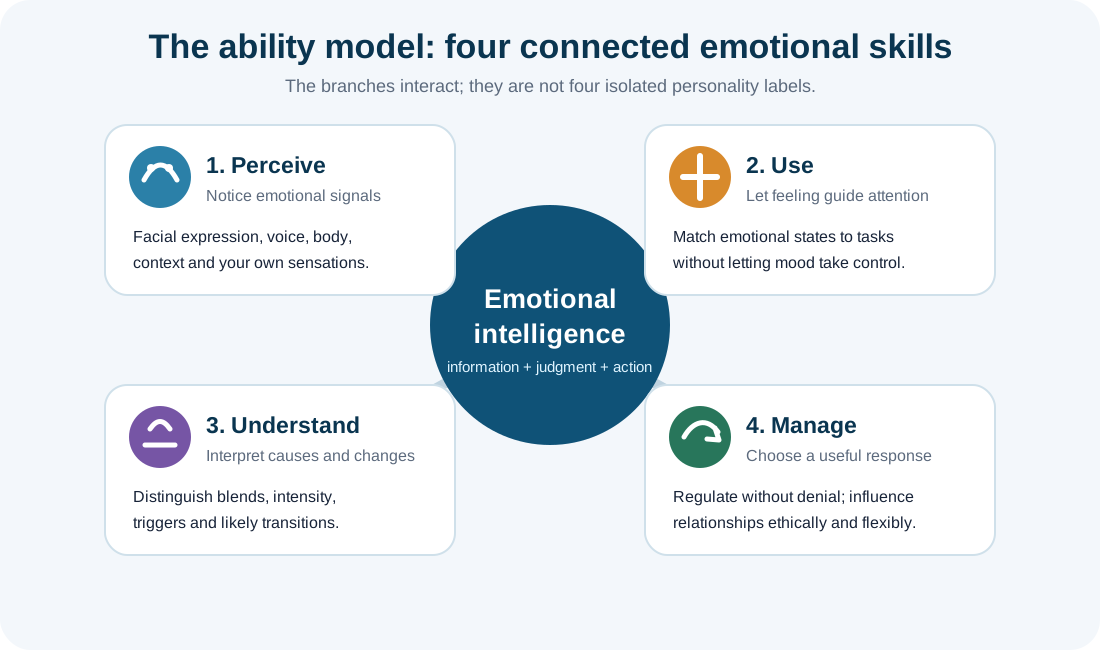
Emotion is information—not an instruction
Fear may signal possible danger, anger possible obstruction or unfairness, sadness possible loss, and joy possible reward or connection. The signal can be valuable while still being incomplete, mistaken or disproportionate.
Emotional intelligence involves gathering more information, considering goals and context, and choosing how to act. It does not require obeying every feeling or suppressing every uncomfortable one.
A practical definition: notice accurately, understand specifically, regulate flexibly and relate ethically.
Self-awareness
Noticing, naming and differentiating your own emotions, body signals, triggers and patterns.
Awareness supplies the information needed for every later choice. It is not the same as dwelling on feelings.Emotion understanding
Interpreting causes, blends, intensity, likely transitions and the information emotions may carry.
Understanding helps you move from “I feel bad” to a more precise and useful explanation.Self-regulation
Pausing, tolerating discomfort, recovering and choosing responses rather than acting automatically.
Regulation does not mean suppressing emotion. It means staying flexible enough to respond deliberately.Empathy
Inferring another person’s perspective and feelings while checking rather than assuming.
Accurate empathy combines sensitivity with curiosity, boundaries and willingness to be corrected.Social awareness
Reading group climate, timing, roles, norms, power, culture and indirect interpersonal cues.
The same words can have different effects depending on context, history and relationship.Relationship management
Communicating clearly, setting boundaries, repairing ruptures, resolving conflict and building cooperation.
Emotional skill becomes visible in what happens between people, especially under pressure.Emotional intelligence versus IQ
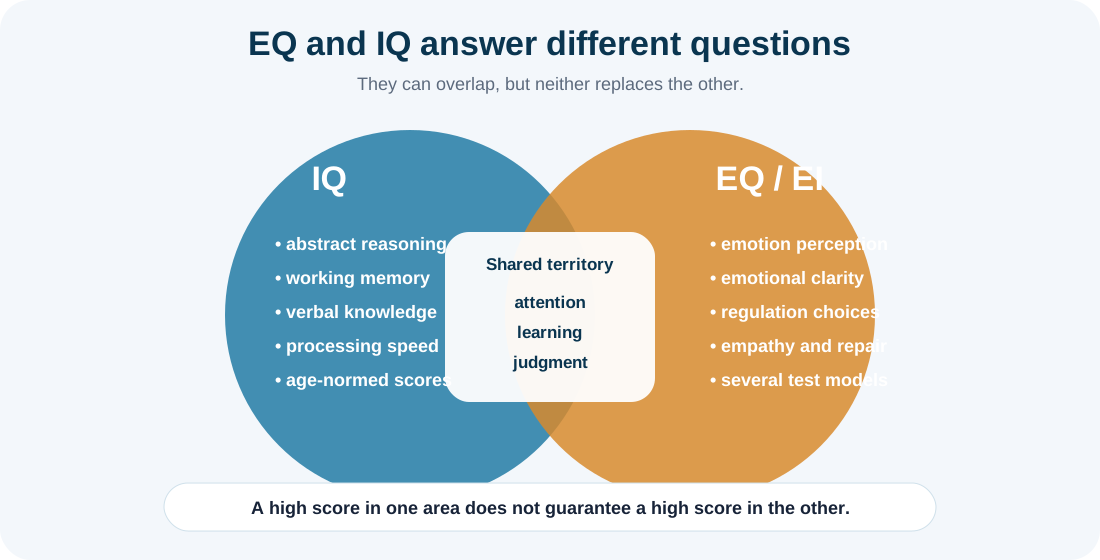
They are related only partly
Conventional IQ batteries sample reasoning, acquired knowledge, working memory, visual-spatial processing and speed under standardized, age-normed conditions. Emotional-intelligence measures focus on emotional information, self-perceptions, interpersonal judgment or competencies, depending on the model.
Emotion-recognition ability has a positive but limited relationship with cognitive intelligence. A person can reason exceptionally well yet struggle with regulation or relationships; another can be socially skilled without scoring unusually high on cognitive tests.
| Question | Typical IQ testing | Emotional-intelligence testing |
|---|---|---|
| Core focus | Cognitive performance across several reasoning and processing domains. | Emotional abilities, self-perceptions, social-emotional competencies or a mixture. |
| Common format | Individually administered tasks with correct scoring rules and age norms. | Performance tasks, self-report, observer ratings, scenarios or 360 feedback. |
| Score scale | Often mean 100 and SD 15 for composite IQ scores. | No universal EQ scale; ranges differ by instrument and publisher. |
| Can people fake? | Deliberate underperformance is possible, but many items are not transparent. | Self-report is especially susceptible to social desirability and impression management. |
| Best use | Educational, clinical or neuropsychological questions when professionally administered. | Research, coaching, development or assessment depending on evidence and instrument. |
| Not established by one score | Worth, motivation, future success, morality or every form of intelligence. | Kindness, mental health, relationship compatibility, leadership quality or ethical behavior. |
The main types of emotional intelligence tests
Ability / performance tests
What can you solve?
These present emotion-related tasks with responses scored according to a defined criterion. The MSCEIT family is the best-known example.
Strength: less dependent on self-image.
Challenge: deciding what counts as the best emotional answer can be complex.
Trait self-report tests
How do you see yourself?
These measure typical emotional self-perceptions and dispositions. TEIQue is a prominent trait-EI instrument.
Strength: efficient and broad.
Challenge: insight, culture and self-presentation strongly affect responses.
Mixed competency tests
How do emotional and social skills operate?
These combine emotional functioning with competencies such as adaptability, motivation, influence or wellbeing. EQ-i 2.0 and workplace competency models are examples.
Strength: practical development language.
Challenge: the construct can become broader than “intelligence.”
360-degree assessments
How do others experience you?
Self-ratings are compared with ratings from colleagues, supervisors, reports or other observers.
Strength: reveals self–other gaps.
Challenge: raters see different contexts and may bring bias or workplace politics.
Well-known professional measures
| Measure | Approach | What to know |
|---|---|---|
| MSCEIT / MSCEIT 2 | Ability-based performance assessment | Measures branches such as perceiving, connecting/using, understanding and managing emotions; professionally published and scored. |
| TEIQue | Trait EI self-report | Assesses emotion-related self-perceptions within personality; full, short and age-specific forms exist. |
| EQ-i 2.0 / EQ 360 | Mixed emotional-social model | Self-report with optional multi-rater feedback; commonly used in coaching and organizations. |
| Schutte / Assessing Emotions Scale | Self-report inspired by early ability theory | A widely researched 33-item questionnaire developed in 1998; interpretations and factor structures vary across studies. |
| ESCI and related competency inventories | Workplace competency / 360 model | Focuses on observable emotional and social competencies in organizational contexts. |
Protected tests should remain protected. A free page should not reproduce proprietary questions, scoring keys, copyrighted images or norms from professional instruments. This test uses original content.
How accurate are emotional intelligence tests?
Accuracy depends on the definition of EI, quality of the instrument, intended use, respondent, language, culture and scoring method. A systematic review found many instruments across ability, trait and mixed models; they cannot be assumed to measure one identical thing.
Are scores sufficiently consistent?
Internal consistency and repeatability matter, but a reliable test can still measure the wrong construct or support only limited uses.
Does it behave like the proposed model?
Evidence should show expected factor patterns and sensible relationships with related—and different—constructs.
Does it relate to meaningful outcomes?
Associations with performance or wellbeing are usually probabilistic and often modest. Correlation does not establish that EI caused the outcome.
Was the person candid and attentive?
Self-report can be distorted by idealized self-image, low insight, current mood, misunderstanding or deliberate impression management.
Is interpretation appropriate across groups?
Emotion expression, eye contact, directness and social expectations vary across cultures, neurotypes, roles and contexts.
Is the decision justified?
A tool adequate for coaching may be inadequate for hiring, diagnosis, legal decisions or evaluating a child.
Use a result responsibly
- Look for repeated behavioral examples.
- Compare self-report with respectful feedback.
- Consider stress, health, culture and setting.
- Retest only after meaningful practice.
- Use qualified assessment for high-stakes questions.
Do not use a result to
- Diagnose ADHD, autism, trauma or personality disorder.
- Declare someone empathic, manipulative or unsafe.
- Make a hiring or promotion decision by itself.
- Predict relationship success or parenting quality.
- Convert an EQ score into an IQ score.
Can emotional intelligence be improved?
Emotional competencies are not fixed in the same way as eye color. Training meta-analyses report moderate average improvements in emotional competencies, including effects that can persist beyond the immediate program. However, results vary considerably, and reviewers note heterogeneity and weaknesses in study quality. Improvement is more credible when measured through behavior, performance or observer feedback—not only a higher self-rating.
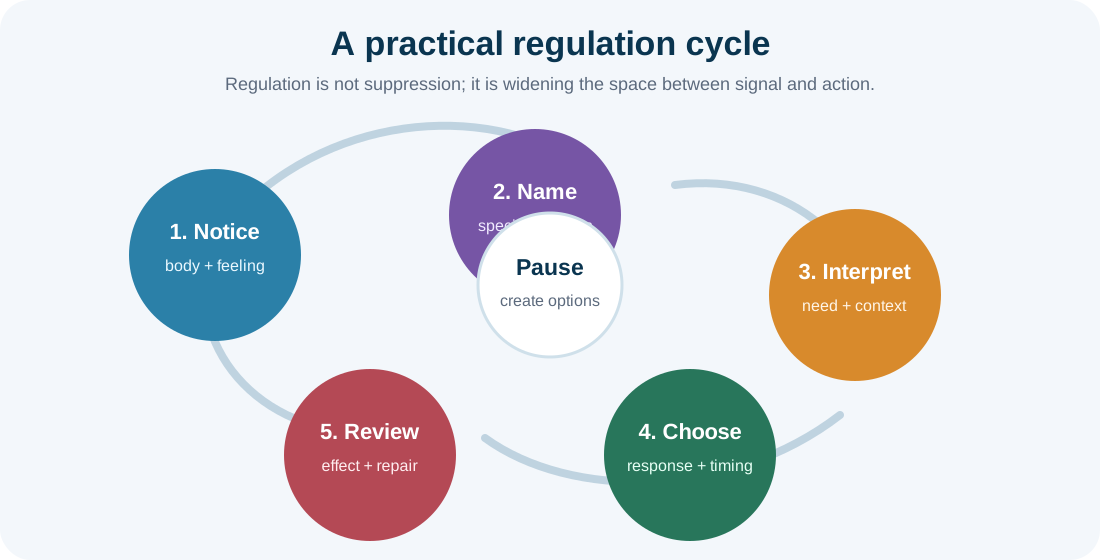
Use deliberate practice
- Choose one behavior: for example, ask before advising.
- Define the cue: “When I notice the urge to fix…”
- Practice a replacement: “Would listening or brainstorming help?”
- Collect evidence: note what happened, not only how you felt.
- Seek feedback: ask whether your response was useful.
Self-awareness
Three-word check-in: name one emotion, one body sensation and one likely trigger three times daily.
Understanding
Emotion chain: write event → interpretation → emotion → urge → need. Separate facts from assumptions.
Regulation
Ninety-second pause: slow exhalation, relax one muscle group, then choose timing and wording.
Empathy
Reflect and verify: “It sounds as though ___ mattered because ___. Am I understanding?”
Social awareness
Context scan: notice who speaks, who withdraws, what feels unsafe and what the group is avoiding.
Relationships
Repair script: “I did ___. The impact may have been ___. I am sorry. Next time I will ___. What would help now?”
Foundations that make emotional skills easier
Sleep, physical health, manageable stress, supportive relationships, safety, adequate nutrition and treatment for mental-health or neurological conditions can affect attention and regulation. These foundations do not automatically create emotional intelligence, but chronic sleep loss, pain, threat and overload can reduce the capacity available for reflective behavior.
Emotional intelligence across life stages
Emotional abilities develop unevenly. Language, executive control, attachment experience, culture, neurodevelopment and opportunities for guided practice all matter. A younger child should not be judged by an adult’s regulation standards.
Ages 3–5
Children expand emotion vocabulary, begin recognizing simple causes and rely heavily on adults for co-regulation. “Use your words” works only when an adult also provides safety and structure.
Ages 6–11
Children become better at mixed emotions, rules, perspective taking and coping strategies, but intense stress can still overwhelm developing control systems.
Ages 12–17
Social sensitivity, identity and reward systems are highly active while planning and inhibition continue developing. Privacy, peer context and respectful coaching are crucial.
Ages 18–29
Greater independence creates repeated practice in conflict, intimacy, work and self-regulation. Skills may improve substantially through experience but are not guaranteed by age alone.
Ages 30–59
Experience can support perspective, pattern recognition and regulation. Chronic role strain, burnout or unaddressed stress can also narrow flexibility.
60+
Emotional priorities and regulation strategies may change with age. Perception of subtle cues can shift, while accumulated knowledge and selective investment in meaningful relationships may help.
Testing children requires age-appropriate measures. This page’s assessment is written for ages 16 and older. Children need developmentally appropriate language, norms, consent and interpretation that includes parents, teachers and context.
History of emotional intelligence and EQ tests
The phrase became famous in the 1990s, but it grew from older work on social intelligence, emotion, personality and cognitive ability. Different traditions then created different kinds of tests.
Thorndike describes social intelligence
Edward Thorndike distinguished abstract, mechanical and social forms of intelligence, including the ability to understand and manage people.
Multiple-intelligences discussion expands
Howard Gardner’s work on interpersonal and intrapersonal intelligences helped broaden public discussion beyond conventional cognitive testing.
“Emotional intelligence” is formally proposed
Peter Salovey and John Mayer published a scientific framework concerning appraisal, expression, regulation and use of emotion.
The idea reaches a mass audience
Daniel Goleman’s book popularized emotional intelligence in education, work and everyday life, while using a broader mixed-competency model.
Self-report measures expand
The Bar-On EQ-i and the Schutte self-report scale helped establish questionnaire-based approaches to emotional and social functioning.
Trait emotional intelligence model
K. V. Petrides and colleagues developed trait EI as a constellation of emotional self-perceptions located within personality.
MSCEIT ability testing
The Mayer–Salovey–Caruso Emotional Intelligence Test introduced performance tasks designed around perceiving, using, understanding and managing emotions.
Models and measures are compared
Research increasingly distinguished ability EI, trait EI and mixed models rather than treating every “EQ test” as interchangeable.
Evidence grows—and remains nuanced
Meta-analyses report associations with outcomes and trainability, while emphasizing measurement differences, modest effects, heterogeneity and the need for stronger designs.
Why the field remains debated
Researchers agree that people differ in emotion-related capacities, but disagree about where “emotional intelligence” should end. Narrow ability models aim to meet criteria for intelligence. Trait models treat emotional self-perceptions as part of personality. Mixed models include broader competencies and wellbeing. A test can be useful within its own framework without proving that all frameworks measure the same construct.
What research links emotional intelligence with
Academic performance
A large meta-analysis found a positive overall association, with differences according to the EI measure used. Cognitive ability remains a major predictor of academic performance.
Work performance
Meta-analytic findings are positive on average but depend on emotional labor, test type and overlap with personality and cognitive ability.
Wellbeing
Higher EI scores are associated with wellbeing and lower stress in many studies. These are group-level relationships, not guarantees for an individual.
Relationships
Accurate perception, regulation, communication and repair can support relationships, but compatibility, safety, values and circumstances also matter.
Leadership
Emotional competencies may help with feedback, conflict and climate. High EI does not compensate for poor judgment, expertise, ethics or organizational conditions.
Mental health
EI relates to several mental-health indicators, but an EQ test is neither a diagnostic instrument nor a substitute for evidence-based treatment.
Most outcome evidence is correlational and uses varied measures. Claims that “EQ determines 80% of success” or always matters more than IQ are not scientifically defensible universal rules.
Ethics, culture and neurodiversity
Emotion is communicated differently across cultures, families, languages, professions and neurotypes. Eye contact, facial display, directness, touch, silence and conversational pacing do not carry one universal meaning. A fair interpretation uses multiple cues, asks rather than assumes and distinguishes difference from deficit.
Emotionally intelligent use
- Seek consent before probing personal emotion.
- Verify interpretations and accept correction.
- Respect boundaries and privacy.
- Consider power and consequences.
- Use skill to increase clarity and autonomy.
Emotionally manipulative use
- Reading vulnerability to pressure someone.
- Demanding emotional disclosure.
- Using “calmness” to silence valid concerns.
- Pathologizing communication differences.
- Using test labels to control or shame.
Frequently asked questions
Is this a real emotional intelligence test?
It is a real, structured educational assessment with original items, transparent scoring and applied scenarios. It is not a standardized or clinically validated instrument, so it must not be represented as equivalent to the MSCEIT, EQ-i 2.0, TEIQue or another professionally normed test.
What does the result measure?
The self-report section measures how you describe your typical emotional behavior across six domains. The scenario section samples judgment in common interpersonal situations. Together they provide a development profile, not a diagnosis or population percentile.
What is a good emotional intelligence score?
There is no universal EQ scale shared by all tests. This page uses a transparent 0–100 development index that applies only to these items. Focus more on the pattern across domains and concrete examples than on the overall number.
Can I compare this score with an IQ score?
No. IQ tests typically use age-based norms with a mean near 100 and standard deviation near 15. Emotional-intelligence tools use different theories, item formats, norms and score ranges. An EQ index of 80 does not correspond to IQ 120 or any other IQ value.
Can emotional intelligence improve?
Specific emotional competencies can be practiced. Meta-analytic evidence suggests training can produce improvements, but effects vary and study quality is uneven. Repeated behavior, feedback and context matter more than merely reading tips.
Does high EQ mean being calm all the time?
No. Emotionally skilled people still experience anger, fear, grief and stress. The relevant abilities include accurately perceiving emotion, understanding it and selecting a context-appropriate response—not eliminating normal feelings.
Is empathy the same as emotional intelligence?
Empathy is one important part, but emotional intelligence also includes self-awareness, emotional understanding, regulation, social context and relationship skills. Empathy without boundaries or accuracy can become overinvolvement or projection.
Can someone use emotional intelligence manipulatively?
Yes. Reading emotions and social dynamics is not automatically ethical. Emotional skill should be paired with consent, honesty, fairness and respect for autonomy. This is one reason the page includes ethical relationship management rather than influence alone.
Can low emotional intelligence diagnose autism, ADHD or a personality disorder?
No. A low result cannot diagnose any condition, and autistic or neurodivergent people may communicate, perceive or express emotion differently without lacking care or moral concern. Diagnosis requires qualified assessment using appropriate evidence.
Can employers use this free result for hiring?
They should not. This tool was not validated for selection, and self-report results are especially vulnerable to impression management. High-stakes decisions require job-related validation, fairness analysis, secure administration and professional oversight.
Why are some questions reverse scored?
Reverse-worded items reduce simple agreement patterns and ask about the same broad skill from another direction. They do not eliminate response bias, misunderstanding or deliberate image management.
Why are there scenario questions?
Self-report captures perceived typical behavior, whereas scenarios sample what you judge to be an effective response. The scenario section adds a different perspective, although it still cannot reproduce a full performance-based professional test.
Should I answer based on my best day or worst day?
Neither. Answer according to your typical behavior during roughly the last three months across several settings. A recent crisis, illness or major transition may temporarily change the profile and should be considered when interpreting it.
Can I retake the test?
Yes, but frequent repetition can create memory and self-presentation effects. A more useful retest is usually after several weeks of focused practice, ideally with behavioral examples or feedback from trusted people.
Are women naturally more emotionally intelligent than men?
Group averages sometimes differ on particular measures or branches, but effects depend on the test, culture, age and sampling. Group findings cannot determine an individual’s skills and should not be used for stereotypes.
Does emotional intelligence decline with age?
The pattern is not a simple rise or fall. Experience may support emotional knowledge and regulation, while some perception tasks can change with aging. Health, cognition, culture, role demands and the specific measure all affect results.
What should I do with a low domain score?
Choose one observable behavior, practice it in a low-stakes setting, collect feedback and review what happened. Examples include naming a feeling precisely, pausing before replying, checking an assumption or making a direct repair.
Where are my answers stored?
Scoring runs in your browser. Progress may be saved in local browser storage so you can resume on the same device. The reset control removes those saved answers. No answer data is sent by this page.
Emotional intelligence glossary
Ability EI
Emotional intelligence conceptualized as a set of mental abilities and assessed with performance tasks.
Trait EI
Emotion-related self-perceptions and dispositions measured mainly through self-report questionnaires.
Mixed model
A broad framework combining emotional skills with competencies, motivation, personality or wellbeing constructs.
Emotion differentiation
The ability to identify and distinguish emotions with useful precision.
Emotion regulation
Processes that influence which emotions occur, when they occur and how they are experienced or expressed.
Empathy
Understanding or resonating with another person’s emotional experience while recognizing that it is their experience.
Perspective taking
Considering a situation from another person’s viewpoint without assuming complete accuracy.
Self-report
A measure in which people describe their own typical thoughts, feelings or behavior.
Performance test
A measure asking people to solve tasks intended to have better and worse responses.
360-degree assessment
A profile combining self-ratings with ratings from coworkers, supervisors, reports or other observers.
Reliability
The consistency and precision of scores under specified conditions.
Validity
Evidence supporting the interpretations and uses made from test scores.
Research and professional sources
- Salovey & Mayer (1990) — Emotional Intelligence
- Mayer, Caruso & Salovey (2016) — The Ability Model of Emotional Intelligence
- Mayer, Salovey & Caruso (2008) — Emotional Intelligence: New Ability or Eclectic Traits?
- Brackett & Salovey (2006) — Measuring Emotional Intelligence with the MSCEIT
- Mayer et al. (2003) — Measuring Emotional Intelligence with the MSCEIT V2.0
- Bru-Luna et al. (2021) — Emotional Intelligence Measures: A Systematic Review
- Schutte et al. (1998) — Development and Validation of a Measure of Emotional Intelligence
- MHS — MSCEIT 2 official assessment information
- MHS — EQ-i 2.0 official assessment information
- UCL — Trait Emotional Intelligence Questionnaire history
- MacCann et al. (2020) — Emotional Intelligence Predicts Academic Performance
- Joseph & Newman (2010) — Integrative Meta-analysis of EI and Job Performance
- Mehler et al. (2024) — Training Emotional Competencies at the Workplace
- Schlegel et al. (2020) — Emotion Recognition Ability and Intelligence Meta-analysis
Publisher pages describe their own products and should be read alongside independent research. This page is educational and has no affiliation with the named test publishers or authors.