Standardized IQ test
No published manual, normative study, scoring system or professional test record identifies Musk as the author of a standardized intelligence assessment.
Original challenge + documented fact check
Take a free 20-question engineering-style reasoning challenge, then examine what is actually known about Elon Musk’s IQ, the reported computer aptitude test, first-principles thinking, interview methods and the difference between achievement and standardized intelligence testing.
Original practice questions inspired by estimation, constraints, probability, systems analysis and first-principles problem solving.
Answer every question, then submit once. Correct answers and explanations remain hidden until submission so the challenge is not spoiled accidentally.
This is not an IQ score. It reflects performance only on these 20 original questions, without representative norms, controlled administration or psychometric validation.
No verified public evidence shows that Elon Musk created a standardized IQ test or disclosed a professionally documented IQ score. The widely repeated numbers are estimates or internet repetition. A reported 1989 computer aptitude result is a different kind of evidence and cannot be converted into a Full Scale IQ.
The challenge is original and deliberately avoids protected items from professional tests.
Last updated: August 2026
No published manual, normative study, scoring system or professional test record identifies Musk as the author of a standardized intelligence assessment.
Musk has described asking applicants to explain difficult problems they faced, how they solved them and the decisions they made. That is behavioral interviewing, not IQ testing.
The 20 questions above were written specifically for this educational page. They are not authentic Musk questions and are not affiliated with his companies.
Creating a real intelligence test is not simply writing difficult puzzles. It requires a defined construct, standardized instructions, representative norms, reliability studies, validity evidence, fairness analysis, secure scoring and rules for appropriate interpretation.
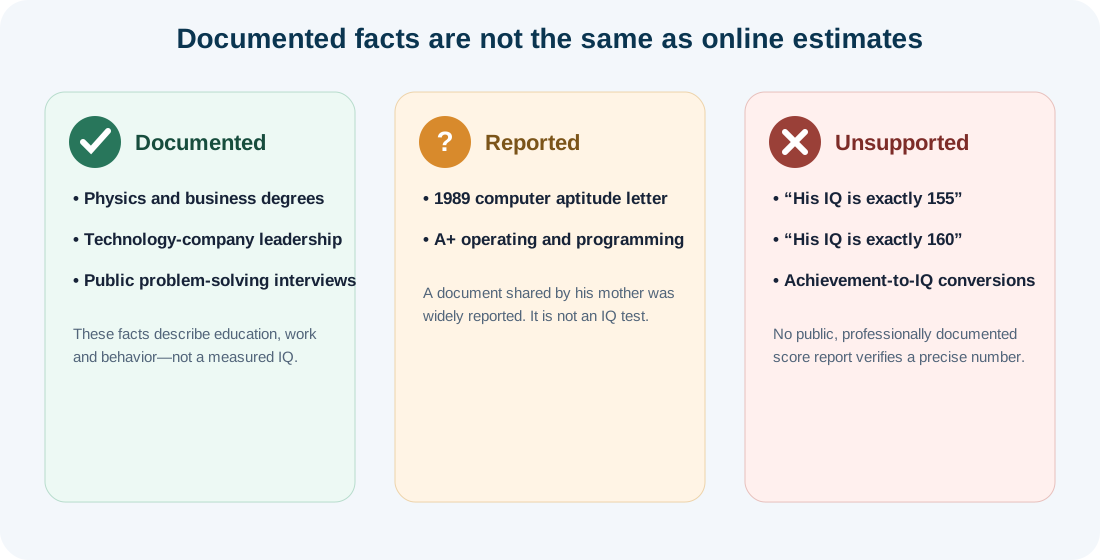
Precise numbers such as 155, 160 or 165 are frequently repeated, but repetition is not documentation. A verifiable score would require, at minimum, the test name and edition, administration date, age norms, testing conditions and an authentic report from a qualified examiner.
| Claim or evidence | What it can support | What it cannot support |
|---|---|---|
| “IQ 155–160” on websites | Shows that a number has become popular online | A verified personal score |
| Physics and business education | Study and achievement in defined fields | An exact IQ or complete cognitive profile |
| Reported 1989 computer aptitude result | Strong performance on the particular assessed computer skills, if the document is authentic | A Full Scale IQ conversion |
| Leadership of engineering companies | Experience with high-complexity organizations and decisions | Proof that one person personally solved every technical problem or has a specific IQ |
In 2025, news reports described a 1989 letter shared by Maye Musk. The letter was said to record A+ results for the seventeen-year-old Musk in programming and operating systems. This is relevant evidence about early computer aptitude, but it should be described with the correct label.
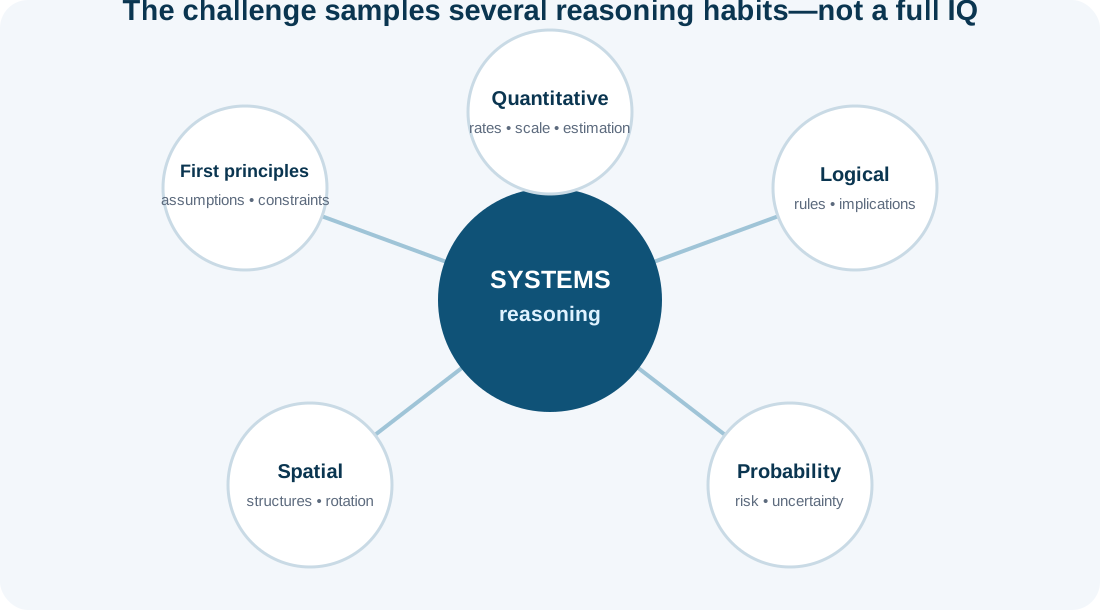
The page does not claim to reconstruct Musk’s private cognitive profile. Instead, it uses reasoning categories that are useful in engineering and are commonly associated with public discussions of first-principles problem solving.
Scale, rates, ratios, binary representation and estimation.
Bottlenecks, reliability, tradeoffs and interacting constraints.
Implications, ordering rules and conclusions that must follow.
Independent events, expected loss and interpretation under uncertainty.
Sample size, base rates, uncertainty and what data are still missing.
A question publicly associated with Musk’s interviews asks candidates to describe difficult problems, how they solved them and key decisions. Try the useful part of that method:
This private text stays in your browser and is not scored or submitted.| Method | Main purpose | Typical evidence | Common mistake |
|---|---|---|---|
| Professional IQ test | Estimate selected cognitive abilities relative to age norms | Multiple standardized subtests, norms, reliability and validity | Treating one score as total human worth or guaranteed success |
| Computer aptitude test | Assess readiness or skill in a technical area | Domain-specific tasks and comparison criteria | Converting a technical grade into Full Scale IQ |
| Behavioral interview | Understand past contribution, judgment and problem-solving behavior | Detailed examples that can be checked against outcomes | Assuming confidence or storytelling equals ability |
| Online reasoning challenge | Practice and entertainment | Number correct on a limited question set | Calling an unnormed quiz a clinical IQ test |
| Business or engineering outcome | Create a product, organization or mission result | Team execution over time under real constraints | Attributing every outcome to one person or one trait |
High-complexity outcomes are produced by interacting factors: technical knowledge, memory, reasoning, creativity, motivation, risk tolerance, social networks, financing, timing, regulation, team quality, labor, prior infrastructure and chance. Even if IQ predicts some outcomes on average, that does not allow a psychologist—or a website—to infer one person’s exact score from a biography.
A contemporary professional battery may assess verbal comprehension, visual-spatial processing, fluid reasoning, working memory and processing speed. It is administered under standardized conditions and interpreted with age-based norms and confidence intervals.
Instructions, timing, start and stop rules, materials and scoring are controlled.
The score is interpreted relative to an appropriate age-based reference sample.
A battery samples several abilities rather than relying on one favorite puzzle type.
Confidence intervals communicate that an obtained score is an estimate, not a perfect quantity.
Research must support the meanings and decisions attached to the scores.
Health, language, disability, education, effort and referral context affect interpretation.
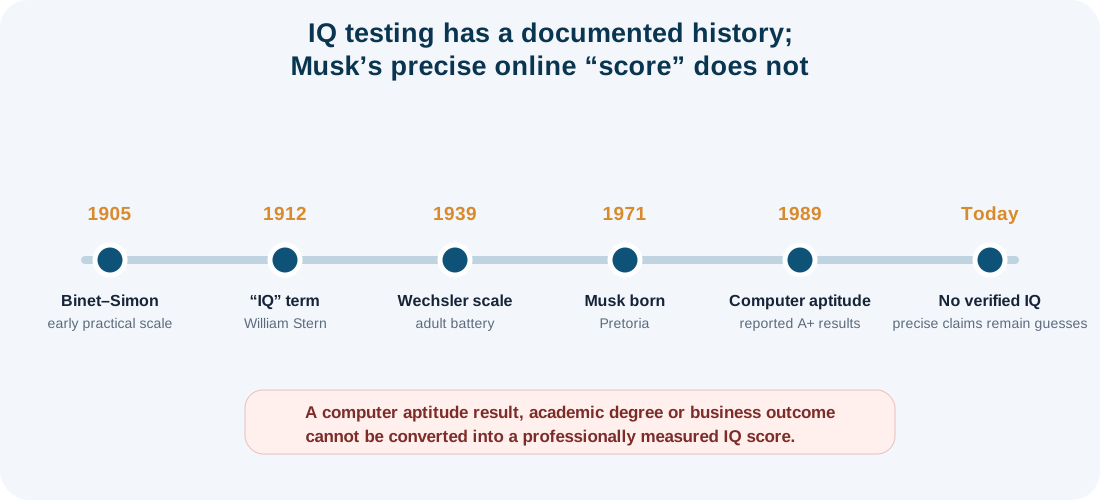
Modern intelligence testing has named developers, manuals, editions and normative studies. A genuine celebrity test result would also leave a traceable record. In contrast, the precise Musk IQ figures typically appear without a test report or primary documentation.
The correct historical method is not to choose the most repeated number; it is to ask where the number first appeared and whether the source had access to a genuine score.
Alfred Binet and Théodore Simon introduced an early practical scale for identifying children who might need educational support.
William Stern proposed the intelligence quotient concept. Early ratio IQ differed from modern age-normed deviation scores.
David Wechsler introduced a broad adult battery combining several task types and age-based comparison.
Musk was born in Pretoria, South Africa, decades after standardized intelligence testing was established.
A letter later shared publicly by Maye Musk was reported as showing A+ grades in operating systems and programming. This was a computer aptitude assessment, not an IQ test.
Tesla’s official biography lists degrees in physics and business from the University of Pennsylvania, followed by work on technology companies.
SpaceX says it was founded in 2002 to advance space technology. Complex engineering outcomes involve teams, capital, testing, leadership and sustained execution—not IQ alone.
Web pages repeatedly assign scores such as 155 or 160 without a public score report, test name, date, norms or examiner documentation.
No verified public IQ result or standardized IQ test authored by Musk is known. A precise score should therefore be described as unknown.
No public professional score report confirms that figure.
Changing the repeated number does not improve the evidence behind it.
A domain-specific grade cannot be converted into a full cognitive composite without validated norms.
Large technical programs depend on thousands of specialized contributors and organizational systems.
Difficulty alone does not create standardization, reliability, validity or norms.
Practice, education, language, attention and familiarity influence performance.
No verified standardized IQ test authored or published by Elon Musk is known. Online pages using his name usually offer independent puzzles or speculate about his intelligence.
No. This is an original educational reasoning challenge inspired by broad themes such as estimation, systems thinking and first-principles analysis. It is not created, approved or endorsed by Elon Musk, Tesla, SpaceX or any related organization.
His measured IQ is not publicly verified. Numbers such as 155, 160 or 165 circulate online, but no credible public score report identifies a professionally administered test, date, norms and examiner.
A 1989 letter shared by his mother and reported by multiple news outlets describes A+ results in programming and operating systems. That is evidence about a specific computer aptitude assessment, not a full-scale IQ score.
Not validly without a published, validated conversion based on appropriate normative data. Strong performance in one technical domain cannot be turned into an exact Full Scale IQ.
No. Education and achievement reflect many influences, including opportunity, knowledge, motivation, interests, persistence, health, collaboration and resources. They do not reveal a precise standardized IQ score.
It reports how many of these 20 original questions you answered correctly and summarizes performance by broad question domain. It has no representative norm sample and must not be interpreted as a clinical IQ.
The phrase refers only to popular public themes associated with engineering discussion—first principles, estimation, constraints and evidence. It does not claim to reproduce Musk’s private thinking or a test he created.
It means breaking a problem into foundational requirements, facts and constraints, then building a solution from those elements rather than copying an existing analogy without examination.
No. It is a problem-solving approach. IQ tests sample selected cognitive abilities under standardized conditions; a reasoning habit can be learned and applied with varying skill.
He has publicly described asking candidates about the hardest problems they faced, how they solved them and the decisions they made. That is a behavioral interview technique seeking evidence of contribution, not an IQ test.
No. Business outcomes depend on knowledge, opportunity, timing, financing, teams, judgment, persistence, communication, regulation, risk and chance, among other factors.
No defensible psychometric conversion exists. Wealth and valuation are not standardized cognitive measurements and are affected by countless non-cognitive variables.
It needs standardized administration, appropriate norms, reliability and validity evidence, controlled scoring, a defined interpretation and qualified use. A set of online puzzles without norming cannot provide the same result.
Yes. Familiarity with ratios, probability, logic and test formats can improve performance. That is useful learning, but it also shows why the score should not be treated as a fixed measure of intelligence.
To preserve the challenge. Explanations and correct answers appear only after every item is answered and the test is submitted.
An assessment intended to measure readiness or potential in a defined skill area, such as programming, mechanical reasoning or language learning.
How frequently an event occurs before considering new test evidence. Rare events can produce counterintuitive false-positive patterns.
The stage or constraint that limits the throughput or performance of an entire system.
A probability-weighted average outcome used to compare uncertain choices.
Foundational facts, requirements and constraints from which a solution is constructed.
Reasoning with novel patterns and relationships rather than relying only on previously learned facts.
An age-normed score from a standardized intelligence assessment, interpreted relative to an appropriate reference group.
Reference data from a defined sample used to interpret an individual test score.
The precision and consistency of scores under specified conditions.
The proportion of true cases that a detection method correctly identifies.
The proportion of non-cases that a detection method correctly rejects.
Evidence supporting the interpretation and use made from test scores.
Sources are separated by purpose: official pages establish public biography and roles; professional sources explain testing standards; reporting describes the aptitude document that was shared publicly.
Official biography used for education and career background.
Open sourceOfficial leadership page identifying Musk’s role at SpaceX.
Open sourceOfficial account of the company’s founding purpose and engineering mission.
Open sourceNews report on the letter shared by Maye Musk; treated as a reported aptitude record, not an IQ score.
Open sourceDiscussion of how unsupported precise IQ claims circulate and are inferred from unrelated achievements or reported scores.
Open sourceAERA, APA and NCME guidance on professional test development, evidence and use.
Open sourceOfficial example of a modern standardized adult cognitive assessment.
Open sourceProfessional definition and historical context for ratio and modern IQ concepts.
Open source