
A useful Mensa practice page must separate challenge, practice and qualification
The quiz below is a free, original Mensa-style reasoning challenge. It is designed to make practice useful without copying secure questions. It can tell you how you performed on these 24 items; it cannot produce a validated IQ, prove giftedness or qualify you for Mensa.
Mensa membership is based on reaching the upper 2%—the 98th percentile or higher—on an accepted, appropriately administered intelligence test. The official online Mensa IQ Challenge is itself described by Mensa as practice rather than qualifying evidence.
Results, correct answers and explanations remain hidden until the challenge is submitted or the optional timer expires.
Last updated: August 2026
24
Original questions
Patterns, logic, verbal, numerical and spatial reasoning
18 min
Optional challenge timer
Time pressure is part of practice—not a valid IQ norm
98th
Mensa membership percentile
Qualification requires an accepted, properly administered test
Private
Browser-only scoring
Your answers are not sent to a server
Free Mensa IQ challenge: 24 original practice questions
Work from the rule that best explains all the information. Do not search for answers, use a calculator or reveal explanations elsewhere on the page—the solution review remains locked until submission.
Before you begin
Choose challenge mode
- Questions: 24 original items across six reasoning domains.
- Timed mode: 18 minutes; unanswered items count as incorrect when time ends.
- Untimed mode: useful for learning the reasoning process without speed pressure.
- Result: raw practice score and domain profile—not an IQ estimate or Mensa qualification.
—out of 24
Independent practice result
Your challenge is complete
This score describes performance on this original item set only. It is not a standardized IQ, percentile or Mensa admission result.
Your reasoning-domain profile
Reveal all correct answers and explanations
Independent and non-qualifying.
“Mensa” is associated with Mensa International and its national organisations. QuickIQTest.net is not affiliated with them. These questions are original and do not reproduce the official Mensa IQ Challenge, an admission test or a commercial Mensa practice test.
Mensa International IQ Test: official challenge, practice and admission
The phrase mensa international iq test is often used as though there were one universal test with one universal numerical cutoff. In practice, three different things are commonly mixed together:
Mensa IQ Challenge
Mensa International currently describes a free online challenge with 35 progressively difficult puzzles and a 25-minute limit. It provides an indication for practice but cannot be used to qualify for membership.
Official challenge informationMensa practice test
National organisations may offer free or paid practice tests. American Mensa describes its online practice test as an indication of likely success, not qualifying evidence.
American Mensa practice informationSupervised admission or prior evidence
Qualification uses approved standardized testing or accepted documentation of a prior score. Procedures, age rules, test batteries, fees and retest policies vary by national Mensa organisation.
Official testing FAQs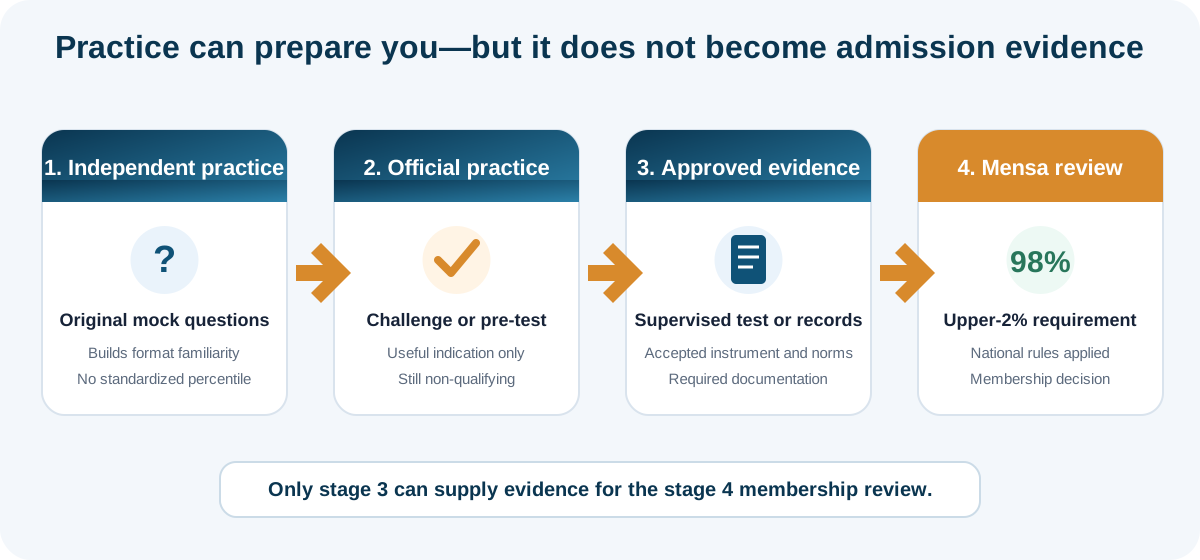
Why national routes differ
Mensa International defines the core upper-2% principle and connects national groups. Each national organisation operates within its own language, legal, professional and testing context. That is why an international Mensa search should end with the official national-group directory rather than a random universal cutoff chart.
Best next step: Find the national Mensa organisation for your country, then verify its accepted tests, minimum age, language options, fees, documentation and retesting policy before paying for anything.
What the 98th percentile means—and why the IQ number changes
Percentile is the common language
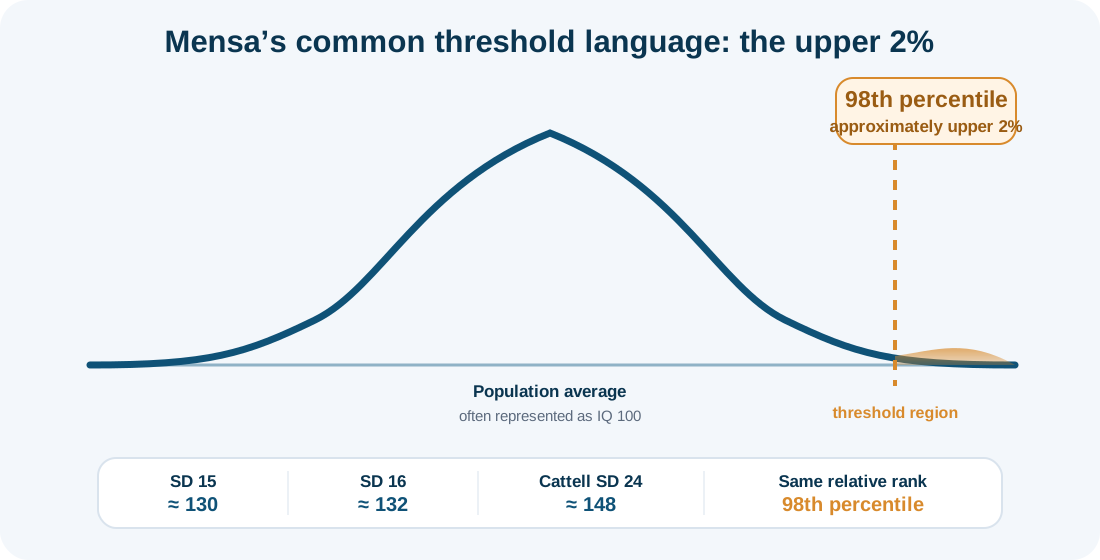
The 98th percentile means performing as high as or higher than approximately 98% of the relevant normative population. It does not mean answering 98% of questions correctly.
Different tests transform the same relative standing onto different numerical scales. Therefore, an IQ number without the test name, edition and norms is incomplete.
Practical rule: Do not ask only “What IQ does Mensa require?” Ask “What qualifying score does my Mensa organisation accept on this specific test and edition?”
| Score language | Approximate upper-2% value | How to interpret it |
|---|---|---|
| Common deviation IQ (SD 15) | 130 | Used by many modern Wechsler and Stanford–Binet interpretations. |
| Deviation IQ (SD 16) | 132 | A different standard deviation changes the number, not the percentile. |
| Older Cattell-style scale (SD 24) | 148 | This is why “Mensa IQ 148” and “IQ 130” can represent the same upper-2% standing. |
| Percentile language | 98th percentile | The stable admission idea is rank relative to the test’s normative population. |
Values are approximate examples for explaining scale differences. Always use the official qualifying table for the named test, edition, date and jurisdiction.
Why a browser quiz cannot establish the 98th percentile
No representative norms
A real percentile requires comparison with a large, appropriate and standardized reference sample.
Uncontrolled conditions
Devices, interruptions, assistance, prior exposure and timing differ between users.
Limited breadth
A short puzzle set cannot sample the breadth and reliability of a professional intelligence battery.
No identity or security controls
High-stakes testing requires secure content, standardized administration and verified examinee conditions.
Mensa sample test, example test and practice questions
Searches for a mensa sample test, mensa example test or mensa practice questions usually reflect the same goal: learning how unfamiliar rules are encoded in patterns. Good practice teaches methods without pretending that memorized formats equal a new IQ.
Sequences
Track differences, ratios, alternating streams, increasing jumps, recurrence rules and position-based changes.
Ask: what changes, what stays fixed, and does one rule explain every term?Matrices
Compare rows and columns for addition, subtraction, rotation, count, position, overlap and symmetry.
Describe each panel with features before choosing an answer.Deduction
Separate what must be true from what might be true. Translate words such as all, some, none, only and exactly one.
Do not import real-world assumptions not given by the premises.Quantitative reasoning
Model rates, proportions, hidden operations, equations and number relationships rather than guessing from surface appearance.
Estimate first, then calculate only what is necessary.Verbal relationships
Identify precise analogy relationships, category boundaries, coding rules and logical implications.
Name the relationship in words before inspecting the options.Spatial reasoning
Mentally rotate, reflect, fold and track orientation while distinguishing viewpoint changes from shape changes.
Use one stable feature as an anchor during transformation.A six-step method for almost every unfamiliar item
- Inventory features
List count, shape, color, position, direction, spacing, size, number or letter value. - Test the simplest rule
Try addition, subtraction, rotation, alternation or combination before inventing a complex story. - Check every example
A valid rule must explain all given cells or terms, not just the last transition. - Use answer choices
Eliminate options that violate one clear feature even if the full rule is not yet obvious. - Control time
Mark difficult items and move on; one stubborn question should not consume an entire section. - Review the rule
After practice, explain why the correct answer works and why each distractor fails.
Mensa IQ test prep and Mensa IQ test preparation
A useful mensa iq test prep plan improves familiarity, pacing and reasoning discipline. It does not promise a particular IQ or membership result. Treat a mensa practice exam or mock mensa test as a rehearsal, not a diagnosis.
Learn the item families
- Practice short sessions across several domains.
- Record the rule you missed, not just the answer.
- Identify whether errors come from concept, attention or time.
Build pacing
- Use one or two timed mixed sets.
- Practice skipping and returning.
- Stop repeated exposure to the same item bank.
Protect performance
- Use ordinary sleep, meals and hydration.
- Prepare identification, route and required materials.
- Avoid an exhausting last-minute marathon.
Execute the plan
- Read instructions exactly.
- Take easy points first.
- Use remaining time to revisit marked items.
Preparation that can help
- Familiarity with common reasoning formats
- Consistent sleep and normal nutrition
- Practicing under realistic time limits
- Reducing avoidable device or travel problems
- Asking about language or access needs in advance
Preparation that can backfire
- Memorizing leaked or protected test items
- Staying awake for last-minute cramming
- Using one online score as a fixed identity label
- Repeating the same small bank until answers are automatic
- Assuming speed always matters more than accuracy
Practice versus coaching effects
Scores on similar tasks can improve because you understand instructions faster, recognize familiar structures and manage time better. That is a real performance benefit, but it must be distinguished from broad change in general cognitive ability. Secure tests use fresh content and standardized procedures partly to limit uncontrolled coaching effects.
What to expect on Mensa test day
Exact procedures vary, so the confirmation from your national or local Mensa organisation is the source of truth. A supervised session may include identity checks, standardized instructions, one or more timed test forms, a break and later score notification.
Verify eligibility
Check age requirements, accepted identification, language, disability access, fee, location, cancellation and retest rules.
Protect standardization
Arrive early, follow device rules and do not discuss secure questions with other candidates.
Follow the exact instructions
Different sections may use different timing, guessing, marking or correction rules. Do not assume.
Understand the result
The organisation may report qualification status rather than detailed item answers or a conventional IQ number.
Submit prior evidence
You may already have an accepted school, clinical, military or other standardized test score. Documentation rules are strict.
Avoid overinterpretation
One result can be affected by fit, health, timing and measurement error. It does not summarize your worth or potential.
Access needs: Contact the testing organisation before the appointment. An accommodation must balance accessibility with the validity and security of the score used for admission.
History of IQ testing, Mensa and online challenges

Binet–Simon scale
Alfred Binet and Théodore Simon published an early practical intelligence scale for identifying children who might need educational support.
The term “IQ”
William Stern proposed the intelligence-quotient concept. Later tests moved toward age-normed deviation scores rather than a simple mental-age ratio.
Stanford–Binet
Lewis Terman’s revision helped popularize individual intelligence testing in the United States.
Mensa founded in Oxford
Roland Berrill and Lancelot Lionel Ware founded Mensa as a non-political high-IQ society with test performance as the entry criterion.
National testing routes expand
National Mensa organisations developed supervised testing and prior-evidence routes using approved standardized tests.
Practice challenges become widely available
Mensa International and national organisations began offering online practice experiences while clearly separating them from qualifying admission evidence.
A global organisation
Mensa International reports around 150,000 members and participation across more than 90 countries.
Why Mensa uses a percentile rather than one permanent IQ number
Tests are revised, renormed and scored on different scales. A percentile criterion allows several accepted instruments to express the same basic membership threshold. This does not make all tests identical; each still needs suitable evidence of reliability, validity, norms and administration.
Children, gifted youth and age-appropriate testing
Children can qualify for Mensa, but a child should not simply take an adult online puzzle score and be labeled. Developmentally appropriate intelligence tests compare the child with same-age peers and require careful interpretation of language, attention, education, disability and emotional state.
Use developmentally appropriate evaluation
Young children’s attention, language and familiarity with testing change rapidly. One score should be interpreted with a broad developmental history.
Connect scores to learning needs
Gifted evaluation may include cognitive, achievement, classroom and social-emotional information—not only a membership cutoff.
Respect identity and autonomy
Testing can support self-understanding, but adults should avoid turning a percentile into pressure, superiority or a fixed expectation.
Check the national rule
Age thresholds for supervised testing differ. Some organisations direct younger candidates to submit accepted prior evidence.
For parents: Do not train a child on stolen or authentic secure items. The most useful goal is valid information and appropriate support—not manufacturing a qualifying score.
Common Mensa test myths
“Every Mensa test requires IQ 130.”
Reality: The percentile is central. The numerical cutoff changes with the test’s score scale.
“The online challenge can admit me.”
Reality: Mensa describes online challenges and pre-tests as practice, not qualifying evidence.
“Practice is cheating.”
Reality: Ethical familiarity with original examples is normal. Accessing protected operational items is different.
“A failed attempt proves I am not intelligent.”
Reality: A result belongs to a particular test, occasion and decision rule. Intelligence is broader than membership status.
“Mensa tests only visual puzzles.”
Reality: Available batteries and accepted prior tests can sample different combinations of verbal, numerical, abstract and nonverbal reasoning.
“Members are all geniuses in every subject.”
Reality: High general test performance does not imply equal knowledge, judgment, creativity or skill in every domain.
Mensa IQ challenge frequently asked questions
Is this the official Mensa IQ Challenge?
No. This is an independent set of original practice questions. It is not affiliated with or endorsed by Mensa International, American Mensa or any national Mensa organisation. The official Mensa IQ Challenge is available through Mensa International.
Can this free challenge qualify me for Mensa?
No. Membership requires an accepted intelligence test administered under the conditions required by the relevant Mensa organisation, or acceptable prior evidence. An unsupervised browser quiz is practice only.
What score is needed to join Mensa?
The central requirement is performance at or above the 98th percentile on an accepted test. The numerical IQ cutoff differs by test scale; approximately 130, 132 or 148 can all describe the same percentile on different scales.
Is there one universal Mensa International IQ Test?
Not in the sense of one identical admission form used everywhere. Mensa International sets the upper-2% principle, while national organisations provide their own approved testing and prior-evidence routes.
How does the official Mensa IQ Challenge work?
Mensa International currently describes an online challenge of 35 progressively difficult puzzles with a 25-minute limit. It gives an indication for practice, but it is not qualifying evidence for membership. Details can change, so check the official page.
Is a Mensa practice test the same as an admission test?
No. Practice tests help you become familiar with timed pattern and reasoning tasks. Admission tests are controlled, standardized and scored under approved conditions.
Does practicing raise my real IQ?
Practice can improve familiarity, speed, strategy and performance on similar item formats. That does not necessarily represent an equal change in broad general intelligence.
Should I memorize leaked Mensa questions?
No. Reproducing or memorizing secure items undermines test validity and can violate copyright or test-security rules. Practice with original question types and reasoning methods instead.
What is the difference between a Mensa sample test and a Mensa example test?
People often use the phrases interchangeably. The important distinction is whether the material is an official practice resource, an independent original mock test, or protected admission content.
Is a “Mensa practise test” different from a “Mensa practice test”?
No. “Practise” is commonly the British verb spelling, while “practice” is the standard noun spelling and the usual American spelling for both noun and verb. Searchers often use both phrases for the same kind of preparation.
Can children join Mensa?
Yes, but testing routes and minimum ages differ by country. For example, American Mensa directs younger children toward qualifying prior evidence and offers supervised testing routes for older youth. Parents should consult their national Mensa organisation.
Do online scores prove giftedness?
No. Online practice results can suggest that further testing may be interesting, but gifted identification and high-stakes decisions require suitable standardized assessment, norms and professional interpretation.
What happens if English is not my first language?
Language-heavy tasks can underestimate some people. Ask the relevant Mensa organisation about nonverbal, culture-reduced or locally appropriate testing options rather than assuming every test is equivalent.
How often may I take a Mensa admission test?
Rules differ by national organisation and test battery. American Mensa currently states that individuals may take a test or test battery once every eight weeks, but you should verify the current local rule before booking.
Does Mensa publish the exact answers to admission tests?
Secure admission content is protected. Official practice resources and independent original questions can teach the format without exposing operational test items.
Does a high IQ guarantee success?
No. IQ tests sample selected reasoning abilities under standardized conditions. Education, health, motivation, creativity, personality, opportunity, emotional skills and many other factors affect real-world outcomes.
Mensa and IQ testing glossary
98th percentile
A rank at or above approximately 98% of the relevant normative group—the upper 2%.
Admission test
A standardized test administered under approved conditions and used as possible evidence for Mensa membership.
Culture-reduced test
A test designed to reduce language and learned-cultural demands, although no test is completely culture-free.
Deviation IQ
An age-normed standard score describing distance from the peer-group average. Many scales use a mean of 100.
Full Scale IQ
A broad composite score calculated from the required parts of a standardized intelligence battery.
Norms
Reference data used to compare a person with an appropriate population, often matched by age.
Practice effect
Improvement caused by familiarity with formats, strategies or prior exposure rather than a broad change in ability.
Prior evidence
Documentation of an earlier qualifying score from an accepted standardized test.
Proctor
A trained person who supervises testing and preserves standardized conditions and security.
Raw score
The number of points earned before conversion through test-specific normative tables.
Standard deviation
A measure of score spread. Different IQ scales can assign different numbers to the same percentile.
Test ceiling
The upper limit beyond which a test cannot reliably distinguish performance.
Official sources and further reading
- Mensa International — Mensa IQ Challenge
- Mensa International — Getting Your IQ Tested: FAQs
- Mensa International — What Is IQ?
- Mensa International — About Us
- Mensa International — National Groups
- American Mensa — Online Mensa Practice Test
- American Mensa — Take the Admission Test
- American Mensa — Join Using Past Test Scores
- American Mensa — Mensa’s History
- American Mensa — Gifted Youth Admission
Official procedures, prices, accepted tests and online challenge details can change. Verify current information with Mensa International and the relevant national Mensa organisation. This independent page has no affiliation with Mensa.