Free 40-question IQ quiz
This original quiz samples pattern recognition, numerical problem solving, verbal relationships, visual transformation and formal logic. It is designed to be interesting and transparent—not to imitate or reveal protected items from a professional test.
Your answers are scored only in this browser. Nothing is sent to a server.
Last updated: August 2026
40Original questionsFour sections from warm-up to challenge
30 minOptional timerUntimed mode is also available
5+Reasoning domainsPatterns, logic, verbal, spatial and numerical
0Spoilers before submissionExplanations remain hidden until completion
Important: This page does not produce a standardized IQ score. A professional IQ interpretation requires appropriate norms, validated scoring, standardized administration and evidence for the intended use.
Before you begin
Choose your mode and protect the challenge
- Use scratch paper if useful, but avoid calculators or searching.
- Work accurately before trying to work quickly.
- All 40 questions must be answered before normal submission.
- Answers and explanations appear only after the quiz is scored.
0out of 40
Your quiz performance
Result
Not an IQ score: this result describes performance on this original question set only.
Domain profile
Reveal answer explanations and review every question
What your free IQ quiz result can—and cannot—mean
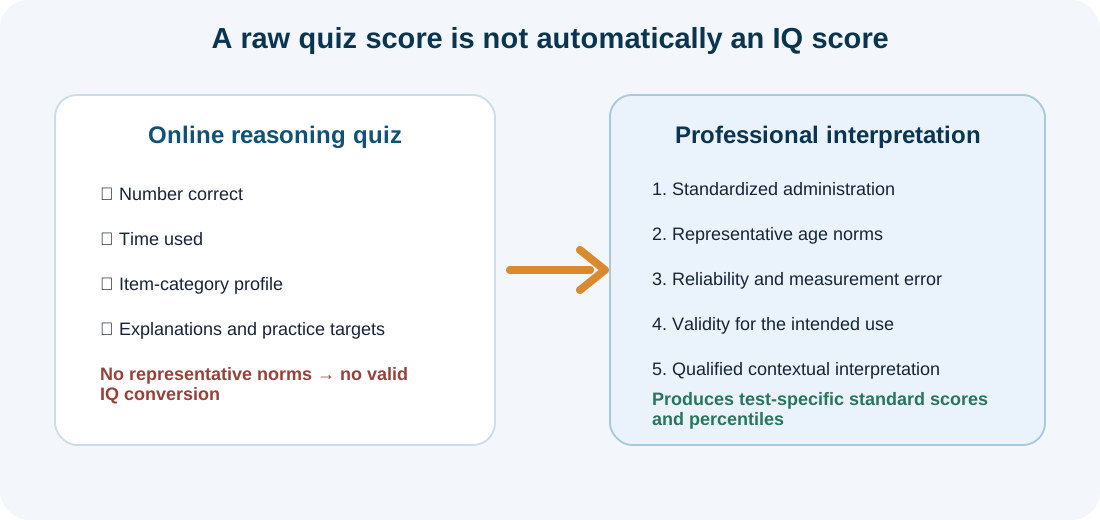
A raw quiz score is useful for reviewing which kinds of problems felt natural or difficult. It is not enough to estimate an IQ because the questions have not been administered to a representative normative sample under standardized conditions.
Reasonable conclusions
- You solved a certain proportion of this specific item set.
- Your strongest and weakest categories can guide practice.
- Time pressure may have influenced your accuracy.
- Explanations can reveal more efficient strategies.
Conclusions to avoid
- “My score proves my exact IQ.”
- “I qualify for a society, school or job.”
- “A low result diagnoses a condition.”
- “This number fixes my lifelong potential.”
IQ quiz vs IQ test vs IQ exam: does the wording matter?
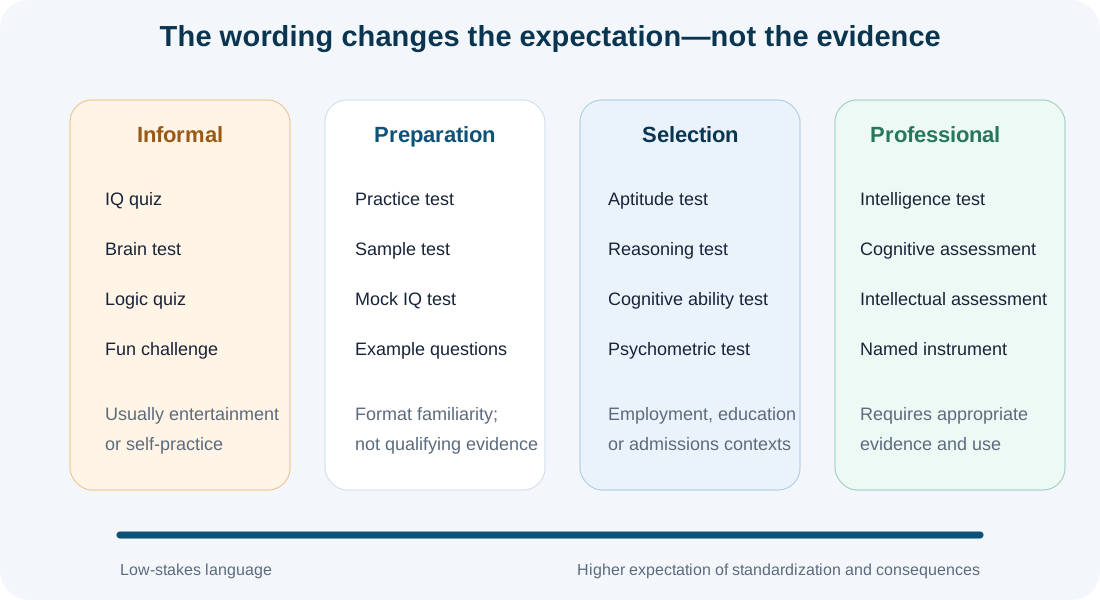
Yes—but the label is a clue, not proof. “Quiz” usually suggests something informal and low stakes. “Exam” suggests a formal event with consequences. “Test” is the broadest everyday term and can describe either a validated professional instrument or a casual website.
The practical rule: judge the evidence behind the score, not just the noun in the heading. A page called an “assessment” can still be weak, while a carefully described “quiz” can be honest and educational.
Casual and inviting; usually short or medium-length, online, self-scored and low stakes. Best for entertainment or practice.
The most common general phrase. It can refer to a professional instrument or an informal website, so users must inspect the source and evidence.
Sounds formal and supervised. Common in search language and some educational contexts, but not the preferred technical term in psychometrics.
The clearest formal label for a standardized instrument intended to measure intellectual or cognitive abilities.
A professional umbrella term that may include intelligence, memory, attention, language, processing speed and executive functions.
Common in employment, education and research. It may measure general mental ability or selected reasoning abilities.
Usually predicts capacity to learn or perform in a particular area. It overlaps with cognitive testing but is not automatically an IQ test.
A narrower label for verbal, numerical, abstract, inductive, deductive or logical reasoning.
A broad technical umbrella covering ability, personality, interest and other standardized measures.
A brief first-pass tool used to identify whether fuller assessment may be useful; not a complete diagnosis.
Preparation material that demonstrates format or difficulty. It should not be treated as qualifying evidence.
Informal marketing labels. They may be fun but do not identify what was measured or how scores were validated.
What people call IQ-style testing around the world
The same underlying activity can be labeled differently by country, language and context. The table below describes common usage patterns rather than rigid legal definitions or search-volume rankings.
| Region or language | Common labels | Typical nuance |
|---|---|---|
| United States & Canada | IQ test, intelligence test, cognitive assessment | “Quiz” generally signals informal practice; “assessment” sounds clinical or educational; “exam” is less typical for professional IQ testing. |
| United Kingdom & Ireland | IQ test, psychometric test, aptitude test, verbal/non-verbal reasoning test | Employment and school-selection contexts often use “psychometric” or “reasoning”; “exam” usually implies an educational qualification or formal paper. |
| Australia & New Zealand | IQ test, cognitive assessment, psychometric assessment, aptitude test | Professional reports commonly favour “assessment”; online entertainment still commonly uses “quiz” or “test.” |
| India and much of South Asia | IQ test, aptitude test, mental ability test, reasoning test, competitive exam | “Exam” is common for high-stakes education and recruitment, so “IQ exam” may appear in everyday search language even though it is not a precise psychometric category. |
| South Africa | Psychometric assessment, cognitive ability test, aptitude test, IQ test | Workplace selection frequently uses the broader “psychometric assessment” label. |
| Spanish-speaking countries | test/prueba de inteligencia, test de CI, coeficiente intelectual | Web users also search “test de IQ,” but CI is the Spanish abbreviation for coeficiente intelectual. |
| French-speaking countries | test de QI, test d’intelligence, bilan cognitif | QI is the French abbreviation; “bilan cognitif” is a broader cognitive evaluation. |
| German-speaking countries | IQ-Test, Intelligenztest, kognitiver Leistungstest | The English abbreviation IQ is widely retained alongside German compound terms. |
| Portuguese-speaking countries | teste de QI, teste de inteligência, avaliação cognitiva | QI is the common Portuguese abbreviation; “avaliação” sounds broader and more professional. |
| Central & Eastern Europe | IQ test plus local equivalents of intelligence/cognitive test | English “IQ test” is widely recognized online, while psychologists generally use the local professional term for assessment. |
Usage varies within every country. Professional services should state the exact test, target age, purpose, qualifications of the examiner and kind of score reported.
Free IQ quiz compared with a professional intelligence test
| Feature | This free IQ quiz | Professional intelligence test |
|---|---|---|
| Main purpose | Practice, interest and reasoning feedback | Answer a defined clinical, educational, research or eligibility question |
| Items | 40 original mixed questions | Protected standardized subtests developed and researched for a target population |
| Administration | Unsupervised browser use | Standard instructions, start points, timing, scoring and qualified administration |
| Norms | No representative age norms | Scores compared with an appropriate normative sample |
| Output | Raw score, accuracy and domain profile | Standard scores, percentiles, confidence intervals, observations and integrated interpretation |
| Valid uses | Entertainment and self-directed learning | Only uses supported by the test evidence, examiner judgment and receiving organization |
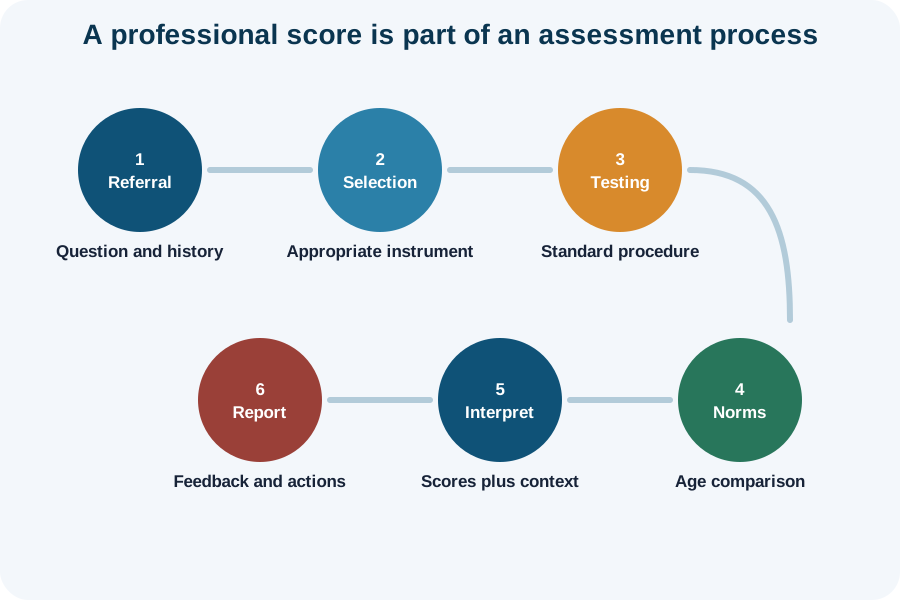
What makes a score interpretable?
- Standardization: the same core procedures are followed.
- Norms: the raw performance is compared with a relevant population.
- Reliability: expected measurement precision is documented.
- Validity: evidence supports the intended meaning and use.
- Context: age, language, disability, health, education and behavior are considered.
What do intelligence and cognitive tests measure?
Fluid and abstract reasoning
Detecting rules, patterns and relationships in unfamiliar problems.
Often sampled by matrices, sequences and analogical tasks.Verbal knowledge and reasoning
Understanding language, concepts, similarities and learned information.
Strongly influenced by language and educational opportunity.Visual-spatial processing
Analyzing shapes, orientation, part-to-whole relationships and spatial transformation.
Vision and motor demands may affect some tasks.Working memory
Holding, updating and mentally reorganizing information over short periods.
Attention, anxiety, fatigue and hearing can influence performance.Processing speed
Quickly and accurately scanning or recording simple information under time limits.
Motor speed, vision and cautious response style matter.Quantitative reasoning
Understanding numerical relations, proportionality and mathematical structure.
Not every IQ battery isolates this as a separate index.History: from intelligence scales to the online IQ quiz
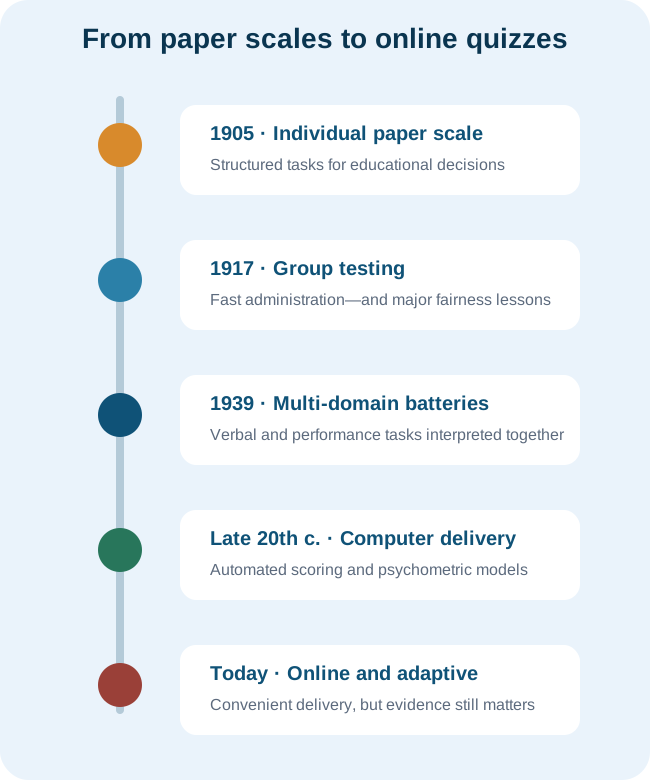
Binet–Simon scale
Alfred Binet and Théodore Simon published an early practical scale to help identify children needing educational support.
The IQ term
William Stern proposed the intelligence quotient concept, originally based on mental age divided by chronological age.
Stanford–Binet
Lewis Terman’s revision helped popularize intelligence testing and the IQ label in the United States.
Large-scale group testing
Army Alpha and Beta testing accelerated group-administered mental testing, while also exposing major language, cultural and fairness problems.
Wechsler–Bellevue
David Wechsler introduced an adult battery that combined several task types and emphasized age-referenced comparison.
Deviation IQ becomes standard
Modern scoring increasingly compared people with same-age normative groups rather than using a literal mental-age ratio.
Psychometrics and computerized testing
Item analysis, reliability, validity research and computer delivery expanded, along with employment aptitude testing.
The online IQ quiz era
Websites made short logic quizzes globally accessible, but most lacked the norms and controls required for professional interpretation.
Adaptive and remote assessment
Computer-adaptive testing can select items based on responses, while professional remote testing still requires security, suitable norms and standardized procedures.
How to judge an online IQ quiz or test
Positive signs
- States whether the tool is entertainment, screening, practice or professional assessment.
- Explains who the norms came from and when they were collected.
- Reports reliability, validity and score limitations in understandable language.
- Uses age-appropriate comparison groups.
- Does not expose protected items from commercial tests.
- Separates raw scores, percentiles and IQ scales correctly.
- Provides privacy and accessibility information.
Warning signs
- Promises an exact IQ from a handful of questions.
- Hides the score behind payment after claiming the test is free.
- Uses fake precision such as “IQ 137.42.”
- Guarantees diagnosis, gifted placement, employment or society admission.
- Does not identify a normative population.
- Copies leaked professional questions.
- Claims that one score measures creativity, wisdom and future success.
Price is not validation. “Free,” “premium,” “exam,” “professional-looking” and “AI-powered” are marketing descriptions unless supported by appropriate technical evidence.
Why the same person can get different results
Sleep and fatigue
Reduced alertness can affect speed, working memory and error control.
Language
Instructions and verbal items may underestimate performance in a weaker language.
Health and stress
Pain, anxiety, illness, medication and acute stress can change test-day performance.
Practice
Familiarity can improve strategy and pacing, especially on repeated formats.
Time limits
Speeded and untimed versions may rank people differently.
Device and interface
Screen size, input method, distraction and accessibility affect online performance.
Education and exposure
Schooling and experience influence learned knowledge and test familiarity.
Measurement error
Every test score contains uncertainty; a single obtained number is not perfectly exact.
IQ quiz, IQ test and IQ exam FAQs
Is this free IQ quiz a real IQ test?
It is a carefully designed, original reasoning quiz, but it is not a standardized or normed professional intelligence test. It reports performance on these 40 questions rather than a clinical IQ score.
Why does the page call it an IQ quiz instead of an IQ test?
“Quiz” signals an informal, low-stakes online activity. “Test” is broader and can describe either a professional assessment or a casual website, so the surrounding evidence matters more than the label alone.
Is an IQ exam the same as an IQ test?
In ordinary speech people may mean the same thing, but “exam” usually sounds formal, supervised and consequential. Psychologists more often use terms such as intelligence test, cognitive assessment or psychological assessment.
Can my raw score be converted into an IQ?
Not responsibly without a representative normative sample, age-based comparison data, reliability evidence, standardized administration and validated score-conversion tables.
What is the difference between an intelligence test and an aptitude test?
An intelligence test aims to estimate broad cognitive functioning. An aptitude test is usually designed to predict learning or performance in a narrower domain, such as numerical, verbal, mechanical or job-related ability.
What is a cognitive ability test?
It is a broad label for tests of reasoning, memory, processing, verbal or numerical abilities. Some cognitive ability tests estimate general intelligence; others measure only selected abilities.
What does psychometric test mean?
Psychometric test is an umbrella term for standardized measures of abilities, personality, interests, attitudes or other psychological characteristics. It does not automatically mean IQ test.
Is a reasoning test an IQ test?
Not necessarily. A reasoning test may measure only numerical, verbal, abstract or logical reasoning. A full intelligence battery usually samples several domains and uses age-based norms.
Does “free” mean an IQ quiz is inaccurate?
No. Price alone says nothing about validity. A free tool can be thoughtfully constructed, while a paid tool can still be weak. Look for norms, reliability, validity, scoring transparency and appropriate claims.
What does a professional IQ score of 100 mean?
On many modern deviation-IQ scales, 100 is the age-group mean. The standard deviation is commonly 15, but the exact score interpretation belongs to the specific test and report.
Why might I score differently on another online quiz?
Different item types, time limits, scoring rules, difficulty, practice, fatigue, language, screen size and random variation can all change results. Online quizzes often lack common norms.
Can practice improve my result?
Practice can improve familiarity, pacing and strategy on similar questions. That improvement should not automatically be interpreted as an equal increase in broad intelligence.
Are online IQ quizzes suitable for children?
Most are not age-normed for children. A child should be compared with same-age peers using an appropriate assessment, not with a general adult internet audience.
Does language affect IQ quiz performance?
Yes. Vocabulary, instructions, educational experience and translation quality can affect verbal and even supposedly nonverbal tasks. No test is completely culture-free.
What should I call a test taken for a job?
Employers commonly use terms such as cognitive ability test, aptitude test, psychometric test, verbal reasoning test, numerical reasoning test or assessment. These are not necessarily full IQ tests.
What should I call a test administered by a psychologist?
“Intelligence test,” “cognitive assessment,” “intellectual assessment” or the exact instrument name is usually clearer than “IQ exam.”
Is “IQ examination” correct English?
It is understandable but uncommon in professional psychology. It may suggest a formal school or medical examination rather than the name of a standardized intelligence instrument.
What is a mock IQ test?
A mock, sample, practice or example test is preparation material. It may imitate the style of reasoning items but should not claim to provide an official or diagnostic score.
Can an IQ quiz diagnose ADHD, autism, dyslexia or intellectual disability?
No. Diagnosis requires a broader evaluation. Intellectual-disability decisions also require evidence about adaptive functioning, not an IQ result alone.
How should I interpret a strong result here?
Treat it as evidence that you solved many items in this particular mixed set. Review the domain profile and explanations, but do not use it for medical, school, employment or membership decisions.
IQ testing glossary
Adaptive test
A computer-delivered test that changes item difficulty or selection in response to performance.
Age norms
Reference data that compare a person with others in the same age range.
Composite score
A score created by combining performance across multiple subtests or domains.
Construct validity
Evidence that score interpretations reflect the psychological ability the test claims to measure.
Deviation IQ
An age-normed standard score, commonly with a mean of 100 and standard deviation of 15 or 16.
Item
One question, problem or task in a test or quiz.
Normative sample
The reference group used to convert raw performance into standard scores or percentiles.
Percentile rank
The percentage of the reference group scoring at or below a given level, subject to test-specific rules.
Practice effect
Improvement caused by familiarity with formats or previous exposure rather than a broad change in ability.
Raw score
The number of points earned before conversion through normative tables.
Reliability
The consistency or precision of scores under defined conditions.
Standardization
Using consistent instructions, timing, materials and scoring so results can be meaningfully compared.
Standard deviation
A measure of spread around the mean in a score distribution.
Test ceiling
The upper range beyond which a test cannot distinguish performance accurately.
Validity
The evidence supporting a particular interpretation and use of test scores.
Professional sources and terminology references
- Standards for Educational and Psychological Testing
- APA Dictionary — Deviation IQ
- APA Dictionary — Stanford–Binet Intelligence Scale
- Pearson — WAIS-5 professional cognitive assessment
- Pearson — KBIT-2 Revised brief intelligence measure
- Mensa International — Getting Your IQ Tested FAQs
- Mensa International — IQ Challenge notice
- UK National Careers Service — Psychometric tests
- UK Civil Service — Verbal and numerical tests
Terminology varies by language, organization and purpose. The professional meaning of a score depends on the exact instrument, normative sample, administration and intended use.