
Child IQ Testing in Winston-Salem

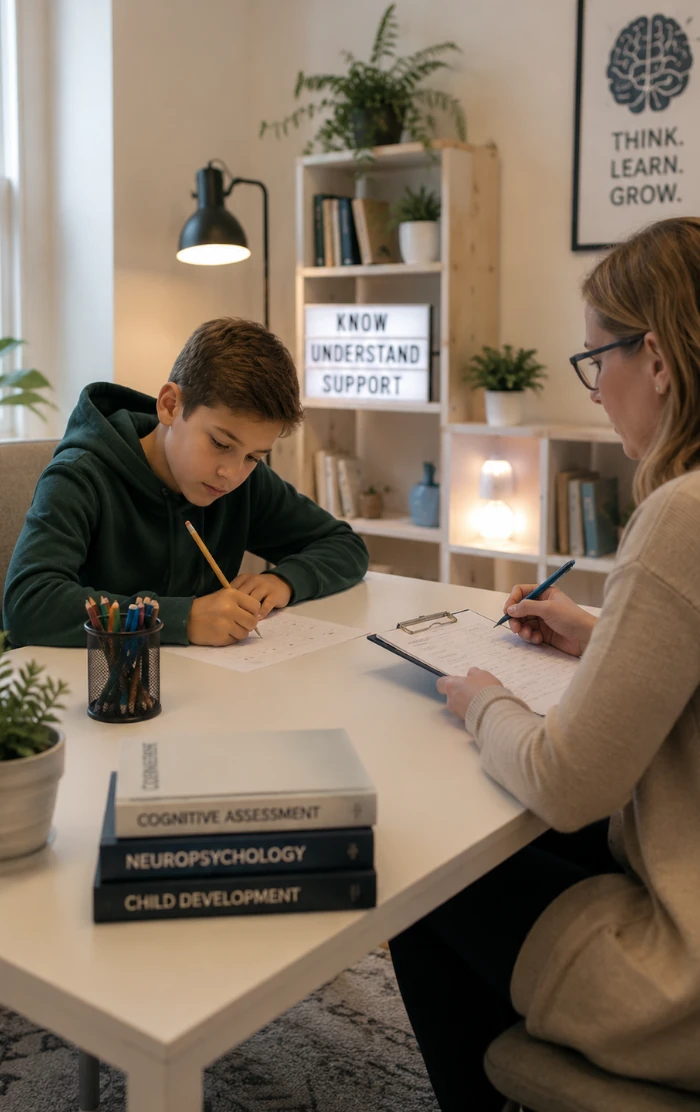
Professional child IQ testing in Winston-Salem – whether you need an assessment for school placement, gifted program eligibility, or to understand your child's learning profile, we connect you with licensed psychologists in the Winston-Salem area.
Last Updated: September 2026
Gifted Testing
Identify giftedness for school placement, enrichment, and talent programs using WISC-V or Stanford-Binet 5.
WISC-V Test
Wechsler Intelligence Scale for Children® Fifth Edition – the gold standard for child IQ testing.
Stanford-Binet 5
Stanford-Binet Intelligence Scales Fifth Edition – comprehensive cognitive assessment for all ages.
Full Evaluation
Combined assessment with detailed report and recommendations. Includes WISC-V or Stanford-Binet 5.
School Placement Testing
Testing for private school admission and gifted program eligibility using WISC-V or Stanford-Binet 5.
Schedule Child IQ Testing
Book your WISC-V & Stanford-Binet 5 for ages 6–16. Gifted identification, learning profiles, etc. with a licensed psychologist in Winston-Salem today.
Child IQ Testing in Winston-Salem: city context
Winston-Salem children attend Winston-Salem/Forsyth County Schools, charter schools, independent and faith-based schools, home schools, and specialized programs. Families seek testing for AG or HAG identification, acceleration, school placement, twice-exceptional needs, learning disabilities, ADHD, autism, language and learning questions, and educational planning.
IQ by gender & ethnicity (child population)
Current Census estimates show that 23.0% of residents are under age 18 and 53.4% of the total population is female. There is no valid Winston-Salem average IQ for boys, girls, racial groups, ethnic groups, language groups, or neighborhoods.
Winston-Salem is the principal city of Forsyth County and a major center of the Piedmont Triad. The U.S. Census Bureau estimated 257,271 residents in 2025, a 3.1% increase from the 2020 estimates base, across approximately 132.68 square miles of land.
Current population statistics provide context but do not establish separate local IQ averages for demographic groups:
- Female population: 53.4%.
- Residents under age 18: 23.0%.
- Residents age 65 and older: 15.4%.
- White alone: 46.1%.
- Black or African American alone: 32.1%.
- American Indian and Alaska Native alone: 0.5%.
- Asian alone: 2.3%.
- Native Hawaiian and other Pacific Islander alone: 0.1%.
- Two or more races: 10.6%.
- Hispanic or Latino: 18.2%; Hispanic origin may overlap with racial categories.
- Foreign-born residents: 11.2%.
- Language other than English at home: 19.5% of residents age five and older.
- Education: 89.1% of adults age 25 and older are high-school graduates or higher, and 39.5% hold a bachelor's degree or higher.
- Labor-force participation: 61.2% overall and 56.5% among women age 16 and older.
- Clinical interpretation: Examiners use age-based national norms and consider education, language, bilingual development, culture, disability, medical history, attention, mood, sleep, medication, and testing conditions rather than inferring ability from gender, race, ethnicity, income, or neighborhood.
Winston-Salem School Districts and Gifted Programs
Winston-Salem/Forsyth County Schools AIG Services
- District framework: WS/FCS identifies and serves Academically or Intellectually Gifted students through its locally approved AIG plan, with differentiated instruction beginning in elementary school and continuing through middle and high school.
- Universal screening: The district publishes second-grade universal-screening and rescreening information; families should verify the current assessment calendar, measures, score criteria, and nomination pathways.
- AG services: Academically Gifted students may receive advanced mathematics and language-arts services, classroom differentiation, enrichment, cluster grouping, or advanced courses according to grade and school.
- HAG services: Highly Academically Gifted programming includes self-contained accelerated options at designated elementary sites and Hanes Magnet School for middle grades; locations and capacity can change by school year.
- Secondary pathways: Middle and high schools may offer HAG, honors, Advanced Placement, dual enrollment, magnet, STEM, arts, early/middle college, and career and technical education options.
- Outside reports: Private WISC-V, Stanford-Binet, achievement, or comprehensive evaluation results may add information but do not automatically determine district identification, HAG placement, acceleration, or services.
North Carolina AIG Framework
- State mandate: North Carolina law requires public school units to identify and serve AIG students in kindergarten through grade 12.
- Local plans: Each local education agency develops a three-year AIG plan using state legislation and NC AIG Program Standards, with local screening, identification, service, professional-development, family-engagement, and disagreement-resolution procedures.
- Multiple evidence sources: Ability, achievement, classroom performance, portfolios, teacher evidence, student potential, and other locally approved data may contribute.
- Equity: Identification and interpretation should account for culture, language, disability, socioeconomic opportunity, and students who may be underrepresented in gifted services.
- Current information: Families should rely on the active WS/FCS AIG plan and school-year guidance rather than old cut scores or another district's procedures.
Winston-Salem Private Schools and Programs Using Testing Information
- Independent and faith-based schools: Forsyth Country Day School, Summit School, Salem Academy, Calvary Day School, Bishop McGuinness, St. Leo Catholic School, and other area schools establish their own admission, placement, acceleration, and documentation procedures.
- Charter schools: Public charter admission generally follows enrollment and lottery rules rather than IQ selection; charter AIG services and advanced pathways vary by school and local plan.
- Specialized programs: Schools serving dyslexia, ADHD, autism, learning disabilities, language needs, or twice-exceptional learners may request comprehensive evaluations rather than a single IQ score.
- Verification: Obtain written confirmation of accepted tests, examiner qualifications, score age, required subtests, deadlines, and whether outside scores affect admission or placement.
- Educational fit: Curriculum, advanced coursework, support services, peer group, social-emotional environment, commute, tuition, and student interests matter alongside scores.
Winston-Salem Gifted Identification Statistics
- No single city rate: Winston-Salem does not publish one authoritative citywide gifted-identification percentage because students attend WS/FCS, charters, private schools, home schools, and neighboring districts.
- Identification is not prevalence: Participation reflects local criteria, screening schedules, referrals, language access, reassessment, mobility, and available services.
- North Carolina data: NCDPI gathers official AIG headcounts from public school units, but local percentages should be interpreted with the district's grade levels, identification pathways, and service definitions.
- WS/FCS programs: AG and HAG services use locally approved procedures; the HAG pathway is not equivalent to a universal private IQ cutoff.
- Private testing: Outside results may add information but do not automatically override district decisions.
- Equity: Universal screening, multiple measures, bilingual interpretation, disability awareness, and attention to educational opportunity can help identify students missed by referral-only systems.
The child IQ testing process: step by step
Understanding the testing process can help parents prepare their child and reduce anxiety. Here's what to expect:
- Initial consultation (15–20 minutes): A brief phone or video call with the psychologist to discuss your child's background, concerns, and goals. This helps determine the right test and approach.
- Testing session (60–90 minutes): The child meets one-on-one with a licensed psychologist in a quiet, comfortable room. The psychologist administers the WISC-V or Stanford-Binet 5, which includes a series of subtests measuring verbal comprehension, visual-spatial reasoning, fluid reasoning, working memory, and processing speed. Breaks are offered as needed.
- Scoring and interpretation (1–2 days): The psychologist scores the test and analyzes the results. They consider the child's age, background, and any relevant medical or educational history.
- Feedback session (45–60 minutes): The psychologist meets with the parents (and the child, if appropriate) to explain the results. They discuss the Full-Scale IQ, index scores, strengths, and areas for growth. They also provide tailored recommendations for home, school, and extracurriculars.
- Comprehensive written report (5–7 days): You receive a detailed report with all scores, normative comparisons, and actionable next steps. This report can be shared with schools, doctors, or other professionals.
The entire process from consultation to report usually takes 1–2 weeks, depending on scheduling. The testing itself is non-invasive and designed to be engaging for children.
What is the WISC-V test?
The WISC-V (Wechsler Intelligence Scale for Children® – Fifth Edition) is the most widely used IQ test for children aged 6:0–16:11. It provides a Full-Scale IQ and five primary index scores: Verbal Comprehension, Visual-Spatial, Fluid Reasoning, Working Memory, and Processing Speed. The test is administered one-on-one by a trained psychologist and takes about 60–90 minutes.
The WISC-V is normed on a large, representative sample of U.S. children and is updated regularly to ensure accuracy. It is the gold standard for gifted identification, learning disability diagnosis, and school placement.
Why test your child's IQ?
IQ testing provides valuable insights into your child's cognitive strengths and weaknesses. It can help:
- Identify giftedness: For admission to gifted programs, private schools, or enrichment opportunities.
- Diagnose learning disabilities: Such as dyslexia, dyscalculia, or ADHD, which can be masked by high intelligence.
- Guide educational planning: Tailor instruction to your child's unique learning profile.
- Provide reassurance: Understand why your child is different from peers and how to support them.
Winston-Salem Gifted Testing Timeline
- Start with WS/FCS or the receiving school: Ask for the current AIG plan, testing calendar, nomination process, accepted evidence, service criteria, and disagreement procedure.
- Universal screening: WS/FCS publishes second-grade screening and rescreening information; exact dates and measures should be verified for the current year.
- Private scheduling: Allow time for consultation, records review, testing, scoring, feedback, and the written report; comprehensive cases may require multiple sessions.
- District review: Submission of a private report does not guarantee immediate AG or HAG identification, placement, acceleration, or a particular school assignment.
- Transfer students: Families should verify how prior identification, charter records, out-of-district reports, bilingual testing, and out-of-state documentation are handled.
- School calendar: Avoid testing immediately after major exams, illness, travel, sleep loss, or demanding extracurricular schedules.
Winston-Salem Gifted Programs by Age Group
- Early childhood and kindergarten: Families may seek developmental, readiness, or early-entrance assessment; current state and school age rules should be confirmed before private testing.
- Elementary years: WS/FCS uses classroom differentiation, AG services, universal screening, rescreening, and designated HAG programming for qualifying students.
- Middle school: Hanes Magnet offers AG and HAG accelerated pathways; other middle schools provide advanced coursework and differentiated services according to the district plan.
- High school: Honors, AP, dual enrollment, Career and College Promise, early/middle college, magnet, arts, STEM, and career and technical education options vary by school.
- Arts pathways: UNCSA, local arts organizations, music, theater, film, dance, and visual-arts programs provide unusually strong regional options.
- Enrichment: Wake Forest, WSSU, Forsyth Tech, Kaleideum, Old Salem, Reynolda House, libraries, robotics, coding, science, debate, and summer programs supplement school services.
Winston-Salem Child ADHD and Learning Disability Assessment
- Comprehensive scope: ADHD and learning evaluations may include cognitive, achievement, attention, executive-function, language, behavioral, emotional, and developmental measures.
- Language considerations: Language exposure, English proficiency, schooling, interpreter use, culture, and test validity are important in Winston-Salem's multilingual population.
- School pathway: Families may request an evaluation through WS/FCS when disability affects education.
- Medical and private pathway: Brenner Children's, Atrium Health Wake Forest Baptist, Novant Health, private psychologists, pediatricians, and Triad specialists may evaluate or refer depending on the question.
- Twice exceptionality: Giftedness can coexist with ADHD, autism, dyslexia, anxiety, language disorder, or medical conditions.
Winston-Salem Summer Programs for Gifted Children
- STEM and health sciences: Wake Forest, WSSU, Forsyth Tech, Innovation Quarter, Kaleideum, robotics, coding, biomedical, and maker programs offer technical enrichment.
- Arts: UNCSA, Salem College, community theaters, music organizations, film programs, museums, writing, and visual arts support advanced creative interests.
- History and humanities: Old Salem, Historic Bethabara, Reynolda House, libraries, archives, genealogy, debate, journalism, and language study provide strong local resources.
- Nature and environmental learning: Salem Lake, Reynolda Gardens, greenways, Pilot Mountain, Hanging Rock, ecology, astronomy, and conservation programs provide field-based learning.
- Entrepreneurship and technology: Innovation Quarter, university programs, business competitions, design, data, and startup events connect academic strengths with real projects.
- Balanced development: Recreation, friendships, sleep, hydration, and unstructured time remain important, especially during hot and humid summers.
Winston-Salem Child Testing Costs by Provider Type
- School evaluation: Eligible public-school evaluations are provided under educational rules and address school-service questions.
- Private IQ testing: Fees vary by instrument, records review, feedback, report detail, language needs, and examiner expertise.
- Comprehensive evaluation: ADHD, autism, learning, emotional, language, neurological, or twice-exceptional questions generally cost more because they require multiple measures and more professional time.
- Insurance: Coverage is more likely when testing is medically necessary than when requested only for gifted or private-school placement.
- Before paying: Confirm the exact report requirements and whether WS/FCS, a private school, college, agency, testing board, or Mensa will accept private results.
Areas we serve
We support all areas of Winston-Salem.
Frequently Asked Questions
Both are excellent tests. WISC-V is more commonly used for school-age children, while Stanford-Binet 5 can be used for ages 2–85. We often recommend WISC-V for gifted identification.
The test itself takes 60–90 minutes. With the consultation, feedback, and report, the entire process is about 1–2 weeks.
No, you can book directly with our psychologists. We serve both self-referred and professionally referred children.
Professional results may be considered by public districts, private schools, and enrichment programs, but each organization sets its own accepted tests, score age, report requirements, and eligibility rules.
Some plans cover cognitive assessments when there is a clinical indication. Check with your provider.
Get a good night's sleep, eat a healthy meal, and arrive relaxed. No specific preparation is needed.
You'll receive a comprehensive report with your child's scores and tailored recommendations.
Interviews and feedback may be available remotely, but many standardized cognitive tests require controlled administration and may need an in-person appointment. Contact us for details.