
Stanford-Binet Test in Winston-Salem

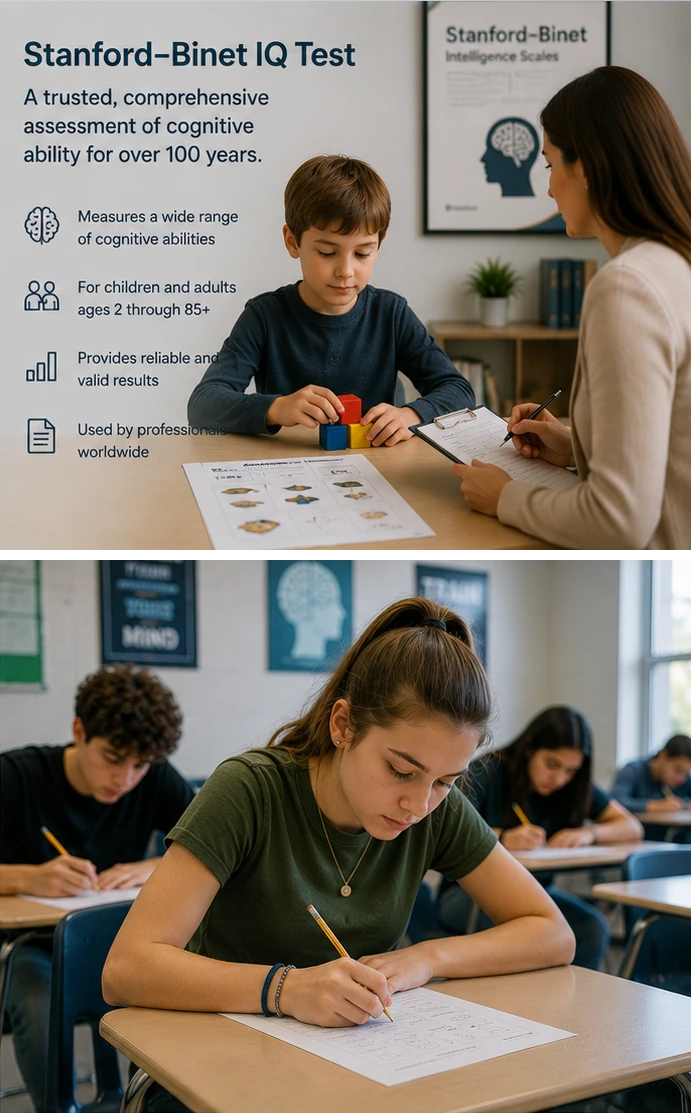
The Stanford-Binet Intelligence Scales is one of the oldest and most respected IQ tests in the world. This comprehensive guide covers the complete history of the Stanford-Binet, the key differences between SB-5 and other major IQ tests (WISC, WAIS, Mensa, and Full Evaluations), and what you need to know about testing in Winston-Salem.
Last Updated: September 2026
Complete SB History
From Binet-Simon (1905) to SB-5 (2003) – the evolution of intelligence testing.
SB-5 vs Other Tests
Detailed comparison of Stanford-Binet vs WISC, WAIS, Mensa, and Full Evaluations.
SB in Winston-Salem
How many people take the Stanford-Binet in Winston-Salem and what the data tells us.
All SB Versions
Complete breakdown of subtests and scores for every Stanford-Binet version.
Why Choose SB-5?
Understanding the advantages of the Stanford-Binet and who it's best for.
Schedule SB Testing
Book your Stanford-Binet assessment with a licensed psychologist in Winston-Salem today.
The Complete History of the Stanford-Binet
The Origins: Binet-Simon Scale (1905)
The story of the Stanford-Binet begins in France with Alfred Binet and Théodore Simon. In 1905, the French Ministry of Education commissioned Binet to develop a test to identify children who would need special assistance in school. The result was the Binet-Simon Scale, which measured memory, attention, comprehension, and judgment.
Stanford-Binet (1916)
Lewis Terman of Stanford University adapted the Binet-Simon Scale for American use in 1916. This version introduced the Intelligence Quotient (IQ) concept, which was calculated as (Mental Age ÷ Chronological Age) × 100. Terman's version became the foundation for modern IQ testing.
Stanford-Binet (1937)
This revision expanded the test to two forms (L and M) and extended the age range to cover ages 2 to adult. It was the first major revision of the SB.
Stanford-Binet (1960)
This version incorporated the best items from Forms L and M into a single Form L-M. It was the first to introduce deviation IQ scores, which are now standard in all modern IQ tests.
Stanford-Binet (1972)
A minor revision with updated norms based on the 1960s population.
Stanford-Binet (1986) – SB-IV
A major revision that introduced a multi-factor structure. It assessed four cognitive areas: Verbal Reasoning, Abstract/Visual Reasoning, Quantitative Reasoning, and Short-Term Memory. It also introduced the concept of Standard Age Score (SAS).
Stanford-Binet (2003) – SB-5
The current version, SB-5, represents the most comprehensive revision to date. It features:
- Five factors: Fluid Reasoning, Knowledge, Quantitative Reasoning, Visual-Spatial Processing, and Working Memory
- Full scale IQ score
- Ten subtests (5 verbal, 5 nonverbal)
- Age range: 2 years to 85+ years
- Administration time: 45-75 minutes
Stanford-Binet vs Other Tests: What's the Difference?
| Feature | Stanford-Binet (SB-5) | WISC-V | WAIS-IV | Mensa Test | Full Evaluation |
|---|---|---|---|---|---|
| Age Range | 2–85+ years | 6–16 years | 16–90 years | 16+ years | Varies |
| Primary Use | Gifted identification, clinical assessment, all ages | Children's IQ, school placement, gifted programs | Adult IQ, career guidance, neuropsychology | High-IQ society admission | Comprehensive cognitive & psychological assessment |
| Factors/Indices | 5 factors (Fluid Reasoning, Knowledge, Quantitative, Visual-Spatial, Working Memory) | 5 indices (VCI, VSI, FRI, WMI, PSI) | 4 indices (VCI, PRI, WMI, PSI) | Varies by test | Multiple cognitive, behavioral, and emotional domains |
| Subtests | 10 (5 verbal, 5 nonverbal) | 10 primary + 5 secondary + 5 tertiary | 10 core + 5 supplemental | Varies | Multiple tests |
| Administration Time | 45-75 minutes | 65-80 minutes | 60-90 minutes | 60-90 minutes | 2-6 hours |
| Best For | Highly gifted individuals, all ages, comprehensive assessment | Children, school placement, ADHD/LD evaluation | Adults, career guidance, Mensa, neuropsychology | Adults seeking Mensa membership | Complex cases, disability diagnosis, legal documentation |
Why Choose the Stanford-Binet?
Advantages of SB-5
- Broad age range: SB-5 can be used from age 2 to 85+, making it the most versatile IQ test available.
- Excellent for gifted identification: The extended ceiling of SB-5 makes it particularly good at identifying highly gifted individuals (IQ 145+).
- CHC theory alignment: SB-5 was designed from the ground up to align with the Cattell-Horn-Carroll (CHC) theory of cognitive abilities.
- Balanced verbal/nonverbal: The 5 verbal and 5 nonverbal subtests provide a balanced assessment of cognitive abilities.
- Strong clinical utility: Excellent for identifying learning disabilities, intellectual disabilities, and cognitive strengths.
- Less influenced by speed: Unlike WISC and WAIS, SB-5 is less affected by processing speed, making it better for individuals with ADHD or motor issues.
When to Choose Other Tests
- WISC-V: Best for children aged 6-16, especially for school placement and learning disability identification.
- WAIS-IV: Best for adults aged 16-90, especially for career guidance, neuropsychological evaluation, and Mensa.
- Mensa Test: Best if your only goal is Mensa admission and you don't need a comprehensive report.
- Full Evaluation: Best if you suspect multiple conditions (e.g., ADHD + anxiety + learning disability) or need documentation for legal purposes.
Stanford-Binet Testing in Winston-Salem
The Stanford-Binet may be used in Winston-Salem for gifted assessment, broad-age cognitive testing, intellectual-disability questions, school planning, clinical evaluation, and Mensa prior evidence when the score and documentation meet current requirements.
Where It May Be Used
- Atrium Health Wake Forest Baptist: An academic medical center with neurology, behavioral neurology, epilepsy, stroke, movement-disorder, pediatric neurology, psychiatry, rehabilitation, and clinical-neuropsychology pathways.
- Brenner Children's: Pediatric specialty services may support developmental, neurological, behavioral, rehabilitation, and complex diagnostic referrals; the exact evaluation service should be confirmed.
- Novant Health Forsyth Medical Center: Provides hospital, neurology, behavioral-health, rehabilitation, imaging, and specialty services, with referrals depending on the clinical question.
- Private psychologists and neuropsychologists: Local and Triad practices offer IQ, ADHD, autism, learning, memory, traumatic-brain-injury, disability, forensic, bariatric, presurgical, and diagnostic evaluations with varying age ranges and specialties.
- VA services: Eligible veterans can access primary, mental-health, rehabilitation, and specialty pathways through VA facilities and community-care referrals serving the Winston-Salem area.
- School-based assessment: WS/FCS evaluates eligible students under educational rules when disability or school-service questions are involved.
- Credential verification: Confirm North Carolina psychologist licensure, neuropsychology or school-psychology training, age range, language competence, test edition, report scope, fees, turnaround, insurance, and receiving-institution requirements.
School and Gifted Context
Winston-Salem/Forsyth County Schools AIG Services
- District framework: WS/FCS identifies and serves Academically or Intellectually Gifted students through its locally approved AIG plan, with differentiated instruction beginning in elementary school and continuing through middle and high school.
- Universal screening: The district publishes second-grade universal-screening and rescreening information; families should verify the current assessment calendar, measures, score criteria, and nomination pathways.
- AG services: Academically Gifted students may receive advanced mathematics and language-arts services, classroom differentiation, enrichment, cluster grouping, or advanced courses according to grade and school.
- HAG services: Highly Academically Gifted programming includes self-contained accelerated options at designated elementary sites and Hanes Magnet School for middle grades; locations and capacity can change by school year.
- Secondary pathways: Middle and high schools may offer HAG, honors, Advanced Placement, dual enrollment, magnet, STEM, arts, early/middle college, and career and technical education options.
- Outside reports: Private WISC-V, Stanford-Binet, achievement, or comprehensive evaluation results may add information but do not automatically determine district identification, HAG placement, acceleration, or services.
North Carolina AIG Framework
- State mandate: North Carolina law requires public school units to identify and serve AIG students in kindergarten through grade 12.
- Local plans: Each local education agency develops a three-year AIG plan using state legislation and NC AIG Program Standards, with local screening, identification, service, professional-development, family-engagement, and disagreement-resolution procedures.
- Multiple evidence sources: Ability, achievement, classroom performance, portfolios, teacher evidence, student potential, and other locally approved data may contribute.
- Equity: Identification and interpretation should account for culture, language, disability, socioeconomic opportunity, and students who may be underrepresented in gifted services.
- Current information: Families should rely on the active WS/FCS AIG plan and school-year guidance rather than old cut scores or another district's procedures.
Local Usage Data
- No citywide count: Winston-Salem does not publish a verified total of Stanford-Binet administrations.
- Provider choice: Many examiners use the WISC-V for school-age children and WAIS editions for adults, while SB-5 is selected when its broad age range or verbal/nonverbal structure fits the referral.
- Acceptance: Confirm WS/FCS, private school, Mensa, disability, legal, or agency requirements before testing.
All Stanford-Binet Versions at a Glance
Frequently Asked Questions
The Stanford-Binet is the oldest continuously used intelligence test, with origins in 1905 France. Key milestones:
- Binet-Simon (1905): Developed by Alfred Binet and Théodore Simon to identify children needing special education.
- Stanford-Binet (1916): Lewis Terman adapted it for American use and introduced the IQ concept (Mental Age ÷ Chronological Age × 100).
- Stanford-Binet (1937): Two forms (L and M) with an extended age range.
- Stanford-Binet (1960): Form L-M. Introduced deviation IQ scores (the modern standard).
- SB-IV (1986): Multi-factor structure with four cognitive areas.
- SB-5 (2003): Current version with five factors (Fluid Reasoning, Knowledge, Quantitative Reasoning, Visual-Spatial Processing, Working Memory) and ages 2-85+.
The Stanford-Binet was the test used by the famous "Termite" study that followed gifted children throughout their lives.
All three are excellent IQ tests, but they have different strengths:
- Stanford-Binet (SB-5): Broadest age range (2-85+). Best for highly gifted individuals. Less influenced by processing speed. Balanced verbal/nonverbal subtests.
- WISC-V: Best for children aged 6-16. Designed for school placement and learning disability identification. Faster administration.
- WAIS-IV: Best for adults aged 16-90. Designed for career guidance, neuropsychology, and Mensa. Most widely used adult IQ test.
Choose Stanford-Binet if you need an assessment that works across all ages and is less affected by processing speed or motor issues.
Yes, Stanford-Binet is often preferred for individuals with ADHD or processing speed issues because it is less influenced by speed compared to WISC and WAIS. The SB-5's emphasis on fluid reasoning and knowledge rather than speed makes it more accessible for individuals with attention difficulties. However, like all IQ tests, SB-5 cannot diagnose ADHD on its own – it provides cognitive profile information that helps clinicians understand how ADHD might affect a person's performance.
Yes. Mensa accepts Stanford-Binet (SB-5) scores for admission. A score of 130 or above (98th percentile) is typically required for membership. We provide official documentation for Mensa applications.
SB-5 takes approximately 45-75 minutes to administer, depending on the individual's age and performance.
Yes! This is one of SB-5's biggest advantages. It covers ages 2-85+ with a single test battery, making it ideal for families who want to compare results across generations.
Typical fees range from $200 to $1,200. Some insurance plans cover testing when medically necessary. We offer sliding-scale options for qualifying individuals.
Yes, many psychologists offer Stanford-Binet testing via secure telehealth platforms. However, some subtests may require in-person administration for accurate scoring. Contact us for details.
A Full Evaluation includes multiple tests (IQ, achievement, personality, behavioral, emotional) and typically takes 2-6 hours. It provides a comprehensive picture of cognitive, academic, emotional, and behavioral functioning. A single IQ test like Stanford-Binet focuses only on cognitive abilities and takes 45-75 minutes. Full Evaluations are best for complex cases, disability diagnosis, or legal documentation.