
Child IQ Testing in Santa Clarita

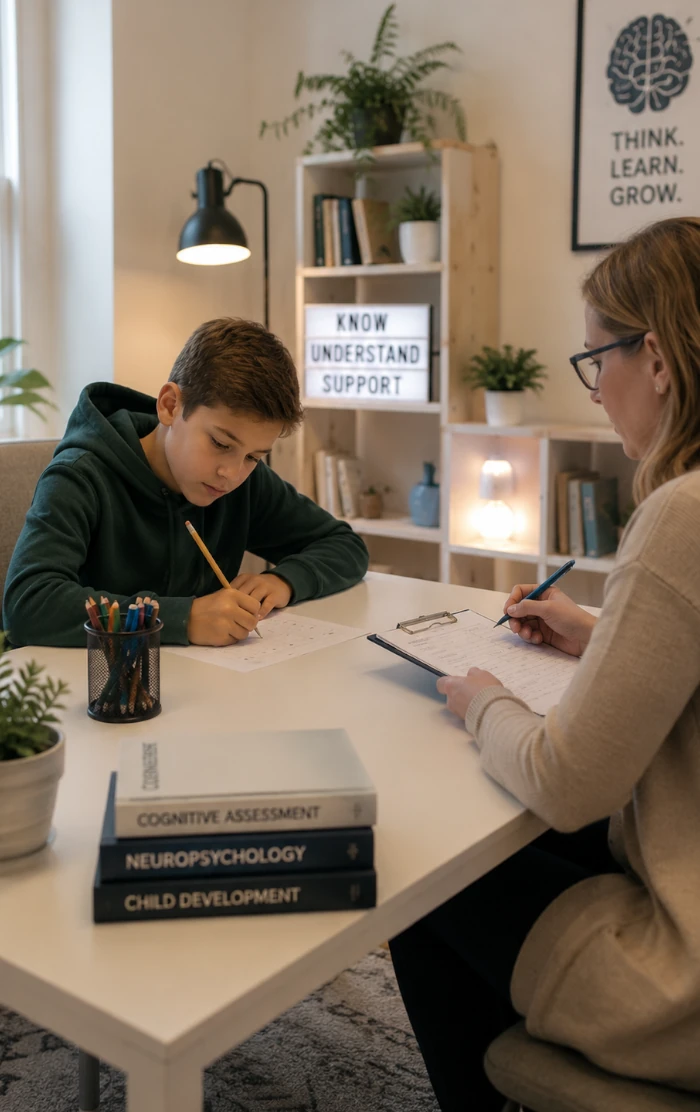
Professional child IQ testing in Santa Clarita – whether you need an assessment for school placement, gifted program eligibility, or to understand your child's learning profile, we connect you with licensed psychologists in the Santa Clarita area.
Last Updated: September 2026
Gifted Testing
Identify giftedness for school placement, enrichment, and talent programs using WISC-V or Stanford-Binet 5.
WISC-V Test
Wechsler Intelligence Scale for Children® Fifth Edition – the gold standard for child IQ testing.
Stanford-Binet 5
Stanford-Binet Intelligence Scales Fifth Edition – comprehensive cognitive assessment for all ages.
Full Evaluation
Combined assessment with detailed report and recommendations. Includes WISC-V or Stanford-Binet 5.
School Placement Testing
Testing for private school admission and gifted program eligibility using WISC-V or Stanford-Binet 5.
Schedule Child IQ Testing
Book your WISC-V & Stanford-Binet 5 for ages 6–16. Gifted identification, learning profiles, etc. with a licensed psychologist in Santa Clarita today.
Child IQ Testing in Santa Clarita: city context
IQ by gender & ethnicity (child population)
Santa Clarita had an estimated 228,430 residents on July 1, 2025. Census 2020–2024 estimates report that 50.6% of residents are female, 24.6% are under age 18, and 13.5% are age 65 or older. The population is 36.3% Hispanic or Latino, 12.3% Asian alone, 4.6% Black alone, 47.2% White alone, and 23.5% reporting two or more races; categories overlap where Hispanic origin is reported separately.
These demographic figures describe the community—not intelligence differences. Professionally interpreted IQ scores must be considered in light of age, language exposure, education, disability, culture, health, and testing conditions. Santa Clarita is linguistically diverse: 36.2% of residents age five and older speak a language other than English at home, and 22.2% are foreign-born. Bilingual assessment, interpreters, nonverbal measures, and careful validity analysis may be appropriate.
- Female residents: 50.6%.
- Children and teens: 24.6% of residents are under 18.
- Older adults: 13.5% are 65 or older.
- Language context: 36.2% speak a language other than English at home.
- Educational context: 91.2% of adults age 25+ finished high school and 39.8% hold a bachelor’s degree or higher.
- Interpretation: No gender, racial, ethnic, or language group should be presumed to have a particular IQ profile; individual testing and appropriate norms are essential.
Santa Clarita School Districts and Gifted Programs
Saugus Union School District GATE Screening and Identification
Saugus Union School District serves many Santa Clarita elementary students. District materials describe GATE identification in grades 3–6, teacher or parent recommendations, universal third-grade screening at many sites, NNAT use, attention to students from varied cultural and economic backgrounds, and differentiated services within the regular school day.
Cluster Grouping, Depth and Complexity, and Enrichment
Identified students may receive cluster-grouped or ability-grouped instruction, advanced and more complex curriculum, depth-and-complexity strategies, enrichment academies and site-specific opportunities. Services and staffing can vary by school and year.
Middle- and High-School Advanced Pathways
The William S. Hart Union High School District serves most local grades 7–12 and offers combinations of honors, Advanced Placement, International Baccalaureate where available, dual enrollment, career academies and specialized courses. These are placement systems, not automatic consequences of a private IQ score.
Other Elementary District and School Options
Newhall, Sulphur Springs Union and Castaic Union elementary districts serve other parts of the Santa Clarita Valley. Referral windows, measures, cut scores, appeals and service models differ, so families should use the district tied to their current address and verify the current written policy.
California Gifted Education Framework
California places GATE programming under local control. Districts determine whether and how to identify and serve gifted students through local priorities and the LCAP process. Private testing can add useful evidence but does not override district criteria.
Santa Clarita Private Schools and Programs Using Testing Information
Santa Clarita-area independent, faith-based and specialized schools may review cognitive, achievement, readiness, attention or learning information when planning instruction, accommodations or admission, but their requirements vary. Examples include Trinity Classical Academy, Santa Clarita Christian School, Legacy Christian Academy and other local programs.
Before arranging testing, request the school’s current written requirements: accepted instruments, examiner license, score age, report format, deadline, observation or interview rules, and whether testing is for admission, placement or support planning.
Santa Clarita Gifted Identification Statistics
Neither the City nor local districts publish a single citywide number representing all gifted children. Enrollment counts depend on district boundaries, grade spans, identification rules, referral access, universal screening, language supports and annual funding.
Population estimates show that 24.6% of Santa Clarita residents are under age 18. This supports substantial demand for school-based screening and private evaluations, but it should not be converted into an assumed gifted count. Families should request current district-level participation data directly.
The child IQ testing process: step by step
Understanding the testing process can help parents prepare their child and reduce anxiety. Here's what to expect:
- Initial consultation (15–20 minutes): A brief phone or video call with the psychologist to discuss your child's background, concerns, and goals. This helps determine the right test and approach.
- Testing session (60–90 minutes): The child meets one-on-one with a licensed psychologist in a quiet, comfortable room. The psychologist administers the WISC-V or Stanford-Binet 5, which includes a series of subtests measuring verbal comprehension, visual-spatial reasoning, fluid reasoning, working memory, and processing speed. Breaks are offered as needed.
- Scoring and interpretation (1–2 days): The psychologist scores the test and analyzes the results. They consider the child's age, background, and any relevant medical or educational history.
- Feedback session (45–60 minutes): The psychologist meets with the parents (and the child, if appropriate) to explain the results. They discuss the Full-Scale IQ, index scores, strengths, and areas for growth. They also provide tailored recommendations for home, school, and extracurriculars.
- Comprehensive written report (5–7 days): You receive a detailed report with all scores, normative comparisons, and actionable next steps. This report can be shared with schools, doctors, or other professionals.
The entire process from consultation to report usually takes 1–2 weeks, depending on scheduling. The testing itself is non-invasive and designed to be engaging for children.
What is the WISC-V test?
The WISC-V (Wechsler Intelligence Scale for Children® – Fifth Edition) is the most widely used IQ test for children aged 6:0–16:11. It provides a Full-Scale IQ and five primary index scores: Verbal Comprehension, Visual-Spatial, Fluid Reasoning, Working Memory, and Processing Speed. The test is administered one-on-one by a trained psychologist and takes about 60–90 minutes.
The WISC-V is normed on a large, representative sample of U.S. children and is updated regularly to ensure accuracy. It is the gold standard for gifted identification, learning disability diagnosis, and school placement.
Why test your child's IQ?
IQ testing provides valuable insights into your child's cognitive strengths and weaknesses. It can help:
- Identify giftedness: For admission to gifted programs, private schools, or enrichment opportunities.
- Diagnose learning disabilities: Such as dyslexia, dyscalculia, or ADHD, which can be masked by high intelligence.
- Guide educational planning: Tailor instruction to your child's unique learning profile.
- Provide reassurance: Understand why your child is different from peers and how to support them.
Santa Clarita Gifted Testing Timeline
- Early elementary: Monitor development, classroom performance and twice-exceptional concerns; avoid overinterpreting one early score.
- Third grade: Saugus Union materials describe universal screening at many sites, commonly using the NNAT, plus referrals in other grades.
- Grades 3–6: Formal Saugus GATE identification and differentiated elementary services.
- Secondary: Review honors, AP, IB, dual-enrollment and academy prerequisites through the Hart district and individual schools.
- Private testing: Schedule early enough for scoring, feedback, report preparation and school deadlines; verify whether outside reports are accepted.
Santa Clarita Gifted Programs by Age Group
- Preschool–grade 2: Developmentally appropriate enrichment, readiness consultation and evaluation when a clear clinical or educational question exists.
- Grades 3–6: District GATE screening, identification, cluster grouping, differentiated instruction and site enrichment.
- Grades 7–8: Honors/accelerated coursework, advanced mathematics, arts, STEM and academy options.
- Grades 9–12: AP, IB where offered, dual enrollment with College of the Canyons, career pathways, arts programs and independent study options.
- Outside school: Library programs, arts instruction, robotics, coding, science, debate, music, athletics, CalArts/COC youth programs and Greater Los Angeles Mensa youth resources when available.
Santa Clarita Child ADHD and Learning Disability Assessment
Children can be bright or gifted and still have ADHD, dyslexia, dysgraphia, dyscalculia, autism, anxiety, language differences or executive-function difficulties. A comprehensive evaluation may include WISC-V or another cognitive measure, achievement testing, attention and behavior scales, language or processing measures, developmental history, records and classroom information.
Santa Clarita families may seek school evaluation through the responsible district or private assessment from licensed psychologists and educational psychologists. Private reports do not replace IDEA/Section 504 procedures, but they can clarify strengths, functional impact and recommendations.
Santa Clarita Summer Programs for Gifted Children
Summer options may include College of the Canyons youth programs, CalArts community and pre-college arts opportunities, public-library programs, city recreation, robotics and coding camps, music and theater, STEM enrichment, academic tutoring, and regional university programs.
Fit matters more than labels. Consider intellectual level, social maturity, sensory needs, transportation, heat exposure, cost and whether the program provides genuine depth rather than repetitive worksheets.
Santa Clarita Child Testing Costs by Provider Type
- School evaluation: No direct family fee when the district evaluates under special-education or district procedures, but scope and eligibility questions are school-defined.
- Brief private IQ/gifted assessment: Often less expensive than a full psychoeducational battery; confirm included report and feedback.
- Psychoeducational evaluation: Higher cost because it may include intelligence, achievement, attention, processing, behavior, records and recommendations.
- Neuropsychological/developmental evaluation: Usually the most extensive; cost and insurance coverage depend on medical necessity and provider contracts.
- Before paying: Ask about deposits, cancellation, records review, school meetings, rush fees, bilingual testing and report turnaround.
Areas we serve
We support all areas of Santa Clarita.
Detailed Santa Clarita Parent Preparation Guide
Parents can improve the usefulness of child testing without coaching test items. The goal is to present an accurate picture of the child’s everyday functioning across home, school and community settings.
- Confirm the district: Use the child’s address to identify Saugus Union, Newhall, Sulphur Springs Union, Castaic Union or another responsible elementary district.
- Request current rules: Ask for the written GATE referral window, instruments, eligibility criteria, appeal procedure and outside-report policy.
- Collect work samples: Include advanced work and examples of difficulty, not only the strongest products.
- Describe development: Note early language, motor milestones, play, interests, sensitivities, friendships and family history.
- Document instruction: Explain schooling changes, tutoring, homeschooling, bilingual education and pandemic or wildfire disruptions.
- Review health: Vision, hearing, sleep, medication, headaches, seizures, allergies and chronic illness can affect testing.
- Choose timing: Avoid testing immediately after illness, overnight travel, major emotional events or an exhausting school day.
- Prepare neutrally: Tell the child they will solve different kinds of problems with an examiner; do not promise a gifted label.
- Bring comfort items: Water, approved snacks, glasses, hearing devices and medication should follow the examiner’s instructions.
- Ask about breaks: Long batteries may be split to reduce fatigue, especially for younger children or children with attention needs.
- Consider bilingual needs: Language history and educational opportunity must be integrated with scores; translation alone is not always sufficient.
- Look for discrepancies: High reasoning with weaker processing speed, working memory, achievement or attention may require more than gifted screening.
- Separate systems: GATE, special education, Section 504, private-school placement and Mensa use different criteria.
- Plan feedback: Ask how results will be explained to the child in developmentally appropriate language.
- Share selectively: Provide only the report sections needed by a school or organization when privacy is a concern.
- Reassess thoughtfully: Repeat testing should answer a new question and respect practice-effect and score-validity considerations.
Frequently Asked Questions
Both are excellent tests. WISC-V is more commonly used for school-age children, while Stanford-Binet 5 can be used for ages 2–85. We often recommend WISC-V for gifted identification.
The test itself takes 60–90 minutes. With the consultation, feedback, and report, the entire process is about 1–2 weeks.
No, you can book directly with our psychologists. We serve both self-referred and professionally referred children.
Professional results may be considered by public districts, private schools, and enrichment programs, but each organization sets its own accepted tests, score age, report requirements, and eligibility rules.
Some plans cover cognitive assessments when there is a clinical indication. Check with your provider.
Get a good night's sleep, eat a healthy meal, and arrive relaxed. No specific preparation is needed.
You'll receive a comprehensive report with your child's scores and tailored recommendations.
Interviews and feedback may be available remotely, but many standardized cognitive tests require controlled administration and may need an in-person appointment. Contact us for details.