
Full Evaluation in Durham Region

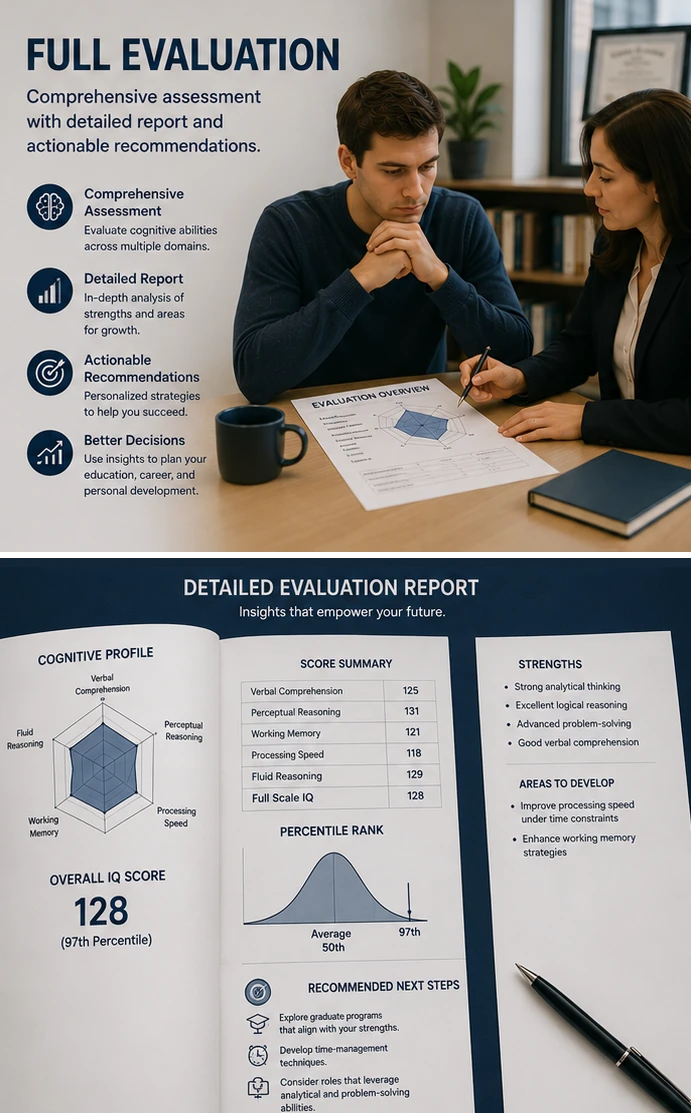
A full evaluation is a comprehensive psychological and psychoeducational assessment that goes beyond a single IQ test. It provides a detailed picture of your cognitive, academic, emotional, and behavioral functioning, with actionable recommendations for academic planning, career development, or clinical intervention.
Last Updated: September 2026
Child IQ Testing
WISC-V & Stanford-Binet 5 for ages 6–16. Gifted identification, learning profiles.
Adult IQ Testing
WAIS-IV & WAIS-5 available. Comprehensive adult cognitive assessments for clinical and occupational purposes.
WAIS-IV & WAIS-5 Tests
Wechsler Adult Intelligence Scale® – Fourth Edition (WAIS-IV) and Fifth Edition (WAIS-5) – the gold standard for adult IQ testing.
Gifted Testing
Identify giftedness for school placement, enrichment, and talent programs using WISC-V or Stanford-Binet 5.
Mensa Testing
Official Mensa admission testing and preparation for the high-IQ society. Accepts WAIS-IV, WAIS-5, and Stanford-Binet 5 scores.
Schedule Full Evaluation
Book your comprehensive assessment with detailed report and recommendations for academic planning. Includes WISC-V, WAIS-IV, WAIS-5, or Stanford-Binet 5 as appropriate, with a registered psychologist in Durham Region today.
What is a Full Evaluation?
A full evaluation is a comprehensive psychological and psychoeducational assessment that provides a complete picture of your cognitive, academic, emotional, and behavioral functioning. Unlike a single IQ test, which focuses only on cognitive abilities, a full evaluation includes multiple tests and assessments to provide a holistic understanding of your strengths and challenges.
Full evaluations are typically conducted by registered psychologists and can take anywhere from 2 to 6 hours of testing time, often spread across multiple sessions.
What a Full Evaluation Includes
- Cognitive Assessment (IQ testing): WISC-V (children), WAIS-IV or WAIS-5 (adults), or Stanford-Binet 5 to measure intellectual abilities
- Academic Achievement Testing: Measures reading, writing, math, and other academic skills
- Behavioral and Emotional Assessment: Questionnaires and interviews to assess emotional well-being, social functioning, and behavioral patterns
- Executive Functioning Assessment: Measures attention, planning, organization, and self-regulation
- Clinical Interview: Detailed interview to understand personal history, concerns, and goals
- Comprehensive Report: Detailed findings with scores, interpretations, and actionable recommendations
Full Evaluation vs. Single IQ Test
| Feature | Full Evaluation | Single IQ Test |
|---|---|---|
| What's Measured | Cognitive, academic, emotional, behavioral | Cognitive abilities only |
| Testing Time | 2-6 hours (often multiple sessions) | 45-90 minutes |
| Tests Included | IQ test + achievement tests + emotional/behavioral assessments | Single IQ test (e.g., WISC-V, WAIS-IV, WAIS-5, SB-5) |
| Report | Comprehensive, multi-page report with detailed recommendations | Shorter report with IQ scores and basic interpretation |
| Best For | Complex cases, learning disabilities, ADHD, emotional concerns, legal documentation | Gifted identification, school placement, Mensa |
| Cost Range | C$2,500-C$5,000 | C$800-C$2,000 |
When Is a Full Evaluation Recommended?
A full evaluation is recommended in several situations:
- Learning disabilities: Suspected dyslexia, dyscalculia, dysgraphia, or other learning disorders
- ADHD: Attention deficit hyperactivity disorder diagnosis and treatment planning
- Giftedness with learning challenges (2E): Twice-exceptional children who are both gifted and have learning disabilities
- Autism assessment: Comprehensive evaluation for autism spectrum disorder
- Educational planning: For Individual Education Plans (IEPs), Identification, Placement and Review Committee (IPRC) decisions, or post-secondary accessibility documentation
- Legal documentation: For court cases, disability claims, or special education advocacy
- Mental health concerns: Anxiety, depression, or other emotional challenges affecting academic or occupational functioning
- College accommodations: Documentation for post-secondary accessibility services, professional examinations, or other settings that require current functional evidence
Durham Region Hospitals and Medical Centers Offering Evaluations
Ontario Shores Centre for Mental Health Sciences
- Location: Whitby-based specialized mental-health hospital serving Durham and broader Ontario referral networks.
- Services: Adult, adolescent, geriatric, neuropsychiatry, forensic, and outpatient programs may include psychological or neuropsychological assessment when clinically indicated.
- Referral: Access depends on program criteria and usually requires an appropriate health-care referral.
- Scope: Hospital assessment is directed by clinical need and is not a routine private gifted or Mensa service.
Lakeridge Health
- Network: Hospital sites and services span Ajax-Pickering, Bowmanville, Oshawa, Port Perry, and Whitby.
- Clinical access: Cognitive, mental-health, rehabilitation, geriatric, and neurologic questions may be addressed within specific programs or through referral onward.
- Medical necessity: The assessment battery is determined by the clinical question rather than by a request for an IQ score alone.
- Wait times: Publicly funded specialty services can have significant eligibility requirements and wait lists.
Grandview Kids and Pediatric Resources
- Grandview Kids: Provides pediatric rehabilitation and developmental services for eligible children and youth across Durham.
- Team approach: Psychology, occupational therapy, speech-language pathology, social work, medicine, and education may contribute depending on the program.
- School coordination: DDSB and DCDSB teams may provide educational assessment or use relevant community reports.
- Toronto referrals: Complex pediatric cases may be referred to SickKids, Holland Bloorview, CAMH, or other specialized centres.
Ontario Tech and Academic Resources
- Research: Ontario Tech studies health, neuroscience-related topics, education, technology, human factors, cybersecurity, and social science.
- Training distinction: Research participation may not provide a diagnosis, treatment plan, or school-ready report.
- Student accessibility: Ontario Tech, Durham College, and Trent Durham have documentation standards for accommodations.
- Greater Toronto access: Toronto academic hospitals and universities broaden specialty options.
Veterans, WSIB, and Public-Sector Resources
- Veterans Affairs Canada: Eligible veterans may access assessment through approved referral and authorization pathways.
- WSIB and insurers: Workplace injury or disability evaluations require defined questions, authorization, and reporting standards.
- School boards: Educational assessments are prioritized according to student need and board process.
- Legal aid and courts: Public funding is limited and depends on the case and authorization.
Private Practice Psychologists
- Services: IQ, ADHD, autism, learning-disability, gifted, disability, capacity, forensic, and psychoeducational evaluations.
- Registration: Verify the psychologist through the College of Psychologists and Behaviour Analysts of Ontario and confirm authorized areas of practice and client populations.
- Fit: Ask whether the clinician has experience with the specific age, language, medical condition, legal purpose, or institution.
- Report use: Obtain written confirmation that the receiving school, employer, insurer, regulator, or court will accept the proposed assessment.
Durham Region Evaluation Costs by Provider
- Focused private IQ assessment: Often costs from the high hundreds into the low thousands of Canadian dollars.
- Psychoeducational assessment: Commonly several thousand dollars because cognitive, academic, behavioural, records, feedback, and reporting are included.
- Neuropsychological or forensic evaluation: May cost more due to extensive testing, medical or legal records, validity measures, collateral interviews, and testimony.
- School-board assessment: No direct family fee when provided, but access is based on educational need and prioritization.
- Hospital service: May be publicly funded for eligible referrals, with scope controlled by the program.
- Benefits: Private plans may reimburse a limited amount per year for psychological services.
Durham Region Legal and Forensic Evaluations
- Family and civil matters: Capacity, disability, personal injury, guardianship, and parenting questions require specialized forensic competence.
- Criminal matters: Fitness, criminal responsibility, risk, and sentencing assessments are distinct from routine IQ testing.
- Workplace and insurance: WSIB, automobile insurance, long-term disability, and accommodation cases require specific referral questions and documentation.
- Expert role: A treating clinician and an independent evaluator have different obligations.
- Consent and records: Reports may be disclosed to retaining parties and may not remain confidential in the same way as treatment records.
- Provider selection: Confirm court experience, authorized practice areas, fees, retainers, testimony rates, and timelines.
Durham Region Evaluation Timeline and Process
- Referral clarification: Define the decision the report must support and obtain institutional requirements.
- Intake: Complete interviews, consent, benefit or authorization checks, and release forms.
- Records: Gather school, medical, developmental, employment, and previous assessment documents.
- Testing: One or more sessions may be required, with breaks and accessibility accommodations.
- Scoring and integration: The psychologist combines test results with history, observations, records, and collateral information.
- Feedback and report: Timelines range from one to several weeks after the final session and can be longer for complex or forensic cases.
Durham Region Insurance Coverage for Evaluations
- OHIP: Does not generally pay for routine private psychological assessment.
- Hospital programs: Public funding may apply when a patient meets program and referral criteria.
- Extended health: Employer or individual plans may reimburse a portion of registered-psychologist fees up to annual limits.
- WSIB and automobile insurers: Prior authorization and approved providers may be required.
- School services: Board assessments have no direct family fee but are not available simply on request.
- Documentation: Ask whether psychometrist time, report writing, feedback, forms, and taxes are eligible expenses.
Durham Region Evaluation Referrals
- Self-referral: Many private psychologists accept direct inquiries.
- School referral: Teachers, special-education staff, and principals coordinate board-based assessment pathways.
- Medical referral: Family physicians, pediatricians, neurologists, psychiatrists, and rehabilitation specialists refer to hospital or neuropsychology services.
- Institutional referral: Accessibility offices, employers, insurers, lawyers, and regulators may define required questions and forms.
- Referral quality: A precise question helps the examiner choose the correct measures and avoid unnecessary cost.
- Urgency: Crisis, safety, acute medical, or rapidly changing cognitive concerns require appropriate health services rather than routine private testing.
Benefits of a Full Evaluation
- Complete picture: Understand the full picture of your or your child's functioning – cognitive, academic, emotional, and behavioral
- Accurate diagnosis: Receive precise diagnoses for learning disabilities, ADHD, autism, or other conditions
- Legal documentation: Obtain documentation for IEPs, IPRC decisions, post-secondary accommodations, disability claims, or court matters
- Personalized recommendations: Receive tailored recommendations for academic planning, career development, therapy, or treatment
- Peace of mind: Understand your or your child's strengths and challenges and how to address them effectively
- Long-term planning: Use the findings for educational, career, and personal planning
Full Evaluations in Durham Region
Durham residents may choose school-board, hospital, agency, or private assessment depending on the question, eligibility, urgency, cost, and required report. A focused IQ test is appropriate when the referral is narrow; a full evaluation is more useful when learning, attention, autism, emotional, medical, disability, or legal issues must be differentiated.
Before booking, provide the examiner with the receiving organization's written requirements and confirm the test version, Canadian norms, clinician registration, report deadline, and whether consultation or form completion is included.
Frequently Asked Questions
A full evaluation typically includes cognitive testing (IQ), academic achievement testing, behavioral and emotional assessments, a clinical interview, and a comprehensive written report with recommendations.
Testing typically takes 2-6 hours, often spread across 2-3 sessions. The entire process from consultation to receiving the report usually takes 2-4 weeks.
The report includes background information, test scores, normative comparisons, interpretation of findings, diagnostic impressions (if applicable), and actionable recommendations for academic planning, treatment, or accommodations.
No. A full evaluation is much more comprehensive and includes cognitive testing, academic testing, emotional/behavioral assessments, and a clinical interview. An IQ test only measures cognitive abilities.
Some extended-health plans cover full evaluations when they are deemed medically necessary. Coverage varies by plan and provider. We recommend checking with your benefits provider.
Yes. A full evaluation can provide evidence for post-secondary accessibility services, but each institution independently determines whether documentation is current, sufficiently comprehensive, and connected to functional limitations.
Some components of a full evaluation can be done via telehealth, but many tests (especially cognitive and achievement tests) require in-person administration for accurate scoring. Contact us for details.
Get a good night's sleep, eat a healthy meal, and arrive relaxed. Bring any relevant documents (previous evaluations, school records, medical history). No specific preparation is needed for the tests themselves.
Comprehensive private evaluations commonly cost several thousand Canadian dollars, depending on scope, records, testing time, and report requirements. Extended-health reimbursement varies by plan.
A full evaluation can provide useful evidence for an IEP or IPRC review, but the school board independently determines identification, placement, services, and accommodations under Ontario requirements and board procedures.