
Child IQ Testing in Durham Region

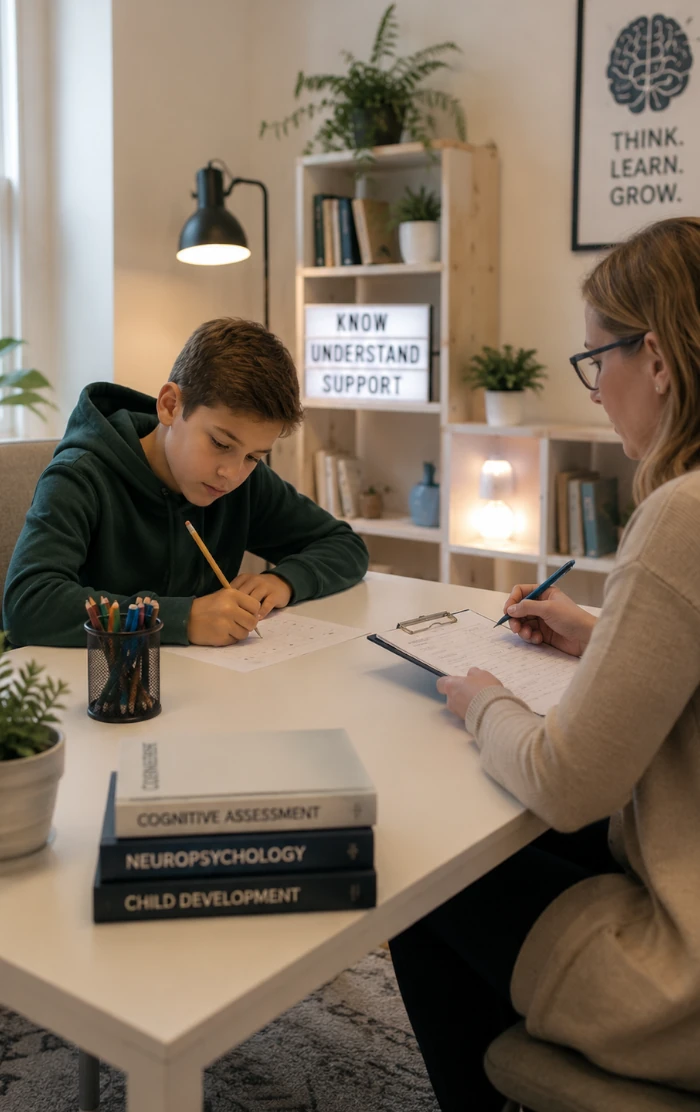
Professional child IQ testing in Durham Region – whether you need an assessment for school placement, gifted program eligibility, or to understand your child's learning profile, we connect you with registered psychologists in the Durham Region area.
Last Updated: September 2026
Gifted Testing
Identify giftedness for school placement, enrichment, and talent programs using WISC-V or Stanford-Binet 5.
WISC-V Test
Wechsler Intelligence Scale for Children® Fifth Edition – the gold standard for child IQ testing.
Stanford-Binet 5
Stanford-Binet Intelligence Scales Fifth Edition – comprehensive cognitive assessment for all ages.
Full Evaluation
Combined assessment with detailed report and recommendations. Includes WISC-V or Stanford-Binet 5.
School Placement Testing
Testing for private school admission and gifted program eligibility using WISC-V or Stanford-Binet 5.
Schedule Child IQ Testing
Book your WISC-V & Stanford-Binet 5 for ages 6–16. Gifted identification, learning profiles, etc. with a registered psychologist in Durham Region today.
Child IQ Testing in Durham Region: city context
Children in Durham Region attend DDSB, DCDSB, French-language public and Catholic boards, independent schools, home schools, and specialized programs. Families seek testing for gifted identification, school planning, acceleration, learning disabilities, ADHD, autism, twice-exceptional profiles, and clarification of uneven achievement.
IQ by gender & ethnicity (child population)
Approximately 18% of Durham residents were under age 15 in 2021, and 51.2% of the total population identified as female. There is no valid regional average IQ for boys, girls, municipalities, or ethnocultural groups. Relevant context includes:
- Visible-minority population: 36.3%.
- Immigrant population: 27.9%.
- South Asian population: 13.4%.
- Black population: 9.6%.
- French-language rights: Some families attend French-language boards; assessment language and school eligibility must be considered separately.
- Assessment fairness: Examiners consider language exposure, educational opportunity, disability, culture, medical history, attention, anxiety, and test familiarity.
- Individual interpretation: The child's complete profile and real-world functioning matter more than demographic group averages.
Durham Region School Boards and Gifted Programs
Durham District School Board Gifted Placement
- Grades served: DDSB provides gifted placement options for formally identified students in Grades 4 through 12.
- Formal identification: An Identification, Placement and Review Committee must identify the student as gifted for a gifted placement.
- Placement choices: Students may remain at their home school with accommodations or enter a self-contained gifted class, depending on current board procedures and capacity.
- Assessment evidence: School screening, classroom evidence, psychological assessment, strengths, needs, and parent input may contribute to decision-making.
- Annual review: IPRC placement is reviewed, and an Individual Education Plan outlines strengths, needs, expectations, and services.
Durham Catholic and French-Language Boards
- DCDSB: Provides special-education identification, programming, and IEP support under Ontario legislation and board policy.
- French-language education: Conseil scolaire Viamonde and Conseil scolaire catholique MonAvenir serve eligible families at designated schools.
- Different procedures: Screening, identification, placement, transportation, and accepted private evidence vary by board.
- Contact first: Families should begin with the classroom teacher, special-education resource teacher, and principal.
Private and Independent School Programs
- Independent requirements: Private schools establish their own admissions, acceleration, enrichment, and testing policies.
- Accepted evidence: WISC-V-CDN, Stanford-Binet, achievement tests, school records, interviews, and teacher recommendations may be requested.
- Report timing: Confirm the accepted instrument, score age, report components, and examiner credentials before testing.
- Admission distinction: A high IQ score does not guarantee admission, scholarship, acceleration, or program fit.
Nearby and Cross-Boundary Options
- Neighbouring boards: Toronto, York, Kawartha Pine Ridge, Peterborough Victoria Northumberland and Clarington Catholic, and other boards have separate boundaries and procedures.
- Catchment: A Durham mailing address does not automatically create eligibility for another board or a Toronto specialty program.
- Transportation: Cross-boundary private programs can involve substantial Highway 401 or GO Transit travel.
- Documentation: A report accepted by one organization may not meet another organization's test, percentile, date, or diagnostic rules.
Ontario Special Education Framework
- Education Act: Ontario school boards deliver special education under provincial legislation and regulations.
- IPRC: The committee decides whether a student is exceptional and identifies placement.
- IEP: Identified students receive an Individual Education Plan, and boards may also develop IEPs for other students who need accommodations.
- Multiple sources: Decisions should consider assessment, classroom performance, achievement, needs, interests, and family input.
- Appeal and review: Families have procedural rights and should use current board guides rather than relying on informal thresholds.
Durham Region Private Schools and Programs Using Testing Information
- Independent schools: Some Durham-area schools request cognitive, achievement, admissions, or psychoeducational testing; requirements change by school and year.
- Specialized programs: Schools serving dyslexia, ADHD, autism, learning disabilities, or twice-exceptional students may request comprehensive reports.
- Public-school distinction: Ontario public and Catholic admission is generally based on residence and eligibility rather than IQ selection.
- Acceleration: Schools may review achievement, ability, maturity, executive functioning, social-emotional readiness, and classroom capacity.
- Home-school planning: Families may use testing to choose curriculum level, identify support needs, or plan re-entry.
- Verification: Obtain written test, score-age, examiner, report, and deadline requirements before booking.
Durham Region Gifted Identification Statistics
- No single regional rate: Durham Region does not publish one authoritative gifted-identification percentage across all school boards and private schools.
- DDSB identification: Formal gifted placement requires an IPRC decision; screening and referral data are not the same as prevalence.
- Identification is not ability prevalence: Program counts reflect criteria, referrals, access, parent decisions, space, and service models.
- Traditional benchmark: Scores near or above the 98th percentile are often associated with intellectual giftedness, but school decisions use board procedures and multiple evidence sources.
- Equity: Language, disability, socioeconomic opportunity, cultural expectations, and referral patterns can affect identification.
- Private testing: Community results may add evidence but do not automatically override the school board process.
The child IQ testing process: step by step
Understanding the testing process can help parents prepare their child and reduce anxiety. Here's what to expect:
- Initial consultation (15–20 minutes): A brief phone or video call with the psychologist to discuss your child's background, concerns, and goals. This helps determine the right test and approach.
- Testing session (60–90 minutes): The child meets one-on-one with a registered psychologist in a quiet, comfortable room. The psychologist administers the WISC-V or Stanford-Binet 5, which includes a series of subtests measuring verbal comprehension, visual-spatial reasoning, fluid reasoning, working memory, and processing speed. Breaks are offered as needed.
- Scoring and interpretation (1–2 days): The psychologist scores the test and analyzes the results. They consider the child's age, background, and any relevant medical or educational history.
- Feedback session (45–60 minutes): The psychologist meets with the parents (and the child, if appropriate) to explain the results. They discuss the Full-Scale IQ, index scores, strengths, and areas for growth. They also provide tailored recommendations for home, school, and extracurriculars.
- Comprehensive written report (5–7 days): You receive a detailed report with all scores, normative comparisons, and actionable next steps. This report can be shared with schools, doctors, or other professionals.
The entire process from consultation to report usually takes 1–2 weeks, depending on scheduling. The testing itself is non-invasive and designed to be engaging for children.
What is the WISC-V test?
The WISC-V (Wechsler Intelligence Scale for Children® – Fifth Edition) is the most widely used IQ test for children aged 6:0–16:11. It provides a Full-Scale IQ and five primary index scores: Verbal Comprehension, Visual-Spatial, Fluid Reasoning, Working Memory, and Processing Speed. The test is administered one-on-one by a trained psychologist and takes about 60–90 minutes.
The WISC-V is normed on a large, representative sample of U.S. children and is updated regularly to ensure accuracy. It is the gold standard for gifted identification, learning disability diagnosis, and school placement.
Why test your child's IQ?
IQ testing provides valuable insights into your child's cognitive strengths and weaknesses. It can help:
- Identify giftedness: For admission to gifted programs, private schools, or enrichment opportunities.
- Diagnose learning disabilities: Such as dyslexia, dyscalculia, or ADHD, which can be masked by high intelligence.
- Guide educational planning: Tailor instruction to your child's unique learning profile.
- Provide reassurance: Understand why your child is different from peers and how to support them.
Durham Region Gifted Testing Timeline
- Start with the school: Ask the teacher and special-education resource teacher about classroom evidence, board screening, and current timelines.
- Clarify the purpose: Decide whether the need is DDSB identification, private-school admission, acceleration, Mensa Canada prior evidence, or a broader diagnostic question.
- Obtain requirements: Confirm accepted instruments, Canadian norms, report age, and deadlines before private testing.
- Assessment: A focused WISC-V-CDN appointment may take 60–90 minutes; broader evaluations require additional sessions.
- Report and meeting: Private reports often take one to several weeks; school IPRC and placement timelines follow board procedure.
- Review: Reassessment is not automatically needed each year, but evolving learning or diagnostic questions may justify updated testing.
Durham Region Gifted Programs by Age Group
- Preschool and primary: Focus on development, language, play, social-emotional needs, and appropriate classroom differentiation rather than early labelling alone.
- Grades 4–8: DDSB self-contained gifted placements begin in Grade 4 for formally identified students, subject to current location and capacity.
- Secondary school: Gifted placement, enriched courses, AP, IB at selected schools, SHSM, dual credits, and post-secondary partnerships may support advanced learners.
- Private and home education: Acceleration and curriculum options vary and should be matched to the child's full profile.
- Summer and enrichment: Ontario Tech, Durham College, libraries, conservation authorities, arts organizations, and community programs offer changing opportunities.
Durham Region Child ADHD and Learning Disability Assessment
- Comprehensive scope: Learning-disability evaluation usually combines cognitive and achievement testing with history, records, and behavioural information.
- ADHD: Diagnosis requires evidence of symptoms and impairment across settings; IQ testing alone is insufficient.
- Twice exceptionality: High reasoning ability can mask reading, writing, math, attention, autism, or executive-function needs.
- School reports: DDSB and DCDSB may use board assessments or relevant community reports in program planning.
- Ontario documentation: Reports should state functional needs and recommendations relevant to an IEP, IPRC, post-secondary accessibility office, or testing organization.
- Medical coordination: Pediatricians, family physicians, speech-language pathologists, occupational therapists, and mental-health clinicians may contribute.
Durham Region Summer Programs for Gifted Children
- Ontario Tech camps: STEM, coding, engineering, science, and technology programs vary annually.
- Durham College camps: Applied technology, skilled trades, media, culinary, health, and career exploration may be offered.
- Libraries: Municipal library systems provide reading, maker, coding, research, arts, and youth leadership programs.
- Conservation and nature: CLOCA, Lake Simcoe Region Conservation Authority, parks, waterfronts, and farms support ecology and outdoor learning.
- Arts and museums: Robert McLaughlin Gallery, Station Gallery, community theatres, music schools, and local museums offer creative enrichment.
- Selection: Match intensity and schedule to the child's interests, disability needs, sleep, friendships, and need for unstructured time.
Durham Region Child Testing Costs by Provider Type
- School-board assessment: No direct family fee when provided by the board, but access depends on educational need, prioritization, and wait time.
- Focused private IQ test: Commonly costs from the high hundreds into the low thousands of Canadian dollars.
- Psychoeducational evaluation: Often several thousand dollars because it includes cognitive, achievement, behavioural, record-review, feedback, and report components.
- Hospital or agency service: May be publicly funded for eligible referrals, but scope and wait lists differ from private assessment.
- Benefits: Extended-health plans may reimburse part of a registered psychologist's fee up to annual limits.
- Quote: Ask whether travel, school consultation, forms, rush service, and report revisions cost extra.
Areas we serve
We support all areas of Durham Region.
Frequently Asked Questions
Both are excellent tests. WISC-V is more commonly used for school-age children, while Stanford-Binet 5 can be used for ages 2–85. We often recommend WISC-V for gifted identification.
The test itself takes 60–90 minutes. With the consultation, feedback, and report, the entire process is about 1–2 weeks.
No, you can book directly with our psychologists. We serve both self-referred and professionally referred children.
Professional results may be considered by public districts, private schools, and enrichment programs, but each organization sets its own accepted tests, score age, report requirements, and eligibility rules.
OHIP does not ordinarily fund routine private assessment. Extended-health benefits may reimburse part of the fee; check your plan and any referral requirements.
Get a good night's sleep, eat a healthy meal, and arrive relaxed. No specific preparation is needed.
You'll receive a comprehensive report with your child's scores and tailored recommendations.
Interviews and feedback may be available remotely, but many standardized cognitive tests require controlled administration and may need an in-person appointment. Contact us for details.