
School Placement Testing in Columbia

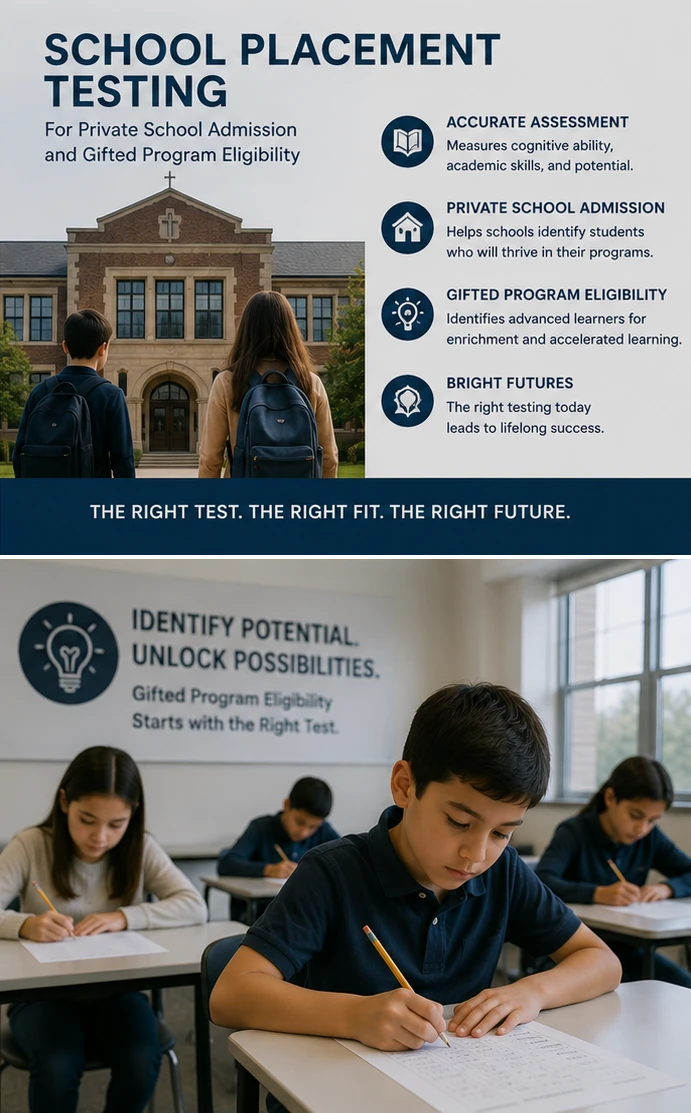
School placement testing is a critical step for families navigating private school admissions and gifted program eligibility in Columbia. This comprehensive guide covers the types of tests used, which Columbia schools require testing, the process, and how to prepare your child for success.
Last Updated: September 2026
Child IQ Testing
WISC-V & Stanford-Binet 5 for ages 6–16. Gifted identification, school placement.
Gifted Testing
Identify giftedness for school placement, enrichment, and talent programs using WISC-V or Stanford-Binet 5.
WISC-V Test
Wechsler Intelligence Scale for Children® Fifth Edition – gold standard for child IQ and school placement.
Stanford-Binet 5
Stanford-Binet Intelligence Scales Fifth Edition – comprehensive cognitive assessment, often used for private school admission.
Full Evaluation
Combined cognitive, academic, and behavioral assessment for complex cases. Includes WISC-V or Stanford-Binet 5.
Schedule School Placement Testing
Book your school placement testing with a licensed psychologist in Columbia today.
What is School Placement Testing?
School placement testing is a specialized cognitive assessment used to determine whether a child is a good fit for a particular educational environment. In Columbia, this typically includes:
- Private school admission testing: Many independent schools require IQ or cognitive testing as part of the application process
- Gifted program eligibility: Columbia Public Schools and other districts require IQ testing for admission to gifted programs
- Educational placement decisions: Testing helps determine the right academic setting for a child's needs
- Early entrance to kindergarten or grade skipping: Some schools require testing to evaluate readiness
Columbia schools and placement testing
Private schools
Hammond School, Heathwood Hall Episcopal School, Cardinal Newman School, Ben Lippen School, and other Columbia-area independent schools publish their own grade-specific admissions processes. Requirements may include records, recommendations, interviews, observations, readiness or achievement measures. Do not assume an IQ test is required; obtain the current written checklist and accepted-report rules.
Ask whether testing is used for admission, initial grade placement, advanced coursework, accommodations, or learning-support planning. Confirm the test edition, score age, administrator qualification, report deadline, and whether the school wants raw scores, narrative interpretation, or a school-specific form. Admissions decisions can involve many factors, and no ethical evaluator should guarantee an outcome.
Public-school gifted and advanced programs
Richland One uses a multi-dimensional gifted-identification process involving reasoning, achievement, and academic performance criteria. Magnet, arts, AP, IB, dual-enrollment, and career programs use separate prerequisites. A private report does not automatically determine eligibility or placement.
Reasoning criteria generally begin at the 93rd national age percentile, achievement criteria at the 94th national percentile or state-set qualifying standard, and academic-performance criteria use approved tasks or GPA rules for applicable grades. The district also states an automatic-eligibility route at the 96th national age percentile composite on a nationally normed aptitude or intelligence test. Current district documents control.
Scores used for one dimension may have a stated validity period, and grade-level performance tasks occur on district timelines. Newly enrolled or transferring students should provide official records early and ask how out-of-district evidence is reviewed. A Columbia mailing address alone does not prove Richland One assignment.
Tests used for school placement in Columbia
Depending on the decision, schools may review nationally normed aptitude measures, achievement tests, state assessments, readiness measures, curriculum-based data, auditions, portfolios, grades, teacher input, or individually administered cognitive tests such as the WISC-V. The correct instrument is the one the receiving school currently accepts for that grade and purpose. Test security and publisher age rules must be followed.
- Aptitude: Group or individual measures may contribute to gifted reasoning criteria.
- Achievement: Reading, writing, and mathematics results show learned skills and are essential for many learning questions.
- Readiness and placement: Grade-specific school measures may guide entry or course level without being IQ tests.
- Arts and specialized programs: Auditions, portfolios, interviews, and prerequisites may be more relevant than cognitive scores.
- Disability evaluation: A comprehensive battery must address the suspected area and functional educational impact.
Repeated exposure to secure tests can invalidate results or restrict retesting. Families should disclose all prior administrations, dates, and forms. Coaching a child on protected test items undermines validity and may leave the school with evidence it cannot use. Preparation should focus on sleep, meals, reassurance, and ordinary familiarity with the testing setting.
The School Placement Testing Process
Step 1: Initial Consultation
A brief phone or video call with a licensed psychologist to discuss your child's needs, the schools you're targeting, and the most appropriate tests. This helps determine the right approach for your child.
Step 2: Testing Session
The child meets one-on-one with a licensed psychologist in a quiet, comfortable room. The psychologist administers the selected test, which includes subtests measuring various cognitive abilities. Breaks are offered as needed. The testing session typically takes 60-90 minutes.
Step 3: Scoring and Interpretation
The psychologist scores the test and analyzes the results, considering the child's age, background, and any relevant medical or educational history.
Step 4: Feedback Session
The psychologist meets with the parents to explain the results, discuss the child's cognitive profile, and provide recommendations for school placement.
Step 5: Comprehensive Written Report
You receive a detailed report with all scores, normative comparisons, and recommendations. This report can be submitted to schools as part of the admission or placement process.
How to Prepare Your Child
Proper preparation can help your child perform at their best during testing. Here are some tips:
- Get a good night's sleep: Ensure your child is well-rested before the test
- Eat a healthy meal: A nutritious breakfast helps maintain focus
- Arrive relaxed: Leave plenty of time to get to the testing location
- Explain the test positively: Let your child know they'll be doing activities that show their strengths
- Avoid pressure: Don't emphasize the importance of the test, which can create anxiety
- No specific preparation needed: IQ tests measure innate abilities, so studying is not necessary
Cost of school placement testing in Columbia
District screening connected with public-program procedures may not require a private fee. Independent evaluations vary by battery, records, report, and consultation time and are often self-pay. Ask whether the school accepts an outside report, what scores and dates it requires, and whether the quoted fee includes feedback, written documentation, and school communication.
Private-school application fees, school-administered testing, independent psychological evaluation, tutoring, and enrollment deposits are separate expenses. Insurance commonly excludes testing performed solely for admission or gifted placement. A family should not purchase a large battery until the school confirms what it will use.
Get refund and cancellation terms in writing, especially when admission deadlines are close. If a report will be sent directly to a school, understand the release form and whether parents receive a copy first. Ask how corrections, addenda, or later school consultations are billed.
School placement testing in Columbia: interpreting data
Placement counts reflect applications, eligibility rules, available seats, program design, mobility, and family access; they do not measure the intelligence of a neighborhood or demographic group. Use current Richland One or school-published data and ask how referrals and outcomes are reviewed for equitable access.
Separate the number of applicants from the number screened, tested, found eligible, offered a seat, enrolled, and retained. Compare outcomes across grade, race, ethnicity, language, disability, and economic status only with appropriate denominators and privacy safeguards. A disparity can signal the need to inspect outreach, referral, transportation, testing access, prerequisites, or program capacity rather than an underlying difference in ability.
Frequently Asked Questions
Columbia independent schools use different admissions processes, and many do not require a clinical IQ test. Confirm the current checklist directly with each school; cognitive or psychoeducational reports are more commonly requested for placement, accommodations, learning support, or complex admissions questions.
WISC-V is the most commonly requested test for private school admission and gifted program eligibility. Stanford-Binet 5 is also widely accepted. Check with your target schools for their specific requirements.
Most gifted programs require a Full-Scale IQ score of 130 or above (98th percentile). However, some programs use multiple criteria including teacher recommendations, academic achievement, and portfolio reviews.
The test itself takes 60-90 minutes. With the consultation, feedback, and report, the entire process is about 1-2 weeks.
The report includes Full-Scale IQ, index scores, strengths and weaknesses, normative comparisons, and recommendations for school placement. This report can be submitted to schools as part of the application process.
Some plans cover cognitive assessments when there is a clinical indication. School placement testing is often considered an educational rather than medical service, so coverage varies. Check with your provider.
Some interview and feedback components may be completed remotely, but many schools require in-person standardized testing. Confirm publisher rules, South Carolina licensure, clinical appropriateness, and the receiving school's documentation policy before scheduling.
Get a good night's sleep, eat a healthy meal, and arrive relaxed. No specific preparation is needed. Avoid putting pressure on your child, which can create anxiety.
Typical fees range from $200 to $1,200 for a single IQ test, with full evaluations costing up to $3,000. Some insurance plans cover testing when medically necessary.