
IQ Testing in Columbia

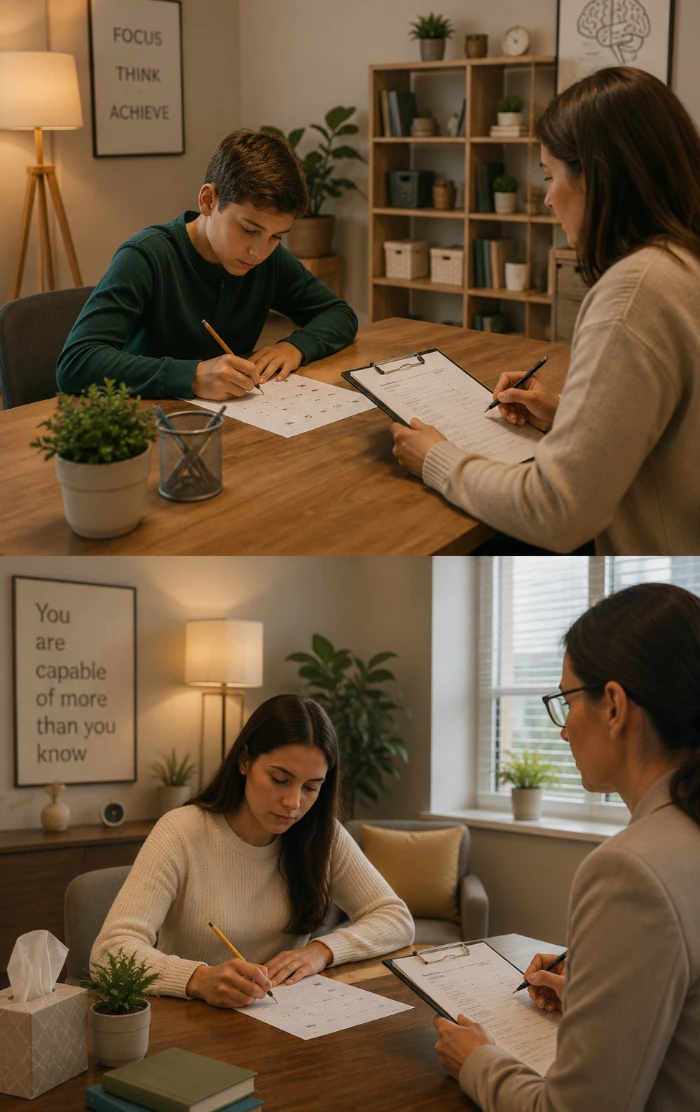
Professional IQ testing in Columbia – whether you need an assessment for school, employment, gifted program eligibility, or personal insight, we connect you with licensed psychologists in the Columbia area.
Last Updated: September 2026
Child IQ Testing
WISC-V & Stanford-Binet for ages 6–16. Gifted identification, learning profiles.
Adult IQ Testing
WAIS-IV & WAIS-5 available. Comprehensive adult cognitive assessments. Clinical & occupational.
WISC-V Test
Wechsler Intelligence Scale for Children® Fifth Edition – the gold standard for child IQ testing.
WAIS-IV & WAIS-5 Tests
Wechsler Adult Intelligence Scale® – Fourth Edition (WAIS-IV) and Fifth Edition (WAIS-5) available for adult IQ testing.
Gifted Testing
Identify giftedness for school placement, enrichment, and talent programs using WISC-V or Stanford-Binet.
Stanford-Binet 5
Stanford-Binet Intelligence Scales Fifth Edition – comprehensive cognitive assessment for all ages.
Mensa Testing
Mensa admission testing and preparation for the high-IQ society. Accepts WAIS-IV, WAIS-5, and Stanford-Binet 5 scores.
Full Evaluation
Combined assessment with detailed report and recommendations. Includes WISC-V, WAIS-IV, WAIS-5, or Stanford-Binet 5 as appropriate.
IQ Testing in Columbia: city context
Columbia is South Carolina's capital and the core of the Midlands. The city combines state government, the University of South Carolina, major hospitals, Fort Jackson, established residential districts, and a growing professional-services economy. Those settings create varied reasons for cognitive assessment: gifted-program decisions, learning and attention questions, disability documentation, career planning, neuropsychological care, and personal understanding.
- Population: 147,035 in the 2025 Census estimate; the 2020 Census counted 136,632 residents.
- Land area: 136.78 square miles, so appointment travel can differ sharply between Downtown, North Columbia, the southeast, and the city's outer edges.
- Age profile: 17.0% of residents are under age 18 and 11.5% are age 65 or older.
- Education: 91.2% of adults age 25 and older have completed high school and 45.9% hold a bachelor's degree or higher.
- Language: 8.7% of residents age five and older speak a language other than English at home; language history remains relevant to valid test selection and interpretation.
Housing and transportation also shape access. Census estimates report a 45.5% owner-occupied housing rate, a median owner-occupied home value of $264,300, and median gross rent of $1,204. A family comparing assessment options should consider the total cost of multiple testing sessions, time away from work or school, parking, transit, and any later feedback or school meeting rather than comparing the advertised test fee alone.
IQ by gender & ethnicity
Census estimates describe Columbia as 50.8% female, 46.9% White alone, 40.6% Black alone, 3.3% Asian alone, 6.7% two or more races, and 6.2% Hispanic or Latino. These are community demographics, not predictions of any individual's intelligence. Properly normed IQ instruments are designed to compare a person with an appropriate age-based reference group, and competent psychologists interpret results alongside education, language exposure, culture, disability, health, opportunity, and testing conditions. Gender or racial stereotypes should never substitute for individualized assessment.
What is professional IQ testing?
Intelligence quotient (IQ) testing is a standardized method to measure human cognitive abilities and intellectual potential. Professional IQ tests are administered by licensed psychologists in a controlled environment to ensure accuracy and reliability. Unlike online quizzes, clinical assessments provide a full-scale IQ score along with detailed breakdowns of verbal comprehension, perceptual reasoning, working memory, and processing speed.
In Columbia, IQ testing is commonly used for gifted program admission, learning disability identification, career guidance, neuropsychological evaluation, and personal development. The results are presented in a comprehensive report that includes normative comparisons, strengths and weaknesses, and actionable recommendations.
Who should get tested?
IQ testing can benefit children, adolescents, and adults in various situations:
- Children: Parents often seek testing for school readiness, gifted placement, or to understand learning challenges.
- Adults: Many adults take IQ tests for career advancement, graduate school applications, or personal curiosity.
- Mensa candidates: High-IQ societies require official test scores for membership.
- Clinical referrals: Psychologists may recommend testing as part of a broader neuropsychological evaluation.
Types of IQ tests
We offer the most recognized and scientifically validated intelligence tests in the field:
- WISC-V (Wechsler Intelligence Scale for Children® – Fifth Edition): The gold standard for children aged 6:0–16:11. It provides a Full-Scale IQ and five primary index scores.
- WAIS-IV (Wechsler Adult Intelligence Scale® – Fourth Edition): The most widely used adult IQ test for ages 16–90. It measures cognitive functioning across four domains.
- Stanford-Binet Intelligence Scales – Fifth Edition: A comprehensive assessment for ages 2–85, often used for gifted identification and clinical evaluations.
- Gifted Testing: Often includes the WISC-V or Stanford-Binet, plus additional creativity and achievement measures.
- Mensa Testing: We provide official Mensa admission testing and preparation materials.
How the testing process works
- Initial consultation: Brief phone or video call to discuss your needs and match you with the right psychologist.
- Testing session: In-person or remote testing (depending on the test) with a licensed psychologist. Most sessions last 1–2 hours.
- Scoring and interpretation: The psychologist scores the test and interprets the results in the context of your background and goals.
- Feedback session: A detailed review of your results, including strengths, weaknesses, and practical recommendations.
- Comprehensive report: You receive a written report with all scores, normative comparisons, and actionable next steps.
How much does IQ testing cost in Columbia?
The cost of IQ testing in Columbia varies depending on the type of test, the psychologist's experience, and whether a comprehensive report is required. Typical fees range from $200 to $1,200 for a full assessment. Gifted testing and Mensa admission testing are often at the lower end, while neuropsychological evaluations may be higher.
Some insurance plans cover IQ testing when it's deemed medically necessary. We recommend checking with your provider for details. We also offer affordable payment plans and sliding-scale options for qualifying individuals.
Columbia's Intellectual History & Legacy
South Carolina's legislature created Columbia as the state capital in 1786 near the Congaree River. It was among the country's earliest intentionally planned cities, laid out on a two-mile grid with unusually broad streets. The settlement grew from a regional trading and ferry area, was chartered as a town in 1805 and as a city in 1854, suffered extensive destruction in 1865, and rebuilt as a government, education, rail, textile, military, and commercial center.
The University of South Carolina traces its Columbia presence to South Carolina College, founded in 1801. Today, the State House, university, research centers, libraries, museums, historic neighborhoods, Fort Jackson, and health systems keep public policy, scholarship, workforce training, and clinical practice closely connected. That history helps explain why cognitive testing in Columbia may intersect with school services, university accommodations, military or public-service careers, rehabilitation, and professional credentialing.
Columbia's broad planned streets and central position helped it become a transportation and administrative hub. Later rail development, textile activity, New Deal-era growth, military expansion, civil-rights history, and modern redevelopment all left distinct educational and economic patterns. A responsible assessment does not reduce those experiences to a score: it asks how schooling, opportunity, language, health, and environment shaped the person being evaluated.
Columbia employment and cognitive-assessment context
Most Columbia employers do not require an IQ score, and employment testing must be job-related and lawful. Cognitive assessment is more commonly requested for career clarification, disability documentation, rehabilitation, or regulated selection processes. Important local employment sectors include:
- Government and public administration: State agencies, the City of Columbia, Richland County, courts, and federal offices employ analysts, administrators, legal professionals, planners, and technical staff.
- Education and research: The University of South Carolina, Richland One, Midlands Technical College, Benedict College, Allen University, and other institutions support teaching, research, information technology, and administration.
- Healthcare: Prisma Health, the Columbia VA Health Care System, medical practices, rehabilitation services, and behavioral-health providers employ clinical and nonclinical professionals.
- Military and defense: Fort Jackson supports training, logistics, civilian employment, family services, and related contractors; occupational standards are separate from clinical IQ testing.
- Insurance, finance, and professional services: Insurers, banks, law firms, accounting practices, consultants, and technology teams value communication, quantitative reasoning, and careful decision-making.
- Manufacturing, logistics, hospitality, and tourism: Regional production, distribution, hotels, restaurants, museums, sports, and events create operations, service, maintenance, and leadership roles.
When career testing is appropriate, a psychologist or qualified career professional should translate scores into cautious hypotheses about learning and problem-solving style. Those hypotheses should be checked against interests, values, credentials, work samples, job demands, and disability-related needs. A high score does not confer a license, security clearance, or professional qualification, and a lower score does not define a person's capacity to succeed with suitable training and supports.
Columbia IQ testing by area
Provider fit matters more than repeating neighborhood names. Downtown and the State House district are near government and professional offices; the University of South Carolina and Five Points areas place students near academic and clinical resources; the Vista and BullStreet districts connect to redevelopment, employment, and healthcare; Shandon, Rosewood, North Columbia, Eau Claire, and southeast Columbia have different school, road, and transit patterns. Forest Acres, Cayce, West Columbia, Irmo, and Lexington are separate municipalities or communities in the wider Midlands and should not be described as Columbia addresses.
Before booking, verify the office's exact street address, parking, accessibility, age range, language capacity, and whether testing must be in person. Families should also allow time for school-day traffic and cross-city travel.
Downtown appointments may be convenient for state employees and USC students but can involve garage or metered parking. Bull Street and Elmwood Avenue connect several clinical and university resources, while Garners Ferry Road serves southeast Columbia and links to I-77. North Main, Two Notch Road, Assembly Street, Gervais Street, and Huger Street can experience commute or event traffic. Ask whether the examiner offers one long session or several shorter visits, because that choice can materially change travel and fatigue.
Columbia universities and research institutions
- University of South Carolina: The flagship Columbia campus supports research, graduate education, medicine, public health, education, engineering, business, arts, and behavioral science.
- Midlands Technical College: A multi-campus public college serving transfer, technical, healthcare, business, manufacturing, and workforce pathways across the Midlands.
- Benedict College and Allen University: Historically Black institutions in Columbia with undergraduate programs and strong civic and cultural roles.
- Columbia College: Offers undergraduate and graduate study in education, business, communication, behavioral science, and other fields.
- University and training clinics: Academic psychology, education, speech-language, medical, and rehabilitation programs may offer services, referrals, supervised training, or research opportunities; availability and eligibility change.
Higher-education disability offices usually evaluate documentation against a functional standard rather than granting accommodations from a diagnosis or IQ score alone. Students should obtain the institution's current documentation guidelines before assessment and ask the examiner to address test validity, relevant limitations, prior accommodations, and recommendations tied to the academic environment.
A professionally administered IQ test can be useful when its purpose, instrument, norms, and written report match the decision that a Columbia school, clinician, employer, or testing agency will actually make.
Columbia Economic Context
- Median household income: $55,529 in 2020–2024 Census estimates.
- Per-capita income: $39,058.
- Residents in poverty: 24.0%.
- Bachelor's degree or higher: 45.9% of adults age 25 and older.
- Mean travel time to work: 17.7 minutes, although interstate congestion, school traffic, and trips across the Midlands can take longer.
- Health care and social assistance: Census business data report approximately $4.37 billion in 2022 receipts/revenue within the city.
- Transportation and warehousing: Approximately $310.13 million in 2022 receipts/revenue.
- Retail sales: Approximately $3.48 billion in 2022, or $24,893 per capita.
- Regional strengths: State government, the University of South Carolina, healthcare, Fort Jackson, insurance, technology, manufacturing, logistics, professional services, tourism, and hospitality.
Economic conditions can affect access to assessment. Ask about the full fee, deposits, insurance coding, payment plans, cancellation policies, report charges, and whether a school or agency offers an evaluation at no cost when legally required.
Columbia school and gifted-program context
Richland County School District One serves much of Columbia, but district assignment depends on the exact address. Families near municipal boundaries should verify zoning rather than relying on a city name. Richland One's Advanced Academic Programs operate in grades 3–12 and use referral, screening, assessment, and an evaluation-and-placement team.
- Dimension A — reasoning: generally the 93rd national age percentile or higher on a nationally normed aptitude test.
- Dimension B — achievement: generally the 94th national percentile in approved reading or mathematics measures, or the state-set qualifying standard on South Carolina testing.
- Dimension C — performance: approved performance tasks for applicable grades or qualifying GPA criteria, used after a student has met Dimension A or B.
- Automatic eligibility: Richland One states that a composite at or above the 96th national age percentile on a nationally normed aptitude or intelligence test can qualify.
Rules, instruments, score validity periods, timelines, and grade-level procedures can change. Obtain the current district profile sheet and ask whether a private report will be reviewed before scheduling an outside evaluation.
South Carolina's framework distinguishes aptitude, achievement, and academic performance. That matters because an individually administered IQ score is neither the only route nor a complete substitute for district evidence. Families should keep copies of referral forms, profile sheets, score reports, and written decisions; ask which scores remain valid for the next cycle; and request an explanation of appeal or review procedures if they disagree with a decision.
For disability questions, gifted eligibility and special-education eligibility are separate processes. A child can be gifted and also need services for dyslexia, ADHD, autism, language, physical disability, or another condition. The evaluation should address both strengths and barriers without using a strong IQ score to dismiss genuine functional needs.
Local testing centers and psychologists
- Comprehensive Psychological Services, LLC: 1816 Bull Street, Columbia, SC 29201; (803) 422-0017. Its official educational-testing page describes comprehensive intellectual, academic, and sometimes additional cognitive testing for clients starting at age six. Confirm the exact instrument, evaluator credentials, purpose, report format, fee, and scheduling before booking.
- University of South Carolina Psychology Services Center: A university training clinic at 1331 Elmwood Avenue that provides assessment and therapy services under professional supervision; confirm current scope, eligibility, wait time, and whether a specific test is offered.
- Richland One school services: School psychologists and district teams address educational eligibility and gifted-placement procedures for enrolled students. A private test does not automatically determine placement.
- Medical and rehabilitation systems: Prisma Health and the Columbia VA Health Care System provide specialty services where neuropsychological referral may be appropriate for medical, neurological, or rehabilitation questions.
- Independent psychologists: Verify South Carolina licensure, training with the requested age group and instrument, language competence, records policy, and whether the receiving organization accepts the report.
When comparing providers, ask who will personally administer and interpret the tests, whether trainees participate, how many in-person hours are expected, what the quoted fee includes, how results are secured, and when the written report is released. For gifted or accommodation decisions, send the receiving organization's rules to the examiner in advance. For medical questions, ask whether a referral from the treating physician is needed and whether the evaluation should be neuropsychological rather than a stand-alone intelligence test.
Columbia learning, professional, and cultural events
University lectures, continuing-education programs, Richland Library events, South Carolina State Museum programs, Columbia Museum of Art activities, EdVenture programs, and professional meetings create year-round learning opportunities. Families may also find science, arts, robotics, debate, and academic enrichment through schools and community organizations. These activities can develop interests and skills, but participation does not substitute for a standardized evaluation when formal documentation is required.
Event calendars change frequently. Check the organizer's current age limits, registration, sensory environment, parking, transit access, and accessibility information. A child who thrives in a museum workshop or an adult who excels in a public lecture may reveal meaningful interests, but assessment conclusions still require standardized evidence and a clear referral question.
Transportation and accessibility
- Interstates: I-20, I-26, and I-77 connect Columbia with the Midlands and the rest of South Carolina.
- Primary corridors: US 1, US 21, US 76, US 176, US 378, SC 277, Assembly Street, Gervais Street, Huger Street, Elmwood Avenue, Bull Street, and Garners Ferry Road.
- The COMET: Regional fixed-route, ReFlex, vanpool, DART ADA paratransit, and mobility-partnership services. Eligibility and advance-reservation rules apply to DART.
- Airport: Columbia Metropolitan Airport serves the region from West Columbia; it is not inside the City of Columbia.
- Appointment planning: Ask about accessible entrances, elevators, sensory conditions, rest breaks, parking validation, and telehealth limits. Standardized cognitive tests are often administered in person.
The COMET reports a regional network of fixed routes, ReFlex service, vanpools, ride-partnership programs, and DART paratransit. DART is not an on-demand substitute for every rider: eligibility, service-area, and reservation requirements apply. People traveling from outside the city should distinguish Columbia from West Columbia and other municipalities when entering an address into navigation tools.
Columbia weather and seasonal considerations
- Summer: Hot, humid conditions and afternoon thunderstorms can affect travel, hydration, fatigue, and concentration.
- Winter: Winters are usually mild, but occasional ice can disrupt roads, schools, and appointments.
- Severe weather: Thunderstorms, flooding, tropical-system remnants, and high winds can require rescheduling.
- Testing comfort: Arrive rested, bring needed vision or hearing aids, eat normally, and tell the examiner about illness, sleep loss, medication changes, pain, or weather-related stress that could affect performance.
Columbia's humid subtropical climate can produce rapid changes in travel conditions. Summer heat may be especially relevant for older adults, young children, and people taking medications that affect hydration or temperature regulation. If severe weather, flooding, or an extended power interruption affects sleep or concentration, rescheduling may yield more representative results than forcing completion under poor conditions.
Areas we serve
We support all areas of Columbia.
Frequently Asked Questions
WISC-V is for children aged 6–16, while WAIS-IV is for adults aged 16–90. Each is normed for its specific age group.
Most IQ tests take between 60 and 90 minutes, plus a feedback session. Allow 2–3 hours total.
No, you can book directly with our psychologists. We serve both self-referred and professionally referred individuals.
Potentially. Acceptance depends on the exact test, edition, qualifying score, administration date, examiner credentials, and current Mensa documentation rules. Confirm before testing.
Some plans cover cognitive assessments when there is a clinical indication. Check with your provider.
Get a good night's sleep, eat a healthy meal, and arrive relaxed. No specific preparation is needed.
You'll receive a comprehensive report with your scores and tailored recommendations.
Some interview and feedback components may be available remotely, but many standardized cognitive tests require in-person administration. Confirm with the psychologist and the organization receiving the report.