
Child IQ Testing in Columbia

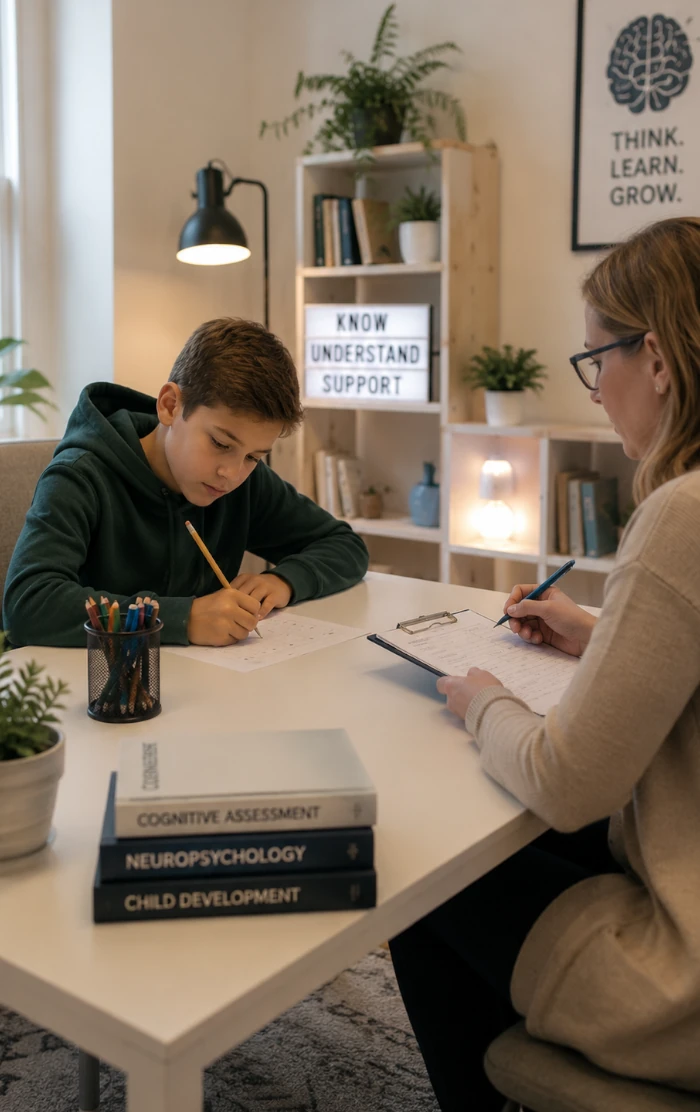
Professional child IQ testing in Columbia – whether you need an assessment for school placement, gifted program eligibility, or to understand your child's learning profile, we connect you with licensed psychologists in the Columbia area.
Last Updated: September 2026
Gifted Testing
Identify giftedness for school placement, enrichment, and talent programs using WISC-V or Stanford-Binet 5.
WISC-V Test
Wechsler Intelligence Scale for Children® Fifth Edition – the gold standard for child IQ testing.
Stanford-Binet 5
Stanford-Binet Intelligence Scales Fifth Edition – comprehensive cognitive assessment for all ages.
Full Evaluation
Combined assessment with detailed report and recommendations. Includes WISC-V or Stanford-Binet 5.
School Placement Testing
Testing for private school admission and gifted program eligibility using WISC-V or Stanford-Binet 5.
Schedule Child IQ Testing
Book your WISC-V & Stanford-Binet 5 for ages 6–16. Gifted identification, learning profiles, etc. with a licensed psychologist in Columbia today.
Child IQ Testing in Columbia: city context
Columbia families request testing for gifted-program questions, uneven school performance, learning disabilities, attention concerns, developmental differences, private-school planning, and twice-exceptional profiles. The city is served primarily by Richland One, but exact district assignment follows the home address, not a general Columbia mailing label.
- Children: 17.0% of city residents are under age 18.
- Household language: 8.7% of residents age five and older speak a language other than English at home.
- Interpretation: School opportunity, language exposure, disability, health, emotional state, and testing conditions belong in the report.
Testing should answer a specific question, not simply produce a number. A gifted referral may need aptitude and achievement evidence aligned with district rules; a learning-disability question needs direct academic testing; an ADHD question needs developmental and behavioral evidence; and an autism or medical referral requires a broader battery. Parents should ask how each proposed test contributes to the decision.
The testing day should be arranged around the child's normal sleep, medication, meals, and school routine. Tell the examiner about illness, anxiety, pain, recent stress, sensory needs, motor or communication differences, and any accommodations used at school. A child who cannot access the standard administration may need approved accommodations or a different measure, with limitations documented clearly.
IQ by gender & ethnicity (child population)
Columbia's children come from varied racial, cultural, linguistic, and economic backgrounds. Census categories and gender do not predict an individual child's ability. The examiner should use appropriate norms, evaluate the child's language and educational history, consider accessibility needs, and avoid interpreting score differences through stereotypes.
Columbia school districts and gifted programs
Richland One Advanced Academic Programs
Richland One provides Advanced Academic Programs in grades 3–12. Identification uses referral, screening, assessment, and a district evaluation-and-placement team. Families should request the current application, testing calendar, score-validity rules, and Gift Profile Sheet.
Richland One's accountability and assessment staff coordinate districtwide achievement and aptitude testing used for academically gifted placement. Translated referral applications may be available. A family submitting private evidence should ask in writing when it must be received, which editions and norms are acceptable, and whether the district will administer its own measures.
Dimension A: reasoning
District guidance generally uses the 93rd national age percentile or higher on a nationally normed aptitude measure. A composite at or above the 96th national age percentile on a nationally normed aptitude or intelligence test may provide automatic eligibility under the stated criteria.
The district lists examples such as CogAT verbal, nonverbal, or composite results, Raven nonverbal scores, and NNAT nonverbal scores. Scores are not interchangeable across every instrument, and the district states validity periods for evidence. Parents should rely on the current district table rather than a provider's assumption.
Dimension B: achievement
District criteria generally use the 94th national percentile on approved reading or mathematics achievement measures, or the current state-set qualifying standard on South Carolina testing. Achievement alone does not establish eligibility.
Examples in district materials include approved nationally normed reading or mathematics tests and the annually set South Carolina state threshold. Achievement scores can be affected by curriculum exposure, instruction, disability, language, and attendance, which is why the multi-dimensional process should be interpreted as a whole.
Dimension C: academic performance
For applicable grades, South Carolina performance tasks or qualifying GPA criteria may be considered after a student has met Dimension A or B. The district states that students ordinarily qualify through at least two of three dimensions.
Performance tasks are administered on an annual schedule for eligible grade levels, while GPA criteria apply under stated grade and course rules. Families should confirm the exact rising-grade procedure, the courses included in GPA, and the review route for newly enrolled students whose records come from another district or state.
Other Columbia school options
Magnet, International Baccalaureate, Advanced Placement, arts, dual-enrollment, and career programs use their own grade, application, prerequisite, audition, or assessment rules. An IQ report is not automatically required or sufficient. Confirm the current process with the specific school.
Artistic gifted identification is also distinct from academic gifted identification and may involve auditions, portfolios, or performance criteria. A child can be advanced in one domain without meeting another program's rules. Placement decisions should consider course content, pace, travel, schedule, peer fit, and the student's own goals.
For students moving into Columbia, bring complete records from the former school, including original score reports and norm information rather than summary labels. Ask which evidence transfers, which tests the district must repeat, and how interim classroom support is handled while eligibility is reviewed. For homeschooled or privately educated students, obtain written district guidance on access and documentation rather than assuming the same procedure.
Columbia private-school admissions and testing
Columbia-area independent schools include Hammond School, Heathwood Hall Episcopal School, Cardinal Newman School, and Ben Lippen School. Admissions requirements vary by school, grade, and year; they may involve records, teacher recommendations, interviews, observations, readiness or achievement testing, but families should not assume that an individually administered IQ test is required. Obtain the current written checklist and ask whether the school accepts outside testing before paying for an evaluation.
If testing is requested, ask for the exact instrument or acceptable alternatives, maximum age of scores, minimum report components, deadline, and who may administer it. Clarify whether the assessment is for admission, grade placement, gifted programming, learning support, or accommodations. Those are different questions and may require different batteries. A psychologist should not promise admission or placement.
Families comparing schools can also ask how each school differentiates instruction, supports dyslexia or ADHD, coordinates accommodations, handles subject acceleration, and communicates with outside clinicians. A selective admissions process is not the same as a clinical evaluation, and a school's internal test may not produce a reusable diagnostic report.
Columbia gifted-identification data and interpretation
Gifted enrollment changes with grade, referrals, eligibility decisions, mobility, and program reporting. Citywide Census data cannot establish how many children should qualify, and the proportion of students identified is not an estimate of intelligence in the community. Ask Richland One for the latest school- and grade-specific data and review access by race, ethnicity, disability, language, and economic status for potential referral gaps.
Useful questions include how many students were referred, screened, assessed, found eligible, served, transferred in, or declined services. Those denominators are different. Families and educators should also examine whether universal screening, translated communication, make-up testing, and disability accommodations are consistently available.
Small school-level groups can make percentages unstable and raise privacy concerns. Multi-year patterns, district explanations, and comparable denominators are more informative than a single percentage. When disparities appear, investigate access to referral information, prior instruction, attendance, transportation, technology, test accommodations, and follow-through before drawing conclusions.
The child IQ testing process: step by step
Understanding the testing process can help parents prepare their child and reduce anxiety. Here's what to expect:
- Initial consultation (15–20 minutes): A brief phone or video call with the psychologist to discuss your child's background, concerns, and goals. This helps determine the right test and approach.
- Testing session (60–90 minutes): The child meets one-on-one with a licensed psychologist in a quiet, comfortable room. The psychologist administers the WISC-V or Stanford-Binet 5, which includes a series of subtests measuring verbal comprehension, visual-spatial reasoning, fluid reasoning, working memory, and processing speed. Breaks are offered as needed.
- Scoring and interpretation (1–2 days): The psychologist scores the test and analyzes the results. They consider the child's age, background, and any relevant medical or educational history.
- Feedback session (45–60 minutes): The psychologist meets with the parents (and the child, if appropriate) to explain the results. They discuss the Full-Scale IQ, index scores, strengths, and areas for growth. They also provide tailored recommendations for home, school, and extracurriculars.
- Comprehensive written report (5–7 days): You receive a detailed report with all scores, normative comparisons, and actionable next steps. This report can be shared with schools, doctors, or other professionals.
The entire process from consultation to report usually takes 1–2 weeks, depending on scheduling. The testing itself is non-invasive and designed to be engaging for children.
What is the WISC-V test?
The WISC-V (Wechsler Intelligence Scale for Children® – Fifth Edition) is the most widely used IQ test for children aged 6:0–16:11. It provides a Full-Scale IQ and five primary index scores: Verbal Comprehension, Visual-Spatial, Fluid Reasoning, Working Memory, and Processing Speed. The test is administered one-on-one by a trained psychologist and takes about 60–90 minutes.
The WISC-V is normed on a large, representative sample of U.S. children and is updated regularly to ensure accuracy. It is the gold standard for gifted identification, learning disability diagnosis, and school placement.
Why test your child's IQ?
IQ testing provides valuable insights into your child's cognitive strengths and weaknesses. It can help:
- Identify giftedness: For admission to gifted programs, private schools, or enrichment opportunities.
- Diagnose learning disabilities: Such as dyslexia, dyscalculia, or ADHD, which can be masked by high intelligence.
- Guide educational planning: Tailor instruction to your child's unique learning profile.
- Provide reassurance: Understand why your child is different from peers and how to support them.
Columbia gifted-testing timeline
Start with the school's current referral window and obtain written criteria. Richland One describes annual performance-task administration for applicable students and publishes district procedures, but dates can change. Allow time for records review, testing, scoring, report preparation, district submission, and any evaluation-team meeting. A private appointment after a deadline may not affect the next placement cycle.
- Before referral: Collect report cards, state and district scores, work samples, teacher observations, and prior evaluations.
- During screening: Confirm testing dates, make-up rules, language and disability accommodations, and who receives results.
- Private evaluation: Give the psychologist the current district criteria and deadline; do not assume every IQ measure is accepted.
- After the decision: Request the completed profile and written rationale, and ask how placement and services begin.
Columbia advanced learning by age group
- Early elementary: Classroom differentiation, enrichment, and referral monitoring can document emerging needs before formal placement grades.
- Grades 3–5: Richland One Advanced Academic Programs and applicable state performance tasks are central considerations.
- Middle school: Advanced courses, arts options, acceleration, and enrichment should match readiness and social-emotional needs.
- High school: AP, IB, dual enrollment, arts, career pathways, and subject acceleration use program-specific prerequisites.
Acceleration can involve a subject, course sequence, or grade and should be evaluated separately from enrichment. Families should examine mastery, motivation, executive skills, peer context, transportation, and long-term course sequencing. A high IQ score alone does not resolve those practical questions.
Columbia child ADHD and learning-disability assessment
IQ testing alone does not diagnose ADHD or a learning disability. A comprehensive evaluation may include developmental and school history, teacher and parent input, observations, achievement measures, attention and executive-function measures, emotional screening, and review of vision, hearing, sleep, language, and medical factors. Parents may request a school evaluation in writing and should ask how private reports are reviewed under current district procedures.
For suspected dyslexia or another academic disorder, direct measures of reading, writing, or mathematics are essential. For ADHD, symptoms must be evaluated across settings and against other explanations. For autism or developmental questions, social communication, adaptive behavior, sensory needs, and developmental history may be more important than IQ alone. Twice-exceptional children can show advanced reasoning while still needing explicit disability supports.
Parents should distinguish a clinical diagnosis from school eligibility. The school team determines eligibility under educational law, while a licensed clinician makes diagnoses within professional scope. The two processes can inform each other, but neither automatically controls the other.
Bring report cards, benchmark and state scores, intervention records, attendance, disciplinary context, teacher comments, developmental and medical history, and examples of work. Tell the examiner about bilingual development, hearing or vision concerns, recent family stress, medication timing, and prior exposure to the same test. Those facts can change both instrument selection and interpretation.
Columbia enrichment and summer learning
Potential resources include University of South Carolina youth programs, Richland Library, the South Carolina State Museum, EdVenture Children's Museum, Columbia Museum of Art, Riverbanks Zoo and Garden, school-based camps, and community arts or STEM organizations. Offerings, ages, fees, and accessibility change each year. Enrichment should follow interests and readiness; an IQ label is not required for most community programs.
- STEM: Look for hands-on science, coding, robotics, engineering, environmental study, and museum programs.
- Humanities: Libraries, archives, debate, writing, history, languages, and theater can support verbal and creative strengths.
- Arts: Visual art, music, dance, and performance opportunities may require auditions or portfolios rather than cognitive scores.
- Well-being: Preserve unstructured time, friendships, physical activity, and sleep; enrichment should not become a year-round test of worth.
For an advanced child, depth and autonomy can be more valuable than simply moving faster. A strong program might let a student pursue an extended project, present to an authentic audience, work with older content in one subject, or collaborate with intellectual peers while remaining with age peers elsewhere. Track engagement and stress rather than counting activities.
Columbia child-testing costs and routes
School evaluations connected to special-education obligations or district identification processes may be available without a private fee, while independent assessments are commonly self-pay or subject to insurance rules. Ask for a written estimate covering consultation, testing time, scoring, feedback, the report, records, school meetings, and any retesting. Verify that the proposed report satisfies the receiving school's current criteria.
Insurance may cover medically necessary diagnostic assessment while excluding educational or gifted testing. Ask for procedure codes, network status, authorization requirements, deductible and coinsurance exposure, and the policy for denied claims. A lower-cost training clinic can be appropriate when its scope, supervision, timeline, and report meet the referral need.
If finances are limited, begin with the school process and a pediatric or primary-care discussion when medical concerns exist. Ask independent providers whether consultation alone can clarify the needed battery, whether records reduce duplicate testing, and whether payment plans or staged evaluation are available without compromising validity. Avoid repeated short tests that consume money but never integrate the child's full profile.
Areas we serve
We support all areas of Columbia.
Frequently Asked Questions
Both are excellent tests. WISC-V is more commonly used for school-age children, while Stanford-Binet 5 can be used for ages 2–85. We often recommend WISC-V for gifted identification.
The test itself takes 60–90 minutes. With the consultation, feedback, and report, the entire process is about 1–2 weeks.
No, you can book directly with our psychologists. We serve both self-referred and professionally referred children.
Yes, our reports are accepted by Columbia Public Schools, private schools, and other gifted programs.
Some plans cover cognitive assessments when there is a clinical indication. Check with your provider.
Get a good night's sleep, eat a healthy meal, and arrive relaxed. No specific preparation is needed.
You'll receive a comprehensive report with your child's scores and tailored recommendations.
Some interview and feedback components may be available remotely, but many standardized cognitive tests require in-person administration. Confirm with the psychologist and the organization receiving the report.