
School Placement Testing in Aurora

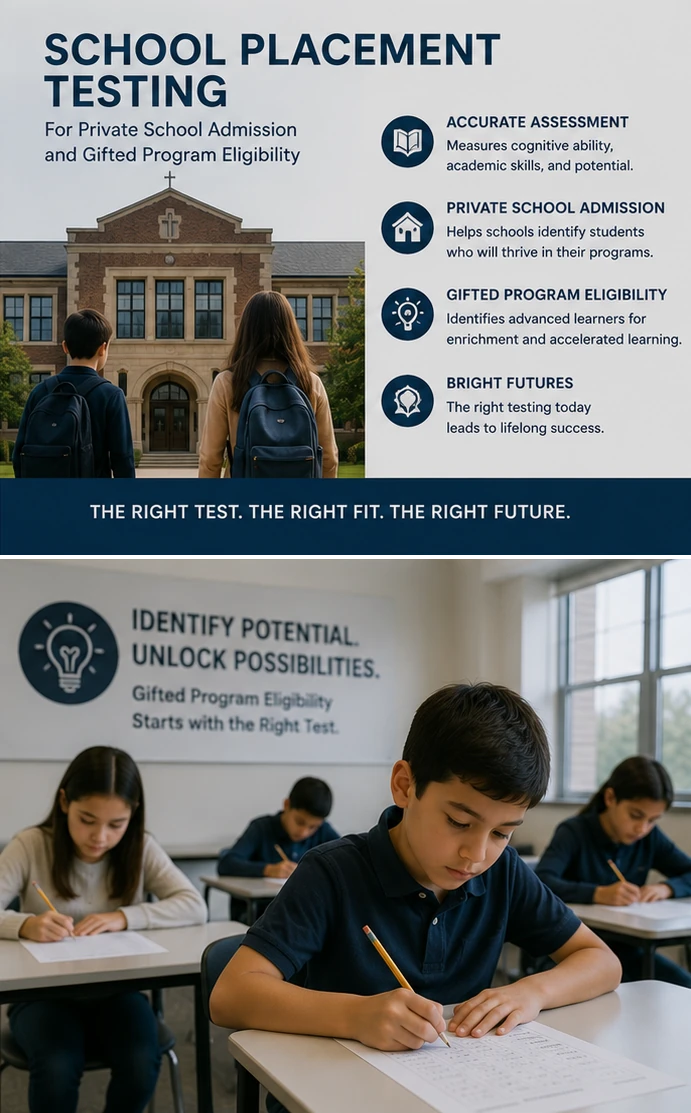
School placement testing is a critical step for families navigating private school admissions and gifted program eligibility in Aurora. This comprehensive guide covers the types of tests used, which Aurora schools require testing, the process, and how to prepare your child for success.
Last Updated: September 2026
Child IQ Testing
WISC-V & Stanford-Binet 5 for ages 6–16. Gifted identification, school placement.
Gifted Testing
Identify giftedness for school placement, enrichment, and talent programs using WISC-V or Stanford-Binet 5.
WISC-V Test
Wechsler Intelligence Scale for Children® Fifth Edition – gold standard for child IQ and school placement.
Stanford-Binet 5
Stanford-Binet Intelligence Scales Fifth Edition – comprehensive cognitive assessment, often used for private school admission.
Full Evaluation
Combined cognitive, academic, and behavioral assessment for complex cases. Includes WISC-V or Stanford-Binet 5.
Schedule School Placement Testing
Book your school placement testing with a licensed psychologist in Aurora today.
What is School Placement Testing?
School placement testing is a specialized cognitive assessment used to determine whether a child is a good fit for a particular educational environment. In Aurora, this typically includes:
- Private school admission testing: Many independent schools require IQ or cognitive testing as part of the application process
- Gifted program eligibility: Aurora Public Schools and other districts require IQ testing for admission to gifted programs
- Educational placement decisions: Testing helps determine the right academic setting for a child's needs
- Early entrance to kindergarten or grade skipping: Some schools require testing to evaluate readiness
Aurora Schools and Programs Using Placement Testing
Private and Independent Schools
- Requirements vary: Aurora and Denver-area private schools may request achievement, cognitive, admissions, interview, teacher, or school-record information.
- No universal test: Some accept WISC-V or Stanford-Binet results; others use school-specific assessments or do not require IQ testing.
- Timing: Obtain the current application deadline, accepted test edition, maximum score age, examiner qualifications, and report-delivery instructions.
- Placement authority: A private report informs but does not guarantee admission, grade acceleration, or financial aid.
Public-School Gifted and Advanced Programs
- Aurora Public Schools: Uses multiple measures for gifted identification and maintains Aurora Quest K–8 plus school-based differentiated services.
- Cherry Creek Schools: Uses district-specific gifted, ALP, acceleration, AP, IB, and concurrent-enrollment procedures.
- Colorado rules: Identified gifted students receive Advanced Learning Plans; one IQ score does not independently determine services.
- Outside testing: Districts may review private reports while retaining authority over identification and placement.
- Twice-exceptionality: Placement decisions should address both advanced strengths and disability-related access needs.
Tests Used for School Placement in Aurora
- Body of evidence: Colorado gifted identification uses multiple sources rather than one score.
- Advanced Learning Plan: The ALP translates identification into academic and affective goals; the test itself is not the service plan.
- Private-school requirements: Ask the admissions office which test, examiner credential, report format, and testing date are accepted.
- Validity: Testing should be current, standardized, administered under appropriate conditions, and interpreted within language, disability, cultural, and educational context.
The School Placement Testing Process
Step 1: Initial Consultation
A brief phone or video call with a licensed psychologist to discuss your child's needs, the schools you're targeting, and the most appropriate tests. This helps determine the right approach for your child.
Step 2: Testing Session
The child meets one-on-one with a licensed psychologist in a quiet, comfortable room. The psychologist administers the selected test, which includes subtests measuring various cognitive abilities. Breaks are offered as needed. The testing session typically takes 60-90 minutes.
Step 3: Scoring and Interpretation
The psychologist scores the test and analyzes the results, considering the child's age, background, and any relevant medical or educational history.
Step 4: Feedback Session
The psychologist meets with the parents to explain the results, discuss the child's cognitive profile, and provide recommendations for school placement.
Step 5: Comprehensive Written Report
You receive a detailed report with all scores, normative comparisons, and recommendations. This report can be submitted to schools as part of the admission or placement process.
How to Prepare Your Child
Proper preparation can help your child perform at their best during testing. Here are some tips:
- Get a good night's sleep: Ensure your child is well-rested before the test
- Eat a healthy meal: A nutritious breakfast helps maintain focus
- Arrive relaxed: Leave plenty of time to get to the testing location
- Explain the test positively: Let your child know they'll be doing activities that show their strengths
- Avoid pressure: Don't emphasize the importance of the test, which can create anxiety
- No specific preparation needed: IQ tests measure innate abilities, so studying is not necessary
Cost of School Placement Testing in Aurora
- Single IQ assessment: Fees vary by instrument, examiner, records review, report detail, and feedback.
- Gifted package: May include interview, cognitive testing, school-focused report, and recommendations.
- Comprehensive evaluation: Costs more because it may include achievement, attention, behavior, executive-function, and diagnostic measures.
- School screening: District gifted screening is provided through school procedures; outside testing is generally the family’s responsibility.
- Insurance: School placement and gifted testing are often excluded as educational services.
- Written estimate: Confirm the total fee, deposit, cancellation policy, report timeline, and charges for school forms or addenda.
School Placement Testing in Aurora: Statistics
- City school landscape: Aurora is served by multiple public districts, charter schools, private schools, military-connected programs, and neighboring district options.
- APS enrollment: Aurora Public Schools reports more than 38,000 P–12 students across the district.
- State gifted context: Colorado publishes statewide gifted-enrollment and district data, but those figures do not define a single Aurora eligibility rate.
- Citywide gifted count: No single official count combines all Aurora districts and charters.
- Formal identification: APS uses a body of evidence under current district and state rules rather than allowing one score to decide eligibility by itself.
- Talent development: APS also supports some high-ability learners with evidence in the 85th–94th percentile range.
- Application competition: Magnet, academy, charter, and private-school capacity varies annually and is not guaranteed by test results.
- Military mobility: Frequent moves increase the importance of complete records, current ALPs, score reports, and communication with the receiving school.
- Two-district city: Aurora Public Schools and Cherry Creek Schools serve different parts of the city and use different calendars and procedures.
- Enrollment boundaries: Verify the assigned school and district before paying for testing or applying to a program.
- Transportation: Magnet, charter, private, or out-of-district placement can create substantial daily travel across Aurora.
- Language access: Families should request translated application information and ask how multilingual evidence is evaluated.
- Placement review: Schools may consider age, achievement, maturity, attendance, behavior, work samples, and available space in addition to cognitive scores.
Frequently Asked Questions
Requirements vary. Some independent or specialized programs may request cognitive or psychoeducational data, while many schools rely on records, achievement measures, interviews, or lotteries. Families should obtain written requirements directly from the school.
WISC-V is the most commonly requested test for private school admission and gifted program eligibility. Stanford-Binet 5 is also widely accepted. Check with your target schools for their specific requirements.
Most gifted programs require a Full-Scale IQ score of 130 or above (98th percentile). However, some programs use multiple criteria including teacher recommendations, academic achievement, and portfolio reviews.
The test itself takes 60-90 minutes. With the consultation, feedback, and report, the entire process is about 1-2 weeks.
The report includes Full-Scale IQ, index scores, strengths and weaknesses, normative comparisons, and recommendations for school placement. This report can be submitted to schools as part of the application process.
Some plans cover cognitive assessments when there is a clinical indication. School placement testing is often considered an educational rather than medical service, so coverage varies. Check with your provider.
Some interviews and feedback can occur remotely, but many schools require in-person cognitive testing. Remote administration must follow publisher, legal and professional requirements; confirm the receiving school's policy.
Get a good night's sleep, eat a healthy meal, and arrive relaxed. No specific preparation is needed. Avoid putting pressure on your child, which can create anxiety.
Typical fees range from $200 to $1,200 for a single IQ test, with full evaluations costing up to $3,000. Some insurance plans cover testing when medically necessary.