
Child IQ Testing in Aurora

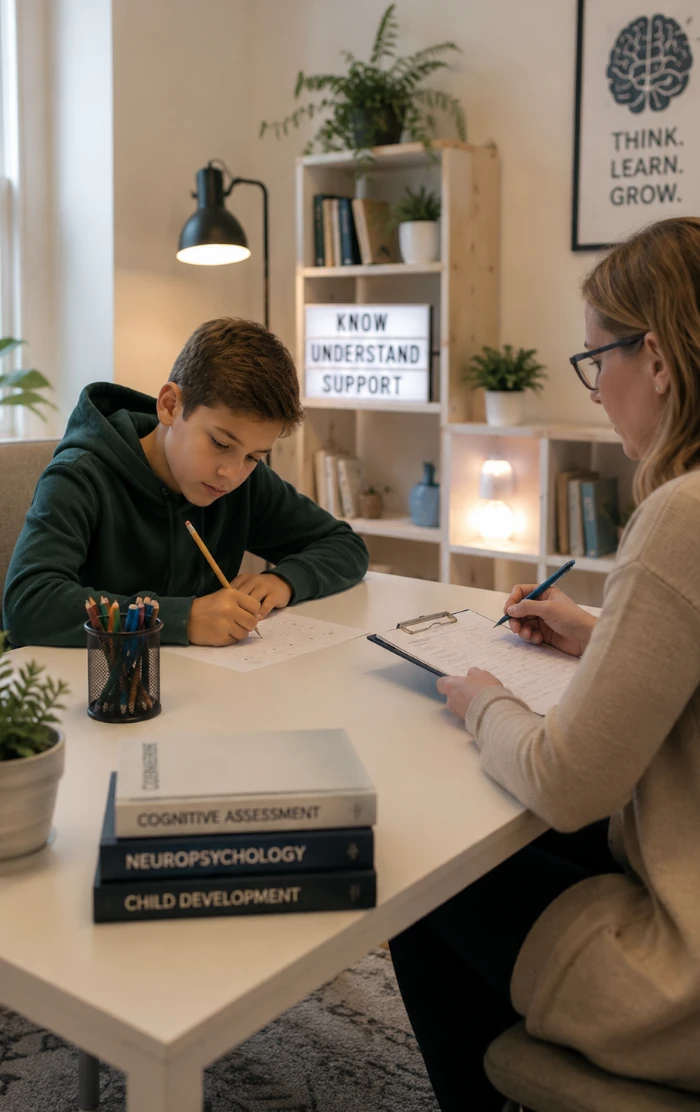
Professional child IQ testing in Aurora – whether you need an assessment for school placement, gifted program eligibility, or to understand your child's learning profile, we connect you with licensed psychologists in the Aurora area.
Last Updated: September 2026
Gifted Testing
Identify giftedness for school placement, enrichment, and talent programs using WISC-V or Stanford-Binet 5.
WISC-V Test
Wechsler Intelligence Scale for Children® Fifth Edition – the gold standard for child IQ testing.
Stanford-Binet 5
Stanford-Binet Intelligence Scales Fifth Edition – comprehensive cognitive assessment for all ages.
Full Evaluation
Combined assessment with detailed report and recommendations. Includes WISC-V or Stanford-Binet 5.
School Placement Testing
Testing for private school admission and gifted program eligibility using WISC-V or Stanford-Binet 5.
Schedule Child IQ Testing
Book your WISC-V & Stanford-Binet 5 for ages 6–16. Gifted identification, learning profiles, etc. with a licensed psychologist in Aurora today.
Child IQ Testing in Aurora: city context
Aurora families seek child IQ testing for gifted identification, school planning, twice-exceptionality, learning concerns, ADHD, autism, private-school applications, early entrance, and a clearer understanding of strengths and needs. The city’s two major school districts and highly diverse multilingual population make careful interpretation especially important.
IQ, gender, and demographic context (child population)
- Child population: 23.9% of Aurora residents are under age 18.
- Gender: 49.7% of all residents are female; child tests use age-based norms, not city gender averages.
- District diversity: APS students come from more than 130 countries and speak more than 160 languages.
- Second-language learners: APS reports 42% of students as second-language learners.
- Gifted identification: APS reports 4.9% of students identified as gifted and talented, but district figures are not citywide IQ rates.
- Testing fairness: Language, educational opportunity, disability, culture, migration, interrupted schooling, and prior test exposure must be considered.
- No neighborhood IQ averages: Valid public data do not establish average child IQ by Aurora neighborhood, sex, race, or school.
Aurora School Districts and Gifted Programs
Aurora Public Schools Gifted Education
- Advanced Academics and Gifted Services: APS uses school gifted facilitators, district specialists, multiple data sources, and differentiated programming.
- Body of evidence: Identification should not rely on one private IQ score; ability, achievement, performance, observation, and contextual evidence may be considered.
- Services: APS describes tiered assignments, affective education, acceleration, honors, AP, IB, STEAM, concurrent enrollment, capstones, and extracurricular options.
- ALPs: Identified Colorado gifted students receive Advanced Learning Plans with academic and affective goals.
Aurora Quest K–8
- Program: Aurora Quest is APS’s magnet school for gifted and high-potential learners, with accelerated literacy and mathematics.
- Eligibility: Applicants must be prequalified as gifted or high potential through APS procedures before the lottery process.
- Evidence: APS lists cognitive assessment, recommendations, report cards, state data, performance measures, and student work among the evidence considered.
- No guarantee: Qualification, application, and lottery placement are separate decisions.
Cherry Creek School District Pathways
- Coverage: Many southern and southeastern Aurora neighborhoods are served by Cherry Creek Schools.
- District procedures: CCSD controls its own identification, Advanced Learning Plan, acceleration, honors, AP, IB, and concurrent-enrollment processes.
- Outside reports: Private WISC-V or Stanford-Binet findings may be reviewed but do not override district rules.
- School contact: Families should start with the school gifted contact or district office for current timelines and accepted evidence.
Advanced Academic and Concurrent-Enrollment Options
- IB and AP: Advanced coursework is available at selected APS and CCSD schools.
- Concurrent enrollment: Students may earn high-school and college credit through district and Community College of Aurora partnerships.
- ASCENT: Eligible students may continue college coursework after completing high-school requirements under state and district rules.
- Magnet and pathway programs: STEM, arts, health, business, and career-technical options vary by school and year.
Colorado Gifted Requirements and Family Rights
- State duty: Colorado administrative units must identify and serve eligible gifted students under the Exceptional Children’s Educational Act.
- Advanced Learning Plan: Every identified gifted student requires an ALP with standards-based academic and affective goals.
- Family role: Families participate in goal setting, share information, and may use district disagreement procedures.
- Twice-exceptionality: Gifted students can also qualify for special education or Section 504 support when disability criteria are met.
Aurora Private Schools and Programs Using Testing Information
- Independent schools: Aurora and Denver-area independent schools set their own admissions, achievement, interview, and testing requirements.
- Faith-based schools: Catholic, Christian, Jewish, Islamic, and other faith-based schools may use records and placement measures rather than a universal clinical IQ test.
- Charter schools: Charter enrollment, lotteries, and specialized-program requirements differ by school; an IQ score does not guarantee admission.
- Specialized learning programs: Schools serving dyslexia, autism, ADHD, or other needs may request cognitive, academic, diagnostic, and functional documentation.
- Current requirements: Families should request written criteria, deadlines, accepted test editions, and report-delivery instructions before paying for testing.
- Independent evaluation use: A psychologist’s report can clarify strengths and needs, but no private-school acceptance or placement decision is guaranteed.
Aurora Gifted Identification Statistics
- Statewide context: Colorado publishes statewide gifted-enrollment and district data, but those figures do not create a citywide Aurora IQ rate.
- Local counts: A single authoritative citywide count is not available because Aurora is served by multiple districts and charter schools.
- APS enrollment: Aurora Public Schools reports more than 38,000 P–12 students across the district.
- Multiple districts: Aurora Public Schools, Cherry Creek Schools, charter schools, private schools, and neighboring districts maintain separate data systems and decision procedures.
- Identification decisions: APS uses a body of evidence under current district and state rules; families should not assume a single percentile automatically controls eligibility.
- Talent development: APS supports high-potential learners through differentiated services as well as formal gifted identification.
- Equity: Universal screening, local norms, multiple measures, culturally responsive review, and talent development can help identify students historically underrepresented in gifted programs.
- Outside testing: Privately obtained results may be reviewed, but the district determines identification and programming under its current rules.
The child IQ testing process: step by step
Understanding the testing process can help parents prepare their child and reduce anxiety. Here's what to expect:
- Initial consultation (15–20 minutes): A brief phone or video call with the psychologist to discuss your child's background, concerns, and goals. This helps determine the right test and approach.
- Testing session (60–90 minutes): The child meets one-on-one with a licensed psychologist in a quiet, comfortable room. The psychologist administers the WISC-V or Stanford-Binet 5, which includes a series of subtests measuring verbal comprehension, visual-spatial reasoning, fluid reasoning, working memory, and processing speed. Breaks are offered as needed.
- Scoring and interpretation (1–2 days): The psychologist scores the test and analyzes the results. They consider the child's age, background, and any relevant medical or educational history.
- Feedback session (45–60 minutes): The psychologist meets with the parents (and the child, if appropriate) to explain the results. They discuss the Full-Scale IQ, index scores, strengths, and areas for growth. They also provide tailored recommendations for home, school, and extracurriculars.
- Comprehensive written report (5–7 days): You receive a detailed report with all scores, normative comparisons, and actionable next steps. This report can be shared with schools, doctors, or other professionals.
The entire process from consultation to report usually takes 1–2 weeks, depending on scheduling. The testing itself is non-invasive and designed to be engaging for children.
What is the WISC-V test?
The WISC-V (Wechsler Intelligence Scale for Children® – Fifth Edition) is the most widely used IQ test for children aged 6:0–16:11. It provides a Full-Scale IQ and five primary index scores: Verbal Comprehension, Visual-Spatial, Fluid Reasoning, Working Memory, and Processing Speed. The test is administered one-on-one by a trained psychologist and takes about 60–90 minutes.
The WISC-V is normed on a large, representative sample of U.S. children and is updated regularly to ensure accuracy. It is the gold standard for gifted identification, learning disability diagnosis, and school placement.
Why test your child's IQ?
IQ testing provides valuable insights into your child's cognitive strengths and weaknesses. It can help:
- Identify giftedness: For admission to gifted programs, private schools, or enrichment opportunities.
- Diagnose learning disabilities: Such as dyslexia, dyscalculia, or ADHD, which can be masked by high intelligence.
- Guide educational planning: Tailor instruction to your child's unique learning profile.
- Provide reassurance: Understand why your child is different from peers and how to support them.
Aurora Gifted Testing Timeline
- Start with the district: Contact the school’s gifted coordinator before private testing to confirm referral windows and accepted evidence.
- Aurora Quest applications: APS publishes an annual application window; for 2026–2027, applications opened November 3, 2025 and were due January 30, 2026, but families must verify each new cycle.
- School-year screening: Districts commonly collect achievement, classroom, cognitive, performance, and observation evidence during the school year.
- Outside reports: Allow time for testing, scoring, feedback, report completion, school review, and possible requests for additional evidence.
- Early access: Early kindergarten or first-grade applications have separate age, deadline, readiness, and evaluation requirements.
- Transfers: Military and other transferring families should bring prior ALPs, eligibility decisions, test reports, achievement records, and service documentation.
- Private-school timing: Admissions deadlines may occur months before enrollment; verify school requirements before scheduling.
- No guaranteed decision: Testing dates and scores do not guarantee district identification, academy admission, acceleration, or private-school placement.
Aurora Gifted Programs by Age Group
- Preschool and early childhood: Early-access questions focus on developmental readiness, academic advancement, social-emotional functioning, and district criteria.
- Kindergarten through grade 2: Talent development, differentiated instruction, observation, achievement data, and screening help identify emerging strengths.
- Grades 3–5: Advanced Learning Plans may support subject acceleration, enrichment, independent study, cluster grouping, competitions, and advanced materials.
- Middle school: APS’s North and Jenkins academies, district advanced classes, honors pathways, and charter options provide different levels of acceleration.
- High school: Honors, Advanced Placement, International Baccalaureate, dual enrollment, career and technical education, independent study, and early college are available across districts.
- Twice-exceptional students: Programming should address advanced strengths alongside ADHD, learning disabilities, autism, emotional needs, medical concerns, or executive-function challenges.
- Military-connected students: Continuity may require rapid record transfer, ALP portability review, flexible scheduling, and coordination between sending and receiving schools.
Aurora Child ADHD and Learning Disability Assessment
- Comprehensive testing: Evaluation may include WISC-V, achievement testing, behavior ratings, interviews, executive-function measures, records, and observation.
- School evaluation: District teams evaluate eligibility for special education and Section 504 supports under educational rules.
- Independent evaluation: Private testing may add diagnostic detail, but schools independently determine educational eligibility and services.
- Twice-exceptionality: High reasoning ability can coexist with dyslexia, ADHD, autism, anxiety, processing-speed weaknesses, or working-memory difficulties.
- Military-family factors: Frequent moves, deployment stress, disrupted records, and differences among state systems can complicate identification.
- Medical referrals: Children’s Colorado, UCHealth, CommonSpirit, pediatricians, and specialists may refer for broader evaluation when medical or neurological questions are present.
- Report planning: Ask whether the report will include school-ready recommendations, diagnostic criteria, test scores, and functional implications.
Aurora Summer Programs for Gifted Children
- CU Anschutz youth programs: University camps and academic offerings may include STEM, cybersecurity, health, arts, athletics, and college-preparation activities.
- Space Foundation Discovery Center: Hands-on space, science, engineering, and educational programming supports children interested in aerospace and exploration.
- Front Range Library District: Libraries provide reading challenges, makerspace activities, technology, science, writing, and enrichment events.
- Buckley Space Force Base and military STEM outreach: Programs vary by year and may include athletics, STEM, leadership, and academy-exploration opportunities.
- Metropolitan State University of Denver and local arts programs: Community arts, writing, music, theater, and academic activities may appeal to verbally and creatively gifted students.
- Outdoor education: Cherry Creek State Park, Star K Ranch, Plains Conservation Center, Aurora Reservoir, nature centers, museums, and environmental organizations provide science and field-learning opportunities.
- Eligibility and safety: Verify age, prerequisites, costs, accessibility, altitude demands, weather policies, and registration deadlines.
Aurora Child Testing Costs by Provider Type
- Single cognitive test: Fees vary by examiner, instrument, report detail, and feedback; ask for a written total before scheduling.
- Gifted-focused evaluation: May include a cognitive test, records review, parent interview, brief report, and school-oriented recommendations.
- Psychoeducational evaluation: Usually combines cognitive, achievement, attention, behavior, and learning measures and costs more than a single IQ test.
- Neuropsychological evaluation: Broader medical and neurological assessment generally requires more testing time, records, interpretation, and professional expertise.
- Insurance: Educational or gifted testing is often self-pay; medically necessary diagnostic assessment may receive partial coverage depending on plan and authorization.
- Military insurance: TRICARE coverage depends on medical necessity, referral rules, provider status, and the specific service.
- School testing: Public-school evaluations are provided under educational procedures when the district suspects a qualifying disability or conducts gifted screening.
- Questions to ask: Confirm deposits, cancellation fees, report turnaround, feedback, school forms, travel, and charges for record review or addenda.
- Referral question first: Gifted screening, diagnostic evaluation, private-school admission, and neuropsychology require different scopes and fees.
- District evaluation: Eligible school evaluations are provided under educational procedures, but families do not select every instrument or evaluator.
- Private evaluation: Independent testing may offer faster scheduling or broader questions but is usually self-pay unless medically necessary.
- Hospital evaluation: Children’s Colorado neuropsychology typically addresses neurological or systemic medical conditions and may require referral.
- Language assessment: Bilingual or culturally responsive evaluation may require additional interview, records, and specialized examiner time.
- School records: Bring report cards, intervention data, state scores, teacher comments, prior evaluations, IEPs, 504 Plans, and ALPs.
- Testing day: Schedule when the child is rested, fed, medically stable, and taking medications as prescribed unless the prescriber advises otherwise.
- Breaks: Young children, children with ADHD, and children with medical or sensory needs may require multiple sessions.
- Prior exposure: Tell the examiner about recent CogAT, NNAT, WISC, WPPSI, DAS, Stanford-Binet, or achievement testing.
- Score validity: Anxiety, illness, sleep loss, language mismatch, pain, medication effects, and low engagement can affect results.
- Aurora Quest timing: Families must complete APS identification and application steps by current deadlines; a private test alone does not secure a seat.
- Early access: Colorado early entrance requires a broader body of evidence involving readiness, achievement, ability, social-emotional factors, and support.
- Transportation: Consider school schedules, R Line service, I-225 traffic, hospital-campus parking, and eastern-Aurora travel time.
- Weather: Snow, hail, smoke, heat, and storms can justify rescheduling if travel or performance would be compromised.
- Feedback for children: Results should be explained in developmentally appropriate, strength-based language.
- Report use: Ask the examiner to distinguish clinical recommendations from decisions reserved for the district or school.
- Reevaluation: Repeat testing should have a clear purpose and respect practice effects and school requirements.
- Confidentiality: Parents control release of private reports except where law, custody orders, or safety duties apply.
Areas we serve
We support clients throughout the City of Aurora. Recommendations are based on age, referral purpose, examiner qualifications, accessibility, school or agency requirements, and the need for in-person administration—not repetitive neighborhood keywords.
- Children and families: Gifted identification, school placement, learning profiles, ADHD and learning-disability assessment, and comprehensive evaluations.
- Adults: WAIS testing, career guidance, graduate planning, Mensa evidence, accommodations, and diagnostic evaluations.
- Schools and professionals: Consultation and documentation subject to the receiving organization’s current requirements.
- All areas of Aurora: We support all areas of the city without using repetitive neighborhood lists in the footer.
Frequently Asked Questions
Both are excellent tests. WISC-V is more commonly used for school-age children, while Stanford-Binet 5 can be used for ages 2–85. We often recommend WISC-V for gifted identification.
The test itself takes 60–90 minutes. With the consultation, feedback, and report, the entire process is about 1–2 weeks.
No, you can book directly with our psychologists. We serve both self-referred and professionally referred children.
Yes, our reports are accepted by Aurora Public Schools, private schools, and other gifted programs.
Some plans cover cognitive assessments when there is a clinical indication. Check with your provider.
Get a good night's sleep, eat a healthy meal, and arrive relaxed. No specific preparation is needed.
You'll receive a comprehensive report with your child's scores and tailored recommendations.
Interviews and feedback may be available remotely, but many standardized cognitive tests require controlled administration and may need an in-person appointment. Contact us for details.