
Child IQ Testing in Yonkers
Professional child IQ testing in Yonkers – whether you need an assessment for school placement, gifted program eligibility, or to understand your child's learning profile, we connect you with licensed psychologists in the Yonkers area.
Last Updated: September 2026
Gifted Testing
Identify giftedness for school placement, enrichment, and talent programs using WISC-V or Stanford-Binet 5.
WISC-V Test
Wechsler Intelligence Scale for Children® Fifth Edition – the gold standard for child IQ testing.
Stanford-Binet 5
Stanford-Binet Intelligence Scales Fifth Edition – comprehensive cognitive assessment for all ages.
Full Evaluation
Combined assessment with detailed report and recommendations. Includes WISC-V or Stanford-Binet 5.
School Placement Testing
Testing for private school admission and gifted program eligibility using WISC-V or Stanford-Binet 5.
Schedule Child IQ Testing
Book your WISC-V & Stanford-Binet 5 for ages 6–16. Gifted identification, learning profiles, etc. with a licensed psychologist in Yonkers today.
Differentiation, Grouping, and Enrichment
Yonkers students may receive differentiated classroom work, flexible grouping, advanced coursework, Academically Talented and PEARLS pathways, technical education, dual enrollment, enrichment, or subject acceleration. The available response depends on grade, school, program criteria, and current district resources.
New York Gifted Education Framework
New York provides guidance for advanced learning but does not operate one mandatory statewide gifted-identification system. District and school procedures vary, so families should verify current Yonkers Public Schools and program rules.
Detailed Yonkers Parent Preparation Guide
Bring the receiving program’s written criteria, school records, work samples, language history, prior reports, medical and developmental information, and specific questions. Schedule when the child is rested and avoid presenting testing as a contest or coaching protected items.
Yonkers Child-Testing Decision Guide
Use school evaluation for suspected educational disability, focused cognitive testing for a narrow accepted purpose, psychoeducational evaluation for learning questions, and neuropsychological or medical evaluation for complex developmental or neurological concerns.
Child IQ Testing in Yonkers: city context
IQ by gender & ethnicity (child population)
Yonkers had an estimated 212,603 residents on July 1, 2025, 0.5% above the April 2020 population-estimate base. U.S. Census Bureau 2020–2024 estimates report that 51.6% of residents are female, 19.6% are under age 18, and 17.6% are age 65 or older. The city is 34.6% White alone, 16.7% Black alone, 1.1% American Indian or Alaska Native alone, 5.5% Asian alone, and 17.9% reporting two or more races. 45.2% are Hispanic or Latino; race and Hispanic-origin categories are not mutually exclusive.
These figures describe community context, not intelligence. IQ scores must be interpreted individually in light of age, disability, health, education, language, culture, socioeconomic opportunity, testing conditions, and measurement error. Yonkers is exceptionally multilingual: 50.3% of residents age five and older speak a language other than English at home, and 33.1% are foreign-born. Language history, literacy in every language, interpreter use, educational continuity, and culturally appropriate test selection may therefore be central to valid interpretation.
- Female residents: 51.6%.
- Children and teens: 19.6% are under 18.
- Older adults: 17.6% are 65 or older.
- Language context: 50.3% speak a language other than English at home.
- Educational context: 83.3% of adults age 25+ completed high school and 35.7% hold a bachelor’s degree or higher.
- Health-access context: 10.0% of residents under age 65 report a disability and 7.4% lack health insurance.
- Interpretation: No gender, racial, ethnic, immigration, language, neighborhood, or income group should be presumed to have a particular IQ profile.
Yonkers School Districts and Gifted Programs
Academically Talented Programs
Yonkers Public Schools states that Academically Talented Programs are designed to provide identified students with appropriate advanced education. Families should obtain the current identification, testing, application, residency, and placement rules from the district.
PEARLS Hawthorne
PEARLS Hawthorne operates an academically talented program for Yonkers residents in prekindergarten through grade 8. The district publishes application windows and eligibility rules annually; private IQ results do not automatically create admission.
Middle- and high-school pathways
Honors, Advanced Placement, International Baccalaureate, early-college, career and technical education, arts, and specialized programs use course prerequisites, grades, performance, applications, and program-specific criteria.
New York gifted-education framework
New York does not use one universal statewide gifted-identification rule for every district. Local districts and schools define programs, evidence, and placement procedures, subject to applicable law and policy.
Yonkers Private Schools and Programs Using Testing Information
Yonkers and nearby Westchester include Catholic, Jewish, independent, Montessori, special-education, homeschool, and enrichment options. Schools may use records, interviews, achievement testing, their own entrance exams, teacher recommendations, work samples, or cognitive reports.
- Before testing: Ask the receiving school for the accepted test, score age, examiner qualification, report format, and deadline.
- Gifted enrichment: Programs may consider reasoning, achievement, creativity, motivation, and work samples rather than one IQ cutoff.
- Twice-exceptional planning: A broader psychoeducational or neuropsychological evaluation is often more useful than a stand-alone IQ test.
- Accommodations: IEP and Section 504 decisions are made through the responsible school’s legally required process.
Yonkers Gifted Identification Statistics
Yonkers Public Schools does not publish one fixed citywide percentage that should be treated as the expected rate of giftedness. Counts depend on program design, referral, screening, grade, language access, available seats, and current criteria.
- Population context: 19.6% of Yonkers residents are under age 18.
- Language context: 50.3% of residents age five and older speak a language other than English at home.
- Equity: Referral-only systems can miss multilingual students, students with disabilities, and children with less access to enrichment.
- Private results: A high score describes an individual profile but does not guarantee PEARLS or another district placement.
The child IQ testing process: step by step
Understanding the testing process can help parents prepare their child and reduce anxiety. Here's what to expect:
- Initial consultation (15–20 minutes): A brief phone or video call with the psychologist to discuss your child's background, concerns, and goals. This helps determine the right test and approach.
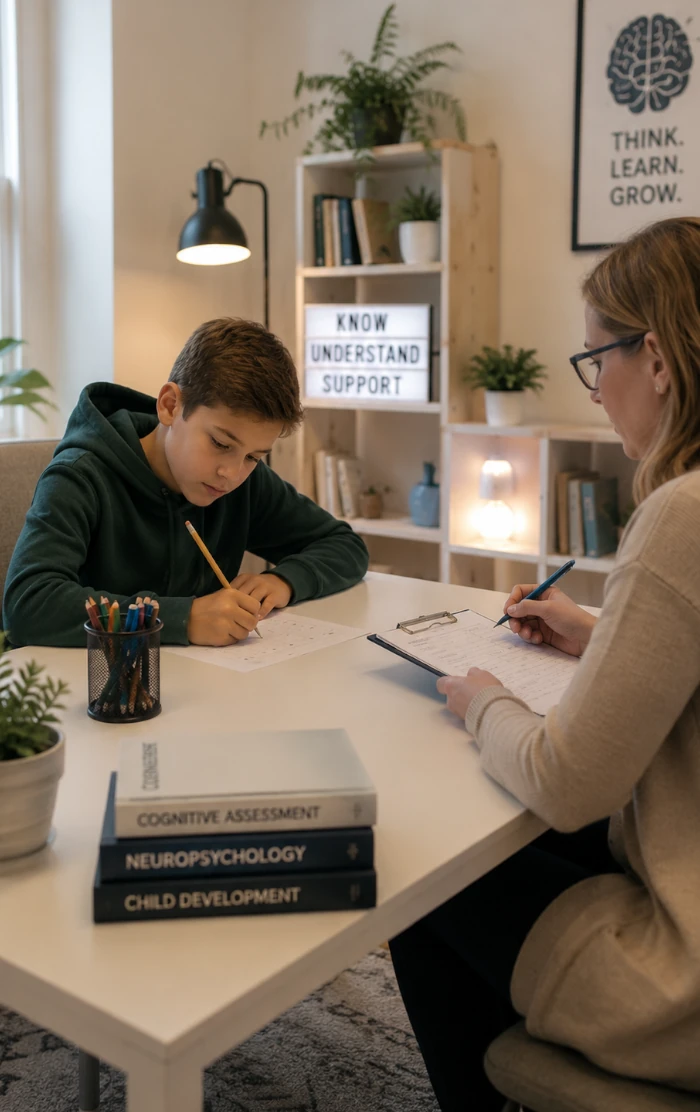
- Testing session (60–90 minutes): The child meets one-on-one with a licensed psychologist in a quiet, comfortable room. The psychologist administers the WISC-V or Stanford-Binet 5, which includes a series of subtests measuring verbal comprehension, visual-spatial reasoning, fluid reasoning, working memory, and processing speed. Breaks are offered as needed.
- Scoring and interpretation (1–2 days): The psychologist scores the test and analyzes the results. They consider the child's age, background, and any relevant medical or educational history.
- Feedback session (45–60 minutes): The psychologist meets with the parents (and the child, if appropriate) to explain the results. They discuss the Full-Scale IQ, index scores, strengths, and areas for growth. They also provide tailored recommendations for home, school, and extracurriculars.
- Comprehensive written report (5–7 days): You receive a detailed report with all scores, normative comparisons, and actionable next steps. This report can be shared with schools, doctors, or other professionals.
The entire process from consultation to report usually takes 1–2 weeks, depending on scheduling. The testing itself is non-invasive and designed to be engaging for children.
What is the WISC-V test?
The WISC-V (Wechsler Intelligence Scale for Children® – Fifth Edition) is the most widely used IQ test for children aged 6:0–16:11. It provides a Full-Scale IQ and five primary index scores: Verbal Comprehension, Visual-Spatial, Fluid Reasoning, Working Memory, and Processing Speed. The test is administered one-on-one by a trained psychologist and takes about 60–90 minutes.
The WISC-V is normed on a large, representative sample of U.S. children and is updated regularly to ensure accuracy. It is the gold standard for gifted identification, learning disability diagnosis, and school placement.
Why test your child's IQ?
IQ testing provides valuable insights into your child's cognitive strengths and weaknesses. It can help:
- Identify giftedness: For admission to gifted programs, private schools, or enrichment opportunities.
- Diagnose learning disabilities: Such as dyslexia, dyscalculia, or ADHD, which can be masked by high intelligence.
- Guide educational planning: Tailor instruction to your child's unique learning profile.
- Provide reassurance: Understand why your child is different from peers and how to support them.
Yonkers Gifted Testing Timeline
- Confirm the target program and current deadline.
- Obtain the accepted-test and examiner requirements in writing.
- Collect developmental, school, language, and work-sample information.
- Select focused gifted testing or a broader twice-exceptional evaluation.
- Test when the child is healthy, rested, and not acutely distressed.
- Review index scores, behavior, validity, language, and educational implications.
- Submit only the documentation the recipient actually requires.
Yonkers Gifted Programs by Age Group
- Early childhood: PEARLS application opportunities, play-based enrichment, language, music, construction, nature, and social-emotional development.
- Elementary: Academically Talented programming, advanced reading and mathematics, projects, arts, science, and enrichment.
- Middle school: PEARLS through grade 8, honors, accelerated courses, debate, coding, robotics, music, and competitions.
- High school: AP, IB, early-college, CTE, research, arts, internships, and leadership.
- Outside school: Yonkers Public Library, Hudson River Museum, Sarah Lawrence, Westchester arts and science programs, NYC museums, universities, and Greater New York Mensa gifted-youth resources.
Yonkers Child ADHD and Learning Disability Assessment
ADHD and learning-disability evaluation should integrate cognitive and achievement testing with developmental history, classroom data, language, attention, executive functioning, behavior, emotional health, hearing, vision, and response to instruction. IQ alone cannot diagnose dyslexia, ADHD, autism, or another disability.
Families may request a school evaluation through Yonkers Public Schools or seek private testing through LifeStance, WJCS, pediatric neuropsychologists, hospitals, and regional practices. Confirm age range and scope before scheduling.
Yonkers Summer Programs for Gifted Children
Families can explore Yonkers Public Library, Hudson River Museum, city recreation, Sarah Lawrence youth programs, Westchester County parks, science and coding camps, arts programs, NYC museums, university outreach, and private enrichment. Programs vary by year, age, cost, transportation, and admission criteria.
Choose programs based on interest, social fit, challenge, accessibility, and family schedule rather than using an IQ score as the only criterion.
Yonkers Child Testing Costs by Provider Type
- School evaluation: No direct family fee when the district evaluates under special-education procedures.
- Focused IQ or gifted assessment: Usually less expensive than a full battery; confirm accepted report and feedback.
- Psychoeducational evaluation: Higher fees reflect intelligence, achievement, attention, language, behavior, records, diagnosis, and detailed recommendations.
- Neuropsychological evaluation: Often the most extensive and costly; insurance coverage depends on medical necessity and network rules.
- Before paying: Ask about deposits, cancellation, school meetings, bilingual assessment, rush fees, and turnaround.
Areas we serve
We support all areas of Yonkers.
Frequently Asked Questions
Both are excellent tests. WISC-V is more commonly used for school-age children, while Stanford-Binet 5 can be used for ages 2–85. We often recommend WISC-V for gifted identification.
The test itself takes 60–90 minutes. With the consultation, feedback, and report, the entire process is about 1–2 weeks.
No, you can book directly with our psychologists. We serve both self-referred and professionally referred children.
Professional results may be considered by public districts, private schools, and enrichment programs, but each organization sets its own accepted tests, score age, report requirements, and eligibility rules.
Some plans cover cognitive assessments when there is a clinical indication. Check with your provider.
Get a good night's sleep, eat a healthy meal, and arrive relaxed. No specific preparation is needed.
You'll receive a comprehensive report with your child's scores and tailored recommendations.
Interviews and feedback may be available remotely, but many standardized cognitive tests require controlled administration and may need an in-person appointment. Confirm the administration format with the selected psychologist before scheduling.