
Child IQ Testing in Tacoma

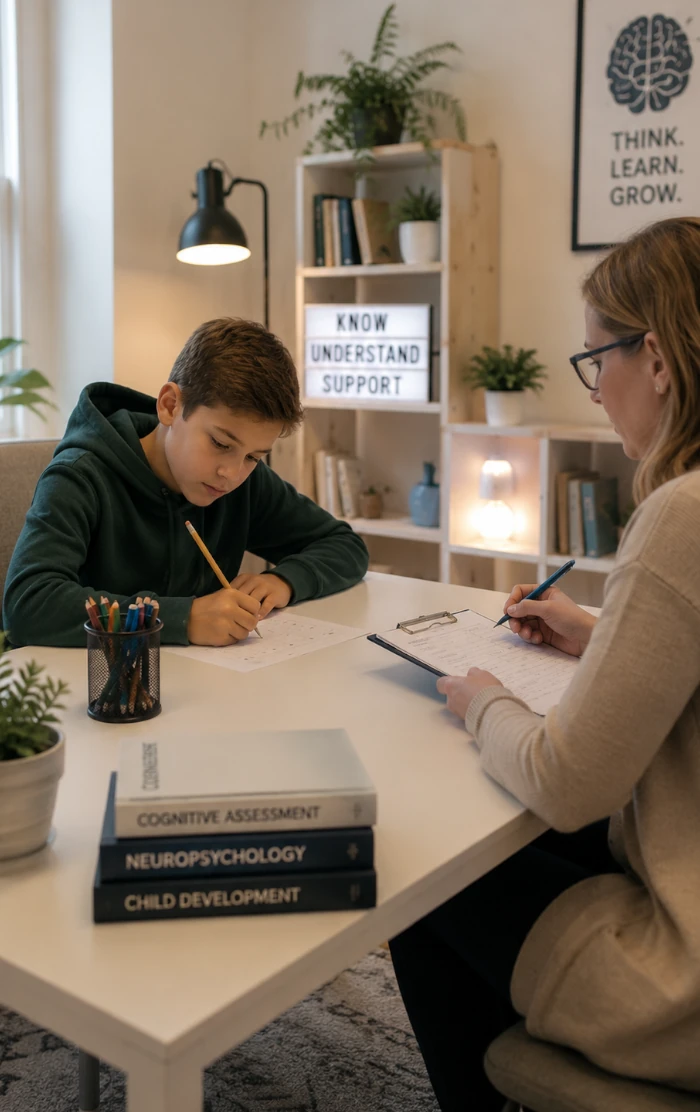
Professional child IQ testing in Tacoma – whether you need an assessment for school placement, gifted program eligibility, or to understand your child's learning profile, we connect you with licensed psychologists in the Tacoma area.
Last Updated: September 2026
Gifted Testing
Identify giftedness for school placement, enrichment, and talent programs using WISC-V or Stanford-Binet 5.
WISC-V Test
Wechsler Intelligence Scale for Children® Fifth Edition – the gold standard for child IQ testing.
Stanford-Binet 5
Stanford-Binet Intelligence Scales Fifth Edition – comprehensive cognitive assessment for all ages.
Full Evaluation
Combined assessment with detailed report and recommendations. Includes WISC-V or Stanford-Binet 5.
School Placement Testing
Testing for private school admission and gifted program eligibility using WISC-V or Stanford-Binet 5.
Schedule Child IQ Testing
Book your WISC-V & Stanford-Binet 5 for ages 6–16. Gifted identification, learning profiles, etc. with a licensed psychologist in Tacoma today.
Child IQ Testing in Tacoma: city context
Tacoma families seek child IQ testing for Highly Capable identification, SAIL placement questions, private-school planning, early entrance, acceleration, ADHD or learning concerns, twice-exceptional profiles, disability evaluation, and educational recommendations.
IQ by gender & ethnicity (child population)
Children under 18 represent 19.8% of Tacoma's population. Tacoma is racially, culturally, linguistically, and economically diverse. Citywide race, ethnicity, language, and gender statistics describe populations—not individual ability. Fair testing requires age-appropriate national norms and careful consideration of language exposure, culture, disability, educational opportunity, anxiety, attention, health, and testing conditions.
- Language: 18.7% of residents age 5+ speak a language other than English at home, making language history and interpreter/bilingual options important.
- School context: Tacoma Public Schools uses district screening and multidisciplinary review; a private IQ score does not automatically determine eligibility.
- Referral choice: A stand-alone WISC-V or SB-5 may answer a narrow question, while ADHD, learning, autism, emotional, or complex school concerns often require a broader psychoeducational evaluation.
Tacoma School Districts and Gifted Programs
Tacoma Public Schools Highly Capable Screening and Identification
Tacoma Public Schools universally screens all second- and fifth-grade students. Second graders take the NNAT3 in fall; fifth graders are reviewed in spring. Students in other grades may be referred by parents, teachers, community members, or themselves. The Multidisciplinary Placement Committee reviews multiple measures, and the district states that one score cannot independently qualify or disqualify a student.
Cluster Grouping and SAIL Elementary Services
The standard K–12 model includes differentiated learning in cluster-grouped general-education classrooms. Identified students in grades 3–5 may also receive SAIL—Self-contained Advanced In-depth Learning—in designated multi-grade classrooms using accelerated pacing, extensions, creative expression, critical thinking, and leadership development. Current sites, boundaries, transportation, and placement rules should be confirmed annually.
Middle- and High-School Advanced Pathways
Grades 6–8 use learning plans and differentiated instruction. Depending on school, students may access advanced pathways, AP, IB, AVID, specialty schools such as SAMi, SOTA and iDEA, Running Start, College in the High School, honors, dual credit, and career-technical options. Identification does not eliminate course prerequisites or scheduling requirements.
Nearby District and School Options
University Place, Clover Park, Franklin Pierce, Fife, Puyallup, Federal Way, Peninsula, Steilacoom, and other districts use separate Highly Capable criteria, timelines, service models, and transfer rules. Private and independent schools set their own admissions and placement requirements.
Washington Highly Capable Education Framework
Washington treats Highly Capable services as part of basic education. State law and WAC 392-170 require equitable identification, universal screening, multiple objective criteria, multidisciplinary selection, and appropriate accelerated learning. Private testing can be supplemental evidence but does not override district procedures.
Tacoma Private Schools and Programs Using Testing Information
- Independent and faith-based schools: Schools such as Annie Wright Schools, Bellarmine Preparatory, Charles Wright Academy, Life Christian Academy, and other regional programs establish their own admissions, readiness, achievement, interview, and testing requirements.
- Specialty public programs: SAMi, SOTA, iDEA, IB, AP, Running Start, and career-technical programs use their own enrollment, application, prerequisite, or lottery procedures.
- Early entrance: Tacoma Public Schools offers a rigorous early-kindergarten exception process for eligible children with birthdays in the district's stated window; families must follow current application and readiness requirements.
- Outside reports: Ask the receiving school whether it accepts WISC-V, Stanford-Binet, achievement, readiness, adaptive, behavioral, or language measures and how recent the report must be.
Tacoma Gifted Identification Statistics
- No single citywide rate: Tacoma does not publish one combined gifted-identification percentage covering TPS, nearby districts, private schools, and homeschool programs.
- Universal grades: TPS screens all second- and fifth-grade students, which reduces reliance on parent or teacher referral at those grades.
- Multiple measures: Eligibility decisions use cognitive, achievement, district/state assessment, referral, and other evidence; no one score is decisive.
- Equity goal: District policy emphasizes equitable identification and a served population that better reflects district demographics.
- Private testing: Private cognitive reports are not the same as district identification and do not guarantee SAIL, acceleration, course placement, IEP, 504, or admission.
The child IQ testing process: step by step
Understanding the testing process can help parents prepare their child and reduce anxiety. Here's what to expect:
- Initial consultation (15–20 minutes): A brief phone or video call with the psychologist to discuss your child's background, concerns, and goals. This helps determine the right test and approach.
- Testing session (60–90 minutes): The child meets one-on-one with a licensed psychologist in a quiet, comfortable room. The psychologist administers the WISC-V or Stanford-Binet 5, which includes a series of subtests measuring verbal comprehension, visual-spatial reasoning, fluid reasoning, working memory, and processing speed. Breaks are offered as needed.
- Scoring and interpretation (1–2 days): The psychologist scores the test and analyzes the results. They consider the child's age, background, and any relevant medical or educational history.
- Feedback session (45–60 minutes): The psychologist meets with the parents (and the child, if appropriate) to explain the results. They discuss the Full-Scale IQ, index scores, strengths, and areas for growth. They also provide tailored recommendations for home, school, and extracurriculars.
- Comprehensive written report (5–7 days): You receive a detailed report with all scores, normative comparisons, and actionable next steps. This report can be shared with schools, doctors, or other professionals.
The entire process from consultation to report usually takes 1–2 weeks, depending on scheduling. The testing itself is non-invasive and designed to be engaging for children.
What is the WISC-V test?
The WISC-V (Wechsler Intelligence Scale for Children® – Fifth Edition) is the most widely used IQ test for children aged 6:0–16:11. It provides a Full-Scale IQ and five primary index scores: Verbal Comprehension, Visual-Spatial, Fluid Reasoning, Working Memory, and Processing Speed. The test is administered one-on-one by a trained psychologist and takes about 60–90 minutes.
The WISC-V is normed on a large, representative sample of U.S. children and is updated regularly to ensure accuracy. It is the gold standard for gifted identification, learning disability diagnosis, and school placement.
Why test your child's IQ?
IQ testing provides valuable insights into your child's cognitive strengths and weaknesses. It can help:
- Identify giftedness: For admission to gifted programs, private schools, or enrichment opportunities.
- Diagnose learning disabilities: Such as dyslexia, dyscalculia, or ADHD, which can be masked by high intelligence.
- Guide educational planning: Tailor instruction to your child's unique learning profile.
- Provide reassurance: Understand why your child is different from peers and how to support them.
Tacoma Gifted Testing Timeline
- Second grade: Universal NNAT3 screening occurs in fall, with spring makeup opportunities for students who were absent.
- Fifth grade: Universal record/data review occurs in spring; additional testing is not automatically required.
- Other grades: Referrals are accepted under district procedures and placed on the spring multidisciplinary-review calendar; late referrals requiring testing may move to the following school year.
- New students: Registered students may access late-summer or mid-year screening procedures and should provide prior state, math, reading, and Highly Capable records.
- Private assessment: Schedule early enough for intake, testing, scoring, feedback, school deadlines, records, and possible follow-up measures.
Tacoma Gifted Programs by Age Group
- Preschool and kindergarten: Developmental enrichment, private evaluation when appropriate, and Tacoma's separate early-kindergarten entrance process.
- Grades K–2: Cluster-grouped differentiated learning for identified students; universal screening occurs in grade 2.
- Grades 3–5: Cluster grouping, learning plans, and possible SAIL self-contained advanced classrooms at designated schools.
- Grades 6–8: Differentiated learning plans, advanced pathways, accelerated subjects, IB/AP preparation, AVID, and school-specific options.
- Grades 9–12: AP, IB, honors, specialty high schools, Running Start, College in the High School, dual credit, career-technical pathways, and individualized acceleration.
- Outside school: Museums, Tacoma Public Library, Metro Parks, universities, arts organizations, robotics, coding, music, debate, and regional gifted-youth groups provide enrichment.
Tacoma Child ADHD and Learning Disability Assessment
IQ testing alone does not diagnose ADHD, dyslexia, autism, anxiety, or other learning and developmental conditions. A comprehensive evaluation may combine WISC-V or SB-5 results with achievement, attention, executive-function, memory, language, behavior, social-emotional, adaptive, developmental, and record data.
- School evaluations: Tacoma Public Schools and nearby districts evaluate eligible students under special-education and Section 504 rules when disability affects education.
- Medical and private resources: Mary Bridge Children's Hospital, MultiCare, Virginia Mason Franciscan Health, pediatric providers, and private psychologists use different referral pathways.
- Twice exceptionality: High reasoning ability can coexist with ADHD, learning disability, autism, anxiety, medical conditions, or executive-function weaknesses.
Tacoma Summer Programs for Gifted Children
- Tacoma Public Schools and community programs: Summer learning, arts, STEM, recreation, and enrichment offerings vary each year.
- UW Tacoma, Tacoma Community College, University of Puget Sound and PLU: May host youth camps, academic events, athletics, music, coding, science, or college-readiness activities.
- Museums and cultural organizations: Museum of Glass, Tacoma Art Museum, Washington State History Museum, Foss Waterway Seaport, Point Defiance Zoo & Aquarium, and Tacoma Public Library offer educational programming.
- Regional gifted resources: Mensa of Western Washington, Northwest Gifted Child Association, Robinson Center, CTY, Davidson, and online programs have separate eligibility and schedules.
Tacoma Child Testing Costs by Provider Type
- Stand-alone cognitive testing: Commonly several hundred dollars, depending on instrument, examiner, feedback, and report detail.
- Psychoeducational evaluation: Often $1,500–$4,000 or more when achievement, attention, behavior, records, interviews, and recommendations are included.
- Neuropsychological evaluation: May cost more because it uses a broader battery and more professional time.
- School evaluation: Public-school testing follows educational eligibility procedures and is not billed like private assessment.
- Insurance: Coverage is more likely for medically necessary diagnostic questions than for gifted or private-school placement testing; verify authorization, deductibles, networks, and report purpose.
Areas we serve
We support all areas of Tacoma.
Frequently Asked Questions
Both are excellent tests. WISC-V is more commonly used for school-age children, while Stanford-Binet 5 can be used for ages 2–85. We often recommend WISC-V for gifted identification.
The test itself takes 60–90 minutes. With the consultation, feedback, and report, the entire process is about 1–2 weeks.
No, you can book directly with our psychologists. We serve both self-referred and professionally referred children.
Professional results may be considered by public districts, private schools, and enrichment programs, but each organization sets its own accepted tests, score age, report requirements, and eligibility rules.
Some plans cover cognitive assessments when there is a clinical indication. Check with your provider.
Get a good night's sleep, eat a healthy meal, and arrive relaxed. No specific preparation is needed.
You'll receive a comprehensive report with your child's scores and tailored recommendations.
Interviews and feedback may be available remotely, but many standardized cognitive tests require controlled administration and may need an in-person appointment. Contact us for details.