
Child IQ Testing in Syracuse

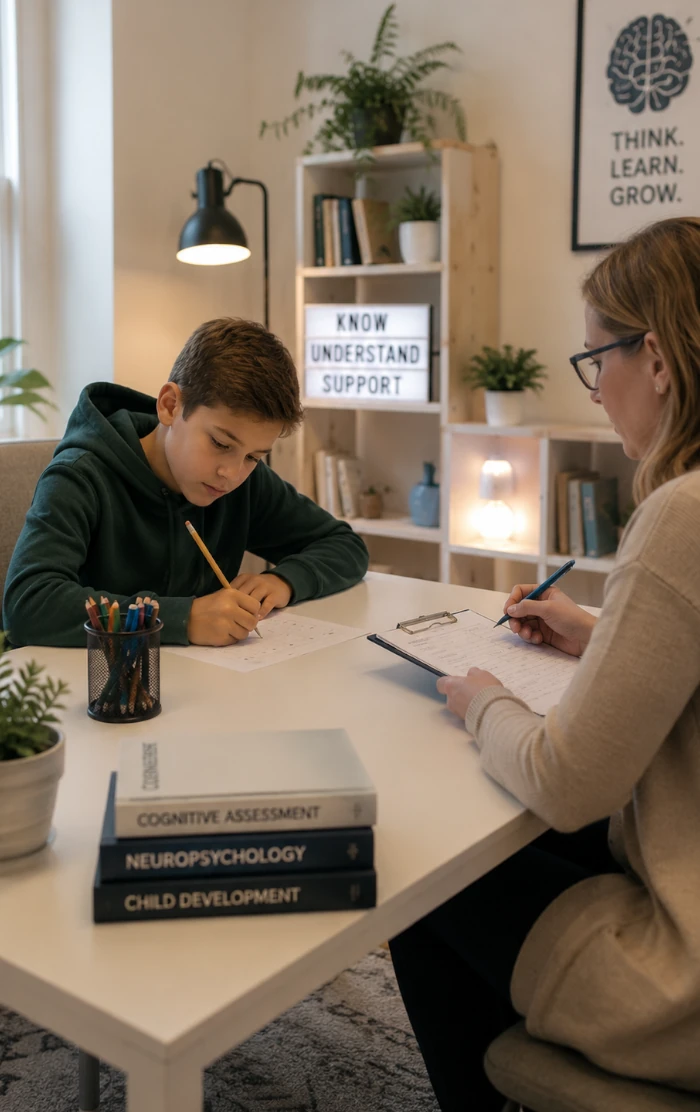
Professional child IQ testing in Syracuse – whether you need an assessment for school placement, gifted program eligibility, or to understand your child's learning profile, we connect you with licensed psychologists in the Syracuse area.
Last Updated: September 2026
Gifted Testing
Identify giftedness for school placement, enrichment, and talent programs using WISC-V or Stanford-Binet 5.
WISC-V Test
Wechsler Intelligence Scale for Children® Fifth Edition – the gold standard for child IQ testing.
Stanford-Binet 5
Stanford-Binet Intelligence Scales Fifth Edition – comprehensive cognitive assessment for all ages.
Full Evaluation
Combined assessment with detailed report and recommendations. Includes WISC-V or Stanford-Binet 5.
School Placement Testing
Testing for private school admission and gifted program eligibility using WISC-V or Stanford-Binet 5.
Schedule Child IQ Testing
Book your WISC-V & Stanford-Binet 5 for ages 6–16. Gifted identification, learning profiles, etc. with a licensed psychologist in Syracuse today.
Child IQ Testing in Syracuse: city context
Syracuse children grow up in a culturally and linguistically varied Central New York city. City Census data show that 20.5% of residents are under age 18, 12.7% are foreign born, and 19.2% of residents age five and older speak a language other than English at home. A child's language exposure, school history, immigration history, disability status, and opportunity to learn must be considered when selecting and interpreting cognitive tests.
Professional child testing in Syracuse commonly supports gifted eligibility, learning-disability assessment, ADHD evaluation, autism and developmental questions, private-school planning, grade acceleration, accommodations, and twice-exceptional profiles.
IQ by gender & ethnicity (child population)
Syracuse is approximately 51.7% female overall. Broad IQ distributions are similar for boys and girls, but individual children can show meaningful differences among verbal, visual-spatial, fluid-reasoning, working-memory, and processing-speed tasks. No authoritative Syracuse dataset establishes separate child IQ averages by sex, race, ethnicity, neighborhood, or home language.
Relevant demographic and educational context includes:
- Hispanic or Latino population: 10.2% citywide.
- Black population: 27.3% identify as Black alone.
- Foreign-born population: 12.7%.
- Language other than English at home: 19.2% of residents age five and older.
- Assessment implication: Bilingual history and English proficiency should be reviewed before using verbally loaded measures.
- Interpretation: Scores should be integrated with school records, achievement data, observations, developmental history, and parent/teacher information.
Demographic group percentages do not predict an individual child's ability. A qualified psychologist determines whether English, Spanish, nonverbal, bilingual, or other assessment approaches are appropriate.
Onondaga County School Districts and Gifted Programs
Onondaga County Public Schools Gifted Education
- State framework: New York defines gifted learners as students with superior intellectual development who are capable of high performance.
- Referral: Parents, teachers, school teams, or other qualified professionals may raise concerns and request consideration under district procedures.
- Evaluation: Eligibility decisions use psychological evaluation and educational information; a single online score is not sufficient.
- Educational Plan: Eligible students receive an EP describing gifted goals, services, and progress monitoring.
- Language considerations: Syracuse's multilingual population may require bilingual records review, language-proficiency data, or appropriate nonverbal measures.
Syracuse City School District Magnet and Choice Programs
- Academic magnets: Programs may include STEM, law, health, engineering, environmental science, visual and performing arts, and other themes under current school offerings.
- Admissions: Requirements vary; many magnet programs use eligibility criteria and random selection rather than a clinical IQ test.
- Application calendar: Families should review the current School Choice and Parental Options timeline each year.
- Gifted services: Magnet admission and gifted eligibility are separate processes, even when a school serves many advanced learners.
- Records: Report cards, standardized achievement, attendance, conduct, auditions, or prerequisite coursework may matter depending on the program.
School for Advanced Studies
- Grades served: Primarily grades 11–12.
- Model: Public dual-enrollment program based at Onondaga Community College campuses.
- Acceleration: Students combine high-school requirements with college coursework and may complete substantial college credit.
- Testing: Admission is based on current program requirements; families should not assume that an IQ score is required or sufficient.
Advanced and Dual-Enrollment Options
- Academic focus: Accelerated high-school and college coursework through partnership with Syracuse University.
- Dual enrollment: Qualified students may take approved Syracuse University or Onondaga Community College courses alongside high-school requirements.
- Planning: Strong executive functioning, study skills, and readiness for college-level pace are important considerations.
- Admissions: Families should use the current program application criteria rather than relying on an outside IQ score alone.
New York Gifted Requirements and Other School Options
- District responsibility: New York districts submit procedures for gifted identification and services under exceptional-student-education rules.
- Private schools: Independent schools set their own admission and accommodation policies; some request achievement or psychoeducational records, while others do not require cognitive testing.
- Charter schools: Charter enrollment, lottery, and program criteria differ by school and are not the same as gifted eligibility.
- Twice-exceptional students: Giftedness can coexist with ADHD, dyslexia, autism, anxiety, or other learning and developmental needs.
- Outside evaluations: Before testing privately, ask whether the target school or district accepts outside reports and what credentials, test editions, dates, and score formats it requires.
- Procedural safeguards: Families should receive written notice and understand consent, evaluation, eligibility, placement, and dispute-resolution rights under New York exceptional-student-education procedures.
- Multilingual records: Review ESOL level, language of instruction, years of schooling, interruptions in education, and literacy in each language before interpreting verbal scores.
- Achievement evidence: Reading, mathematics, writing, classroom performance, and progress-monitoring data help distinguish high ability from uneven opportunity or a learning disorder.
- Teacher input: Classroom observations and rating scales can document advanced reasoning, creativity, motivation, persistence, and the need for differentiated instruction.
- Parent input: Developmental history, early milestones, interests, problem-solving behavior, and examples of advanced learning provide important context.
- Program fit: Eligibility does not guarantee that every magnet, acceleration, or enrichment option is appropriate; academic pace, emotional readiness, transportation, and family logistics matter.
- Reevaluation and transitions: Families should plan for EP reviews, school changes, middle- and high-school transitions, and updated documentation when needs or receiving organizations change.
Syracuse Private Schools Requiring IQ Testing
Private-school requirements change frequently, and many Syracuse independent schools do not require an IQ test for routine admission. Families sometimes obtain cognitive or psychoeducational evaluations for grade placement, gifted planning, learning support, accommodations, or complex admissions questions. Always confirm the current policy directly with the school.
- Ransom Everglades School: Selective independent middle and upper school; use the school's current admissions checklist and testing rules.
- Gulliver Preparatory School: Independent PK–12 system with academic and student-support services; requirements vary by grade and program.
- Carrollton School of the Sacred Heart: Independent girls' school; families should confirm current admissions and accommodation documentation.
- Syracuse Country Day School: Independent PK–12 school in Syracuse Shores; testing requirements depend on the applicant's grade and circumstances.
- Palmer Trinity School: Independent Episcopal middle and upper school; current admissions requirements should be checked directly.
- Belen Jesuit Preparatory School: Boys' school with its own entrance and placement process; an outside IQ score should not be assumed to replace required school testing.
- Learning-support documentation: Schools may request a recent comprehensive report for accommodations even when no IQ test is required for admission.
Syracuse Gifted Identification Statistics
- District scale: Onondaga County Public Schools serves hundreds of thousands of students across traditional, magnet, charter, alternative, and specialized settings.
- State reporting: New York gifted enrollment can be reviewed through state education data systems; counts change by school year and should not be estimated from city population alone.
- Eligibility: Gifted identification is an educational determination made under New York and district procedures, not a diagnosis and not merely a 130-IQ rule.
- Underrepresentation: Multilingual learners, low-income students, students with disabilities, and children with uneven achievement may require proactive referral and culturally responsive assessment.
- Outside testing: Private reports may inform school teams, but district acceptance and additional evaluation requirements should be confirmed in advance.
- Program availability: Services depend on the student's school, grade, Educational Plan, and district placement options.
The child IQ testing process: step by step
Understanding the testing process can help parents prepare their child and reduce anxiety. Here's what to expect:
- Initial consultation (15–20 minutes): A brief phone or video call with the psychologist to discuss your child's background, concerns, and goals. This helps determine the right test and approach.
- Testing session (60–90 minutes): The child meets one-on-one with a licensed psychologist in a quiet, comfortable room. The psychologist administers the WISC-V or Stanford-Binet 5, which includes a series of subtests measuring verbal comprehension, visual-spatial reasoning, fluid reasoning, working memory, and processing speed. Breaks are offered as needed.
- Scoring and interpretation (1–2 days): The psychologist scores the test and analyzes the results. They consider the child's age, background, and any relevant medical or educational history.
- Feedback session (45–60 minutes): The psychologist meets with the parents (and the child, if appropriate) to explain the results. They discuss the Full-Scale IQ, index scores, strengths, and areas for growth. They also provide tailored recommendations for home, school, and extracurriculars.
- Comprehensive written report (5–7 days): You receive a detailed report with all scores, normative comparisons, and actionable next steps. This report can be shared with schools, doctors, or other professionals.
The entire process from consultation to report usually takes 1–2 weeks, depending on scheduling. The testing itself is non-invasive and designed to be engaging for children.
What is the WISC-V test?
The WISC-V (Wechsler Intelligence Scale for Children® – Fifth Edition) is the most widely used IQ test for children aged 6:0–16:11. It provides a Full-Scale IQ and five primary index scores: Verbal Comprehension, Visual-Spatial, Fluid Reasoning, Working Memory, and Processing Speed. The test is administered one-on-one by a trained psychologist and takes about 60–90 minutes.
The WISC-V is normed on a large, representative sample of U.S. children and is updated regularly to ensure accuracy. It is the gold standard for gifted identification, learning disability diagnosis, and school placement.
Why test your child's IQ?
IQ testing provides valuable insights into your child's cognitive strengths and weaknesses. It can help:
- Identify giftedness: For admission to gifted programs, private schools, or enrichment opportunities.
- Diagnose learning disabilities: Such as dyslexia, dyscalculia, or ADHD, which can be masked by high intelligence.
- Guide educational planning: Tailor instruction to your child's unique learning profile.
- Provide reassurance: Understand why your child is different from peers and how to support them.
Syracuse Gifted Testing Timeline
- Initial concern or referral: Parent, teacher, or school team documents advanced learning needs and reviews current performance.
- Screening and records review: School data may include achievement, classroom work, observations, language information, and prior testing.
- Consent: Written parent consent is generally required before an individual psychological evaluation.
- Evaluation: A qualified school or private psychologist administers appropriate cognitive measures and gathers supporting data.
- Eligibility meeting: A multidisciplinary team reviews whether the student meets New York and district gifted criteria.
- Educational Plan: If eligible, the team develops goals and services; this is separate from magnet admission.
- Magnet and private-school deadlines: Application windows often occur in fall and winter, so families should begin well before a school deadline.
- Outside-report lead time: Allow time for consultation, testing, scoring, report writing, feedback, and any school-requested follow-up.
Syracuse Gifted Programs by Age Group
- Preschool: Developmental assessment may identify advanced language, reasoning, or early academic skills, but formal gifted eligibility usually follows school-district procedures.
- Elementary school: Cluster grouping, gifted resource services, enrichment, differentiated curriculum, subject acceleration, and magnet options may be available.
- Middle school: Advanced coursework, honors, accelerated mathematics, specialized magnets, project-based learning, and talent-development programs become more prominent.
- High school: Current honors, Advanced Placement, dual-enrollment, career-technical, arts, and specialized pathways vary by school and year.
- Twice-exceptional students: Programs should address both advanced potential and disability-related needs through coordinated gifted and exceptional-student services.
- Summer and extracurricular options: Universities, museums, arts organizations, coding programs, environmental-science centers, and community organizations offer enrichment outside school.
Syracuse Child ADHD and Learning Disability Assessment
- Comprehensive approach: ADHD and learning-disability evaluations should include history, interviews, rating scales, school records, achievement testing, and cognitive or executive-function measures as appropriate.
- Local clinical resources: Upstate Golisano Children's Hospital, SUNY Upstate services, Crouse Health, and private psychologists provide various pediatric services.
- School evaluation: Syracuse City School District can evaluate suspected disabilities through exceptional-student-education procedures when concerns affect school functioning.
- Bilingual assessment: Language acquisition must be distinguished from disability; evaluators should document language dominance and educational exposure.
- Twice exceptionality: High reasoning ability can mask dyslexia, ADHD, autism, anxiety, or slow processing, while disability symptoms can obscure gifted potential.
- Documentation: Ask schools and testing agencies what recency, test editions, diagnostic evidence, and functional-impact statements are required for accommodations.
Syracuse Summer Programs for Gifted Children
- Syracuse University youth programs: Offerings vary annually across academics, music, athletics, precollege study, health, and enrichment.
- Syracuse University camps: Summer options may include STEM, coding, engineering, arts, business, environment, and college-preparation themes.
- Onondaga Community College: Campus-based youth, arts, technology, academic, and workforce programs vary by location and year.
- Frost Science: Science camps and public programming support hands-on STEM learning.
- Zoo Syracuse, Fairchild, and environmental programs: Provide biology, conservation, ecology, and outdoor learning experiences.
- Arts organizations: Syracuse City Ballet, New World Symphony, museums, theaters, and community arts centers offer performance and creative-development opportunities.
- Selection: Match the program to the child's interests, stamina, social needs, transportation, and readiness rather than using IQ alone.
Syracuse Child Testing Costs by District
- Public-school evaluation: When Syracuse City School District initiates an evaluation under applicable exceptional-student-education procedures, eligible school-based evaluation services are provided through the district rather than billed as private testing.
- Private single cognitive test: Fees vary by psychologist, test, language needs, report length, and feedback services.
- Psychoeducational evaluation: Costs are higher when cognitive, academic, attention, memory, executive-function, behavioral, and emotional measures are combined.
- Neuropsychological evaluation: Complex medical, neurological, developmental, or forensic questions require more testing and professional time.
- Insurance: Educational or gifted testing is often not covered; medically necessary neuropsychological services may be covered subject to referral, authorization, network, deductible, and plan rules.
- School acceptance: Confirm report requirements before paying privately, especially for gifted eligibility, accommodations, private-school admission, or standardized-test accommodations.
- Language services: Bilingual assessment, interpreters, translated records, and additional testing sessions can affect cost and scheduling.
Areas we serve
We support all areas of Syracuse.
Frequently Asked Questions
Both are excellent tests. WISC-V is more commonly used for school-age children, while Stanford-Binet 5 can be used for ages 2–85. We often recommend WISC-V for gifted identification.
The test itself takes 60–90 minutes. With the consultation, feedback, and report, the entire process is about 1–2 weeks.
No, you can book directly with our psychologists. We serve both self-referred and professionally referred children.
Yes, our reports are accepted by Syracuse City School District, private schools, and other gifted programs.
Some plans cover cognitive assessments when there is a clinical indication. Check with your provider.
Get a good night's sleep, eat a healthy meal, and arrive relaxed. No specific preparation is needed.
You'll receive a comprehensive report with your child's scores and tailored recommendations.
Some interview and feedback components may be available remotely, but many standardized cognitive tests require in-person administration. Confirm with the psychologist and the organization receiving the report.