
Child IQ Testing in Springfield, MO

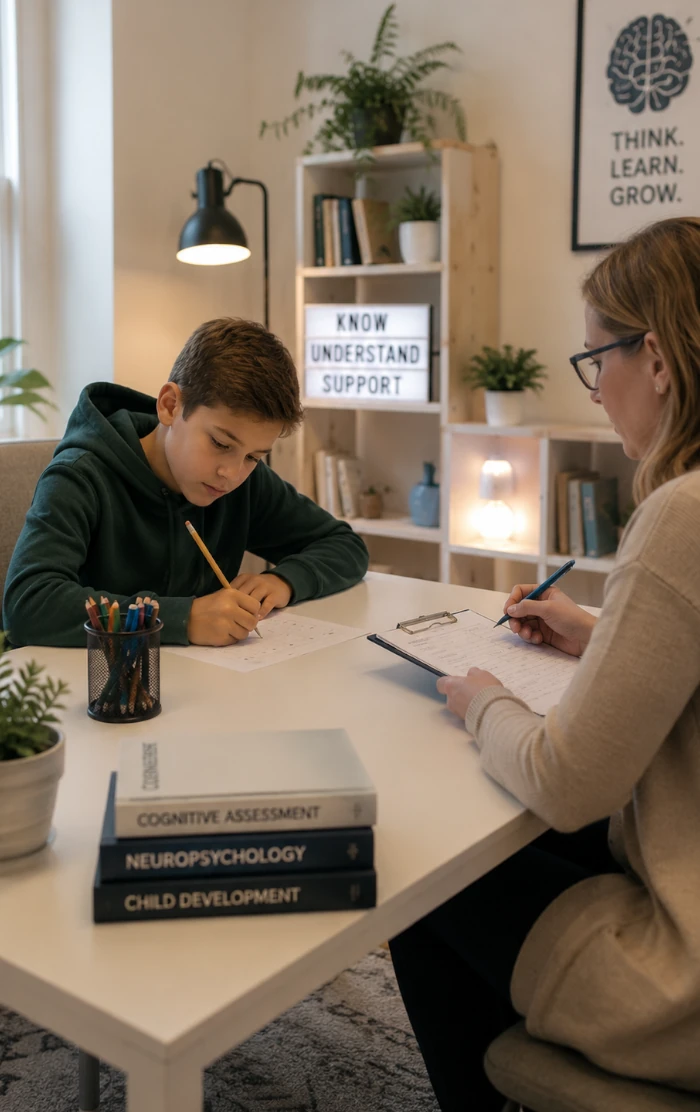
Professional child IQ testing in Springfield, MO – whether you need an assessment for school placement, gifted program eligibility, or to understand your child's learning profile, we connect you with licensed psychologists in the Springfield, MO area.
Last Updated: September 2026
Gifted Testing
Identify giftedness for school placement, enrichment, and talent programs using WISC-V or Stanford-Binet 5.
WISC-V Test
Wechsler Intelligence Scale for Children® Fifth Edition – the gold standard for child IQ testing.
Stanford-Binet 5
Stanford-Binet Intelligence Scales Fifth Edition – comprehensive cognitive assessment for all ages.
Full Evaluation
Combined assessment with detailed report and recommendations. Includes WISC-V or Stanford-Binet 5.
School Placement Testing
Testing for private school admission and gifted program eligibility using WISC-V or Stanford-Binet 5.
Schedule Child IQ Testing
Book your WISC-V & Stanford-Binet 5 for ages 6–16. Gifted identification, learning profiles, etc. with a licensed psychologist in Springfield, MO today.
Child IQ Testing in Springfield, MO: city context
Springfield families use cognitive assessment for gifted-program questions, learning and attention concerns, twice-exceptional profiles, school planning, disability documentation, and a clearer understanding of a child's strengths. The city is home to Springfield Public Schools, independent and faith-based schools, charter options, and regional programs that serve families from across southwest Missouri.
Children should be assessed with attention to age, developmental history, school opportunity, language exposure, sensory or motor needs, health, sleep, anxiety, and the specific decision the results will inform. An IQ score alone does not diagnose ADHD, dyslexia, autism, or an emotional disorder and should not be treated as a permanent limit on learning.
IQ by gender & ethnicity (child population)
Springfield is approximately 51.6% female overall. Standardized intelligence tests are designed so broad averages are similar for girls and boys, while individual children may show meaningful differences among verbal, visual-spatial, fluid-reasoning, working-memory, and processing-speed skills. No authoritative Springfield dataset reports child IQ averages by sex, race, ethnicity, school, neighborhood, or family income.
- Citywide context: 83.8% White alone, 4.6% Black alone, 1.9% Asian alone, 7.4% two or more races, and 5.8% Hispanic or Latino.
- Language context: 6.1% of residents age five and older speak a language other than English at home.
- Assessment implication: The examiner should review language proficiency, educational access, attendance, interventions, and the child's opportunity to learn before interpreting verbally loaded scores.
- Interpretation: Cognitive results are strongest when integrated with achievement testing, teacher and parent information, records, observations, and developmental history.
Demographic group membership must never be used to infer an individual child's ability. Test selection and interpretation should be culturally responsive and matched to the referral question.
Springfield Public Schools and Gifted Programs
Springfield Public Schools provides gifted services through the Phelps Center for Gifted Education. Families should obtain the district's current referral windows, screening procedures, eligibility criteria, and program descriptions because requirements can change.
Springfield Public Schools Gifted Education
The district's WINGS program and related services use a formal identification process. A privately administered WISC-V or Stanford-Binet score may be reviewed, but the district determines whether additional screening or district evaluation is required and whether a student meets current Missouri and local criteria.
WINGS and Elementary Services
WINGS serves identified students through specialized instruction at the Phelps Center. Referral does not guarantee placement, and parents should confirm grade levels, transportation, schedule, and the evidence used in current decisions.
Springfield, MO Scholars
Springfield, MO Scholars is a full-time option for highly gifted students in the middle grades. Admission is selective and multi-factor; families should use the district's current application materials rather than assume a single IQ cutoff.
Advanced Learning in Middle and High School
Honors, Advanced Placement, dual-credit, career-technical, arts, and other advanced opportunities may use course prerequisites or program-specific criteria separate from gifted identification.
Missouri Gifted Requirements and Other School Options
Missouri provides state guidance while local districts design identification and services. Charter, independent, and faith-based schools set their own placement rules. Ask each receiving school exactly which test, edition, age of results, examiner credentials, and report elements it will accept.
Springfield, MO Private Schools Requiring IQ Testing
No single list can establish that every Springfield private school requires an IQ test. Admission practices differ by school, grade, and year. Some schools use records, interviews, readiness measures, achievement testing, classroom visits, or program-specific assessments instead of a clinical IQ test.
- Contact the admissions office before scheduling and request written testing requirements.
- Confirm whether WISC-V, Stanford-Binet 5, an achievement test, or another measure is requested.
- Ask about score age, report format, psychologist licensure, deadlines, and whether outside results are accepted.
- Do not assume that a high score guarantees admission, grade acceleration, scholarship support, or gifted services.
- For disability accommodations, ask what evidence of current educational impact is required in addition to diagnosis.
Springfield, MO Gifted Identification Statistics
Springfield Public Schools does not provide a simple citywide percentage that can be converted into an expected IQ distribution or a guaranteed chance of gifted placement. Identification numbers vary by grade, referral patterns, screening practices, program capacity, and current policy.
- No neighborhood inference: School or neighborhood demographics do not establish a child's ability.
- Multiple criteria: District decisions may consider cognitive, achievement, creativity, performance, observation, and other evidence.
- Private results: Outside reports may contribute information but do not override district procedures.
- Equitable referral: Language, disability, income, mobility, and access to enrichment can affect referral patterns and should be considered in fair identification.
The child IQ testing process: step by step
Understanding the testing process can help parents prepare their child and reduce anxiety. Here's what to expect:
- Initial consultation (15–20 minutes): A brief phone or video call with the psychologist to discuss your child's background, concerns, and goals. This helps determine the right test and approach.
- Testing session (60–90 minutes): The child meets one-on-one with a licensed psychologist in a quiet, comfortable room. The psychologist administers the WISC-V or Stanford-Binet 5, which includes a series of subtests measuring verbal comprehension, visual-spatial reasoning, fluid reasoning, working memory, and processing speed. Breaks are offered as needed.
- Scoring and interpretation (1–2 days): The psychologist scores the test and analyzes the results. They consider the child's age, background, and any relevant medical or educational history.
- Feedback session (45–60 minutes): The psychologist meets with the parents (and the child, if appropriate) to explain the results. They discuss the Full-Scale IQ, index scores, strengths, and areas for growth. They also provide tailored recommendations for home, school, and extracurriculars.
- Comprehensive written report (5–7 days): You receive a detailed report with all scores, normative comparisons, and actionable next steps. This report can be shared with schools, doctors, or other professionals.
The entire process from consultation to report usually takes 1–2 weeks, depending on scheduling. The testing itself is non-invasive and designed to be engaging for children.
What is the WISC-V test?
The WISC-V (Wechsler Intelligence Scale for Children® – Fifth Edition) is the most widely used IQ test for children aged 6:0–16:11. It provides a Full-Scale IQ and five primary index scores: Verbal Comprehension, Visual-Spatial, Fluid Reasoning, Working Memory, and Processing Speed. The test is administered one-on-one by a trained psychologist and takes about 60–90 minutes.
The WISC-V is normed on a large, representative sample of U.S. children and is updated regularly to ensure accuracy. It is the gold standard for gifted identification, learning disability diagnosis, and school placement.
Why test your child's IQ?
IQ testing provides valuable insights into your child's cognitive strengths and weaknesses. It can help:
- Identify giftedness: For admission to gifted programs, private schools, or enrichment opportunities.
- Diagnose learning disabilities: Such as dyslexia, dyscalculia, or ADHD, which can be masked by high intelligence.
- Guide educational planning: Tailor instruction to your child's unique learning profile.
- Provide reassurance: Understand why your child is different from peers and how to support them.
Springfield, MO Gifted Testing Timeline
- Clarify the purpose: District referral, private-school admission, acceleration, enrichment planning, or clinical evaluation.
- Obtain current criteria: Request written requirements and deadlines from Springfield Public Schools or the receiving school.
- Gather records: Report cards, achievement results, teacher observations, prior evaluations, intervention history, and language/developmental information.
- Schedule appropriately: Leave time for intake, testing, scoring, feedback, report completion, and any district review.
- Avoid retesting too quickly: Practice effects and receiving-agency rules may limit when a test can be repeated.
- Plan next steps: Discuss enrichment, classroom differentiation, social-emotional needs, and twice-exceptional support rather than focusing only on the score.
Springfield, MO Gifted Programs by Age Group
- Preschool and early childhood: Assessment may address development, school readiness, unusually advanced skills, or clinical concerns; scores at young ages require cautious interpretation.
- Elementary school: WINGS and school-based differentiation may be considered under current district procedures.
- Middle school: Springfield, MO Scholars, advanced courses, subject acceleration, arts, and enrichment options may be relevant.
- High school: Honors, AP, dual credit, career-technical education, research, arts, and mentorship opportunities often matter more than repeating an IQ test.
- Independent education: Private, charter, homeschool, and regional programs set separate criteria and should be contacted directly.
Springfield, MO Child ADHD and Learning Disability Assessment
A child IQ score cannot diagnose ADHD, dyslexia, dysgraphia, dyscalculia, autism, language disorder, or emotional difficulties. A sound evaluation combines history, school records, achievement measures, behavior ratings, observations, interviews, and other tests chosen for the referral question.
- School route: Families may request evaluation through Springfield Public Schools when a suspected disability affects education.
- Private route: Licensed psychologists and neuropsychologists can provide independent evaluations; ask whether the report meets school or testing-agency standards.
- Medical route: Pediatricians, CoxHealth, Mercy, Burrell, and specialty providers may refer for developmental, behavioral, neurological, or psychiatric assessment.
- Twice exceptionality: High reasoning can coexist with ADHD, learning disability, autism, anxiety, or processing weaknesses.
- Intervention: Testing should lead to specific teaching, accommodation, treatment, and progress-monitoring recommendations.
Springfield, MO Summer Programs for Gifted Children
Summer opportunities change each year. Springfield families can review official calendars from the Phelps Center, Missouri State University, Drury University, Evangel University, Ozarks Tech, the Springfield-Greene County Library District, museums, arts organizations, camps, and regional STEM providers.
- Verify age, prerequisites, cost, transportation, supervision, accessibility, and whether formal gifted identification is required.
- Choose programs based on the child's interests and readiness rather than using IQ as the sole criterion.
- Balance challenge with rest, social connection, physical activity, and mental-health needs.
- For highly advanced learners, ask about subject acceleration, mentorship, research, music, coding, robotics, writing, or dual-enrollment options.
Springfield, MO Child Testing Costs by District
Evaluation through a public school may be available at no direct cost when the district determines an assessment is warranted under special-education or gifted procedures. Private testing is paid separately unless insurance applies to a medically necessary clinical question.
- Focused gifted or cognitive testing: Common private-market fees may begin in the hundreds of dollars.
- Psychoeducational evaluation: Costs increase when achievement, attention, behavior, records, and a detailed report are included.
- Neuropsychological evaluation: Broad medical or neurological evaluations can cost substantially more and take multiple sessions.
- Before paying: Confirm exactly what the district or school accepts, the deadline, report requirements, and whether additional testing will still be required.
Areas we serve
We support children and families throughout Springfield, MO. Confirm the psychologist's age range, school-system experience, test edition, office accessibility, report timeline, insurance status, and whether the receiving school accepts outside results.
Frequently Asked Questions
Both are excellent tests. WISC-V is more commonly used for school-age children, while Stanford-Binet 5 can be used for ages 2–85. We often recommend WISC-V for gifted identification.
The test itself takes 60–90 minutes. With the consultation, feedback, and report, the entire process is about 1–2 weeks.
No, you can book directly with our psychologists. We serve both self-referred and professionally referred children.
Yes, our reports are accepted by Springfield Public Schools, private schools, and other gifted programs.
Some plans cover cognitive assessments when there is a clinical indication. Check with your provider.
Get a good night's sleep, eat a healthy meal, and arrive relaxed. No specific preparation is needed.
You'll receive a comprehensive report with your child's scores and tailored recommendations.
Some interview and feedback components may be available remotely, but many standardized cognitive tests require in-person administration. Confirm with the psychologist and the organization receiving the report.