
IQ Testing in Springfield, MO

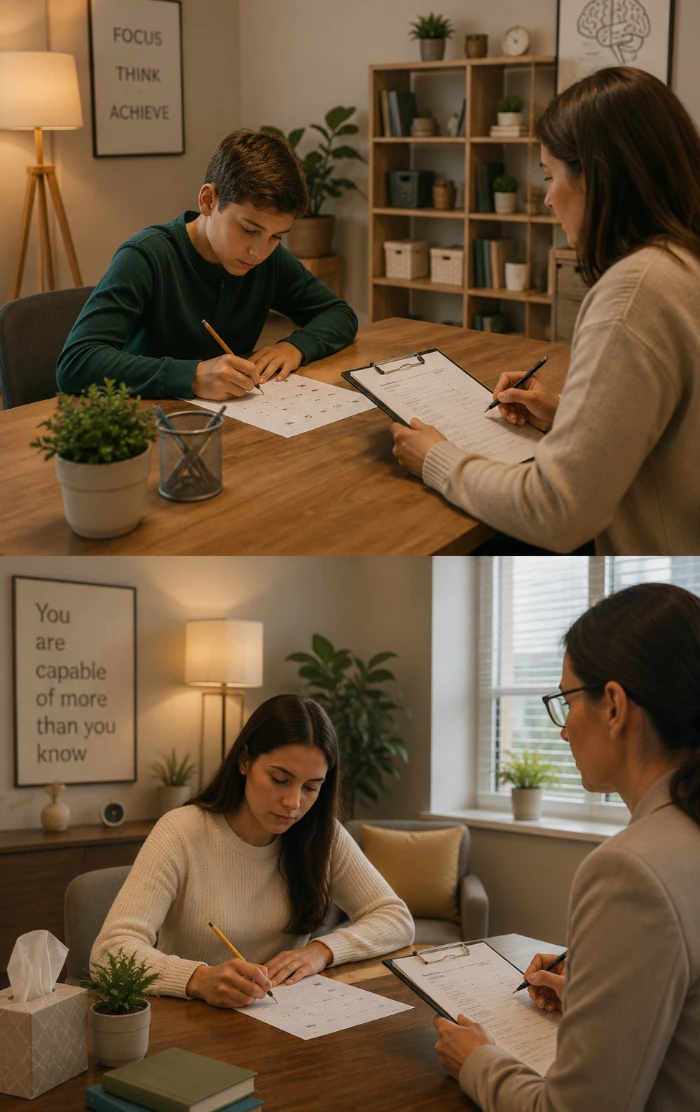
Professional IQ testing in Springfield, MO – whether you need an assessment for school, employment, gifted program eligibility, or personal insight, we connect you with licensed psychologists in the Springfield, MO area.
Last Updated: September 2026
Child IQ Testing
WISC-V & Stanford-Binet for ages 6–16. Gifted identification, learning profiles.
Adult IQ Testing
WAIS-IV & WAIS-5 available. Comprehensive adult cognitive assessments. Clinical & occupational.
WISC-V Test
Wechsler Intelligence Scale for Children® Fifth Edition – the gold standard for child IQ testing.
WAIS-IV & WAIS-5 Tests
Wechsler Adult Intelligence Scale® – Fourth Edition (WAIS-IV) and Fifth Edition (WAIS-5) available for adult IQ testing.
Gifted Testing
Identify giftedness for school placement, enrichment, and talent programs using WISC-V or Stanford-Binet.
Stanford-Binet 5
Stanford-Binet Intelligence Scales Fifth Edition – comprehensive cognitive assessment for all ages.
Mensa Testing
Professional cognitive testing for possible Mensa prior-evidence submission; confirm the current accepted test, edition, score, and documentation rules before scheduling.
Full Evaluation
Combined assessment with detailed report and recommendations. Includes WISC-V, WAIS-IV, WAIS-5, or Stanford-Binet 5 as appropriate.
IQ Testing in Springfield, MO: city context
Springfield is the principal city of southwest Missouri and a regional center for healthcare, higher education, logistics, manufacturing, retail, government, and professional services. The U.S. Census Bureau estimated 169,847 residents in 2025 across approximately 82.43 square miles of land. The city serves a much larger commuting, education, and healthcare region that includes communities throughout Greene and Christian counties.
Local testing needs reflect Springfield's large medical sector, multiple colleges and universities, public and independent schools, military-veteran population, and workforce spanning clinical care, education, transportation, advanced manufacturing, technology, public safety, and corporate services. A professional evaluation should consider education, health, language, disability, culture, and the referral question rather than treating a single score as a complete description of ability.
IQ by gender & ethnicity
Springfield's population is approximately 51.6% female. Modern intelligence tests are normed so broad male and female averages are similar, although individuals may have different profiles across verbal comprehension, visual-spatial reasoning, fluid reasoning, working memory, and processing speed. There is no authoritative city dataset establishing separate Springfield IQ averages by sex, race, ethnicity, neighborhood, or home language.
Current city demographic and educational context includes:
- White alone: 83.8% of residents; White non-Hispanic residents are 81.6%.
- Black alone: 4.6%.
- Asian alone: 1.9%.
- American Indian or Alaska Native alone: 0.3%.
- Native Hawaiian or other Pacific Islander alone: 0.2%.
- Two or more races: 7.4%.
- Hispanic or Latino residents: 5.8%.
- Foreign-born residents: 4.1%; 6.1% of residents age five and older speak a language other than English at home.
- Educational attainment: 92.8% of adults age 25 and older are high-school graduates or higher, and 31.4% hold a bachelor's degree or higher.
Population percentages do not predict an individual's cognitive ability. A licensed psychologist interprets results in light of the person's developmental, educational, medical, linguistic, and occupational history, along with behavioral observations and the purpose of testing.
What is professional IQ testing?
Intelligence quotient (IQ) testing is a standardized method to measure human cognitive abilities and intellectual potential. Professional IQ tests are administered by licensed psychologists in a controlled environment to ensure accuracy and reliability. Unlike online quizzes, clinical assessments provide a full-scale IQ score along with detailed breakdowns of verbal comprehension, perceptual reasoning, working memory, and processing speed.
In Springfield, IQ testing is commonly used for gifted program admission, learning disability identification, career guidance, neuropsychological evaluation, and personal development. The results are presented in a comprehensive report that includes normative comparisons, strengths and weaknesses, and actionable recommendations.
Who should get tested?
IQ testing can benefit children, adolescents, and adults in various situations:
- Children: Parents often seek testing for school readiness, gifted placement, or to understand learning challenges.
- Adults: Many adults take IQ tests for career advancement, graduate school applications, or personal curiosity.
- Mensa candidates: High-IQ societies require official test scores for membership.
- Clinical referrals: Psychologists may recommend testing as part of a broader neuropsychological evaluation.
Types of IQ tests
We offer the most recognized and scientifically validated intelligence tests in the field:
- WISC-V (Wechsler Intelligence Scale for Children® – Fifth Edition): The gold standard for children aged 6:0–16:11. It provides a Full-Scale IQ and five primary index scores.
- WAIS-IV (Wechsler Adult Intelligence Scale® – Fourth Edition): The most widely used adult IQ test for ages 16–90. It measures cognitive functioning across four domains.
- Stanford-Binet Intelligence Scales – Fifth Edition: A comprehensive assessment for ages 2–85, often used for gifted identification and clinical evaluations.
- Gifted Testing: Often includes the WISC-V or Stanford-Binet, plus additional creativity and achievement measures.
- Mensa Testing: We can help clarify professional testing options, but American Mensa determines whether any test and documentation qualify under its current rules.
How the testing process works
- Initial consultation: Brief phone or video call to discuss your needs and match you with the right psychologist.
- Testing session: In-person or remote testing (depending on the test) with a licensed psychologist. Most sessions last 1–2 hours.
- Scoring and interpretation: The psychologist scores the test and interprets the results in the context of your background and goals.
- Feedback session: A detailed review of your results, including strengths, weaknesses, and practical recommendations.
- Comprehensive report: You receive a written report with all scores, normative comparisons, and actionable next steps.
How much does IQ testing cost in Springfield, MO?
The cost of IQ testing in Springfield, MO varies by the test selected, the examiner's credentials, the purpose of the evaluation, and the amount of record review and written reporting required. A focused cognitive assessment may commonly fall in the $200 to $1,200 range, while a broad psychoeducational or neuropsychological evaluation can cost substantially more.
Insurance is more likely to contribute when testing is medically necessary for a clinical question than when it is requested only for gifted placement, Mensa, admissions, or personal curiosity. Before scheduling, ask for a written estimate, what the fee includes, whether a feedback session and full report are included, cancellation terms, and whether the psychologist is in network.
Springfield, Missouri's Intellectual History & Legacy
Missouri State University is the city's largest university and supports teaching and research across psychology, education, business, health, science, technology, public affairs, and the arts. Its Springfield campus enrolled more than 25,000 students in fall 2025, making higher education a major part of the city's intellectual and economic life.
Drury University, Evangel University, and Ozarks Technical Community College add liberal-arts, professional, technical, nursing, workforce, and transfer pathways. Springfield also hosts a University of Missouri School of Medicine clinical campus, connecting medical education with the region's hospital systems.
The city's research and applied-knowledge tradition is closely tied to healthcare, education, manufacturing, agriculture, transportation, public policy, and entrepreneurship. IQ and cognitive testing belong within that broader evidence-based culture: scores are useful when interpreted by qualified professionals and connected to real educational, clinical, or vocational decisions.
Top Employers in Springfield, MO Requiring Cognitive Testing
Most Springfield employers do not require a clinical IQ test. Hiring decisions more commonly use education, licenses, structured interviews, work samples, background checks, aptitude measures, or job-specific examinations. A psychologist-administered cognitive test may be relevant for a disability evaluation, vocational rehabilitation, return-to-work planning, or another clearly defined clinical or legal question.
- Healthcare: CoxHealth and Mercy employ large clinical, technical, administrative, and support workforces.
- Education: Springfield Public Schools, Missouri State University, Ozarks Tech, Drury, and Evangel employ educators, researchers, clinicians, and operations staff.
- Corporate and retail headquarters: Bass Pro Shops and O'Reilly Auto Parts anchor major local business operations.
- Technology and financial services: Jack Henry and other regional firms recruit for software, data, security, customer-service, and professional roles.
- Manufacturing and logistics: The region supports advanced manufacturing, stainless-steel fabrication, distribution, trucking, warehousing, and supply-chain work.
- Public sector and utilities: City, county, state, federal, public-safety, and City Utilities roles may involve job-specific qualification standards.
Applicants should never submit a clinical IQ report unless it is relevant, requested through a lawful process, and reviewed with the psychologist who prepared it.
Springfield, MO IQ Testing by Neighborhood
There are no valid neighborhood-level IQ averages for Springfield. Differences in school opportunity, income, health, mobility, language, and access to services should not be converted into assumptions about residents. Location matters only for practical access to an appropriately qualified examiner.
- Central Springfield and the Missouri State area: Convenient to university, counseling, and medical services.
- Downtown and Commercial Street: Accessible from central-city workplaces, campuses, and public transportation routes.
- South Springfield and the Medical Mile: Concentration of hospital, specialty-clinic, and private-practice services along the National and Primrose corridors.
- North Springfield: Access for families near Drury, Evangel, Ozarks Tech, and northern employment centers.
- West, southeast, and east Springfield: Appointment travel may depend on James River Freeway, Kansas Expressway, Glenstone, Battlefield, Sunshine, and other major corridors.
Confirm the office address, parking, accessibility, age range, language capacity, testing format, and report turnaround before booking.
Springfield, MO Universities and Research Institutions
- Missouri State University: Public university with undergraduate, graduate, professional, and research programs; disability documentation follows current university standards.
- Drury University: Private university offering liberal-arts, professional, graduate, and continuing-education programs.
- Evangel University: Private Christian university with undergraduate, graduate, education, counseling, and professional pathways.
- Ozarks Technical Community College: Public two-year institution serving transfer, technical, health-science, workforce, and adult learners.
- University of Missouri School of Medicine Springfield Clinical Campus: Supports clinical medical education in partnership with Springfield health systems.
IQ testing is rarely a routine admissions requirement. Students more commonly seek comprehensive evaluation for disability accommodations, diagnostic clarification, learning strategy development, or documentation requested by a professional program or testing agency.
Springfield, MO Economic Context
Springfield's economic and educational environment affects why residents seek testing, how quickly they can access specialists, and whether services are paid privately, through insurance, through a school process, or through vocational and disability programs.
- Median household income: $49,311 in 2020–2024 U.S. Census estimates.
- Per-capita income: $32,041.
- Residents in poverty: 18.4%.
- Bachelor's degree or higher: 31.4% of adults age 25 and older.
- Mean travel time to work: 17.6 minutes, although cross-city and regional trips can take longer during peak traffic or road construction.
- Health and social assistance: This is one of the region's largest employment sectors. The Census QuickFacts city table suppresses the corresponding 2022 receipts figure, so no unsupported city total should be stated.
- Transportation and warehousing: Approximately $3.88 billion in 2022 receipts/revenue reflects Springfield's role as a regional distribution and trucking center.
- Retail sales: Approximately $7.81 billion in 2022.
- Accommodation and food services: Approximately $926.6 million in 2022 sales.
- Regional strengths: Healthcare, education, distribution and logistics, advanced manufacturing, stainless-steel fabrication, corporate operations, retail, technology, tourism, government, and business services.
These figures describe community context, not cognitive ability. Financial barriers, transportation, insurance networks, and specialist availability may influence how families choose between school-based evaluation, private testing, hospital services, or university and training clinics.
Springfield, MO School District Data
Springfield Public Schools is Missouri's largest public-school district and serves a broad range of elementary, middle, and high-school students. The district's Phelps Center for Gifted Education provides citywide gifted services, including WINGS and other advanced-learning pathways. Current referral, eligibility, and placement rules should always be confirmed directly with the district.
- Gifted evaluation: A cognitive score may be one component of a multi-criteria process; no private test guarantees eligibility.
- Special education: School teams consider educational performance, interventions, observations, achievement, language, development, and other data—not IQ alone.
- Independent and faith-based schools: Each school sets its own admission, placement, and accommodation documentation policies.
- Outside evaluations: A district or school may review a private report while retaining responsibility for its own eligibility and service decisions.
- Missouri procedures: Families should ask for current written criteria, deadlines, appeal options, and documentation standards before paying for testing.
Local Testing Centers and Psychologists
Springfield has hospital-based, community, university-affiliated, and private-practice options for psychological and neuropsychological assessment. Availability, age range, accepted insurance, language capacity, and test inventory change, so verify the exact service before scheduling.
- Cornerstone Psychology / Cornerstone Counseling: Psychological testing for children and adults at 3506 S. Culpepper Circle, Suite F, Springfield, MO 65804; the local office number used on these pages is (417) 888-3012.
- CoxHealth and Mercy: Medical, neurological, rehabilitation, behavioral-health, and specialty services may refer patients for cognitive or neuropsychological assessment when clinically appropriate.
- Burrell Behavioral Health: Regional behavioral-health services include psychological and neuropsychological evaluation options; confirm current referral criteria and locations.
- Private licensed psychologists: May offer IQ, psychoeducational, ADHD, autism, disability, forensic, gifted, and school-related evaluations.
- School-based evaluation: Springfield Public Schools can evaluate eligible students through district procedures when a disability or gifted concern affects education.
Ask whether the provider is licensed in Missouri, has experience with the referral question, uses the edition required by the receiving organization, and provides the type of report you need.
Springfield, MO Events and Conferences
Springfield's universities, hospital systems, professional associations, libraries, schools, and community organizations regularly host education, healthcare, disability, workforce, and family events. Relevant opportunities may include:
- Continuing-education programs for psychologists, counselors, educators, physicians, and allied-health professionals.
- Parent workshops on gifted education, learning differences, ADHD, autism, school services, and college transition.
- Missouri State, Drury, Evangel, and Ozarks Tech lectures, research presentations, career fairs, and public programs.
- Regional healthcare conferences and community screenings sponsored by CoxHealth, Mercy, and behavioral-health organizations.
- American Mensa local-group or regional activities listed through the official Mensa directory.
Schedules and eligibility change; use official event calendars rather than relying on old listings.
Transportation and Accessibility
- Major roads: I-44, US 60/James River Freeway, US 65, Kansas Expressway, Glenstone Avenue, National Avenue, Battlefield Road, Sunshine Street, and Chestnut Expressway shape appointment travel.
- Public transit: City Utilities operates The Bus; route frequency and walking distance to an office should be checked in advance.
- Paratransit: Access Express provides eligible riders with complementary paratransit service under current program rules.
- Regional access: Springfield-Branson National Airport serves the city, while clients from Nixa, Ozark, Republic, Willard, and other communities often drive into Springfield for specialty care.
- Accessibility: Ask about step-free entry, elevators, accessible parking, sensory needs, rest breaks, mobility accommodations, and whether a support person may attend permitted portions of the visit.
- Testing conditions: Allow time for traffic, construction, parking, check-in, and a calm transition before standardized testing.
Springfield, MO Weather and Seasonal Considerations
Springfield has hot, humid summers, variable spring and fall weather, and winters that can include freezing rain, ice, and snow. Severe thunderstorms and tornado risk are important spring and early-summer considerations. Weather does not change intelligence, but it can affect attendance, sleep, stress, medication routines, and travel safety.
- Spring: Monitor severe-weather alerts and allow flexibility for school testing deadlines and storm-related rescheduling.
- Summer: Morning appointments may reduce heat, fatigue, and schedule conflicts; maintain normal sleep rather than intensive test preparation.
- Fall: Gifted, accommodation, and school-placement requests can increase as classes resume, so book before hard deadlines.
- Winter: Ice and snow may affect driving and office operations; confirm cancellation and telehealth policies.
- Year-round: Arrive rested, fed, hydrated, and with prescribed medication taken as directed unless the clinician gives different instructions.
Areas we serve
We support clients throughout Springfield, MO. Appointment location, age range, language capacity, specialty, insurance participation, accessibility, and in-person requirements vary by psychologist, so confirm those details before scheduling.
Frequently Asked Questions
WISC-V is for children aged 6–16, while WAIS-IV is for adults aged 16–90. Each is normed for its specific age group.
Most IQ tests take between 60 and 90 minutes, plus a feedback session. Allow 2–3 hours total.
No, you can book directly with our psychologists. We serve both self-referred and professionally referred individuals.
Potentially. Acceptance depends on the exact test, edition, qualifying score, administration date, examiner credentials, and current Mensa documentation rules. Confirm before testing.
Some plans cover cognitive assessments when there is a clinical indication. Check with your provider.
Get a good night's sleep, eat a healthy meal, and arrive relaxed. No specific preparation is needed.
You'll receive a comprehensive report with your scores and tailored recommendations.
Some interview and feedback components may be available remotely, but many standardized cognitive tests require in-person administration. Confirm with the psychologist and the organization receiving the report.