
School Placement Testing in Salt Lake City

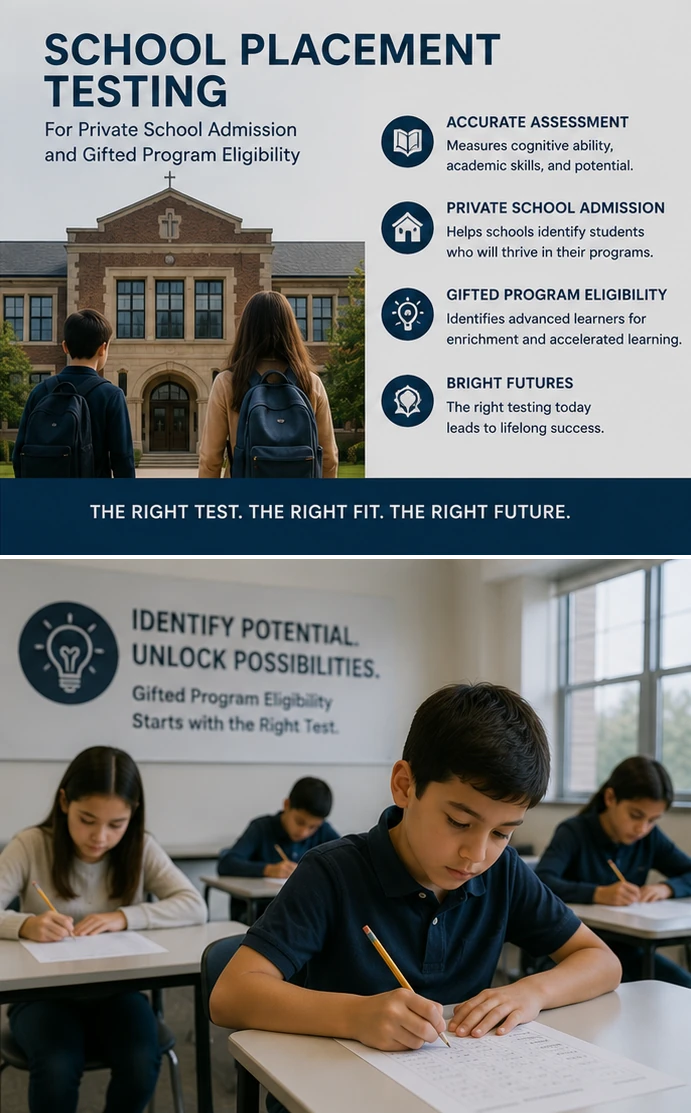
School placement testing is a critical step for families navigating private school admissions and gifted program eligibility in Salt Lake City. This comprehensive guide covers the types of tests used, which Salt Lake City schools require testing, the process, and how to prepare your child for success.
Last Updated: September 2026
Child IQ Testing
WISC-V & Stanford-Binet 5 for ages 6–16. Gifted identification, school placement.
Gifted Testing
Identify giftedness for school placement, enrichment, and talent programs using WISC-V or Stanford-Binet 5.
WISC-V Test
Wechsler Intelligence Scale for Children® Fifth Edition – gold standard for child IQ and school placement.
Stanford-Binet 5
Stanford-Binet Intelligence Scales Fifth Edition – comprehensive cognitive assessment, often used for private school admission.
Full Evaluation
Combined cognitive, academic, and behavioral assessment for complex cases. Includes WISC-V or Stanford-Binet 5.
Schedule School Placement Testing
Book your school placement testing with a licensed psychologist in Salt Lake City today.
Salt Lake City Placement Decisions by Setting
- SLCSD neighborhood enrollment: Residency, boundaries, open-enrollment rules, and district procedures control assignment; IQ testing does not change residency requirements.
- Magnet Gifted and AAMP: Use current Advanced Academics procedures, including designated CogAT assessment and other data points.
- Honors and advanced courses: Honors can be self-selected under current district descriptions; AP, concurrent enrollment, and accelerated courses use course-specific readiness.
- Private-school admission: Ask whether the school accepts WISC-V, SB-5, achievement testing, its own entrance process, interviews, or work samples.
- Grade acceleration: Review academic mastery, social maturity, physical development, motivation, executive function, and receiving-grade curriculum.
- Subject acceleration: Above-level achievement testing may be more informative than a general IQ score.
- Twice-exceptional placement: Plan advanced work and disability accommodations together.
- Multilingual learners: Distinguish English acquisition from academic weakness and review prior schooling in every language.
Records to Bring to a Placement Evaluation
- Report cards, benchmark and state-test results, and current course syllabi.
- Writing samples, mathematics work, reading lists, projects, and examples of independent learning.
- Teacher comments, attendance, behavior information, intervention history, and gifted-service records.
- Prior cognitive, achievement, speech-language, occupational-therapy, medical, developmental, or neuropsychological reports.
- Language history, school transitions, homeschool curriculum, refugee or international schooling, and tutoring history.
- The receiving school’s written criteria, deadline, accepted test list, and required forms.
What is School Placement Testing?
School placement testing is a specialized cognitive assessment used to determine whether a child is a good fit for a particular educational environment. In Salt Lake City, this typically includes:
- Private school admission testing: Many independent schools require IQ or cognitive testing as part of the application process
- Gifted program eligibility: Salt Lake City-area districts use their own gifted-identification procedures, which may include ability measures, achievement, classroom performance, referrals, and other evidence.
- Educational placement decisions: Testing helps determine the right academic setting for a child's needs
- Early entrance to kindergarten or grade skipping: Some schools require testing to evaluate readiness
Salt Lake City Schools and Programs Using Placement Testing
Salt Lake City School District
SLCSD uses its published Advanced Academics assessment and eligibility procedures for Magnet Gifted and related services. Current materials describe CogAT screening or full assessment at designated grades and routes, AAMP, honors, and multiple data points.
Charter and advanced programs
Charter schools set their own enrollment, lottery, curriculum, and placement procedures. Some may use achievement, readiness, prior records, interviews, or internal assessments rather than private IQ testing.
Private, faith-based, and independent programs
Rowland Hall, The McGillis School, Judge Memorial, The Madeleine Choir School, homeschool programs, and specialized learning services may use records, interviews, work samples, achievement tests, recommendations, or cognitive reports. Requirements should be obtained directly from the receiving school.
Tests Used for School Placement in Salt Lake City
- CogAT: Used in SLCSD’s published Advanced Academics procedures at designated grades and testing routes.
- WISC-V or Stanford-Binet: Individual cognitive profile when explicitly requested by a receiving school or needed for broader clinical interpretation.
- Achievement testing: Reading, writing, mathematics, fluency, and subject mastery for grade or course placement.
- School entrance assessments: The receiving school may prefer its own standardized or curriculum-based instrument.
- Language assessment: English-language development, bilingual literacy, and home-language history when relevant.
- Executive and social-emotional measures: Useful when independence, attention, behavior, anxiety, or twice-exceptionality affects placement.
- Records: Report cards, benchmark data, curriculum history, work samples, teacher observations, and prior accommodations.
The School Placement Testing Process
Step 1: Initial Consultation
A brief phone or video call with a licensed psychologist to discuss your child's needs, the schools you're targeting, and the most appropriate tests. This helps determine the right approach for your child.
Step 2: Testing Session
The child meets one-on-one with a licensed psychologist in a quiet, comfortable room. The psychologist administers the selected test, which includes subtests measuring various cognitive abilities. Breaks are offered as needed. The testing session typically takes 60-90 minutes.
Step 3: Scoring and Interpretation
The psychologist scores the test and analyzes the results, considering the child's age, background, and any relevant medical or educational history.
Step 4: Feedback Session
The psychologist meets with the parents to explain the results, discuss the child's cognitive profile, and provide recommendations for school placement.
Step 5: Comprehensive Written Report
You receive a detailed report with all scores, normative comparisons, and recommendations. This report can be submitted to schools as part of the admission or placement process.
How to Prepare Your Child
Proper preparation can help your child perform at their best during testing. Here are some tips:
- Get a good night's sleep: Ensure your child is well-rested before the test
- Eat a healthy meal: A nutritious breakfast helps maintain focus
- Arrive relaxed: Leave plenty of time to get to the testing location
- Explain the test positively: Let your child know they'll be doing activities that show their strengths
- Avoid pressure: Don't emphasize the importance of the test, which can create anxiety
- No specific preparation needed: IQ tests measure innate abilities, so studying is not necessary
Cost of School Placement Testing in Salt Lake City
- District Advanced Academics assessment: Conducted through the district process without a private IQ-testing fee.
- School special-education evaluation: No direct family fee when the responsible public agency evaluates under applicable law.
- Brief private IQ/gifted assessment: Often less expensive than a full psychoeducational battery; confirm included report and feedback.
- Psychoeducational evaluation: Higher cost because it may include intelligence, achievement, attention, processing, behavior, records, diagnosis, and recommendations.
- Neuropsychological/developmental evaluation: Usually the most extensive; cost and coverage depend on medical necessity and provider contracts.
- Before paying: Ask about deposits, cancellation, school meetings, rush fees, bilingual assessment, insurance, and report turnaround.
School Placement Testing in Salt Lake City: Statistics
Salt Lake City’s 51.5% bachelor’s-degree attainment and multilingual population create strong demand for advanced coursework and individualized placement, but community education levels do not determine a child’s placement. Decisions should use direct evidence of achievement, reasoning, language, independence, and readiness.
- Children and teens: 16.4% of city residents are under age 18.
- Language: 23.5% of residents age five and older speak a language other than English at home.
- District assessment: Current Advanced Academics procedures include CogAT assessment at designated grades and routes.
- Honors: Current district descriptions allow self-selection for honors advanced classes without an assessment score.
- Private reports: Acceptance varies by school and year; obtain written requirements first.
- Equity: Multiple evidence sources are important for multilingual, disabled, low-income, mobile, and historically underrepresented students.
Frequently Asked Questions
Requirements vary by school and admission year. Some independent or specialized programs may request cognitive or achievement testing, while others rely on records, interviews, recommendations, or their own admission measures. Contact each admissions office for its current written policy before scheduling an evaluation.
WISC-V is the most commonly requested test for private school admission and gifted program eligibility. Stanford-Binet 5 is also widely accepted. Check with your target schools for their specific requirements.
There is no single Salt Lake City-wide cutoff. A 98th-percentile score is a common traditional gifted reference, but Salt Lake City School District, neighboring districts, and private schools use their own current criteria, which may include ability, achievement, classroom performance, referrals, and other evidence.
The test itself takes 60-90 minutes. With the consultation, feedback, and report, the entire process is about 1-2 weeks.
The report includes Full-Scale IQ, index scores, strengths and weaknesses, normative comparisons, and recommendations for school placement. This report can be submitted to schools as part of the application process.
Some plans cover cognitive assessments when there is a clinical indication. School placement testing is often considered an educational rather than medical service, so coverage varies. Check with your provider.
Some interviews and feedback can occur remotely, but many schools require in-person cognitive testing. Remote administration must follow publisher, legal and professional requirements; confirm the receiving school's policy.
Get a good night's sleep, eat a healthy meal, and arrive relaxed. No specific preparation is needed. Avoid putting pressure on your child, which can create anxiety.
Typical fees range from $200 to $1,200 for a single IQ test, with full evaluations costing up to $3,000. Some insurance plans cover testing when medically necessary.