
IQ Testing in Salt Lake City

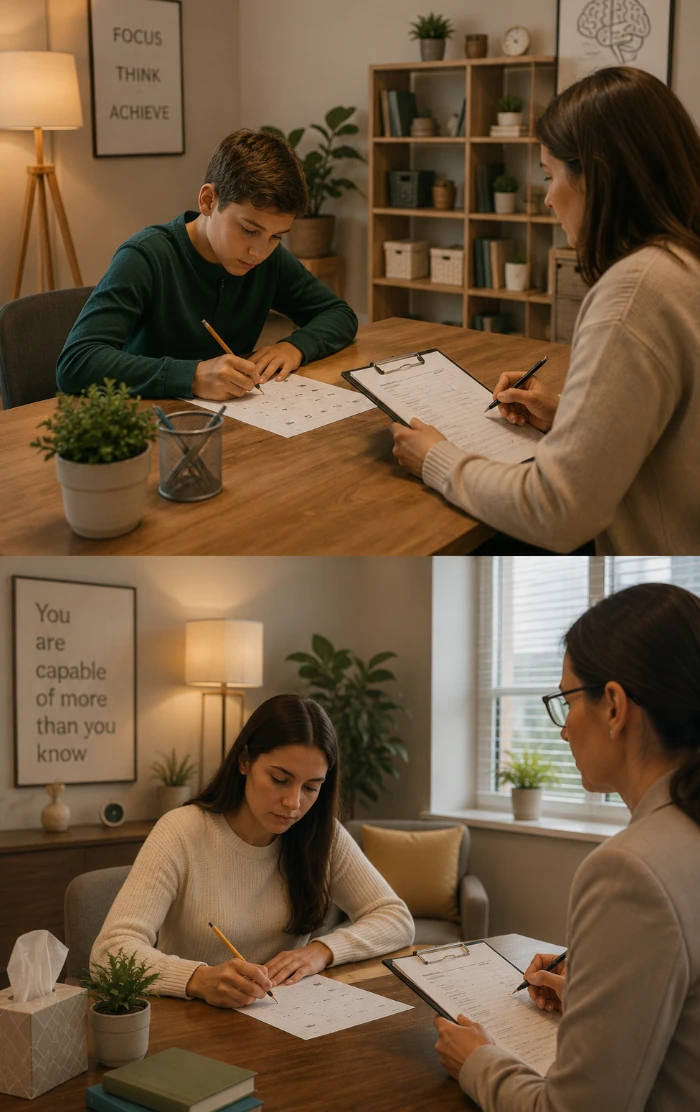
Professional IQ testing in Salt Lake City – whether you need an assessment for school, employment, gifted program eligibility, or personal insight, we connect you with licensed psychologists in the Salt Lake City area.
Last Updated: September 2026
Child IQ Testing
WISC-V & Stanford-Binet for ages 6–16. Gifted identification, learning profiles.
Adult IQ Testing
WAIS-IV & WAIS-5 available. Comprehensive adult cognitive assessments. Clinical & occupational.
WISC-V Test
Wechsler Intelligence Scale for Children® Fifth Edition – the gold standard for child IQ testing.
WAIS-IV & WAIS-5 Tests
Wechsler Adult Intelligence Scale® – Fourth Edition (WAIS-IV) and Fifth Edition (WAIS-5) available for adult IQ testing.
Gifted Testing
Identify giftedness for school placement, enrichment, and talent programs using WISC-V or Stanford-Binet.
Stanford-Binet 5
Stanford-Binet Intelligence Scales Fifth Edition – comprehensive cognitive assessment for all ages.
Mensa Testing
Mensa admission testing and preparation for the high-IQ society. Accepts WAIS-IV, WAIS-5, and Stanford-Binet 5 scores.
Full Evaluation
Combined assessment with detailed report and recommendations. Includes WISC-V, WAIS-IV, WAIS-5, or Stanford-Binet 5 as appropriate.
IQ Testing in Salt Lake City: city context
Gender, age and demographic statistics
Salt Lake City had an estimated 218,428 residents on July 1, 2025. U.S. Census Bureau 2020–2024 estimates report that 48.3% of residents are female, 16.4% are under age 18, and 12.5% are age 65 or older. The city is 69.5% White alone, 2.6% Black alone, 1.1% American Indian or Alaska Native alone, 5.0% Asian alone, 1.6% Native Hawaiian or Other Pacific Islander alone, and 11.2% reporting two or more races. 20.8% of residents are Hispanic or Latino; race and Hispanic-origin categories are not mutually exclusive.
These figures describe community context, not intelligence. IQ results must be interpreted individually in light of age, education, disability, health, culture, language exposure, educational opportunity, and testing conditions. Salt Lake City is multilingual: 23.5% of residents age five and older speak a language other than English at home, and 14.9% are foreign-born. English-Spanish bilingual history, Pacific Islander and refugee-community language backgrounds, literacy in each language, interpreter use, and limits on verbal-score interpretation may therefore be important to a valid evaluation.
- Female residents: 48.3%.
- Children and teens: 16.4% are under 18.
- Older adults: 12.5% are 65 or older.
- Language context: 23.5% speak a language other than English at home.
- Educational context: 92.1% of adults age 25+ completed high school and 51.5% hold a bachelor’s degree or higher.
- Health-access context: 9.3% of residents under age 65 report a disability and 11.8% lack health insurance.
- Interpretation: No gender, racial, ethnic, immigration, language, neighborhood, religious, or income group should be presumed to have a particular IQ profile.
What is professional IQ testing?
Intelligence quotient (IQ) testing is a standardized method to measure human cognitive abilities and intellectual potential. Professional IQ tests are administered by licensed psychologists in a controlled environment to ensure accuracy and reliability. Unlike online quizzes, clinical assessments provide a full-scale IQ score along with detailed breakdowns of verbal comprehension, perceptual reasoning, working memory, and processing speed.
In Salt Lake City, IQ testing is commonly used for gifted program admission, learning disability identification, career guidance, neuropsychological evaluation, and personal development. The results are presented in a comprehensive report that includes normative comparisons, strengths and weaknesses, and actionable recommendations.
Who should get tested?
IQ testing can benefit children, adolescents, and adults in various situations:
- Children: Parents often seek testing for school readiness, gifted placement, or to understand learning challenges.
- Adults: Many adults take IQ tests for career advancement, graduate school applications, or personal curiosity.
- Mensa candidates: High-IQ societies require official test scores for membership.
- Clinical referrals: Psychologists may recommend testing as part of a broader neuropsychological evaluation.
Types of IQ tests
We offer the most recognized and scientifically validated intelligence tests in the field:
- WISC-V (Wechsler Intelligence Scale for Children® – Fifth Edition): The gold standard for children aged 6:0–16:11. It provides a Full-Scale IQ and five primary index scores.
- WAIS-IV (Wechsler Adult Intelligence Scale® – Fourth Edition): The most widely used adult IQ test for ages 16–90. It measures cognitive functioning across four domains.
- Stanford-Binet Intelligence Scales – Fifth Edition: A comprehensive assessment for ages 2–85, often used for gifted identification and clinical evaluations.
- Gifted Testing: Often includes the WISC-V or Stanford-Binet, plus additional creativity and achievement measures.
- Mensa Testing: We provide official Mensa admission testing and preparation materials.
How the testing process works
- Initial consultation: Brief phone or video call to discuss your needs and match you with the right psychologist.
- Testing session: In-person or remote testing (depending on the test) with a licensed psychologist. Most sessions last 1–2 hours.
- Scoring and interpretation: The psychologist scores the test and interprets the results in the context of your background and goals.
- Feedback session: A detailed review of your results, including strengths, weaknesses, and practical recommendations.
- Comprehensive report: You receive a written report with all scores, normative comparisons, and actionable next steps.
How much does IQ testing cost in Salt Lake City?
The cost of IQ testing in Salt Lake City varies depending on the type of test, the psychologist's experience, and whether a comprehensive report is required. Typical fees range from $200 to $1,200 for a full assessment. Gifted testing and Mensa admission testing are often at the lower end, while neuropsychological evaluations may be higher.
An online IQ test offers Salt Lake City residents a convenient way to explore reasoning questions, whereas school placement, accommodations, or clinical decisions require professionally administered testing.
Some insurance plans cover IQ testing when it's deemed medically necessary. We recommend checking with your provider for details. We also offer affordable payment plans and sliding-scale options for qualifying individuals.
Salt Lake City's Intellectual History & Legacy
Salt Lake City developed at the crossroads of Indigenous homelands, western migration, rail transportation, mining, government, higher education, medicine, and global commerce. Its intellectual history includes scientific research, computer graphics, public-health innovation, urban planning, religious studies, outdoor-industry design, and the engineering required to build in a high-desert mountain basin.
- Indigenous context: The Salt Lake Valley is part of the ancestral and contemporary homelands of Indigenous peoples, including Ute, Shoshone, Goshute, and Paiute communities. Ethical assessment respects tribal sovereignty, community history, and culturally appropriate interpretation.
- University of Utah: Founded in 1850 and now the state’s flagship research university, the U supports medicine, psychology, neuroscience, engineering, computing, genetics, public policy, environmental science, and the arts.
- Computer-graphics legacy: University of Utah researchers and alumni helped shape modern computer graphics, digital imaging, animation, visualization, and human-computer interaction.
- Healthcare and neuroscience: University of Utah Health, Huntsman Mental Health Institute, Primary Children’s Hospital, and regional health systems support clinical research and complex cognitive evaluation.
- 2002 Winter Olympics: Olympic planning accelerated transportation, infrastructure, sports science, tourism, and international visibility; the region is again preparing for the 2034 Olympic and Paralympic Winter Games.
- Ethical testing: Modern psychology rejects ranking neighborhoods, religions, races, or cultural groups by IQ. Valid assessment requires individual interpretation, language and cultural context, measurement error, and multiple evidence sources.
Top Employers in Salt Lake City Requiring Cognitive Skills
Salt Lake City’s employment base combines healthcare, higher education, government, finance, technology, life sciences, aviation, logistics, manufacturing, outdoor products, hospitality, construction, and professional services. Major employers and institutions include the University of Utah and University of Utah Health, Intermountain Health, state and local government, Salt Lake City International Airport and its airlines, Zions Bancorporation, PacifiCorp, financial-services firms, and regional technology and life-science companies.
- Healthcare and life sciences: Clinical reasoning, laboratory analysis, documentation, medical technology, genetics, rehabilitation, research, quality systems, and interdisciplinary teamwork.
- Higher education and research: Teaching, data analysis, grant administration, engineering, psychology, neuroscience, computing, and scientific communication.
- Finance and professional services: Quantitative reasoning, risk, compliance, audit, cybersecurity, client communication, and complex decision-making.
- Aviation, logistics, and distribution: Scheduling, routing, maintenance, safety, operations control, warehouse systems, and supply-chain analysis.
- Technology and gaming: Software engineering, product design, data science, user experience, digital media, quality assurance, and project management.
- Outdoor products and recreation: Materials, industrial design, marketing, environmental analysis, retail operations, and product testing.
- Government and public service: Planning, law, public safety, utilities, transportation, social services, policy analysis, and multilingual communication.
Salt Lake City IQ Testing by City Area
Testing decisions should be based on clinical purpose, examiner qualifications, accepted instruments, language needs, and travel burden—not on assumptions about a neighborhood. Salt Lake City includes compact urban districts, university and medical areas, historic residential neighborhoods, industrial and airport districts, and foothill communities.
- Downtown and Central City: Strong access to TRAX, buses, offices, courts, cultural institutions, and professional services; parking and event traffic should be planned in advance.
- University, Federal Heights, and East Bench: Close to the University of Utah, University of Utah Health, Primary Children’s Hospital, research facilities, and specialty medical services.
- Sugar House and 9th & 9th: Mixed-use areas with local services, schools, bus connections, and active-transportation options.
- Rose Park, Fairpark, Glendale, and Poplar Grove: Diverse west-side communities where language access, transportation, and culturally responsive assessment may be important.
- Capitol Hill, The Avenues, and Marmalade: Central neighborhoods with access to downtown, LDS Hospital, government, and university routes.
- Ballpark, Liberty Wells, and Central Ninth: TRAX and bus access can support appointments, although event schedules and construction may affect travel.
- Northwest Quadrant and airport area: Industrial, logistics, and aviation employment can involve shift work; scheduling should account for fatigue and travel time.
Footer and service-area language is intentionally limited to supporting all areas of the city rather than repeating neighborhood names for search-engine targeting.
Salt Lake City Universities and Research Institutions
- University of Utah: Flagship public research university with programs in psychology, neuroscience, medicine, engineering, computer science, education, business, law, social science, and the arts.
- University of Utah Health: Academic medical system supporting neuropsychology, neurology, rehabilitation, psychiatry, pediatrics, genetics, and clinical research.
- Westminster University: Private university in Salt Lake City offering undergraduate and graduate programs, including psychology, counseling, education, business, nursing, and public health.
- Salt Lake Community College: The South City Campus and other regional sites provide transfer, workforce, technical, disability-support, and continuing-education pathways.
- Ensign College: Downtown institution focused on applied business, technology, health, communication, and professional education.
- Neumont College of Computer Science: Downtown technology-focused college emphasizing software development and project-based learning.
- Research ecosystem: Huntsman Cancer Institute, the Scientific Computing and Imaging Institute, Utah Population Database research, biotechnology firms, and public agencies contribute to data-intensive work.
Salt Lake City Economic Context
- Median household income: $75,090 in 2020–2024 Census estimates.
- Per-capita income: $51,173.
- Residents in poverty: 13.6%.
- Bachelor’s degree or higher: 51.5% of adults age 25 and older.
- Mean travel time to work: 19.5 minutes, although canyon traffic, winter weather, construction, and cross-valley commutes can be much longer.
- Health and social-assistance activity: Census business data report approximately $6.83 billion in 2022 receipts/revenue within the city.
- Transportation and warehousing: Approximately $8.95 billion in 2022 receipts/revenue reflects the importance of the airport, freight, distribution, and the city’s Intermountain West location.
- Retail sales: Approximately $10.38 billion in 2022.
- Accommodation and food services: Approximately $1.53 billion in 2022 sales.
- Regional strengths: Healthcare, higher education, government, finance, technology, life sciences, outdoor products, logistics, manufacturing, distribution, gaming, tourism, and professional services.
Income, education, and occupation affect opportunity and test familiarity but do not define intellectual potential. Evaluators should distinguish acquired knowledge, educational access, disability, language, and current functioning.
Salt Lake City School District Data
Salt Lake City School District Advanced Academics
The district’s Advanced Academics Department manages gifted/talented and high-ability services through differentiated instruction, full-day Magnet Gifted and Talented programs, the part-time Advanced Academic Mentoring Program (AAMP), honors courses, Advanced Placement, and other accelerated options.
- Elementary assessment: Current district procedures use CogAT screening or full CogAT assessment at designated grades, with grade-wide and opt-in routes.
- Elementary magnet sites: Current 2026–2027 district information lists Edison, Indian Hills, Nibley Park, and Whittier elementary schools.
- Middle-school options: Honors courses can be self-selected, while Magnet placement uses the district assessment process; current sites include Clayton, Hillside, and West High School programs.
- Private reports: A WISC-V or Stanford-Binet report may help explain an individual profile, but it does not automatically replace district criteria or guarantee placement.
Secondary pathways
Honors, Advanced Placement, International Baccalaureate where offered, concurrent enrollment, career and technical education, arts, athletics, research, and subject acceleration use course-specific requirements. Grades, prerequisites, achievement, and readiness often matter more than one Full Scale IQ score.
Private and independent options
Rowland Hall, The McGillis School, Judge Memorial Catholic High School, The Madeleine Choir School, independent learning programs, homeschool networks, and specialized services use different admission and placement evidence. Families should obtain the receiving program’s current written requirements before ordering testing.
Local Testing Centers and Psychologists
- Dr. Brian Carl, Ph.D. & Associates: Located at 160 South 1000 East in Salt Lake City. The practice describes cognitive and intellectual assessments, including IQ tests, as part of broader psychological evaluation. Call (801) 839-5594 to verify age range, test edition, purpose, fees, and current availability.
- University of Utah Health Neuropsychology: Provides medically focused neuropsychological evaluation for cognitive changes, neurological conditions, brain injury, and rehabilitation questions, generally through referral.
- Huntsman Mental Health Institute: University-based behavioral-health services include psychological and neuropsychological testing in selected clinics; referral and insurance requirements vary.
- Primary Children’s Hospital Neuropsychology: Pediatric specialty evaluation for children with medical, neurological, developmental, and complex learning concerns.
- Psychology Specialists of Utah: Salt Lake City practice focused on neurodevelopmental, autism, ADHD, learning-disability, behavioral, and mental-health evaluations across age groups.
- School and college evaluation teams: SLCSD, charter schools, private schools, the University of Utah, Westminster, and SLCC apply different legal and documentation standards.
Before scheduling, confirm that the evaluator is licensed, the proposed instrument is accepted by the school, employer, Mensa, court, or agency receiving the report, and the report includes the required scores and documentation.
Salt Lake City Events and Conferences
Salt Lake City hosts university lectures, healthcare and life-science meetings, technology and outdoor-industry conferences, arts festivals, FanX, Utah Arts Festival, Living Traditions Festival, book and film events, and professional continuing education. Sundance Film Festival programming and related industry activity may include Salt Lake City venues, although schedules and locations change.
- Academic and clinical events: University of Utah, University of Utah Health, Huntsman Mental Health Institute, Westminster University, and professional associations.
- Technology and business: Salt Palace conventions, Silicon Slopes and startup events, finance and cybersecurity meetings, and industry training.
- Outdoor and sports: Outdoor-product events, mountain recreation, University athletics, and Olympic-related planning.
- Family enrichment: Natural History Museum of Utah, Clark Planetarium, Discovery Gateway, Tracy Aviary, The Leonardo, libraries, and cultural institutions.
- Testing-day caution: Large conventions, games, festivals, road closures, and downtown parking demand can affect arrival time and concentration.
Transportation and Accessibility
- Major roads: I-15 runs north–south through the valley; I-80 runs east–west and connects downtown, the airport, Parleys Canyon, and the Wasatch Back; I-215 forms a regional belt route; US-89/State Street, Foothill Drive, Redwood Road, North Temple, 400 South, 700 East, and 2100 South are major city corridors.
- Public transit: Utah Transit Authority operates local and rapid buses, TRAX light rail, paratransit, and regional services. The Blue, Red, and Green TRAX lines connect downtown with the University of Utah, airport, Central Pointe, and valley destinations.
- Regional rail: FrontRunner commuter rail serves Salt Lake Central and North Temple, connecting Salt Lake City with Davis, Weber, and Utah County communities.
- Airport: Salt Lake City International Airport (SLC) is about five miles northwest of downtown. The city-owned airport reports more than 330 daily departures to 100 nonstop destinations.
- Distance to other cities: Typical driving is about 30–40 minutes to Park City, 35–45 minutes to Ogden, 40–55 minutes to Provo, 35–50 minutes to Tooele, 80–95 minutes to Logan, and roughly 3.5–4 hours to Moab; winter storms and peak traffic can add substantial time.
- Walkability: Downtown, Central City, Central Ninth, 9th & 9th, Sugar House, and portions of the University area have the strongest concentration of walkable destinations. Wide blocks, steep foothill grades, snow, heat, and high-speed arterials can limit access elsewhere.
- Bike infrastructure: The 9 Line Trail, Jordan River Parkway, City Creek and Bonneville Boulevard routes, 300 West protected bikeway, 300 South and 200 West facilities, neighborhood byways, urban trails, and GREENbike support cycling and rolling trips.
- Appointment planning: I-15 and I-80 congestion, canyon closures, winter snow, inversion-related visibility, downtown events, university traffic, and airport construction can materially affect arrival time and testing stamina.
Salt Lake City Weather and Seasonal Considerations
Salt Lake City has hot, dry summers; cold winters with valley snow; a high-desert elevation above 4,000 feet; and periodic winter inversions, summer ozone, wildfire smoke, and dust. These conditions can affect sleep, breathing, hydration, medication use, travel reliability, headache, and cognitive stamina.
- Winter snow and ice: Allow extra travel time, especially from benches, canyons, and regional communities; reschedule when driving is unsafe.
- Inversions: Poor winter air quality can worsen asthma, headache, fatigue, and concentration for sensitive individuals.
- Summer heat and ozone: Morning appointments, hydration, and avoiding prolonged heat exposure may support more representative performance.
- Wildfire smoke and dust: Document respiratory symptoms, sleep disruption, and medication changes that could affect testing.
- Altitude and travel: Visitors arriving from lower elevations should consider acclimatization, hydration, and sleep before a high-stakes assessment.
- Testing validity: Reschedule when illness, sleep loss, acute stress, severe air-quality symptoms, or unsafe travel would make scores unrepresentative.
Areas we serve
We support all areas of Salt Lake City.
Frequently Asked Questions
WISC-V is for children aged 6–16, while WAIS-IV is for adults aged 16–90. Each is normed for its specific age group.
Most IQ tests take between 60 and 90 minutes, plus a feedback session. Allow 2–3 hours total.
No, you can book directly with our psychologists. We serve both self-referred and professionally referred individuals.
Some professionally administered scores may be submitted as prior evidence, but acceptance is determined solely by American Mensa under its current rules.
Some plans cover cognitive assessments when there is a clinical indication. Check with your provider.
Get a good night's sleep, eat a healthy meal, and arrive relaxed. No specific preparation is needed.
You'll receive a comprehensive report with your scores and tailored recommendations.
Interviews and feedback may be available remotely, but many standardized cognitive tests require controlled administration and may need an in-person appointment. Contact us for details.