
School Placement Testing in Pittsburgh

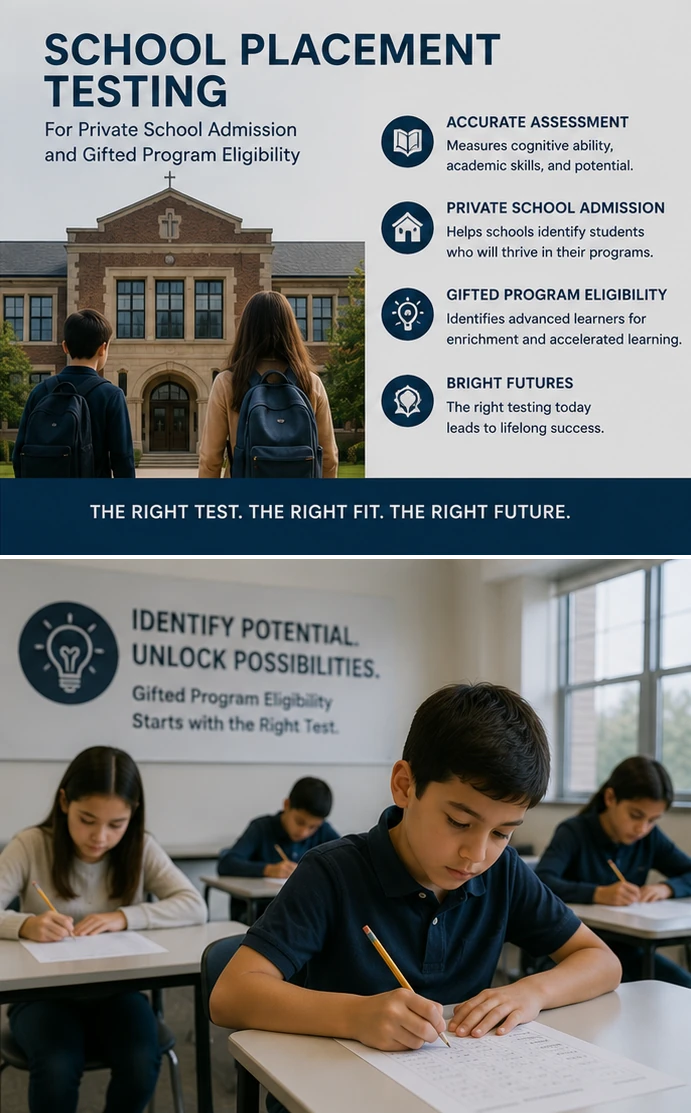
School placement testing is a critical step for families navigating private school admissions and gifted program eligibility in Pittsburgh. This comprehensive guide covers the types of tests used, which Pittsburgh schools require testing, the process, and how to prepare your child for success.
Last Updated: September 2026
Child IQ Testing
WISC-V & Stanford-Binet 5 for ages 6–16. Gifted identification, school placement.
Gifted Testing
Identify giftedness for school placement, enrichment, and talent programs using WISC-V or Stanford-Binet 5.
WISC-V Test
Wechsler Intelligence Scale for Children® Fifth Edition – gold standard for child IQ and school placement.
Stanford-Binet 5
Stanford-Binet Intelligence Scales Fifth Edition – comprehensive cognitive assessment, often used for private school admission.
Full Evaluation
Combined cognitive, academic, and behavioral assessment for complex cases. Includes WISC-V or Stanford-Binet 5.
Schedule School Placement Testing
Book your school placement testing with a licensed psychologist in Pittsburgh today.
What is School Placement Testing?
School placement testing is a specialized cognitive assessment used to determine whether a child is a good fit for a particular educational environment. In Pittsburgh, this typically includes:
- Private school admission testing: Many independent schools require IQ or cognitive testing as part of the application process
- Gifted program eligibility: Pittsburgh-area districts use their own gifted-identification procedures, which may include ability measures, achievement, classroom performance, referrals, and other evidence.
- Educational placement decisions: Testing helps determine the right academic setting for a child's needs
- Early entrance to kindergarten or grade skipping: Some schools require testing to evaluate readiness
Pittsburgh Schools and Programs Using Placement Testing
Pittsburgh Public Schools and Advanced Programs
- Gifted evaluation: PPS follows Pennsylvania Chapter 16 and a multidisciplinary evaluation process.
- Pittsburgh Gifted Center: Eligible K–8 students with GIEPs may receive weekly accelerated and enriched instruction.
- Centers for Advanced Study: High-school enriched and accelerated courses for gifted and academically talented students.
- Magnet programs: CAPA, Science and Technology Academy, Obama Academy, and other programs have separate application, audition, eligibility, or assignment rules.
- Outside reports: Private WISC-V or Stanford-Binet results may provide evidence but do not independently determine district eligibility or placement.
Private, Charter, and Regional Schools
- Independent schools: Some request cognitive, achievement, admissions, or psychoeducational testing; requirements vary annually.
- Parochial schools: Placement may involve records, achievement, interviews, recommendations, and outside evaluations.
- Charter schools: Public charter admission generally follows enrollment and lottery law rather than IQ selection.
- Specialized schools: Programs serving dyslexia, ADHD, autism, learning disabilities, or twice-exceptional students may request comprehensive testing.
- Nearby districts: Mt. Lebanon, Upper St. Clair, North Allegheny, Fox Chapel, Woodland Hills, Penn Hills, and others use separate policies.
- Verification: Obtain written test, score-age, examiner, report, and deadline requirements before scheduling.
Tests Used for School Placement in Pittsburgh
- Do not assume acceptance: School requirements can change each admission year.
- Qualified examiner: Reports must meet the receiving institution's credential rules.
- Current norms: Schools may reject outdated tests, expired scores, incomplete protocols, or nonstandard administration.
- Educational decision: Placement is determined by the school or district, not by the psychologist alone.
The School Placement Testing Process
Step 1: Initial Consultation
A brief phone or video call with a licensed psychologist to discuss your child's needs, the schools you're targeting, and the most appropriate tests. This helps determine the right approach for your child.
Step 2: Testing Session
The child meets one-on-one with a licensed psychologist in a quiet, comfortable room. The psychologist administers the selected test, which includes subtests measuring various cognitive abilities. Breaks are offered as needed. The testing session typically takes 60-90 minutes.
Step 3: Scoring and Interpretation
The psychologist scores the test and analyzes the results, considering the child's age, background, and any relevant medical or educational history.
Step 4: Feedback Session
The psychologist meets with the parents to explain the results, discuss the child's cognitive profile, and provide recommendations for school placement.
Step 5: Comprehensive Written Report
You receive a detailed report with all scores, normative comparisons, and recommendations. This report can be submitted to schools as part of the admission or placement process.
How to Prepare Your Child
Proper preparation can help your child perform at their best during testing. Here are some tips:
- Get a good night's sleep: Ensure your child is well-rested before the test
- Eat a healthy meal: A nutritious breakfast helps maintain focus
- Arrive relaxed: Leave plenty of time to get to the testing location
- Explain the test positively: Let your child know they'll be doing activities that show their strengths
- Avoid pressure: Don't emphasize the importance of the test, which can create anxiety
- No specific preparation needed: IQ tests measure innate abilities, so studying is not necessary
Cost of School Placement Testing in Pittsburgh
A focused cognitive assessment is generally less expensive than a comprehensive psychoeducational evaluation. Total cost depends on the test, records, achievement measures, behavior scales, report requirements, feedback, and deadline.
Before paying, obtain written confirmation from the school or program that it accepts the proposed instrument, examiner credential, score date, and report format. Admissions testing and gifted placement evaluations are often self-pay.
School Placement Testing in Pittsburgh: Statistics
- No citywide placement rate: Students attend district, charter, private, parochial, specialized, and home-school programs with different rules.
- Gifted identification: PPS uses a multidisciplinary Chapter 16 process rather than a single private-score cutoff.
- Magnet distinction: Gifted eligibility, magnet admission, auditions, lotteries, and school assignment are separate decisions.
- Private-school variation: Requirements may change each admissions year.
- Outside testing: A private report can inform a decision but does not guarantee admission, acceleration, scholarship, or services.
Frequently Asked Questions
Requirements vary by school and admission year. Some independent or specialized programs may request cognitive or achievement testing, while others rely on records, interviews, recommendations, or their own admission measures. Contact each admissions office for its current written policy before scheduling an evaluation.
WISC-V is the most commonly requested test for private school admission and gifted program eligibility. Stanford-Binet 5 is also widely accepted. Check with your target schools for their specific requirements.
There is no single Pittsburgh-wide cutoff. A 98th-percentile score is a common traditional gifted reference, but Pittsburgh Unified, Kernersville Unified, neighboring districts, and private schools use their own current criteria, which may include ability, achievement, classroom performance, referrals, and other evidence.
The test itself takes 60-90 minutes. With the consultation, feedback, and report, the entire process is about 1-2 weeks.
The report includes Full-Scale IQ, index scores, strengths and weaknesses, normative comparisons, and recommendations for school placement. This report can be submitted to schools as part of the application process.
Some plans cover cognitive assessments when there is a clinical indication. School placement testing is often considered an educational rather than medical service, so coverage varies. Check with your provider.
Some interviews and feedback can occur remotely, but many schools require in-person cognitive testing. Remote administration must follow publisher, legal and professional requirements; confirm the receiving school's policy.
Get a good night's sleep, eat a healthy meal, and arrive relaxed. No specific preparation is needed. Avoid putting pressure on your child, which can create anxiety.
Typical fees range from $200 to $1,200 for a single IQ test, with full evaluations costing up to $3,000. Some insurance plans cover testing when medically necessary.