
Child IQ Testing in Newark

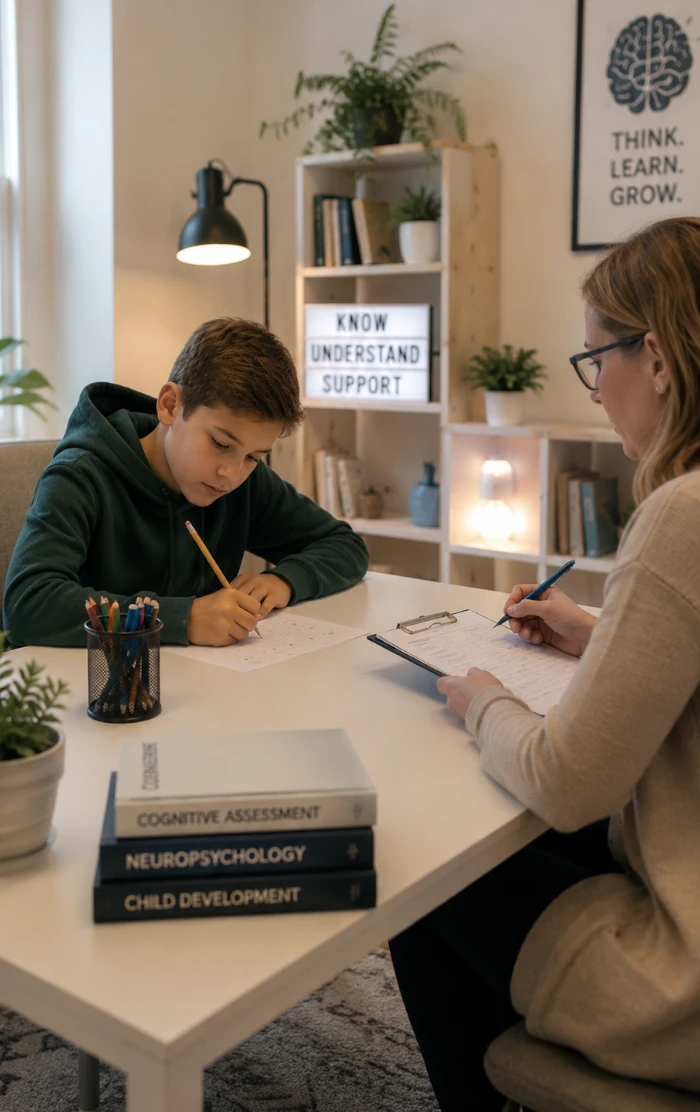
Professional child IQ testing in Newark – whether you need an assessment for school placement, gifted program eligibility, or to understand your child's learning profile, we connect you with licensed psychologists in the Newark area.
Last Updated: September 2026
Gifted Testing
Identify giftedness for school placement, enrichment, and talent programs using WISC-V or Stanford-Binet 5.
WISC-V Test
Wechsler Intelligence Scale for Children® Fifth Edition – the gold standard for child IQ testing.
Stanford-Binet 5
Stanford-Binet Intelligence Scales Fifth Edition – comprehensive cognitive assessment for all ages.
Full Evaluation
Combined assessment with detailed report and recommendations. Includes WISC-V or Stanford-Binet 5.
School Placement Testing
Testing for private school admission and gifted program eligibility using WISC-V or Stanford-Binet 5.
Schedule Child IQ Testing
Book your WISC-V & Stanford-Binet 5 for ages 6–16. Gifted identification, learning profiles, etc. with a licensed psychologist in Newark today.
Child IQ Testing in Newark: city context
Newark children attend Christina School District schools, Newark Charter School, other public charter and choice schools, private schools, home schools, and specialized programs across New Castle County. Families seek testing for gifted services, school placement, acceleration, twice-exceptional needs, learning disabilities, ADHD, autism, and educational planning.
IQ by gender & ethnicity (child population)
Current Census estimates show that 11.4% of Newark residents are under age 18 and 52.7% of the total population is female. The unusually low child share reflects the city's large university population. There is no valid local average IQ for boys, girls, or racial and ethnic groups. Relevant context includes:
- Black or African American population: 10.0%.
- Asian population: 8.9%.
- Hispanic or Latino population: 10.3%.
- Two or more races: 10.8%.
- Foreign-born residents: 12.9%.
- Language other than English at home: 17.6% of residents age five and older.
- Assessment fairness: Examiners consider language exposure, educational opportunity, disability, culture, medical history, attention, anxiety, and test familiarity.
- Individual interpretation: A child's complete profile and real-world functioning matter more than demographic group averages.
Newark School Districts and Gifted Programs
Christina School District Gifted & Talented Services
- K–5 framework: Christina describes critical- and creative-thinking lessons for all students, broader identification using portfolios and a short cognitive-abilities measure, differentiated instruction, and multiple levels of advanced service.
- Grades 3–5: Identified students may receive advanced academic support from certified gifted and talented teachers in classroom or pull-out settings.
- Middle school: Honors, advanced coursework, enrichment, and specialized pathways continue subject to current district placement and scheduling rules.
- High school: Newark High School and other Christina schools offer AP, dual enrollment, career pathways, world languages, and advanced courses.
- Multiple evidence: District identification should be confirmed directly; a private WISC-V or Stanford-Binet score does not automatically determine placement.
- Family process: Begin with the classroom teacher, gifted contact, counselor, or school administrator and request current written criteria and timelines.
Newark Charter School and Other Charter Pathways
- Newark Charter School: A public charter school with its own enrollment, curriculum, advanced-course, and student-support policies.
- Choice and lottery: Charter admission generally follows application and lottery rules rather than private IQ selection.
- Specialized programs: New Castle County charter and public schools may focus on science, technology, arts, languages, college preparation, or career pathways.
- Assessment use: Schools may use cognitive, achievement, classroom, and behavioral data after enrollment to plan supports.
- Verification: Families should confirm whether outside evaluations are accepted and which report components are required.
Red Clay, Appoquinimink, Cecil County, and Boundary Issues
- District boundaries: Nearby families may live in Christina, Red Clay, Appoquinimink, Colonial, or Maryland districts despite using a Newark-area mailing address.
- Different procedures: Gifted identification, acceleration, school choice, and acceptance of private testing vary by district and state.
- Red Clay options: Specialized and magnet pathways in the Wilmington area have separate eligibility and application rules.
- Appoquinimink growth: Families south of Newark should review current district boundaries and advanced-learning procedures.
- Cecil County: Maryland schools follow Maryland regulations and local criteria, which may differ from Delaware standards.
New Castle County and Regional Education Options
- Private schools: Independent and religious schools may use interviews, records, achievement tests, cognitive tests, and teacher recommendations.
- Delaware School for the Deaf: Located in the Christina system and provides specialized educational services under its own eligibility procedures.
- Specialized learning programs: Dyslexia, autism, ADHD, language, and twice-exceptional programs may request comprehensive evaluations.
- University enrichment: University of Delaware, libraries, museums, parks, and community organizations offer youth programs that change annually.
- Regional access: Wilmington, southeastern Pennsylvania, and Cecil County broaden school and enrichment choices but create commute and residency considerations.
Delaware Gifted Education Framework
- Local implementation: Delaware districts and charter schools develop services within state requirements and available resources.
- Screening and equity: Christina's model includes universal thinking lessons and broader evidence intended to identify students who might be missed by traditional referral.
- Multiple pathways: Cognitive ability, achievement, classroom performance, portfolios, creativity, and demonstrated strengths may contribute.
- Private testing: Independent results can add information but do not override district or charter procedures.
- Current rules: Families should rely on current district, school, and Delaware Department of Education guidance rather than old score thresholds.
Newark Private Schools and Programs Using Testing Information
- Independent requirements: Private schools set their own admissions, acceleration, learning-support, and testing policies and may change them annually.
- Accepted evidence: Schools may request WISC-V, Stanford-Binet, achievement testing, school records, interviews, teacher recommendations, or comprehensive evaluations.
- Specialized schools: Programs serving dyslexia, ADHD, autism, language disorders, or twice-exceptional learners may require broader psychoeducational documentation.
- Early entrance and acceleration: Decisions may consider cognitive ability, achievement, maturity, classroom readiness, and social-emotional development.
- Home-school planning: Families may use testing to select curriculum level, document strengths, or plan transitions, subject to Delaware requirements.
- Testing verification: Obtain written confirmation of the accepted test, examiner qualifications, score age, report deadline, and required subtests before scheduling.
Newark Gifted Identification Statistics
- No single city rate: Newark does not publish one authoritative citywide gifted-identification percentage because children attend district, charter, private, and home schools.
- Small resident child population: Census data show only 11.4% of city residents are under 18, so city percentages are strongly affected by the university population.
- Identification is not prevalence: Participation reflects screening, referral, criteria, access, capacity, and service models—not the total number of advanced learners.
- Christina model: Universal thinking lessons and expanded evidence are designed to broaden access to gifted identification.
- Charter distinction: Charter enrollment and gifted services follow separate school policies.
- Private testing: Outside results may support discussion but do not guarantee program admission, acceleration, or school choice.
- Reporting: Ask the school for current identification results, service plans, review procedures, and appeal rights.
The child IQ testing process: step by step
Understanding the testing process can help parents prepare their child and reduce anxiety. Here's what to expect:
- Initial consultation (15–20 minutes): A brief phone or video call with the psychologist to discuss your child's background, concerns, and goals. This helps determine the right test and approach.
- Testing session (60–90 minutes): The child meets one-on-one with a licensed psychologist in a quiet, comfortable room. The psychologist administers the WISC-V or Stanford-Binet 5, which includes a series of subtests measuring verbal comprehension, visual-spatial reasoning, fluid reasoning, working memory, and processing speed. Breaks are offered as needed.
- Scoring and interpretation (1–2 days): The psychologist scores the test and analyzes the results. They consider the child's age, background, and any relevant medical or educational history.
- Feedback session (45–60 minutes): The psychologist meets with the parents (and the child, if appropriate) to explain the results. They discuss the Full-Scale IQ, index scores, strengths, and areas for growth. They also provide tailored recommendations for home, school, and extracurriculars.
- Comprehensive written report (5–7 days): You receive a detailed report with all scores, normative comparisons, and actionable next steps. This report can be shared with schools, doctors, or other professionals.
The entire process from consultation to report usually takes 1–2 weeks, depending on scheduling. The testing itself is non-invasive and designed to be engaging for children.
What is the WISC-V test?
The WISC-V (Wechsler Intelligence Scale for Children® – Fifth Edition) is the most widely used IQ test for children aged 6:0–16:11. It provides a Full-Scale IQ and five primary index scores: Verbal Comprehension, Visual-Spatial, Fluid Reasoning, Working Memory, and Processing Speed. The test is administered one-on-one by a trained psychologist and takes about 60–90 minutes.
The WISC-V is normed on a large, representative sample of U.S. children and is updated regularly to ensure accuracy. It is the gold standard for gifted identification, learning disability diagnosis, and school placement.
Why test your child's IQ?
IQ testing provides valuable insights into your child's cognitive strengths and weaknesses. It can help:
- Identify giftedness: For admission to gifted programs, private schools, or enrichment opportunities.
- Diagnose learning disabilities: Such as dyslexia, dyscalculia, or ADHD, which can be masked by high intelligence.
- Guide educational planning: Tailor instruction to your child's unique learning profile.
- Provide reassurance: Understand why your child is different from peers and how to support them.
Newark Gifted Testing Timeline
- Start with the receiving program: Confirm deadlines, accepted tests, examiner credentials, and maximum age of scores before booking.
- District cycles: Screening, referral, identification, and placement may follow the school calendar and cannot always be expedited by private testing.
- Private-school deadlines: Admissions offices may require reports months before the enrollment year.
- Testing window: Choose a date when the child is healthy, rested, and not overwhelmed by exams, travel, or major transitions.
- Report time: Allow time for intake, records, administration, scoring, interpretation, feedback, and report preparation.
- Follow-up: Schools may request achievement data, classroom observations, teacher input, or updated testing.
Newark Gifted Programs by Age Group
- Preschool and early childhood: Developmental history, observation, readiness, language exposure, and flexible measures may be more informative than a single score.
- Elementary school: Christina provides universal thinking lessons and differentiated or pull-out services for identified students; charter and private policies vary.
- Middle school: Honors, compacted coursework, enrichment, electives, and specialized pathways become more prominent.
- High school: AP, dual enrollment, career and technical education, independent study, university coursework, and research opportunities support advanced learners.
- University enrichment: UD, libraries, museums, environmental programs, coding, arts, music, and summer camps offer changing opportunities.
- Social-emotional fit: Pace, peers, executive-function demands, perfectionism, anxiety, disability supports, and transportation matter at every age.
Newark Child ADHD and Learning Disability Assessment
- School evaluation: Christina and charter-school teams evaluate suspected disabilities under special-education rules using cognitive, academic, language, behavioral, processing, and classroom evidence as appropriate.
- Private evaluation: Licensed psychologists may assess ADHD, dyslexia, dyscalculia, dysgraphia, autism, executive functioning, anxiety, and twice-exceptional profiles.
- Medical resources: Nemours and ChristianaCare provide pediatric and behavioral-health services for appropriate referral questions.
- Role of IQ: WISC-V or Stanford-Binet results describe cognitive functioning but do not diagnose ADHD or a learning disorder alone.
- Documentation: The receiving school or testing agency determines whether a report meets its accommodation standards.
- Equity: Interpretation should consider language development, education, culture, sensory or motor needs, health, trauma, and access to instruction.
Newark Summer Programs for Gifted Children
- University of Delaware: Youth camps, engineering, science, athletics, arts, music, leadership, and academic programs vary by summer.
- UD Cooperative Extension: 4-H, agriculture, environmental science, and community programs provide hands-on learning.
- White Clay Creek State Park: Nature, ecology, outdoor recreation, and environmental education support science interests.
- Libraries and museums: Newark Free Library, Delaware libraries, museums, and cultural organizations offer reading, maker, history, and arts programming.
- School and charter programs: District and school summer enrichment, acceleration, and bridge programs change annually.
- Regional access: Wilmington, Philadelphia, Cecil County, and southeastern Pennsylvania expand STEM, arts, debate, and university options.
- Selection: Match program intensity, age, interests, disability supports, cost, transportation, and need for downtime.
Newark Child Testing Costs by Provider Type
- Brief IQ testing: A focused WISC-V or Stanford-Binet assessment with limited reporting is generally less expensive than a full evaluation.
- Gifted or school-placement package: Cost depends on intake, test selection, report requirements, school forms, and feedback.
- Psychoeducational evaluation: Cognitive, achievement, attention, executive, emotional, and behavioral measures require substantially more time.
- Medical neuropsychology: Costs and coverage depend on referral, medical necessity, authorization, deductibles, and network rules.
- School evaluation: Eligible public-school evaluations are provided through the school process, but the scope is tied to educational need.
- Before paying: Confirm fees, cancellation policy, turnaround, report recipients, accepted payment, and whether the receiving institution will use the results.
Areas we serve
We support all areas of Newark.
Frequently Asked Questions
Both are excellent tests. WISC-V is more commonly used for school-age children, while Stanford-Binet 5 can be used for ages 2–85. We often recommend WISC-V for gifted identification.
The test itself takes 60–90 minutes. With the consultation, feedback, and report, the entire process is about 1–2 weeks.
No, you can book directly with our psychologists. We serve both self-referred and professionally referred children.
Professional results may be considered by public districts, private schools, and enrichment programs, but each organization sets its own accepted tests, score age, report requirements, and eligibility rules.
Some plans cover cognitive assessments when there is a clinical indication. Check with your provider.
Get a good night's sleep, eat a healthy meal, and arrive relaxed. No specific preparation is needed.
You'll receive a comprehensive report with your child's scores and tailored recommendations.
Interviews and feedback may be available remotely, but many standardized cognitive tests require controlled administration and may need an in-person appointment. Contact us for details.