
Child IQ Testing in Macon-Bibb County

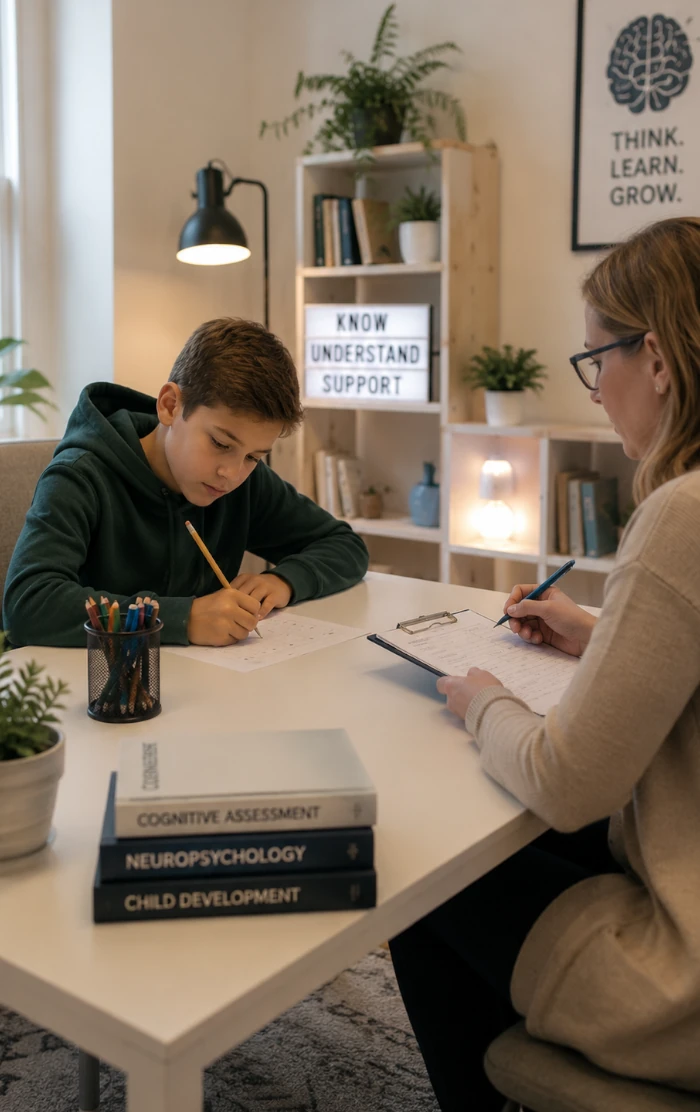
Professional child IQ testing in Macon-Bibb County – whether you need an assessment for school placement, gifted program eligibility, or to understand your child's learning profile, we connect you with licensed psychologists in the Macon-Bibb County area.
Last Updated: September 2026
Gifted Testing
Identify giftedness for school placement, enrichment, and talent programs using WISC-V or Stanford-Binet 5.
WISC-V Test
Wechsler Intelligence Scale for Children® Fifth Edition – the gold standard for child IQ testing.
Stanford-Binet 5
Stanford-Binet Intelligence Scales Fifth Edition – comprehensive cognitive assessment for all ages.
Full Evaluation
Combined assessment with detailed report and recommendations. Includes WISC-V or Stanford-Binet 5.
School Placement Testing
Testing for private school admission and gifted program eligibility using WISC-V or Stanford-Binet 5.
Schedule Child IQ Testing
Book your WISC-V & Stanford-Binet 5 for ages 6–16. Gifted identification, learning profiles, etc. with a licensed psychologist in Macon-Bibb County today.
Child IQ Testing in Macon-Bibb County: city context
Children make up approximately 24.4% of Macon-Bibb County’s population, which means tens of thousands of local residents are moving through early-childhood, elementary, middle-school, high-school, and transition-to-adulthood stages. Families request cognitive testing for gifted identification, learning concerns, developmental differences, school placement, twice-exceptional profiles, private-school applications, disability documentation, or a clearer understanding of strengths and support needs.
The local educational landscape includes the Bibb County School District, magnet and specialty programs, private and parochial schools, home-school families, early-learning centers, and regional programs. Some children have stable educational histories, while others have changed schools, experienced interrupted instruction, received intensive intervention, or moved between rural and urban settings. A psychologist should review developmental, medical, language, cultural, educational, and family history; classroom data; prior interventions; and the exact decision the report must support.
Census estimates describe Macon-Bibb County as 52.9% female, 54.9% Black alone, 35.3% White alone, 2.3% Asian alone, 4.6% multiracial, and 4.7% Hispanic or Latino. Approximately 5.9% of residents age five and older speak a language other than English at home. These statistics describe the community, not a child’s intelligence. Fair testing requires current norms, culturally responsive interviewing, careful language assessment, disability access, and interpretation that separates measured performance from opportunity, health, stress, and test familiarity.
Economic access also matters. With 24.7% of residents living in poverty and 85.8% of households reporting broadband subscriptions, families may differ in access to private specialists, transportation, enrichment, tutoring, technology, and time away from work. Those differences can affect when concerns are identified and what records are available, but they must not be mistaken for differences in inherent ability.
A focused IQ test may answer a narrow question, while a full psychoeducational or neurodevelopmental evaluation may add achievement, attention, executive-function, memory, language, adaptive-behavior, emotional, or autism-related measures. The examiner should explain why each measure is being used, what it can and cannot establish, and how the results relate to classroom functioning. A single Full Scale IQ should never replace a comprehensive view of the child.
When results are intended for a school meeting, families should bring prior evaluations, report cards, intervention records, attendance information, and examples of work. They should also write down the exact questions they need answered. This helps the psychologist distinguish a request for gifted screening from a broader concern about learning, attention, development, or emotional functioning and reduces the risk of ordering measures that do not address the real decision.
Where results are compared with school data, the psychologist should reconcile differences among test scores, grades, teacher observations, intervention response, and everyday functioning. Apparent contradictions can provide important clues about motivation, disability, instructional fit, language demands, health, or environmental pressures and should be interpreted rather than ignored.
Macon-Bibb County School Districts and Gifted Programs
The Bibb County School District is the main public-school system serving the consolidated city-county. Its Gifted and Advanced Academics office supports K–12 gifted services, gifted screening and testing, academic competitions, Governor’s Honors nominations, International Baccalaureate, Advanced Placement, and related advanced pathways. The district also operates magnet, STEM/STEAM, career, arts, and specialty options whose application and placement rules may differ from gifted eligibility.
Georgia gifted identification follows state rules and district procedures. School teams may examine evidence in four broad areas: mental ability, achievement, creativity, and motivation. Depending on the approved eligibility route, teams may use standardized tests, rating scales, classroom performance, work products, and other evidence. Exact instruments, score requirements, referral windows, and decision rules can change, so families should rely on the current Bibb County and Georgia Department of Education manuals rather than an older cutoff found online.
A privately administered WISC-V, Stanford-Binet 5, DAS-II, or achievement test can provide valuable information, especially when a child has an uneven profile, suspected disability, unusually advanced reasoning, or a need for independent diagnostic clarification. It does not automatically establish public-school gifted eligibility or dictate services. The district remains responsible for its own evaluation, eligibility, notice, and placement procedures.
Families should request the current referral and screening calendar, ask whether universal or grade-level screening is used, and confirm how parent, teacher, student, or self-referrals are handled. They should also ask which measures are administered by the school, whether outside data can be considered, how recent outside scores must be, and whether the district requires original protocols or only a signed interpretive report.
Gifted eligibility, special-education evaluation, Section 504 support, magnet admission, grade acceleration, and clinical diagnosis are different decisions. A child can be gifted and also have ADHD, dyslexia, autism, anxiety, a language disorder, or another disability. Conversely, advanced classroom performance does not by itself establish a clinical diagnosis. Families should ask which team controls each decision, what evidence it may consider, how disagreements are reviewed, and what services follow a favorable decision.
Macon-Bibb County Private Schools Requiring IQ Testing
Macon-Bibb County and nearby Middle Georgia include independent, faith-based, Montessori, college-preparatory, and specialized schools. Some may request admissions testing, achievement data, classroom records, interviews, teacher recommendations, developmental information, or psychoeducational reports. Others use their own readiness or placement tests, and many do not require an IQ score at all.
Requirements can differ by grade, campus, and admission cycle. A school may accept the WISC-V for one purpose but require achievement testing, curriculum-based placement, or an interview for another. Some schools want a brief score report, while others require a full signed report with subtests, composites, confidence intervals, behavioral observations, validity discussion, and recommendations.
Before paying for private testing, obtain the school’s current written policy. Confirm the accepted test and edition, examiner license, age range, required score types, report format, deadline, whether testing must occur within a particular period, and whether the school accepts outside results. Ask whether accommodations were permitted during testing and how they should be documented.
Families should not assume that a professionally administered WISC-V or Stanford-Binet report guarantees admission, grade placement, or services. Schools may consider space, readiness, achievement, behavior, interviews, prior records, and mission fit. A psychologist should describe the child accurately without coaching toward a desired cutoff or overstating what the scores predict.
Macon-Bibb County Gifted Identification Statistics
No single public figure reliably describes the percentage of children identified as gifted across every current Macon-Bibb County grade, school, and program. Identification rates can change with enrollment, screening methods, referral practices, state rules, available measures, staff training, mobility, attendance, and the use of different eligibility pathways.
District-wide percentages can also hide important variation. One school may serve more students who have already been screened, while another may enroll more newcomers, multilingual learners, students with disabilities, or children whose talents appear outside traditional academic measures. Differences in participation do not prove that one neighborhood or demographic group has greater or lesser ability.
Families who need current data should request it from the Bibb County School District and ask how the figures were calculated: total enrollment or tested students, newly identified or all served students, grade level, school year, and program type. They should also ask whether the district reviews representation and whether local norms, universal screening, alternative measures, or talent-development opportunities are used to reduce missed identification.
Private testing can reveal an advanced cognitive profile, but the school’s eligibility rate is not a benchmark for an individual child. The useful question is whether the evaluation validly explains the child’s learning pattern and provides evidence that the relevant school team or program is authorized to consider.
The child IQ testing process: step by step
Understanding the testing process can help parents prepare their child and reduce anxiety. Here's what to expect:
- Initial consultation (15–20 minutes): A brief phone or video call with the psychologist to discuss your child's background, concerns, and goals. This helps determine the right test and approach.
- Testing session (60–90 minutes): The child meets one-on-one with a licensed psychologist in a quiet, comfortable room. The psychologist administers the WISC-V or Stanford-Binet 5, which includes a series of subtests measuring verbal comprehension, visual-spatial reasoning, fluid reasoning, working memory, and processing speed. Breaks are offered as needed.
- Scoring and interpretation (1–2 days): The psychologist scores the test and analyzes the results. They consider the child's age, background, and any relevant medical or educational history.
- Feedback session (45–60 minutes): The psychologist meets with the parents (and the child, if appropriate) to explain the results. They discuss the Full-Scale IQ, index scores, strengths, and areas for growth. They also provide tailored recommendations for home, school, and extracurriculars.
- Comprehensive written report (5–7 days): You receive a detailed report with all scores, normative comparisons, and actionable next steps. This report can be shared with schools, doctors, or other professionals.
The full process includes intake, records review, testing, scoring, feedback, and report preparation. Timing varies with provider availability and referral complexity, so confirm deadlines before scheduling. The testing itself is non-invasive and designed to be engaging for children.
The intake should identify the referral question, people authorized to receive the report, prior testing, developmental and medical history, language exposure, school interventions, and any deadline. During testing, the examiner should follow standardized procedures while documenting breaks, accommodations, motivation, and behavior that may affect validity. Scoring should use the correct age norms and current edition.
Feedback should translate scores into understandable strengths, weaknesses, and practical recommendations. Families should receive confidence intervals, an explanation of meaningful index differences, and clear limits on interpretation. Recommendations may address instruction, accommodations, further medical or language assessment, counseling, executive-skill support, or progress monitoring. A strong report distinguishes evidence from speculation and does not promise a school placement.
Parents should review names, dates, school information, and factual history when the report arrives. Corrections to factual errors should be requested promptly, while disagreements about professional interpretation can be discussed in feedback or through a second opinion. Keep the signed report securely because schools, testing agencies, and high-IQ organizations may require an original or unaltered copy.
What is the WISC-V test?
The WISC-V (Wechsler Intelligence Scale for Children® – Fifth Edition) is the most widely used IQ test for children aged 6:0–16:11. It provides a Full-Scale IQ and five primary index scores: Verbal Comprehension, Visual-Spatial, Fluid Reasoning, Working Memory, and Processing Speed. The test is administered one-on-one by a trained psychologist and takes about 60–90 minutes.
The WISC-V is normed on a large, representative sample of U.S. children and is updated regularly to ensure accuracy. It is the gold standard for gifted identification, learning disability diagnosis, and school placement.
Why test your child's IQ?
IQ testing provides valuable insights into your child's cognitive strengths and weaknesses. It can help:
- Identify giftedness: For admission to gifted programs, private schools, or enrichment opportunities.
- Diagnose learning disabilities: Such as dyslexia, dyscalculia, or ADHD, which can be masked by high intelligence.
- Guide educational planning: Tailor instruction to your child's unique learning profile.
- Provide reassurance: Understand why your child is different from peers and how to support them.
Macon-Bibb County Gifted Testing Timeline
School screening and referral calendars are set by the Bibb County School District and may change each year. Families should contact the school’s gifted coordinator early, request the current referral window and consent forms, and ask when school-administered screening, formal testing, eligibility meetings, written notice, placement decisions, and appeals occur.
The sequence may involve review of existing classroom and achievement data, an initial screening stage, consent for additional evaluation, administration of approved measures, collection of creativity or motivation evidence, and a multidisciplinary eligibility decision. Not every referred child proceeds through every stage, and the school may need additional data when results are incomplete or inconsistent.
Private evaluations require their own timeline: intake, record collection, teacher or parent questionnaires, one or more testing sessions, scoring, interpretation, feedback, and report preparation. Complex learning, attention, autism, language, or emotional questions may take longer than a focused cognitive assessment. Provider availability and insurance authorization can also add time.
Start well before a school, camp, scholarship, acceleration, or admissions deadline. Confirm whether the receiving program accepts outside testing, how recent the results must be, and whether the report needs achievement scores or specific subtests. A rushed assessment conducted when a child is ill, exhausted, distressed, or inadequately prepared for disability accommodations may produce less representative results.
Macon-Bibb County Gifted Programs by Age Group
- Early childhood and primary grades: Developmental observation, language growth, play, curiosity, early literacy and numeracy, and classroom differentiation may clarify advanced learning. Very young children can show rapid developmental change, so examiners should explain the limits of long-term prediction and avoid overreliance on one score.
- Elementary school: Bibb County gifted services, magnet and STEM/STEAM options, advanced reading and mathematics, project-based learning, academic competitions, arts, and enrichment may be available according to current school procedures. The right level of challenge should preserve foundational skills and social-emotional well-being.
- Middle school: Advanced or honors coursework, robotics, engineering, science fairs, mathematics teams, debate, fine arts, world languages, writing, and leadership opportunities may support different strengths. Students with uneven profiles may need both acceleration and disability support.
- High school: Advanced Placement, International Baccalaureate, dual enrollment, career academies, Governor’s Honors nominations, specialized arts or technical pathways, internships, and college-level study may be relevant. Course placement should consider prerequisites, workload, transportation, mental health, and long-term goals.
- Community and college resources: Mercer University, Middle Georgia State University, Wesleyan College, Central Georgia Technical College, Middle Georgia Regional Library, the Museum of Arts and Sciences, Tubman Museum, music and theater organizations, and seasonal camps may provide additional enrichment.
Program names, eligibility, fees, transportation, scholarships, and schedules change. Families should verify current information directly and choose opportunities that fit the child’s interests, readiness, health, and social-emotional needs. Formal gifted identification may be required for some school services but not for many community programs.
Acceleration is only one option. Curriculum compacting, subject-specific advancement, mentorship, independent study, competitions, creative production, and peer grouping may be more appropriate for some children. The evaluation should translate test findings into practical educational questions rather than simply recommend “more difficult work.”
Macon-Bibb County Child ADHD and Learning Disability Assessment
IQ testing alone cannot diagnose ADHD, dyslexia, dyscalculia, dysgraphia, autism, language disorder, intellectual disability, anxiety, or another learning or developmental condition. A comprehensive child evaluation may include developmental history, interviews, teacher and parent rating scales, achievement tests, attention and executive-function measures, language or motor assessment, adaptive behavior, classroom data, and review of response to intervention.
Twice-exceptional children can have very high reasoning ability and a genuine disability at the same time. Strong vocabulary or problem solving may help a child compensate for weak reading fluency, working memory, written expression, attention, or processing speed, delaying recognition of the disability. Conversely, frustration, poor attendance, trauma, sleep problems, hearing or vision issues, and inconsistent instruction can resemble a neurodevelopmental disorder.
Families can request a school evaluation through the Bibb County School District and may also seek an independent clinical assessment. These processes have different legal purposes. The school determines eligibility and educational need under applicable procedures; a private psychologist can diagnose and recommend, but cannot unilaterally create an IEP, Section 504 plan, gifted placement, or specific service.
Confirm whether the psychologist’s report will include the measures and recommendations required for the intended purpose. For dyslexia or another learning disability, cognitive scores alone are insufficient; achievement, instructional history, intervention response, and functional impact matter. For ADHD, symptoms must be considered across settings and over time. For autism, social-communication and restricted-behavior evidence is required beyond IQ.
Ask how language, culture, medication, fatigue, sensory needs, and accommodations will be handled. The final report should explain meaningful score differences, limitations, diagnostic reasoning, and practical supports rather than treating every low subtest as a disorder or every high subtest as proof of gifted eligibility.
Macon-Bibb County Summer Programs for Gifted Children
Summer enrichment may be offered through Mercer University, Middle Georgia State University, Wesleyan College, Central Georgia Technical College, museums, libraries, arts organizations, parks and recreation, faith communities, private camps, and regional STEM or academic programs. Offerings change annually and may focus on science, robotics, coding, writing, music, theater, visual arts, history, sports, leadership, entrepreneurship, health careers, or college preparation.
Some programs are designed specifically for students identified as gifted, while many are open based on age, interest, audition, application, or prerequisite skill. Families should verify whether an IQ report is actually required before purchasing testing. An enrichment provider may accept school identification, teacher recommendations, work samples, grades, or a short application instead.
Compare age limits, daily schedule, supervision, staff qualifications, cost, scholarships, transportation, meals, disability accommodations, sensory environment, and cancellation policies. For children with ADHD, autism, anxiety, medical needs, or learning disabilities, ask how support is provided without unnecessarily restricting access.
A child’s interests and readiness are usually more useful than choosing a program solely because it is marketed as “gifted.” Summer can also be a time for rest, friendships, physical activity, family responsibilities, and creative exploration. A balanced plan may be more beneficial than continuous acceleration.
Macon-Bibb County Child Testing Costs by District
Public-school evaluations and private clinical testing operate under different funding systems. When the Bibb County School District determines that an evaluation is necessary for special-education eligibility, the school process is generally conducted without charging the family. Gifted screening and identification procedures are also governed by district and state rules. A parent-requested private evaluation is separate and is not automatically reimbursed.
A private focused cognitive assessment may include intake, one intelligence test, scoring, feedback, and a brief or full report. A comprehensive psychoeducational evaluation may add achievement, attention, executive-function, memory, language, adaptive-behavior, emotional, autism, or other measures. The broader battery usually requires more professional time and higher fees, but it may be necessary when the referral question is more complex than gifted screening.
Fees vary by psychologist, battery, number of sessions, records, questionnaires, collateral interviews, report length, school consultation, and specialist expertise. Bilingual assessment, forensic questions, disability documentation, expedited deadlines, travel, or extensive record review may add cost. Ask whether test materials, feedback, and a signed report are included or billed separately.
Insurance may consider medically necessary diagnostic testing but often excludes evaluations performed solely for gifted placement, private-school admission, grade acceleration, career exploration, or Mensa. Confirm coverage with both the provider and insurer, including authorization, network, deductible, coinsurance, excluded educational services, and anticipated billing codes. A quoted “evaluation fee” is not the same as guaranteed insurance payment.
Before paying, request a written estimate and ask about deposit, cancellation, rescheduling, missed appointments, payment plans, report turnaround, retesting, and follow-up consultation. Obtain the receiving school or program’s written requirements first so the family does not purchase an expensive battery that will not be accepted.
Families with limited resources can begin with the school team, pediatrician, insurer, vocational or disability programs, university clinics, or community referral resources. Cost and access barriers should be discussed openly; they are practical constraints, not evidence about a child’s potential. The goal is the least burdensome valid evaluation that answers the actual question.
Areas we serve
We support all areas of Macon-Bibb County.
Frequently Asked Questions
Both are excellent tests. WISC-V is more commonly used for school-age children, while Stanford-Binet 5 can be used for ages 2–85. We often recommend WISC-V for gifted identification.
The testing session often takes about 60–90 minutes for a focused measure, but broader batteries take longer. Intake, records review, scoring, feedback, and report timing vary by provider and referral complexity.
Referral requirements vary. Contact the psychologist directly and ask whether self-referral is accepted; insurance, school, or agency funding may require authorization or a formal referral.
A private report may be reviewed as one source of information, but Macon-Bibb County, Georgia Public Schools and each private program apply their own current eligibility, score, recency, instrument, and documentation rules. Obtain those requirements before testing; no private report guarantees admission or placement.
Some plans cover cognitive assessments when there is a clinical indication. Check with your provider.
Get a good night's sleep, eat a healthy meal, and arrive relaxed. No specific preparation is needed.
You'll receive a comprehensive report with your child's scores and tailored recommendations.
Some interview and feedback components may be available remotely, but many standardized cognitive tests require in-person administration. Confirm with the psychologist and the organization receiving the report.