
IQ Testing in Macon-Bibb County
Professional IQ testing in Macon-Bibb County – whether you need an assessment for school, employment, gifted program eligibility, or personal insight, we connect you with licensed psychologists in the Macon-Bibb County area.
Last Updated: September 2026
Child IQ Testing
WISC-V & Stanford-Binet for ages 6–16. Gifted identification, learning profiles.
Adult IQ Testing
WAIS-IV & WAIS-5 available. Comprehensive adult cognitive assessments. Clinical & occupational.
WISC-V Test
Wechsler Intelligence Scale for Children® Fifth Edition – the gold standard for child IQ testing.
WAIS-IV & WAIS-5 Tests
Wechsler Adult Intelligence Scale® – Fourth Edition (WAIS-IV) and Fifth Edition (WAIS-5) available for adult IQ testing.
Gifted Testing
Identify giftedness for school placement, enrichment, and talent programs using WISC-V or Stanford-Binet.
Stanford-Binet 5
Stanford-Binet Intelligence Scales Fifth Edition – comprehensive cognitive assessment for all ages.
Mensa Testing
Professional cognitive testing for possible Mensa prior-evidence submission; confirm the current accepted test, edition, score, and documentation rules before scheduling.
Full Evaluation
Combined assessment with detailed report and recommendations. Includes WISC-V, WAIS-IV, WAIS-5, or Stanford-Binet 5 as appropriate.
A professionally administered IQ test is most useful when it answers a clearly defined educational, clinical, vocational, or documentation question and is interpreted with the examinee’s history.
IQ Testing in Macon-Bibb County: city context
Macon-Bibb County is Georgia’s consolidated city-county government and the principal urban center of Middle Georgia. The U.S. Census Bureau estimated 157,556 residents on July 1, 2025, compared with 157,346 counted in 2020, across approximately 249.38 square miles. About 24.4% of residents are younger than 18, so gifted identification, learning assessment, developmental questions, school accommodations, and transition planning are significant local concerns.
Residents seek professional cognitive testing for educational planning, disability documentation, diagnostic clarification, vocational decisions, admissions questions, legal matters, and personal understanding. Macon-Bibb County’s role as a healthcare, education, logistics, government, manufacturing, cultural, and regional-service hub means reports may need to satisfy very different receiving organizations. The psychologist should know the intended use before selecting a battery.
The consolidated area includes dense historic neighborhoods, suburban communities, rural edges, and families with varied schooling, health, language, and employment histories. Standardized scores should therefore be interpreted alongside developmental history, educational opportunity, culture, language, sensory or motor needs, medical factors, sleep, medication, and current emotional functioning—not as a stand-alone label.
IQ by gender & ethnicity
Census estimates describe Macon-Bibb County as 52.9% female. Residents identifying as Black alone account for approximately 54.9%, White alone 35.3%, Asian alone 2.3%, two or more races 4.6%, and Hispanic or Latino residents 4.7%. About 3.8% of residents are foreign-born, and 5.9% of people age five and older speak a language other than English at home.
These population statistics must never be treated as evidence that one gender, race, ethnicity, neighborhood, or language group is inherently more intelligent than another. Research on average test-score differences is shaped by sampling, schooling, health, socioeconomic conditions, stereotype threat, language exposure, test familiarity, and measurement choices. Individual clinical decisions require individual evidence.
Examiners should use current norms, document identity and language factors relevant to interpretation, provide accommodations that do not invalidate standardization, and consider whether nonverbal, bilingual, achievement, adaptive, or broader neuropsychological measures are needed. Uneven scores may reflect a meaningful cognitive profile, but they may also reflect fatigue, anxiety, disability, interrupted education, or limited familiarity with the testing language.
What is professional IQ testing?
Intelligence quotient (IQ) testing is a standardized method to measure human cognitive abilities and intellectual potential. Professional IQ tests are administered by licensed psychologists in a controlled environment to ensure accuracy and reliability. Unlike online quizzes, clinical assessments provide a full-scale IQ score along with detailed breakdowns of verbal comprehension, perceptual reasoning, working memory, and processing speed.
In Macon-Bibb County, IQ testing is commonly used for gifted program admission, learning disability identification, career guidance, neuropsychological evaluation, and personal development. The results are presented in a comprehensive report that includes normative comparisons, strengths and weaknesses, and actionable recommendations.
Who should get tested?
IQ testing can benefit children, adolescents, and adults in various situations:
- Children: Parents often seek testing for school readiness, gifted placement, or to understand learning challenges.
- Adults: Many adults take IQ tests for career advancement, graduate school applications, or personal curiosity.
- Mensa candidates: High-IQ societies require official test scores for membership.
- Clinical referrals: Psychologists may recommend testing as part of a broader neuropsychological evaluation.
Types of IQ tests
Commonly requested, professionally administered IQ tests include:
- WISC-V (Wechsler Intelligence Scale for Children® – Fifth Edition): The gold standard for children aged 6:0–16:11. It provides a Full-Scale IQ and five primary index scores.
- WAIS-IV (Wechsler Adult Intelligence Scale® – Fourth Edition): The most widely used adult IQ test for ages 16–90. It measures cognitive functioning across four domains.
- Stanford-Binet Intelligence Scales – Fifth Edition: A comprehensive assessment for ages 2–85, often used for gifted identification and clinical evaluations.
- Gifted Testing: Often includes the WISC-V or Stanford-Binet, plus additional creativity and achievement measures.
- Mensa Testing: We can help clarify professional testing options, but American Mensa determines whether any test and documentation qualify under its current rules.
A professionally administered IQ test should be selected for the examinee’s age, language background, referral question, and the documentation rules of the school or organization receiving the report.
How the testing process works
- Initial consultation: Brief phone or video call to discuss your needs and match you with the right psychologist.
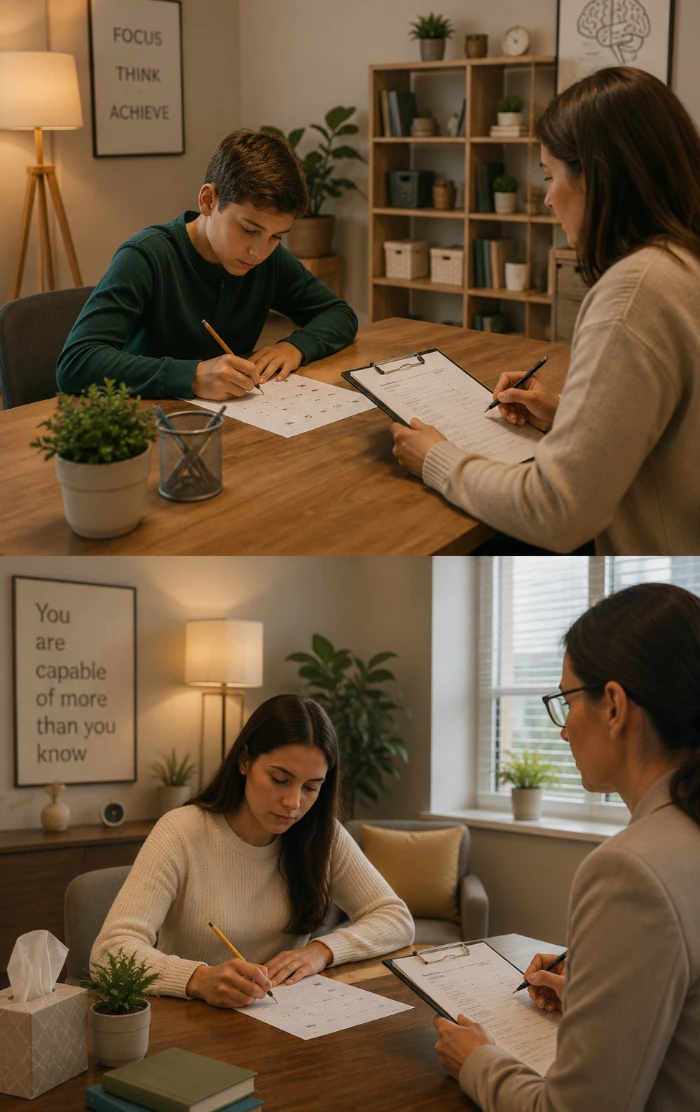
- Testing session: In-person or remote testing (depending on the test) with a licensed psychologist. Most sessions last 1–2 hours.
- Scoring and interpretation: The psychologist scores the test and interprets the results in the context of your background and goals.
- Feedback session: A detailed review of your results, including strengths, weaknesses, and practical recommendations.
- Comprehensive report: You receive a written report with all scores, normative comparisons, and actionable next steps.
How much does IQ testing cost in Macon-Bibb County?
Fees vary according to the referral question, test battery, record review, scoring, feedback time, report length, and whether bilingual, disability, legal, or neuropsychological expertise is required. A focused adult cognitive assessment may cost less than a comprehensive evaluation that includes achievement, attention, memory, executive functioning, personality, adaptive behavior, or collateral interviews.
Before paying, request a written estimate that identifies the test edition, professional credentials, number of sessions, cancellation policy, insurance or authorization process, report turnaround, and whether follow-up communication with a school, attorney, physician, employer, or agency is included. Insurance is more likely to consider medically necessary diagnostic evaluation than testing performed solely for curiosity, career exploration, or high-IQ society admission.
Macon-Bibb County’s Intellectual History & Legacy
Macon-Bibb County’s intellectual history begins long before the modern city. The Ocmulgee River corridor preserves more than 12,000 years of human history, including the monumental earthworks now protected at Ocmulgee Mounds National Historical Park and the continuing cultural significance of the Muscogee (Creek) people. Fort Hawkins, established in 1806, became an early federal trading and military post, and the city of Macon was chartered in 1823.
Education and scholarship became central to the region through institutions such as Mercer University, Wesleyan College, Middle Georgia State University, Central Georgia Technical College, public schools, libraries, museums, faith communities, and professional training programs. Macon’s musical legacy—associated with artists and institutions spanning gospel, soul, rock, classical, and popular music—also demonstrates forms of creativity and achievement that are not captured by a single IQ score.
The City of Macon and Bibb County consolidated in 2014. Today, intellectual and civic life includes healthcare research and training, aviation and logistics connections, arts and preservation, entrepreneurship, public administration, and community initiatives. A modern cognitive assessment should recognize this broad range of abilities and opportunities rather than reducing potential to one number.
Top Employers in Macon-Bibb County and Cognitive-Testing Context
Major employment sectors include healthcare, education, government, manufacturing, logistics, retail, hospitality, construction, finance, professional services, and defense-related activity across Middle Georgia. Important local and regional institutions include Atrium Health Navicent, Mercer University, the Bibb County School District, Macon-Bibb County government, Middle Georgia State University, Central Georgia Technical College, YKK AP America, Kumho Tire, GEICO, logistics operations along I-75 and I-16, and employers connected to nearby Robins Air Force Base.
Employers generally use education, credentials, experience, interviews, work samples, safety requirements, and job-specific assessments—not clinical IQ tests—to make routine hiring decisions. A psychologist’s cognitive report may be relevant for vocational rehabilitation, disability accommodation, return-to-work planning, capacity questions, or a defined clinical referral, but it should not be marketed as a shortcut to employment.
Before testing for an occupational purpose, obtain the employer’s, attorney’s, rehabilitation counselor’s, or licensing body’s written requirements. Confirm whether the request concerns intelligence, achievement, attention, memory, executive functioning, personality, functional capacity, or another construct, because these require different measures and professional expertise.
Macon-Bibb County IQ Testing by Neighborhood
Appointment logistics differ across Downtown Macon, College Hill, Vineville, Ingleside, Pleasant Hill, East Macon, North Macon, South Macon, West Macon, Bloomfield, Rutland, Lizella, and the county’s less-dense outer areas. Travel time can increase around school arrival and dismissal, hospital shift changes, Mercer events, downtown festivals, interstate construction, and congestion near I-75, I-16, Eisenhower Parkway, Riverside Drive, and Gray Highway.
Neighborhood is not a measure of intelligence or potential. Compare examiner credentials, age range, testing language, disability access, parking, transit, total travel time, fees, report quality, and whether the receiving organization accepts the report. The footer therefore states only that services support all areas of Macon-Bibb County rather than repeating neighborhood names for search-engine purposes.
Macon-Bibb County Universities and Research Institutions
- Mercer University: A private research university headquartered in Macon with undergraduate, graduate, professional, medical, pharmacy, engineering, business, law, education, health-science, and research programs.
- Middle Georgia State University: A public university with a Macon campus and regional programs in aviation, information technology, nursing, business, education, arts, sciences, and graduate study.
- Wesleyan College: A historic women’s college in Macon offering liberal arts, sciences, business, education, nursing-related pathways, and graduate programs.
- Central Georgia Technical College: Provides technical education, adult education, allied-health, public-safety, business, industrial, transportation, and workforce programs.
- Regional clinical and research resources: Atrium Health Navicent, Mercer University School of Medicine, and nearby Robins Air Force Base broaden health, training, aerospace, and applied-research opportunities.
Colleges ordinarily rely on transcripts, prerequisites, portfolios, recommendations, experience, and program-specific admissions criteria. Clinical IQ testing is generally relevant only when it answers a defined diagnostic or accommodation question. Students should obtain current documentation requirements from disability services or the testing agency before scheduling.
Macon-Bibb County Economic Context
U.S. Census Bureau 2020–2024 estimates and 2022 business data provide the following Macon-Bibb County context:
- Median household income: $51,234.
- Per-capita income: $31,699.
- Residents in poverty: 24.7%.
- Bachelor’s degree or higher: 26.3% of adults age 25 and older.
- High-school graduate or higher: 87.4% of adults age 25 and older.
- Mean travel time to work: 22.2 minutes, although cross-county trips, interstate congestion, and travel to regional employers can take longer.
- Health and social-assistance activity: Approximately $2.450 billion in 2022 receipts/revenue.
- Transportation and warehousing: Approximately $395.1 million in 2022 receipts/revenue.
- Retail sales: Approximately $5.870 billion in 2022.
- Accommodation and food-service sales: Approximately $584.1 million in 2022.
- Regional strengths: Healthcare, education, government, advanced manufacturing, automotive and aerospace supply chains, logistics, warehousing, defense-related services, construction, finance, retail, hospitality, tourism, music and creative industries, and small business.
Income, education, and industry figures describe access and economic conditions; they do not measure any person’s intelligence. Testing plans should account for fees, insurance or authorization rules, transportation, time away from work or school, accessibility, and the exact documentation required by the receiving organization.
Macon-Bibb County School District Data
The Bibb County School District is the principal public-school system serving Macon-Bibb County and reports more than 21,000 students across elementary, middle, high, magnet, alternative, and specialty programs. Private, parochial, charter, home-school, and state-supported options also serve local families. Enrollment boundaries, application windows, grade spans, and program criteria can change, so families should verify requirements directly with the student’s school.
The district’s Gifted and Advanced Academics office supports K–12 gifted services, gifted screening and testing, academic competitions, Governor’s Honors nominations, International Baccalaureate, Advanced Placement, and related advanced-academic pathways. Georgia gifted eligibility is a school-team decision governed by state rules and district procedures; it is not determined solely by a privately obtained IQ score.
Evaluation may consider mental ability, achievement, creativity, motivation, classroom evidence, work samples, rating scales, and other approved information. A private WISC-V, Stanford-Binet, or achievement report may contribute useful evidence, but families should obtain the current district manual, referral window, accepted test editions, score-report requirements, consent procedures, appeals, and accommodation rules before paying for outside testing.
Gifted eligibility, special-education evaluation, clinical diagnosis, magnet admission, grade acceleration, and college accommodation are different decisions. Ask which team controls each decision and what evidence it can legally and practically use.
Local Testing Centers and Psychologists
Mercer Medicine Downtown Macon lists licensed clinical psychologist R. Alan Williams, PhD, who provides evaluations and psychological testing for children, adults, and families. The office is at 250 Martin Luther King Jr. Boulevard, Macon, GA 31201, and the local scheduling number is (478) 301-4111.
Public information confirms broad psychological-testing services but does not promise that every referral includes a WISC-V, WAIS-IV/WAIS-5, Stanford-Binet 5, achievement testing, or a stand-alone IQ battery. Before scheduling, confirm the examinee’s age, referral question, exact instrument and edition, examiner credentials, insurance or authorization requirements, testing language, accessibility, total fees, report turnaround, and acceptance by the school, university, employer, court, agency, licensing body, or high-IQ organization receiving the report.
Macon-Bibb County Events and Conferences
Educational and cultural activity includes Mercer University lectures and performances, Middle Georgia State University programs, Bibb County school events, Middle Georgia Regional Library workshops, the International Cherry Blossom Festival, Bragg Jam, Ocmulgee Indigenous Celebration, Tubman Museum programming, Museum of Arts and Sciences events, downtown First Friday activities, job fairs, and healthcare education.
Dates and venues change, and large events can affect traffic, parking, hotel demand, and transit schedules. Testing clients should verify the office location, allow extra travel time, and avoid scheduling a demanding assessment immediately after overnight travel, a late performance, or an unusually long work shift.
Transportation and Accessibility
Macon-Bibb County is centered on Interstates 75 and 16, with U.S. 80, U.S. 23, U.S. 41, Eisenhower Parkway, Riverside Drive, Pio Nono Avenue, Gray Highway, and other major routes connecting the consolidated area. The Macon Transit Authority operates local bus service, Middle Georgia Regional Airport serves the area, and Hartsfield-Jackson Atlanta International Airport is the principal major commercial airport for many travelers.
Traffic: Allow extra time during weekday peaks, school travel, hospital and industrial shift changes, downtown events, interstate work, and severe weather. Accessibility: Ask about accessible parking, elevators, quiet waiting areas, and accommodations for mobility, sensory, hearing, or visual needs. Transit: Confirm current routes and return schedules before a long session. Fatigue: Long trips from rural portions of the county or neighboring Middle Georgia communities can affect attention and processing speed, so schedule accordingly.
Macon-Bibb County Weather and Seasonal Considerations
Macon-Bibb County has hot, humid summers and generally mild winters, with spring pollen, thunderstorms, heavy rain, occasional tornado risk, extreme heat, and the remnants of tropical systems. Flash flooding, power outages, school closures, and hazardous travel can interrupt appointments, while heat and allergies may affect sleep, medication use, and concentration.
Testing rooms should be quiet and comfortable, and examinees should arrive rested, hydrated, and wearing prescribed glasses or hearing devices. During severe weather, acute illness, power disruption, or unsafe road conditions, follow official guidance and reschedule when circumstances would make standardized results less representative.
Areas we serve
We support all areas of Macon-Bibb County.
Frequently Asked Questions
WISC-V is for children aged 6–16, while WAIS-IV is for adults aged 16–90. Each is normed for its specific age group.
Most IQ tests take between 60 and 90 minutes, plus a feedback session. Allow 2–3 hours total.
Referral requirements vary. Contact the psychologist directly and ask whether self-referral is accepted; insurance, school, court, or agency funding may require authorization or a formal referral.
Potentially. Acceptance depends on the exact test, edition, qualifying score, administration date, examiner credentials, and current Mensa documentation rules. Confirm before testing.
Some plans cover cognitive assessments when there is a clinical indication. Check with your provider.
Get a good night's sleep, eat a healthy meal, and arrive relaxed. No specific preparation is needed.
You'll receive a comprehensive report with your scores and tailored recommendations.
Some interview and feedback components may be available remotely, but many standardized cognitive tests require in-person administration. Confirm with the psychologist and the organization receiving the report.