
IQ Testing in Las Vegas

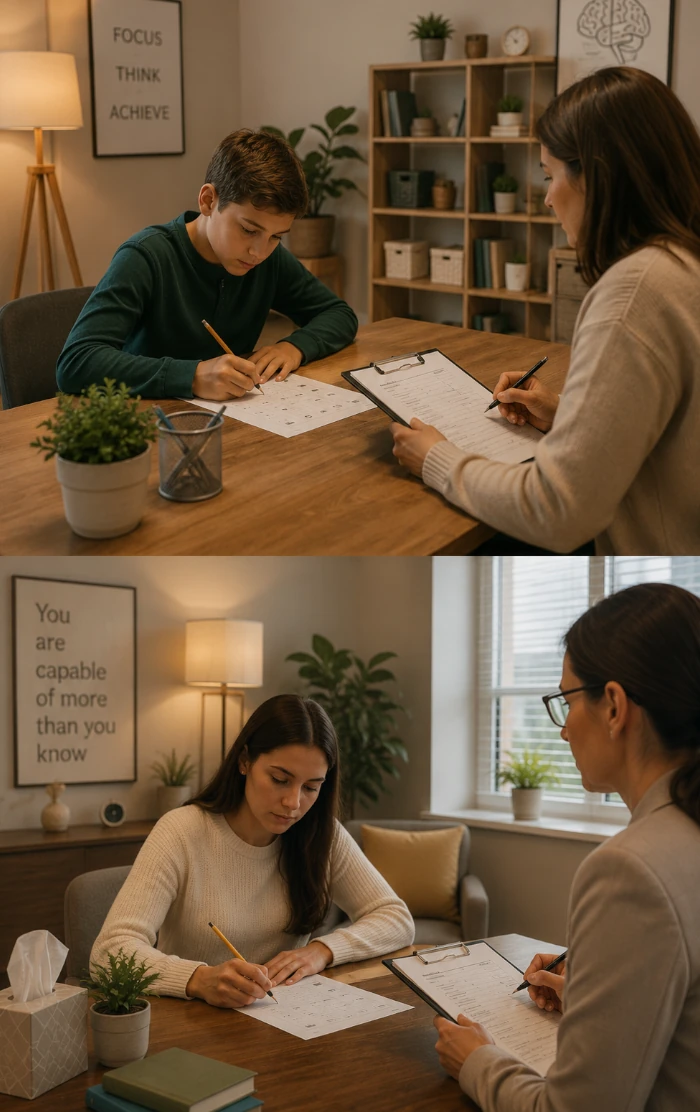
Professional IQ testing in Las Vegas – whether you need an assessment for school, employment, gifted program eligibility, or personal insight, we connect you with licensed psychologists in the Las Vegas area.
Last Updated: October 2026
Child IQ Testing
WISC-V & Stanford-Binet for ages 6–16. Gifted identification, learning profiles.
Adult IQ Testing
WAIS-IV & WAIS-5 available. Comprehensive adult cognitive assessments. Clinical & occupational.
WISC-V Test
Wechsler Intelligence Scale for Children® Fifth Edition – the gold standard for child IQ testing.
WAIS-IV & WAIS-5 Tests
Wechsler Adult Intelligence Scale® – Fourth Edition (WAIS-IV) and Fifth Edition (WAIS-5) available for adult IQ testing.
Gifted Testing
Identify giftedness for school placement, enrichment, and talent programs using WISC-V or Stanford-Binet.
Stanford-Binet 5
Stanford-Binet Intelligence Scales Fifth Edition – comprehensive cognitive assessment for all ages.
Mensa Testing
Mensa qualification guidance and testing that may provide accepted prior evidence, subject to current American Mensa rules. American Mensa's published prior-evidence list includes WAIS-IV and Stanford-Binet 5; verify current acceptance of WAIS-5 before testing.
Full Evaluation
Combined assessment with detailed report and recommendations. Includes WISC-V, WAIS-IV, WAIS-5, or Stanford-Binet 5 as appropriate.
IQ Testing in Las Vegas: city context
Las Vegas is Nevada's largest city and the center of a metropolitan area that also includes North Las Vegas, Henderson and extensive unincorporated Clark County communities. The U.S. Census Bureau estimated the city population at 679,817 in 2025, up 5.3% from the 2020 estimates base. Professional cognitive assessment in the valley serves children, adults, students, hospitality and gaming employees, healthcare workers, military families, executives, performers, first responders, older adults and people seeking disability or educational documentation.
Local assessment resources include private licensed psychologists and neuropsychologists, the University of Nevada, Las Vegas (UNLV), the Kirk Kerkorian School of Medicine at UNLV, University Medical Center of Southern Nevada, Children's Hospital of Nevada at UMC, Cleveland Clinic Lou Ruvo Center for Brain Health, the VA Southern Nevada Healthcare System, military-connected services at Nellis Air Force Base, and school-based teams within the Clark County School District. The right referral depends on whether the question is gifted identification, school placement, ADHD or learning disability, adult career planning, Mensa evidence, neurological change, legal documentation, or a broader psychoeducational or neuropsychological evaluation.
IQ, gender, language, and demographic context
Professional IQ tests use national age-based norms rather than a separate Las Vegas norm for men, women, racial groups, ethnic groups, casino employees, military personnel or neighborhoods. Overall IQ distributions overlap substantially by sex. Individual people can nevertheless show important differences across verbal comprehension, visual-spatial reasoning, fluid reasoning, working memory, processing speed and quantitative reasoning.
Current Census context for Las Vegas city includes:
- Female residents: 50.2% of the population.
- Residents under age 18: 22.4%; residents age 65 and older: 16.0%.
- Female civilian labor-force participation: 57.7% among residents age 16 and older in 2020–2024.
- Hispanic or Latino residents: 34.7%; Hispanic origin may overlap with race categories.
- Black residents: 11.7%; Asian residents: 7.2%; American Indian and Alaska Native residents: 1.1%; Native Hawaiian and Other Pacific Islander residents: 0.7%; two or more races: 19.0%.
- Foreign-born residents: 20.9%.
- Language other than English spoken at home: 33.3% of residents age five and older.
- High-school graduate or higher: 86.1% of adults age 25 and older; bachelor's degree or higher: 27.7%.
- Veterans: 39,887 in the 2020–2024 Census estimate period.
No authoritative public dataset establishes valid Las Vegas IQ averages by gender, race, ethnicity, immigration history, occupation, school, ZIP code or neighborhood. A psychologist interprets an individual's results in light of age, education, language exposure, culture, disability, health, sleep, medication, effort, test familiarity and testing conditions. Multilingualism, shift work and interrupted schooling must be evaluated as context rather than treated as evidence of lower ability.
What is professional IQ testing?
Intelligence quotient (IQ) testing is a standardized method to measure human cognitive abilities and intellectual potential. Professional IQ tests are administered by licensed psychologists in a controlled environment to ensure accuracy and reliability. Unlike online quizzes, clinical assessments provide a full-scale IQ score along with detailed breakdowns of verbal comprehension, perceptual reasoning, working memory, and processing speed.
In Las Vegas, IQ testing is commonly used for gifted program admission, learning disability identification, career guidance, neuropsychological evaluation, and personal development. The results are presented in a comprehensive report that includes normative comparisons, strengths and weaknesses, and actionable recommendations.
Who should get tested?
IQ testing can benefit children, adolescents, and adults in various situations:
- Children: Parents often seek testing for school readiness, gifted placement, or to understand learning challenges.
- Adults: Many adults take IQ tests for career advancement, graduate school applications, or personal curiosity.
- Mensa candidates: High-IQ societies require official test scores for membership.
- Clinical referrals: Psychologists may recommend testing as part of a broader neuropsychological evaluation.
Types of IQ tests
We offer the most recognized and scientifically validated intelligence tests in the field:
- WISC-V (Wechsler Intelligence Scale for Children® – Fifth Edition): The gold standard for children aged 6:0–16:11. It provides a Full-Scale IQ and five primary index scores.
- WAIS-IV (Wechsler Adult Intelligence Scale® – Fourth Edition): The most widely used adult IQ test for ages 16–90. It measures cognitive functioning across four domains.
- Stanford-Binet Intelligence Scales – Fifth Edition: A comprehensive assessment for ages 2–85, often used for gifted identification and clinical evaluations.
- Gifted Testing: Often includes the WISC-V or Stanford-Binet, plus additional creativity and achievement measures.
- Mensa Testing: We provide guidance on Mensa qualification routes and can connect consumers with psychologists whose complete reports may be submitted as prior evidence, subject to current American Mensa rules.
How the testing process works
- Initial consultation: Brief phone or video call to discuss your needs and match you with the right psychologist.
- Testing session: In-person or remote testing (depending on the test) with a licensed psychologist. Most sessions last 1–2 hours.
- Scoring and interpretation: The psychologist scores the test and interprets the results in the context of your background and goals.
- Feedback session: A detailed review of your results, including strengths, weaknesses, and practical recommendations.
- Comprehensive report: You receive a written report with all scores, normative comparisons, and actionable next steps.
How much does IQ testing cost in Las Vegas?
Fees vary according to the test selected, the referral question, the clinician's credentials, the amount of records review, and whether the service includes only a score summary or a comprehensive written report and feedback session. A stand-alone IQ assessment usually costs less than a full psychoeducational or neuropsychological evaluation.
Request a written estimate covering consultation, testing, scoring, report preparation, feedback, and any additional measures. Insurance is more likely to contribute when testing is medically necessary than when it is requested solely for curiosity, career exploration, school admission, or Mensa documentation.
Las Vegas's Intellectual History & Educational Legacy
Las Vegas developed from a railroad and desert-service settlement into an international center for hospitality, gaming, conventions, sports, entertainment, medicine, aviation and technology. The city's intellectual history includes Indigenous Southern Paiute knowledge, railroad engineering, Hoover Dam-era regional growth, casino mathematics and security, hospitality management, stagecraft, architecture, desert ecology, water conservation and large-scale event logistics.
UNLV has become a major urban research university with colleges and schools in engineering, business, education, hospitality, law, medicine, public health, sciences, nursing and the arts. The Desert Research Institute contributes expertise in atmospheric science, hydrology, climate and environmental systems. The region's modern knowledge economy also includes cybersecurity, autonomous systems, sports analytics, digital media, medical education, neuroscience and advanced entertainment production.
These local traditions matter because intelligence is expressed through many different problem-solving environments. A profile that supports success in hospitality operations may emphasize rapid processing, working memory and social judgment; engineering and cybersecurity may rely heavily on fluid and visual-spatial reasoning; law and public administration may emphasize verbal comprehension; and live production may combine timing, spatial reasoning, creativity and attention under pressure.
Major Las Vegas Employers and Cognitive Skill Demands
Hospitality, Gaming & Conventions
MGM Resorts, Caesars Entertainment, Wynn, Venetian operations, convention facilities and thousands of supporting businesses use rapid decision-making, customer communication, numerical accuracy, scheduling, security awareness and executive control.
For Las Vegas residents who want an informal introduction to reasoning questions, an online IQ test can be a useful starting point, while a licensed psychologist is necessary when formal documentation or diagnosis is required.
Processing speed + judgmentHealthcare & Neuroscience
UMC, Sunrise, MountainView, Dignity Health, UNLV health programs, the Lou Ruvo Center and private practices require clinical reasoning, memory, communication, documentation and sustained attention.
Working memory + verbal reasoningEducation & Research
CCSD, UNLV, the College of Southern Nevada, Nevada State University, Roseman University and research organizations need teaching, data analysis, writing, project management and scientific problem-solving.
Verbal + analytical reasoningAviation, Logistics & Construction
Harry Reid International Airport, distribution centers, contractors, utilities and transportation agencies use spatial reasoning, safety judgment, technical learning, sequencing and attention to detail.
Visual-spatial + executive skillsMilitary, Public Safety & Government
Nellis and Creech Air Force Base communities, Clark County, the City of Las Vegas, law enforcement and emergency services rely on planning, ethical judgment, attention, communication and performance under stress.
Attention + decision-makingSports, Entertainment & Digital Media
Professional sports organizations, theaters, production companies, music venues, film, immersive attractions and esports use creativity, timing, spatial organization, technology and collaboration.
Creativity + visual reasoningLas Vegas IQ Testing by Neighborhood and Area
Las Vegas addresses can refer to the incorporated city or to the broader valley. Confirm the exact office location before scheduling because the Strip, Paradise, Spring Valley, Enterprise and Winchester are largely in unincorporated Clark County, while Henderson and North Las Vegas are separate cities.
Downtown, Arts District & Medical District
Central access to civic offices, UMC, the Arts District, Fremont-area neighborhoods and major bus routes; event traffic and paid parking may affect arrival time.
Summerlin & West Las Vegas
Includes Summerlin, The Lakes, Peccole Ranch, Queensridge and western medical/professional corridors. Summerlin Parkway and the 215 Beltway are key routes.
Northwest & Centennial Hills
Centennial Hills, Skye Canyon, Providence, Lone Mountain and northwest communities often require travel on US 95, the 215 Beltway or surface arterials.
Central Valley, Paradise & the Resort Corridor
UNLV, the Strip, convention areas, Paradise and Winchester have dense traffic, special events, pedestrian activity and limited parking at peak times.
Southwest, Spring Valley & Enterprise
Rapidly growing residential and employment areas served by the 215 Beltway, I-15, Rainbow, Durango, Buffalo, Jones and major east–west arterials.
North Las Vegas, Henderson & Boulder City
Neighboring cities and outlying communities may add significant travel time. Confirm licensure, office location, school-district acceptance and telehealth rules before choosing a provider.
Las Vegas Universities and Research Institutions
- University of Nevada, Las Vegas: Fall 2025 enrollment reached 33,706, including 4,682 graduate and 1,085 professional students. UNLV offers more than 190 graduate degree and certificate programs and includes psychology, education, engineering, hospitality, law, medicine, public health, nursing and neuroscience-related training.
- College of Southern Nevada: A multi-campus community college serving academic transfer, workforce, technical, health and adult-education pathways across the valley.
- Nevada State University: A teaching-focused university in nearby Henderson with more than 70 high-demand majors and minors and strong education, nursing and allied-health relevance.
- Roseman University of Health Sciences: Henderson and Summerlin-area programs in nursing, pharmacy, dental medicine, graduate biomedical sciences and medicine.
- Touro University Nevada: Henderson-based graduate and professional education in osteopathic medicine, health sciences and related fields.
- Desert Research Institute: Nevada research institution with expertise in environmental science, climate, water, atmospheric processes and applied technology.
Applicants should verify each institution's current documentation standards. A university disability office, graduate department, licensing body or testing agency may require a broader evaluation rather than a stand-alone IQ score.
Las Vegas Economic Context
- Median household income: $73,877 in 2020–2024 Census data.
- Per-capita income: $39,906; poverty rate: 14.0%.
- Accommodation and food-service sales: More than $5.1 billion in 2022 within city QuickFacts, reflecting the central role of hospitality.
- Healthcare and social-assistance revenue: More than $7.2 billion in 2022.
- Retail sales: More than $17.8 billion in 2022.
- Mean commute: 25.7 minutes, although resort-corridor events, construction and cross-valley trips can produce much longer travel.
Las Vegas is diversifying beyond tourism through healthcare, logistics, professional sports, technology, advanced manufacturing, film and digital media, renewable-energy services and defense-related work. Cognitive testing can clarify strengths, but career recommendations should also consider interests, work values, shift tolerance, education, physical demands, language skills, licensing requirements and local wage conditions.
The city and the wider valley also function on a 24-hour schedule. A score obtained after an overnight shift, major convention, long flight or repeated sleep disruption may not represent typical functioning. Clinicians should document work hours, travel, heat exposure and fatigue and reschedule when standardized conditions cannot be maintained.
Testing recommendations should therefore be practical for a desert metropolitan area: realistic commute times, accessible locations, employer schedules, school calendars and the availability of qualified follow-up providers matter as much as the numerical scores.
Las Vegas School District and Gifted-Education Context
The Clark County School District (CCSD) serves Las Vegas and most of the surrounding county. CCSD Gifted Education Services conducts universal screening of full-time second-grade students, assesses referred students, and provides several service models:
- GATE grades 3–5: Identified students receive a minimum of 150 minutes per week of gifted services.
- Highly Gifted Program: Services may begin at age seven for students identified as highly gifted under district criteria.
- TAGS: Title I Alternative Gifted Services provide a minimum of 50 minutes per week in participating Title I schools.
- Universal screening and referrals: Screening is not the same as a private WISC-V or Stanford-Binet evaluation; families should follow current CCSD referral and eligibility procedures.
- Magnet and career-technical schools: CCSD offers K–12 magnet pathways in STEM, International Baccalaureate, leadership, performing arts and career-technical education. Programs include Advanced Technologies Academy, Las Vegas Academy of the Arts, Clark High School programs and multiple career and technical academies.
An outside IQ score does not automatically create eligibility for a district, charter or private-school program. Confirm accepted instruments, score recency, required achievement data, application dates, auditions, lotteries and transportation rules before paying for testing.
Local Testing Centers and Psychologists
- Private licensed psychologists: May offer WISC-V, WAIS-IV, WAIS-5, Stanford-Binet 5, achievement testing, ADHD evaluation and full psychoeducational or neuropsychological assessment.
- Nevada Board verification: The State of Nevada Board of Psychological Examiners regulates psychology, maintains license information and has its office in Las Vegas. Verify the individual clinician's active license and disciplinary history.
- UNLV and academic health resources: Psychology, medicine, education and health programs may provide clinics, training services, referrals or research opportunities; availability and eligibility change.
- Cleveland Clinic Lou Ruvo Center for Brain Health: A major Las Vegas resource for neurological and cognitive disorders; services are medically focused and are not interchangeable with routine gifted or school-placement testing.
- UMC and Children's Hospital of Nevada: Hospital services can support medical, developmental and behavioral referrals. Ask which department handles the referral question and whether neuropsychological testing is available.
- VA and military-connected care: Eligible veterans and service members should check referral, authorization, records-release and network requirements.
Before scheduling, ask which test will be administered, who will administer it, whether the report includes all scores, whether feedback is included, how long the report takes, whether insurance is billed, and whether the receiving school or organization accepts the report.
Las Vegas Learning Events and Professional Resources
- UNLV lectures and public programs: University colleges, museums, libraries and research centers host academic, cultural and professional events.
- Las Vegas-Clark County Library District: Branches provide educational programming, technology access, maker activities, tutoring resources and public meeting spaces.
- Discovery Children's Museum: Downtown hands-on learning in science, art, engineering and early childhood exploration.
- Springs Preserve and Nevada State Museum: Programs in desert ecology, water, history, archaeology and regional culture.
- Southern Nevada Mensa: Local intellectual and social programming subject to current schedules and membership policies.
- Professional associations: Nevada Psychological Association, school-psychology, counseling, neuropsychology and education organizations can help consumers understand credentials and referral options.
Transportation and Accessibility
- Major roads: I-15 runs north–south through the resort corridor and connects Southern California with Utah; US 95/I-11 carries northwest–southeast traffic through the Spaghetti Bowl and toward Henderson; the Clark County 215 Beltway circles the west and south valley; Summerlin Parkway serves the west; major arterials include Charleston, Sahara, Desert Inn, Flamingo, Tropicana, Russell, Blue Diamond, Las Vegas Boulevard, Eastern, Maryland Parkway, Rainbow, Buffalo and Durango.
- Public transit: The Regional Transportation Commission of Southern Nevada operates fixed-route buses throughout the valley, the Deuce along the Strip and Downtown, express services on selected corridors, transit centers, park-and-ride facilities and ADA paratransit. Route frequency and late-night service vary.
- Airport: Harry Reid International Airport (LAS) is immediately east of the Strip and provides extensive domestic and international service. North Las Vegas Airport (VGT) primarily serves general aviation. Airport traffic, rental-car activity and convention arrivals can affect nearby appointments.
- Distance to other cities: Downtown Las Vegas is roughly 20–30 minutes from central Henderson, 35–45 minutes from Boulder City, 60–75 minutes from Pahrump, 75–90 minutes from Mesquite, about 2 hours from St. George, about 1 hour 45 minutes from Kingman, approximately 4–5 hours from Los Angeles and about 4.5–5.5 hours from Phoenix under normal conditions.
- Walkability: The Fremont Street/Downtown core, the Arts District, portions of the Strip and selected mixed-use districts such as Downtown Summerlin are the most walkable clusters. The Strip is largely outside incorporated Las Vegas, distances between resorts are longer than they appear, and most residential areas remain car-oriented.
- Bike infrastructure: Southern Nevada has hundreds of miles of bicycle lanes and paths, while the RTC regional plan works toward more than 2,000 miles of bike lanes and walking paths. Important facilities include the River Mountains Loop Trail, Las Vegas Wash Trail, Bonanza Trail, Flamingo Arroyo Trail and I-215 West Beltway Trail; extreme heat limits practical use during summer afternoons.
- Event and resort traffic: Conventions, Formula 1 preparations, Raiders and Golden Knights games, concerts, festivals, road construction and lane closures can sharply increase travel time on I-15, Las Vegas Boulevard, Tropicana, Flamingo, Sahara and Downtown streets.
- Cross-valley travel: A Summerlin-to-Henderson, Centennial Hills-to-UNLV or North Las Vegas-to-southwest appointment may take far longer than the straight-line distance suggests. Build in extra time for the Spaghetti Bowl, school release, airport traffic and freeway incidents.
- Accessibility: Confirm accessible parking, elevator access, wheelchair routes, restroom access, quiet waiting areas, interpreter services, sensory accommodations, break policies and whether the building requires long walks from a parking garage.
Las Vegas Weather and Seasonal Considerations
- Extreme heat: From late spring through early fall, afternoon temperatures can exceed 105°F and sometimes 110°F. Morning testing is often preferable, especially for children, older adults and people taking medications affected by heat or hydration.
- Hydration and sleep: Heat, dehydration, late-night work and disrupted sleep can reduce attention, processing speed and frustration tolerance. Arrive rested and follow normal food, medication and caffeine routines unless the clinician gives different instructions.
- Monsoon storms and flash flooding: Summer thunderstorms can flood low crossings and underpasses quickly. Do not drive through standing water; allow extra travel time when warnings are active.
- Wind and dust: High winds and blowing dust can reduce visibility and aggravate allergies or respiratory conditions.
- Winter conditions: Valley winters are generally mild, but early mornings can be cold and mountain routes to communities such as Mount Charleston may experience snow or closures.
- Tourism calendar: Major conventions, holiday weekends, sporting events and festival periods can affect hotel-area access, rideshare prices and parking even when the weather is calm.
Areas we serve
We connect consumers with IQ-testing and evaluation resources serving Las Vegas and the wider valley, including Downtown, the Arts District, Symphony Park, the Medical District, Huntridge, Rancho, West Las Vegas, Summerlin, The Lakes, Peccole Ranch, Queensridge, Lone Mountain, Centennial Hills, Skye Canyon, Providence, Northwest Las Vegas, Spring Valley, Enterprise, Paradise, Winchester, the Strip corridor, UNLV, Sunrise Manor, Whitney, North Las Vegas, Aliante, Henderson, Green Valley, Inspirada, Anthem, Boulder City and nearby Clark County communities.
- City versus valley: Confirm whether the office is inside Las Vegas city limits or in an unincorporated or neighboring jurisdiction.
- Long cross-valley trips: Schedule enough time for I-15, US 95/I-11, the 215 Beltway, construction and event traffic.
- Rural and outlying residents: Pahrump, Mesquite, Moapa Valley and other communities may require substantial travel; verify remote options and Nevada licensure before scheduling.
- Receiving organization: Confirm that a school, employer, court, licensing board, Mensa or disability office will accept the selected test and report format.
Frequently Asked Questions
WISC-V is for children aged 6–16, while WAIS-IV is for adults aged 16–90. Each is normed for its specific age group.
Most IQ tests take between 60 and 90 minutes, plus a feedback session. Allow 2–3 hours total.
No, you can book directly with our psychologists. We serve both self-referred and professionally referred individuals.
A complete psychologist's report may be submitted as prior evidence if the test, score, administration conditions, and documentation satisfy the receiving organization's current rules. Verify requirements before testing.
Some plans cover cognitive assessments when there is a clinical indication. Check with your provider.
Get a good night's sleep, eat a healthy meal, and arrive relaxed. No specific preparation is needed.
You'll receive a comprehensive report with your scores and tailored recommendations.
Remote administration may be possible only in limited circumstances. The evaluator must confirm publisher guidance, test validity, state licensing, technology requirements, and acceptance by the receiving school or organization.