
Child IQ Testing in Las Vegas

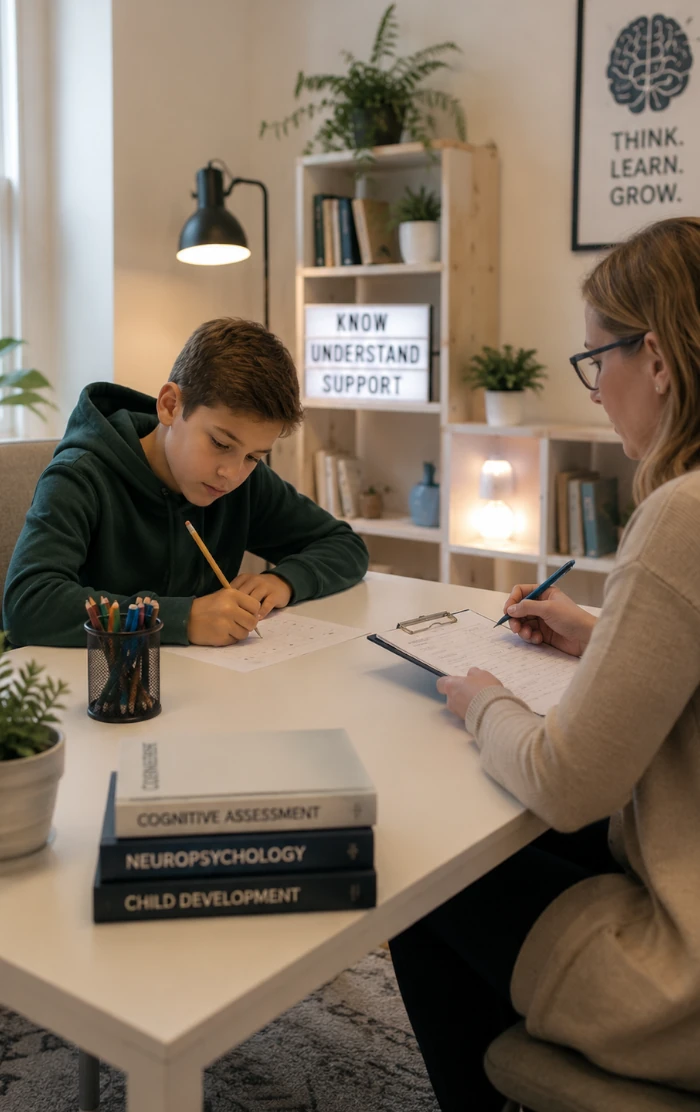
Professional child IQ testing in Las Vegas – whether you need an assessment for school placement, gifted program eligibility, or to understand your child's learning profile, we connect you with licensed psychologists in the Las Vegas area.
Last Updated: July 2026
Gifted Testing
Identify giftedness for school placement, enrichment, and talent programs using WISC-V or Stanford-Binet 5.
WISC-V Test
Wechsler Intelligence Scale for Children® Fifth Edition – the gold standard for child IQ testing.
Stanford-Binet 5
Stanford-Binet Intelligence Scales Fifth Edition – comprehensive cognitive assessment for all ages.
Full Evaluation
Combined assessment with detailed report and recommendations. Includes WISC-V or Stanford-Binet 5.
School Placement Testing
Testing for private school admission and gifted program eligibility using WISC-V or Stanford-Binet 5.
Schedule Child IQ Testing
Book your WISC-V & Stanford-Binet 5 for ages 6–16. Gifted identification, learning profiles, etc. with a licensed psychologist in Las Vegas today.
Child IQ Testing in Las Vegas: city context
Las Vegas has 679,817 residents in the 2025 Census estimate, with 22.4% under age 18. Families seek child testing for gifted identification, school planning, learning concerns, ADHD, autism, disability documentation, private-school questions, acceleration and a clearer understanding of cognitive strengths.
The Clark County School District serves most public-school students in the valley. Other options include charter schools, magnet schools, career and technical academies, private schools, home-school programs and neighboring jurisdictions such as Henderson and North Las Vegas.
IQ, gender, language, and demographic context (child population)
WISC-V and Stanford-Binet 5 scores use national age-based norms. They do not use separate Las Vegas norms for boys and girls, and overall IQ distributions overlap substantially by sex. Individual children may show important differences among verbal, visual-spatial, fluid-reasoning, working-memory and processing-speed abilities.
- Residents under age 18: 22.4%.
- Female residents: 50.2% of the total city population.
- Hispanic or Latino: 34.7%.
- Black or African American alone: 11.7%.
- Asian alone: 7.2%.
- Native Hawaiian and Other Pacific Islander alone: 0.7%.
- Two or more races: 19.0%.
- Language other than English spoken at home: 33.3% of residents age five and older.
No valid local source supports assigning IQ averages to Las Vegas children by gender, race, ethnicity, school, ZIP code or neighborhood. Equitable assessment considers language exposure, educational opportunity, disability, culture, health, attendance, test familiarity and the appropriateness of the selected instrument.
Las Vegas School Districts and Gifted Programs
Clark County School District Gifted Education Services
- Universal screening: CCSD conducts universal screening of all second-grade students enrolled full time.
- GATE grades 3–5: Identified students receive at least 150 minutes per week of gifted services.
- Highly gifted: Services are available for students identified as highly gifted beginning at age seven.
- TAGS: Title I Alternative Gifted Services provide at least 50 minutes per week in participating Title I schools.
- Referral and assessment: Parents and school staff should use current district referral procedures; private IQ testing is not automatically interchangeable with district identification.
Highly Gifted and TAGS Service Models
The Highly Gifted and TAGS pathways are not simply higher and lower versions of the same private IQ-testing service. The Highly Gifted Program begins at age seven for students who meet district identification criteria and addresses advanced academic and affective needs. TAGS is a Title I alternative gifted model with at least 50 minutes of weekly service in participating schools. Families should ask which service is available at the child’s assigned school, how transfer rules work, and whether transportation is provided.
Nevada Framework and Outside Evaluations
The Nevada Department of Education provides statewide technical assistance, while CCSD establishes local identification and service procedures. A private psychologist can clarify a child’s cognitive profile, but the district retains authority over school eligibility and placement. Before testing, request the current referral form, accepted evidence, reevaluation rules, appeal procedures and the name of the school’s gifted specialist.
CCSD Magnet and Advanced Programs
- Magnet grades K–12: Programs include STEM, International Baccalaureate, leadership, performing arts and career-technical themes.
- High-school examples: Advanced Technologies Academy, Las Vegas Academy of the Arts, West Career and Technical Academy, Northwest Career and Technical Academy, Southeast Career Technical Academy, East Career and Technical Academy and Clark High School specialty programs.
- Middle and elementary examples: Hyde Park Academy of Science and Mathematics, Jo Mackey iLead Academy, Gordon McCaw STEAM Academy and other magnet options.
- Application rules: Families may select programs through the current School Choice process; eligibility, auditions, lotteries, transportation and grade-entry rules vary.
Charter, Private and Home-School Options
- Charter schools: Nevada charter schools set school-specific enrollment, lottery and academic procedures.
- Private schools: The Meadows School, Faith Lutheran, Bishop Gorman, Adelson Educational Campus, Alexander Dawson and other schools use their own records, interviews, observations and testing requirements.
- Home-school families: Private testing may support curriculum planning or gifted/learning questions, but it is not a substitute for a school or agency's required process.
Las Vegas Private Schools and Testing Requirements
Las Vegas-area independent and faith-based schools use grade-specific admissions processes. Some rely on school records, teacher recommendations, interviews, classroom visits, readiness measures, achievement testing or school-selected entrance examinations. Do not assume a WISC-V or Stanford-Binet is required.
- The Meadows School: College-preparatory independent school; confirm current grade-level application and assessment requirements.
- Faith Lutheran: Large private Christian school with grade-specific admissions and placement procedures.
- Bishop Gorman: Catholic college-preparatory high school; verify entrance, transcript and placement requirements.
- Adelson Educational Campus: Jewish community school with school-specific admissions procedures.
- Alexander Dawson School: Independent school in the Summerlin area; confirm accepted records and assessments.
- Before testing: Obtain written confirmation of the accepted test, examiner credentials, score age, report format and deadline.
Las Vegas Gifted Identification Statistics
No reliable public dataset reports a single Las Vegas gifted-identification rate or the annual number of private WISC-V assessments. CCSD's universal second-grade screening increases access, while GATE, Highly Gifted and TAGS services use different criteria and populations.
- Universal screening: All full-time second graders are screened under current CCSD practice.
- Service intensity: GATE grades 3–5 provides at least 150 minutes weekly; TAGS provides at least 50 minutes in participating Title I schools.
- Highly gifted services: Begin at age seven for students meeting district criteria.
- No universal score: A 130 IQ is a common high-IQ reference point, but it is not a universal admission rule for every CCSD, charter, private or magnet program.
- Equity: Language, disability, school opportunity and referral patterns can affect identification; district screening and private clinical testing serve different purposes.
The child IQ testing process: step by step
Understanding the testing process can help parents prepare their child and reduce anxiety. Here's what to expect:
- Initial consultation (15–20 minutes): A brief phone or video call with the psychologist to discuss your child's background, concerns, and goals. This helps determine the right test and approach.
- Testing session (60–90 minutes): The child meets one-on-one with a licensed psychologist in a quiet, comfortable room. The psychologist administers the WISC-V or Stanford-Binet 5, which includes a series of subtests measuring verbal comprehension, visual-spatial reasoning, fluid reasoning, working memory, and processing speed. Breaks are offered as needed.
- Scoring and interpretation (1–2 days): The psychologist scores the test and analyzes the results. They consider the child's age, background, and any relevant medical or educational history.
- Feedback session (45–60 minutes): The psychologist meets with the parents (and the child, if appropriate) to explain the results. They discuss the Full-Scale IQ, index scores, strengths, and areas for growth. They also provide tailored recommendations for home, school, and extracurriculars.
- Comprehensive written report (5–7 days): You receive a detailed report with all scores, normative comparisons, and actionable next steps. This report can be shared with schools, doctors, or other professionals.
The entire process from consultation to report usually takes 1–2 weeks, depending on scheduling. The testing itself is non-invasive and designed to be engaging for children.
What is the WISC-V test?
The WISC-V (Wechsler Intelligence Scale for Children® – Fifth Edition) is the most widely used IQ test for children aged 6:0–16:11. It provides a Full-Scale IQ and five primary index scores: Verbal Comprehension, Visual-Spatial, Fluid Reasoning, Working Memory, and Processing Speed. The test is administered one-on-one by a trained psychologist and takes about 60–90 minutes.
The WISC-V is normed on a large, representative sample of U.S. children and is updated regularly to ensure accuracy. It is the gold standard for gifted identification, learning disability diagnosis, and school placement.
Why test your child's IQ?
IQ testing provides valuable insights into your child's cognitive strengths and weaknesses. It can help:
- Identify giftedness: For admission to gifted programs, private schools, or enrichment opportunities.
- Diagnose learning disabilities: Such as dyslexia, dyscalculia, or ADHD, which can be masked by high intelligence.
- Guide educational planning: Tailor instruction to your child's unique learning profile.
- Provide reassurance: Understand why your child is different from peers and how to support them.
Las Vegas Gifted Testing Timeline
- Early fall: Review school calendars, magnet information, private-school deadlines and current CCSD referral procedures.
- Before testing: Confirm whether outside testing is accepted and whether achievement, behavior, teacher or adaptive data are also required.
- Testing day: Avoid scheduling after a late event, travel day, illness, sleep loss or prolonged heat exposure.
- Report timing: Allow time for scoring, interpretation, feedback and possible additional testing before application deadlines.
- School submission: Follow the receiving program's rules; do not send a report without understanding privacy and records implications.
Las Vegas Gifted Programs by Age Group
- Preschool and kindergarten: Readiness, language, development and behavior are often more useful than an isolated IQ score; private schools use different entry processes.
- Grade 2: CCSD universal screening is a major identification point.
- Grades 3–5: GATE and TAGS services, magnet options, enrichment and acceleration discussions become relevant.
- Middle school: Magnet STEM, arts, leadership and IB pathways, honors courses and subject acceleration may be available.
- High school: Career and technical academies, Advanced Technologies Academy, Las Vegas Academy of the Arts, IB, AP, dual enrollment and specialized programs require separate applications and may use auditions or lotteries rather than IQ scores.
Las Vegas Child ADHD and Learning Disability Assessment
- IQ is one component: A full learning evaluation may add achievement, attention, executive, language, memory, behavior and social-emotional measures.
- School evaluation: Families may request evaluation through CCSD or the relevant charter/public school under applicable special-education procedures.
- Private evaluation: May offer more flexible scheduling or broader questions but can be costly; confirm school acceptance and insurance coverage.
- Child Find: CCSD maintains Child Find services for children who may need special-education evaluation, including preschool-age children.
- Context: Heat, sleep, attendance, multilingual development, anxiety, sensory needs and family stress can affect performance.
Las Vegas Summer and Enrichment Programs for Advanced Learners
- UNLV youth programs: Camps, academic programs, arts, athletics and pre-college opportunities vary by year.
- Discovery Children's Museum: Hands-on science, engineering, art and problem-solving activities.
- Springs Preserve: Desert ecology, sustainability, history and outdoor learning.
- Library district: Summer reading, maker activities, technology, tutoring and teen programs across branches.
- Arts and performance: Smith Center, community arts organizations, music, dance and theater programs provide creative enrichment.
- Heat planning: Outdoor activities should be scheduled with extreme-heat precautions, hydration and air-quality awareness.
Las Vegas Child Testing Costs and School Evaluations
Private fees vary by clinician, test battery, records review, report detail and feedback. A stand-alone IQ test generally costs less than a full psychoeducational or neuropsychological evaluation. Ask for a written estimate covering consultation, testing, scoring, report preparation, feedback and additional measures.
- Public-school evaluation: When a disability is suspected, eligible school evaluations are provided through the student's public education system, but the scope is educational and determined by the evaluation team.
- Private testing: May address giftedness, private-school placement or broader diagnostic questions; insurance coverage is more likely when medically necessary than when requested only for admission or curiosity.
- Out-of-network issues: Verify deductibles, prior authorization, superbills and whether the clinician's report is accepted by CCSD, a charter school or a private school.
Areas we serve
Child-testing resources serve Las Vegas, Summerlin, Centennial Hills, Downtown, the Medical District, UNLV, Spring Valley, Paradise, Enterprise, Sunrise Manor, North Las Vegas, Aliante, Henderson, Green Valley, Boulder City and nearby Clark County communities.
- School jurisdiction: Confirm the child's district, charter or private-school rules before testing.
- Travel: Cross-valley trips can be lengthy; schedule enough time and avoid arriving after stressful traffic.
- Heat and sleep: Morning appointments are often preferable during extreme summer temperatures.
- Language: Tell the psychologist about all languages used at home and school and any schooling outside the United States.
Frequently Asked Questions
Both are excellent tests. WISC-V is more commonly used for school-age children, while Stanford-Binet 5 can be used for ages 2–85. We often recommend WISC-V for gifted identification.
The test itself takes 60–90 minutes. With the consultation, feedback, and report, the entire process is about 1–2 weeks.
No, you can book directly with our psychologists. We serve both self-referred and professionally referred children.
A report may be considered, but acceptance is never automatic. Confirm CCSD, charter, private-school or program requirements before testing.
Some plans cover cognitive assessments when there is a clinical indication. Check with your provider.
Get a good night's sleep, eat a healthy meal, and arrive relaxed. No specific preparation is needed.
You'll receive a comprehensive report with your child's scores and tailored recommendations.
Remote administration may be possible only in limited circumstances. The evaluator must confirm publisher guidance, test validity, state licensing, technology requirements, and acceptance by the receiving school or organization.