
Full Evaluation in Lancaster

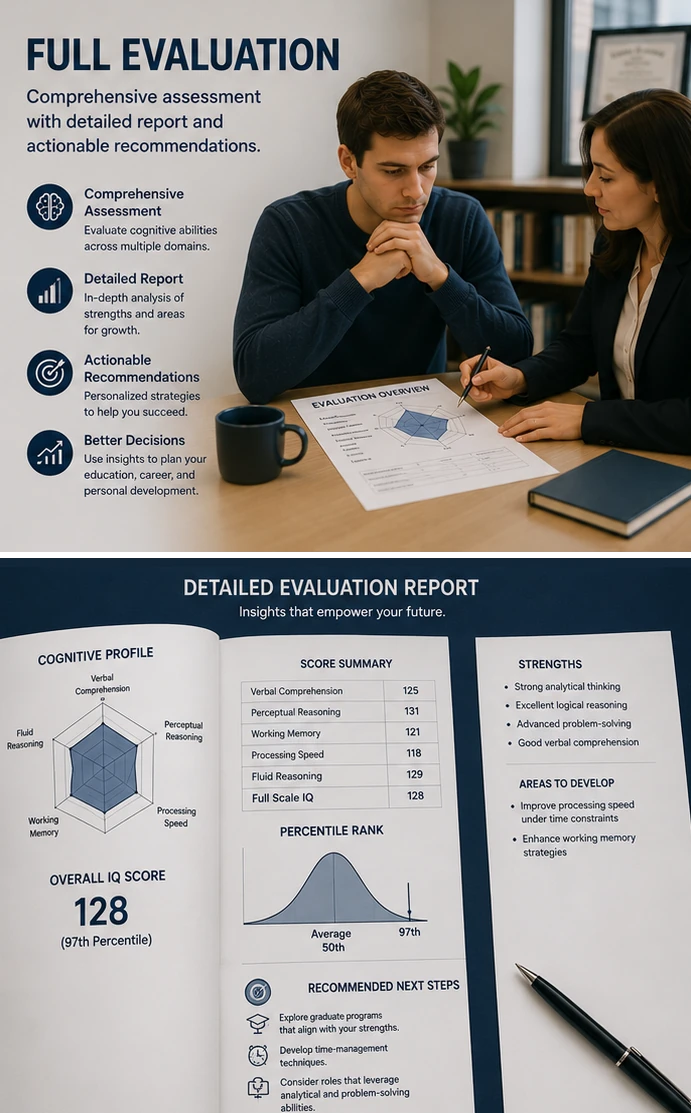
A full evaluation is a comprehensive psychological and psychoeducational assessment that goes beyond a single IQ test. It provides a detailed picture of your cognitive, academic, emotional, and behavioral functioning, with actionable recommendations for academic planning, career development, or clinical intervention.
Last Updated: September 2026
Child IQ Testing
WISC-V & Stanford-Binet 5 for ages 6–16. Gifted identification, learning profiles.
Adult IQ Testing
WAIS-IV & WAIS-5 available. Comprehensive adult cognitive assessments for clinical and occupational purposes.
WAIS-IV & WAIS-5 Tests
Wechsler Adult Intelligence Scale® – Fourth Edition (WAIS-IV) and Fifth Edition (WAIS-5) – the gold standard for adult IQ testing.
Gifted Testing
Identify giftedness for school placement, enrichment, and talent programs using WISC-V or Stanford-Binet 5.
Mensa Testing
Official Mensa admission testing and preparation for the high-IQ society. Accepts WAIS-IV, WAIS-5, and Stanford-Binet 5 scores.
Schedule Full Evaluation
Book your comprehensive assessment with detailed report and recommendations for academic planning. Includes WISC-V, WAIS-IV, WAIS-5, or Stanford-Binet 5 as appropriate, with a licensed psychologist in Lancaster today.
What is a Full Evaluation?
A full evaluation is a comprehensive psychological and psychoeducational assessment that provides a complete picture of your cognitive, academic, emotional, and behavioral functioning. Unlike a single IQ test, which focuses only on cognitive abilities, a full evaluation includes multiple tests and assessments to provide a holistic understanding of your strengths and challenges.
Full evaluations are typically conducted by licensed psychologists and can take anywhere from 2 to 6 hours of testing time, often spread across multiple sessions.
What a Full Evaluation Includes
- Cognitive Assessment (IQ testing): WISC-V (children), WAIS-IV or WAIS-5 (adults), or Stanford-Binet 5 to measure intellectual abilities
- Academic Achievement Testing: Measures reading, writing, math, and other academic skills
- Behavioral and Emotional Assessment: Questionnaires and interviews to assess emotional well-being, social functioning, and behavioral patterns
- Executive Functioning Assessment: Measures attention, planning, organization, and self-regulation
- Clinical Interview: Detailed interview to understand personal history, concerns, and goals
- Comprehensive Report: Detailed findings with scores, interpretations, and actionable recommendations
Full Evaluation vs. Single IQ Test
| Feature | Full Evaluation | Single IQ Test |
|---|---|---|
| What's Measured | Cognitive, academic, emotional, behavioral | Cognitive abilities only |
| Testing Time | 2-6 hours (often multiple sessions) | 45-90 minutes |
| Tests Included | IQ test + achievement tests + emotional/behavioral assessments | Single IQ test (e.g., WISC-V, WAIS-IV, WAIS-5, SB-5) |
| Report | Comprehensive, multi-page report with detailed recommendations | Shorter report with IQ scores and basic interpretation |
| Best For | Complex cases, learning disabilities, ADHD, emotional concerns, legal documentation | Gifted identification, school placement, Mensa |
| Cost Range | $1,200-$3,000 | $200-$1,200 |
When Is a Full Evaluation Recommended?
A full evaluation is recommended in several situations:
- Learning disabilities: Suspected dyslexia, dyscalculia, dysgraphia, or other learning disorders
- ADHD: Attention deficit hyperactivity disorder diagnosis and treatment planning
- Giftedness with learning challenges (2E): Twice-exceptional children who are both gifted and have learning disabilities
- Autism assessment: Comprehensive evaluation for autism spectrum disorder
- Educational planning: For Individualized Education Programs (IEPs) or 504 plans
- Legal documentation: For court cases, disability claims, or special education advocacy
- Mental health concerns: Anxiety, depression, or other emotional challenges affecting academic or occupational functioning
- College accommodations: Documentation for accommodations on college entrance exams (SAT, ACT, GRE) or in college settings
Lancaster Hospitals and Medical Centers Offering Evaluations
Hospital and health-system evaluation is most appropriate when the referral includes neurological symptoms, injury, developmental complexity, serious psychiatric concerns, rehabilitation, or medical causes of cognitive change. Availability must be confirmed because a hospital may provide referral or related specialty care without offering routine outpatient IQ testing.
Antelope Valley Medical Center
Antelope Valley Medical Center is Lancaster's major acute-care hospital. Its medical, pediatric, trauma, behavioral, rehabilitation, and specialty pathways may help determine whether cognitive symptoms require neurological, developmental, psychiatric, or other medical follow-up.
Kaiser Permanente and High Desert Regional Health Center
Regional outpatient systems may evaluate medical and behavioral-health concerns or coordinate referrals depending on insurance, eligibility, diagnosis, and clinical need. Ask specifically whether neuropsychological, developmental, or psychoeducational testing is offered at the requested location.
Pediatric and Academic Specialty Referrals
Children or adults with medically complex questions may be referred to Children's Hospital Los Angeles, UCLA Health, USC-affiliated services, Olive View–UCLA Medical Center, or other Los Angeles County specialists. A medical evaluation and a school or private psychological evaluation may answer different parts of the referral question.
Regional Health Systems
County behavioral-health services, rehabilitation providers, primary-care groups, neurologists, psychiatrists, and specialty practices across the Antelope Valley and Los Angeles County may offer evaluation or referrals depending on diagnosis, insurance, and medical necessity.
Private Practice Psychologists
Morris Clinic, Inc. lists psychological testing and evaluations at 1672 West Avenue J, Suite 103, Lancaster, CA 93534; call (661) 951-4662 to confirm whether the required IQ, achievement, attention, autism, or diagnostic instruments are available. Other psychologists may specialize in neuropsychology, psychoeducational evaluation, forensic work, disability documentation, or bilingual assessment.
Lancaster Evaluation Costs by Provider
- Focused IQ assessment: Usually less expensive than a full evaluation because the battery and report are narrower.
- Psychoeducational evaluation: May include cognition, reading, writing, mathematics, phonological processing, attention, executive function, behavior, and school recommendations.
- Neuropsychological evaluation: Often costs more because it can involve extensive record review and testing of memory, language, motor, executive, and emotional functioning.
- Hospital or health-system services: Cost depends on medical necessity, insurance authorization, deductible, copay, and whether the provider is in network.
- Forensic or legal evaluation: Depositions, court testimony, attorney communication, and record volume are typically billed separately.
- Written estimate: Ask whether intake, test materials, scoring, feedback, report, school meeting, forms, travel, and follow-up are included.
Complexity, not merely the number of hours in the office, drives cost. A clinician may spend substantial time reviewing records, selecting measures, scoring, comparing competing diagnoses, consulting with schools or physicians, and writing recommendations. Ask whether additional testing can be authorized only if the initial results show it is needed.
When comparing quotes, confirm the examiner—not only the practice—will be licensed and experienced with the relevant age, disability, cultural background, language, and legal or educational standard. A report that is inexpensive but rejected by the receiving institution can create more cost, delay, and repeated testing.
Lancaster Legal and Forensic Evaluations
Legal, immigration, disability, conservatorship, workers' compensation, personal-injury, competency, and criminal matters require specialized expertise. A general IQ-testing appointment may not satisfy forensic standards.
- Retain the right expert: Confirm California licensure, forensic experience, conflicts, test security, and willingness to testify.
- Clarify the client: In legal work, the attorney, agency, court, or examinee may have different roles and confidentiality expectations.
- Language access: Qualified interpreters and culturally informed methods may be necessary; informal family interpretation can undermine validity.
- Records: School, employment, medical, immigration, police, military, and prior-testing records may be relevant.
- Deadlines: Court dates and filing requirements should be disclosed before scheduling.
Lancaster Evaluation Timeline and Process
- Referral clarification: Identify the decision the evaluation must support and who will receive the report.
- Benefits and eligibility check: Verify insurance, school, legal, employer, or program requirements before testing.
- Records and interview: Collect developmental, educational, medical, work, language, and treatment history.
- Testing: One or more sessions may be needed depending on age, stamina, disability, and battery length.
- Scoring and integration: The psychologist compares results with norms, behavior, history, records, and validity indicators.
- Feedback: Findings, uncertainty, diagnoses, strengths, and recommendations are discussed.
- Written report: Turnaround varies from days to several weeks; urgent legal or school deadlines should be discussed in advance.
Lancaster Insurance Coverage for Evaluations
Insurance commonly distinguishes medically necessary diagnostic testing from educational, admissions, gifted, career, or Mensa testing. Coverage is never guaranteed merely because a psychologist recommends an evaluation.
- Ask whether prior authorization is required and whether the psychologist, facility, and test codes are in network.
- Request the deductible, coinsurance, copay, visit limits, and exclusion rules in writing.
- Confirm whether school-only learning-disability testing or academic achievement testing is excluded.
- Ask the office for procedure and diagnosis codes, but remember that final coding must reflect the actual clinical service.
- For self-pay work, request a good-faith estimate and cancellation policy.
Lancaster Evaluation Referrals
- Self-referral: Many private psychologists accept direct inquiries.
- School referral: Teachers, counselors, special-education teams, or parents may initiate school-based concerns.
- Medical referral: Pediatricians, primary-care physicians, neurologists, psychiatrists, rehabilitation clinicians, and therapists may refer for diagnostic clarification.
- Legal referral: Attorneys, courts, disability representatives, or agencies may require a forensic specialist.
- Local office: Morris Clinic, Inc., 1672 West Avenue J, Suite 103, Lancaster, CA 93534, (661) 951-4662—confirm the exact evaluation type and test battery.
Benefits of a Full Evaluation
- Complete picture: Understand the full picture of your or your child's functioning – cognitive, academic, emotional, and behavioral
- Accurate diagnosis: Receive precise diagnoses for learning disabilities, ADHD, autism, or other conditions
- Legal documentation: Obtain documentation for IEPs, 504 plans, college accommodations, disability claims, or court cases
- Personalized recommendations: Receive tailored recommendations for academic planning, career development, therapy, or treatment
- Peace of mind: Understand your or your child's strengths and challenges and how to address them effectively
- Long-term planning: Use the findings for educational, career, and personal planning
Full Evaluations in Lancaster
A full Lancaster evaluation should be tailored to the question, not built from a fixed package. A gifted-placement question, suspected dyslexia, adult ADHD, memory change, autism evaluation, disability accommodation, and legal matter require different records, instruments, norms, and expertise.
Lancaster's multilingual context makes language planning especially important. Ask how the psychologist will evaluate English proficiency, choose tests, use interpreters, interpret verbal scores, and describe limitations. The final report should be understandable, evidence based, and specific about next steps.
- Confirm California licensure and specialty.
- Verify that the receiving organization accepts the evaluation.
- Ask which tests are planned and why.
- Clarify fees, report length, turnaround, and follow-up.
- Bring prior reports, school or work records, medication list, glasses/hearing aids, and relevant medical information.
What a High-Quality Report Should Explain
- The referral question and who requested the evaluation.
- Developmental, educational, occupational, medical, language, cultural, and treatment history relevant to interpretation.
- Tests administered, editions, norms, accommodations, interpreter use, and departures from standard procedure.
- Behavioral observations, engagement, validity indicators, and factors that may raise or lower confidence in a score.
- Integrated findings rather than a disconnected list of numbers.
- Diagnostic reasoning, including plausible alternatives and why they were accepted or rejected.
- Functional implications at school, work, home, and in the community.
- Prioritized recommendations with responsible parties, timelines, and follow-up measures.
For school, disability, or legal use, the report may also need examiner credentials, signature, license number, testing dates, complete score tables, and a statement connecting findings to requested accommodations or legal criteria. Confirm those requirements before the first appointment.
Frequently Asked Questions
A full evaluation typically includes cognitive testing (IQ), academic achievement testing, behavioral and emotional assessments, a clinical interview, and a comprehensive written report with recommendations.
Testing typically takes 2-6 hours, often spread across 2-3 sessions. The entire process from consultation to receiving the report usually takes 2-4 weeks.
The report includes background information, test scores, normative comparisons, interpretation of findings, diagnostic impressions (if applicable), and actionable recommendations for academic planning, treatment, or accommodations.
No. A full evaluation is much more comprehensive and includes cognitive testing, academic testing, emotional/behavioral assessments, and a clinical interview. An IQ test only measures cognitive abilities.
Some insurance plans cover full evaluations when they are deemed medically necessary. Coverage varies by plan and provider. We recommend checking with your insurance provider.
Yes. A full evaluation provides the documentation needed for college accommodations, including extended time on exams, note-taking assistance, and other academic support services.
Some components of a full evaluation can be done via telehealth, but many tests (especially cognitive and achievement tests) require in-person administration for accurate scoring. Contact us for details.
Get a good night's sleep, eat a healthy meal, and arrive relaxed. Bring any relevant documents (previous evaluations, school records, medical history). No specific preparation is needed for the tests themselves.
Typical fees range from $1,200 to $3,000 or more, depending on the complexity of the evaluation. Some insurance plans cover testing when medically necessary.
Yes. A full evaluation provides the comprehensive documentation needed to qualify for IEPs, 504 plans, and other educational accommodations in Lancaster Public Schools and other districts.
Lancaster coordination note: A comprehensive evaluation may require records from more than one local system, such as a school district, Antelope Valley College, a medical provider, a therapist, or a regional specialist. Written releases and early record requests can prevent delays. Families should also clarify whether feedback will include practical recommendations for home, school, work, healthcare, and any long commute to follow-up services.