
Child IQ Testing in Lakewood

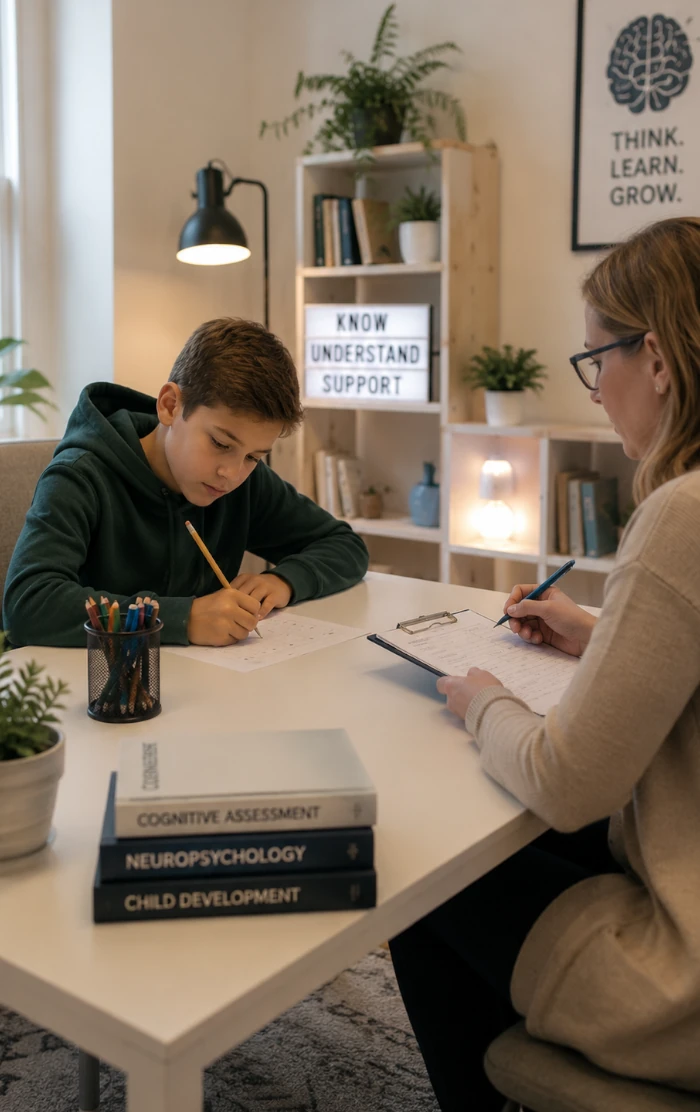
Professional child IQ testing in Lakewood – whether you need an assessment for school placement, gifted program eligibility, or to understand your child's learning profile, we connect you with licensed psychologists in the Lakewood area.
Last Updated: September 2026
Gifted Testing
Identify giftedness for school placement, enrichment, and talent programs using WISC-V or Stanford-Binet 5.
WISC-V Test
Wechsler Intelligence Scale for Children® Fifth Edition – the gold standard for child IQ testing.
Stanford-Binet 5
Stanford-Binet Intelligence Scales Fifth Edition – comprehensive cognitive assessment for all ages.
Full Evaluation
Combined assessment with detailed report and recommendations. Includes WISC-V or Stanford-Binet 5.
School Placement Testing
Testing for private school admission and gifted program eligibility using WISC-V or Stanford-Binet 5.
Schedule Child IQ Testing
Book your WISC-V & Stanford-Binet 5 for ages 6–16. Gifted identification, learning profiles, etc. with a licensed psychologist in Lakewood today.
Child IQ Testing in Lakewood, Colorado: city context
Lakewood is a Jefferson County city immediately west of Denver, extending from the West Colfax corridor toward Green Mountain and the foothills. The U.S. Census Bureau's July 1, 2025 estimate lists 156,927 residents, and the city covers approximately 43.47 square miles of land. Lakewood combines established residential neighborhoods, the Denver Federal Center, the Belmar civic and commercial district, medical services, higher education, arts organizations, parks, and direct access to the broader Denver labor market.
Child assessment requests commonly involve Jeffco gifted identification, private-school or program placement, ADHD and learning-disability questions, twice-exceptionality, acceleration, educational planning, and documentation for school supports. A professional interpretation should consider education, language history, cultural background, health, attention, motivation, and testing conditions rather than treating a single composite score as a complete description of a person.
IQ by gender & ethnicity (child population)
Lakewood's overall population is approximately 50.0% female, and 16.3% of residents are under age 18. Properly standardized intelligence tests are designed so broad male and female averages are comparable, although any individual may have a distinctive pattern across verbal comprehension, visual-spatial reasoning, fluid reasoning, working memory, and processing speed. No authoritative dataset establishes separate Lakewood IQ averages by sex, race, ethnicity, neighborhood, or language group.
Current Census demographic context includes:
- White alone: 73.8% of residents.
- Black or African American alone: 1.5%.
- American Indian and Alaska Native alone: 1.0%.
- Asian alone: 3.6%.
- Native Hawaiian and Other Pacific Islander alone: 0.1%.
- Two or more races: 16.4%.
- Hispanic or Latino residents: 22.6%; White alone, not Hispanic or Latino, 68.2%.
- Foreign-born residents: 8.0%.
- Language other than English at home: 12.8% of residents age five and older.
- Educational attainment: 94.0% of adults age 25 and older are high-school graduates or higher, and 45.3% hold a bachelor's degree or higher.
These population statistics are context only. A licensed psychologist selects, administers, and interprets tests for the individual referral question and should document relevant linguistic, educational, sensory, medical, and cultural considerations.
Jeffco Public Schools and Gifted Programs
Jeffco Gifted and Talented Identification
- Body of evidence: Jeffco identifies gifted students through multiple sources such as cognitive ability, achievement, classroom performance, observations, portfolios, and demonstrated need; one IQ score does not make the decision by itself.
- Universal screening: All second graders are screened with the Cognitive Abilities Test (CogAT). Additional CogAT sessions are generally offered during district fall and spring windows for referred students.
- Advanced Learning Plan: Identified students receive an ALP describing strength areas, goals, and programming.
- Private reports: Families can submit outside cognitive testing, but the district reviews whether the instrument, norms, scores, and supporting evidence meet its requirements.
Neighborhood Schools and GT Centers
- Neighborhood model: Jeffco reports that most gifted students receive services in their neighborhood schools through differentiation, advanced coursework, grouping, and ALPs.
- GT Center model: A smaller share attends designated center programs for highly gifted learners. Lakewood-area pathways include Kendrick Lakes Elementary and Creighton Middle School, subject to current boundaries, eligibility, and available space.
- Twice-exceptional students: Gifted and disability needs should be evaluated together so advanced ability does not mask ADHD, autism, dyslexia, language, emotional, or executive-function needs—and vice versa.
Early Access and Acceleration
- Early Access: Colorado permits early kindergarten or first-grade entry for highly advanced children who demonstrate exceptional aptitude, achievement, and readiness, generally around the 98th percentile.
- Acceleration: Subject or grade acceleration requires evidence of readiness and consideration of academic, social, emotional, and practical factors.
- Deadlines: Families should check Jeffco's current referral, testing, Early Access, choice-enrollment, and GT Center calendars before arranging private testing.
Choice, Charter, and Private Schools
Lakewood families may consider neighborhood schools, district option programs, charter schools, private schools, homeschooling, or online education. These systems use different admissions and placement criteria. A private IQ report does not guarantee admission, gifted identification, acceleration, or a particular service.
Lakewood Private and Choice Schools: When Testing May Be Requested
It would be inaccurate to say that every private school in Lakewood requires an IQ test. Schools such as Denver Christian School, Bethlehem Lutheran School, and other local independent or faith-based programs set their own grade-specific application, readiness, achievement, interview, and records requirements. Policies can change annually.
- Ask for written requirements: Confirm the accepted test, edition, age norms, examiner credentials, score-report format, and deadline before scheduling.
- Clarify the purpose: Admissions, gifted placement, learning-support planning, and disability accommodations may require different batteries.
- Do not assume acceptance: A WISC-V or Stanford-Binet report prepared for one school or program may not satisfy another.
- Local admissions testing: Four Corners Psychological Services publishes WISC-V, WAIS-5, and WIAT-4 services for ages 6–18; families should verify that the receiving school accepts its report.
Lakewood and Jeffco Gifted Identification Context
- District scale: Jeffco Public Schools reports about 74,200 students and 145 schools in 2025–2026.
- Identification is district-based: There is no reliable city-only count of gifted students for Lakewood, and gifted prevalence should not be estimated from general population or income data.
- Universal second-grade screening: CogAT screening helps broaden access beyond parent or teacher referral alone.
- Multiple pathways: Cognitive, achievement, creative/productive thinking, leadership, visual arts, performing arts, and specific academic strengths may be considered under Colorado and district rules.
- Equity: Multilingual learners, students from lower-income households, twice-exceptional children, and students with uneven school performance can be overlooked unless teams examine multiple forms of evidence.
- Outside testing: A private report can contribute evidence but does not compel a particular district determination or placement.
The child IQ testing process: step by step
Understanding the testing process can help parents prepare their child and reduce anxiety. Here's what to expect:
- Initial consultation (15–20 minutes): A brief phone or video call with the psychologist to discuss your child's background, concerns, and goals. This helps determine the right test and approach.
- Testing session (60–90 minutes): The child meets one-on-one with a licensed psychologist in a quiet, comfortable room. The psychologist administers the WISC-V or Stanford-Binet 5, which includes a series of subtests measuring verbal comprehension, visual-spatial reasoning, fluid reasoning, working memory, and processing speed. Breaks are offered as needed.
- Scoring and interpretation (1–2 days): The psychologist scores the test and analyzes the results. They consider the child's age, background, and any relevant medical or educational history.
- Feedback session (45–60 minutes): The psychologist meets with the parents (and the child, if appropriate) to explain the results. They discuss the Full-Scale IQ, index scores, strengths, and areas for growth. They also provide tailored recommendations for home, school, and extracurriculars.
- Comprehensive written report (5–7 days): You receive a detailed report with all scores, normative comparisons, and actionable next steps. This report can be shared with schools, doctors, or other professionals.
The entire process from consultation to report usually takes 1–2 weeks, depending on scheduling. The testing itself is non-invasive and designed to be engaging for children.
What is the WISC-V test?
The WISC-V (Wechsler Intelligence Scale for Children® – Fifth Edition) is the most widely used IQ test for children aged 6:0–16:11. It provides a Full-Scale IQ and five primary index scores: Verbal Comprehension, Visual-Spatial, Fluid Reasoning, Working Memory, and Processing Speed. The test is administered one-on-one by a trained psychologist and takes about 60–90 minutes.
The WISC-V is normed on a large, representative sample of U.S. children and is updated regularly to ensure accuracy. It is the gold standard for gifted identification, learning disability diagnosis, and school placement.
Why test your child's IQ?
IQ testing provides valuable insights into your child's cognitive strengths and weaknesses. It can help:
- Identify giftedness: For admission to gifted programs, private schools, or enrichment opportunities.
- Diagnose learning disabilities: Such as dyslexia, dyscalculia, or ADHD, which can be masked by high intelligence.
- Guide educational planning: Tailor instruction to your child's unique learning profile.
- Provide reassurance: Understand why your child is different from peers and how to support them.
Lakewood Gifted Testing Timeline
- Start with the goal: Determine whether the need is district identification, GT Center consideration, Early Access, private-school admission, acceleration, or general learning-profile information.
- Review school evidence: Gather report cards, achievement data, work samples, teacher observations, prior evaluations, language history, and information about disability or social-emotional needs.
- District windows: Jeffco's universal second-grade screening and additional CogAT windows follow school-year calendars; confirm dates directly with the district.
- Private evaluation: Allow time for consultation, testing, scoring, report writing, feedback, and any school-requested clarification.
- Team review: The school evaluates the full body of evidence and develops an ALP when identification is made.
- Choice or center deadlines: Identification, program eligibility, choice enrollment, and seat availability are separate questions, each with its own process.
Lakewood Gifted Programs by Age Group
- Preschool and early childhood: Developmental testing can describe advanced skills, while Early Access uses Colorado and Jeffco readiness procedures for exceptionally advanced four- and five-year-olds.
- Elementary school: Differentiation, advanced grouping, enrichment, ALPs, subject acceleration, and GT Center options may be considered.
- Middle school: Advanced mathematics, honors, project-based work, electives, academic competitions, and Creighton Middle's GT Center pathway may be relevant.
- High school: Honors, Advanced Placement, International Baccalaureate, dual enrollment, career/technical education, arts, and specialized pathways can support advanced learners.
- Twice-exceptional students: IEP, Section 504, mental-health, and gifted supports should be coordinated rather than treated as mutually exclusive.
- Outside enrichment: Lakewood Cultural Center, 40 West Arts, parks programs, libraries, Red Rocks Community College, Colorado Christian University, and nearby Denver/Golden science and cultural institutions offer changing opportunities.
Lakewood Child ADHD and Learning-Disability Assessment
- IQ testing is one component: ADHD, dyslexia, dysgraphia, dyscalculia, autism, language disorder, anxiety, and executive-function concerns require broader evidence than an IQ score.
- School evaluation: Jeffco can evaluate suspected educational disabilities when concerns affect school functioning. Families can make a written request and should ask about procedural timelines and rights.
- Private evaluation: A psychologist may combine WISC-V, achievement testing, interviews, rating scales, observations, records, and additional measures based on the referral question.
- Medical concerns: Pediatricians or specialists should address hearing, vision, sleep, medication, seizures, head injury, and other health factors that could affect performance.
- Twice-exceptionality: High reasoning ability can coexist with a meaningful disability; interpretation should examine discrepancies, functional impact, and classroom evidence without relying on simplistic score formulas.
Lakewood Summer and Enrichment Options
- City of Lakewood: Recreation, nature, arts, sports, cultural, and youth programs vary each season.
- Lakewood Cultural Center and 40 West Arts: Creative classes, performances, exhibitions, and arts events can support artistic strengths.
- Red Rocks Community College and Colorado Christian University: Camps, precollege, athletics, arts, academic, and community offerings vary annually.
- Nearby Golden and Denver: Colorado School of Mines, museums, libraries, science organizations, zoos, universities, and nonprofit programs broaden STEM and humanities options.
- Program fit: Choose by readiness, interest, sensory and social needs, transportation, cost, and instructional quality—not solely by an IQ cutoff.
Lakewood Child Testing Costs and Funding
- Jeffco evaluation: When the district initiates an evaluation under special-education procedures, eligible school-based services are provided through the school system rather than purchased as private testing.
- Private cognitive testing: Four Corners Psychological Services publishes $600 for cognitive testing and $1,000 for combined cognitive and achievement testing; current fees and inclusions should be confirmed.
- Comprehensive private evaluation: Fees may be higher when attention, learning, autism, emotional, adaptive, or neuropsychological measures are included.
- Insurance: Gifted or admissions testing is usually not covered; diagnostic testing may qualify depending on medical necessity, benefits, provider status, authorization, and coding.
- Before paying: Confirm whether the school accepts outside testing and whether the quoted fee includes consultation, records, written report, feedback, and follow-up.
Areas we serve
We support all areas of the City of Lakewood. Confirm the psychologist's child age range, school-report experience, accessibility, language capacity, and testing purpose before scheduling.
Frequently Asked Questions
Both are excellent tests. WISC-V is more commonly used for school-age children, while Stanford-Binet 5 can be used for ages 2–85. We often recommend WISC-V for gifted identification.
The test itself takes 60–90 minutes. With the consultation, feedback, and report, the entire process is about 1–2 weeks.
No, you can book directly with our psychologists. We serve both self-referred and professionally referred children.
A private report may be submitted to Jeffco or another school, but acceptance and eligibility are determined by the receiving organization. Confirm the required test, edition, evidence, examiner credentials, and deadline before testing.
Some plans cover cognitive assessments when there is a clinical indication. Check with your provider.
Get a good night's sleep, eat a healthy meal, and arrive relaxed. No specific preparation is needed.
You'll receive a comprehensive report with your child's scores and tailored recommendations.
Some interview and feedback components may be available remotely, but many standardized cognitive tests require in-person administration. Confirm with the psychologist and the organization receiving the report.