
IQ Testing in Lakewood

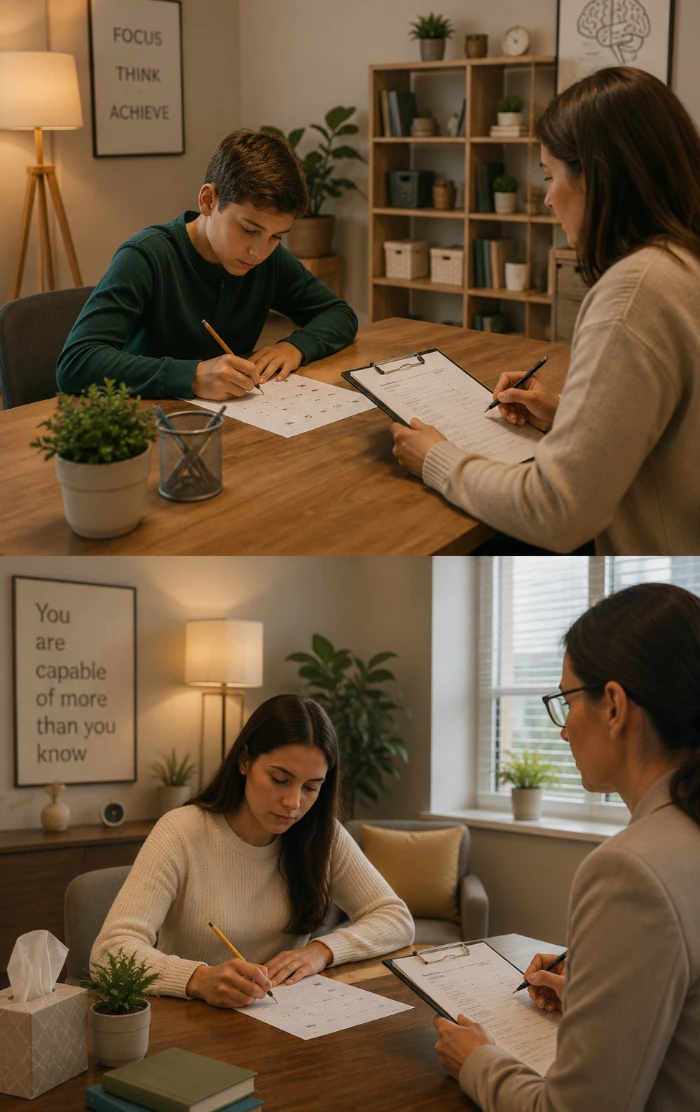
Professional IQ testing in Lakewood – whether you need an assessment for school, employment, gifted program eligibility, or personal insight, we connect you with licensed psychologists in the Lakewood area.
Last Updated: September 2026
Child IQ Testing
WISC-V & Stanford-Binet for ages 6–16. Gifted identification, learning profiles.
Adult IQ Testing
WAIS-IV & WAIS-5 available. Comprehensive adult cognitive assessments. Clinical & occupational.
WISC-V Test
Wechsler Intelligence Scale for Children® Fifth Edition – the gold standard for child IQ testing.
WAIS-IV & WAIS-5 Tests
Wechsler Adult Intelligence Scale® – Fourth Edition (WAIS-IV) and Fifth Edition (WAIS-5) available for adult IQ testing.
Gifted Testing
Identify giftedness for school placement, enrichment, and talent programs using WISC-V or Stanford-Binet.
Stanford-Binet 5
Stanford-Binet Intelligence Scales Fifth Edition – comprehensive cognitive assessment for all ages.
Mensa Testing
Mensa admission testing and preparation for the high-IQ society. Accepts WAIS-IV, WAIS-5, and Stanford-Binet 5 scores.
Full Evaluation
Combined assessment with detailed report and recommendations. Includes WISC-V, WAIS-IV, WAIS-5, or Stanford-Binet 5 as appropriate.
IQ Testing in Lakewood, Colorado: city context
Lakewood is a Jefferson County city immediately west of Denver, extending from the West Colfax corridor toward Green Mountain and the foothills. The U.S. Census Bureau's July 1, 2025 estimate lists 156,927 residents, and the city covers approximately 43.47 square miles of land. Lakewood combines established residential neighborhoods, the Denver Federal Center, the Belmar civic and commercial district, medical services, higher education, arts organizations, parks, and direct access to the broader Denver labor market.
Local requests for cognitive assessment commonly involve Jeffco Public Schools gifted identification, private-school or college documentation, ADHD and learning-disability questions, disability accommodations, career decisions, adult diagnostic clarification, and admission to high-IQ organizations. A professional interpretation should consider education, language history, cultural background, health, attention, motivation, and testing conditions rather than treating a single composite score as a complete description of a person.
IQ by gender & ethnicity
Lakewood's population is approximately 50.0% female. Properly standardized intelligence tests are designed so broad male and female averages are comparable, although any individual may have a distinctive pattern across verbal comprehension, visual-spatial reasoning, fluid reasoning, working memory, and processing speed. No authoritative dataset establishes separate Lakewood IQ averages by sex, race, ethnicity, neighborhood, or language group.
Current Census demographic context includes:
- White alone: 73.8% of residents.
- Black or African American alone: 1.5%.
- American Indian and Alaska Native alone: 1.0%.
- Asian alone: 3.6%.
- Native Hawaiian and Other Pacific Islander alone: 0.1%.
- Two or more races: 16.4%.
- Hispanic or Latino residents: 22.6%; White alone, not Hispanic or Latino, 68.2%.
- Foreign-born residents: 8.0%.
- Language other than English at home: 12.8% of residents age five and older.
- Educational attainment: 94.0% of adults age 25 and older are high-school graduates or higher, and 45.3% hold a bachelor's degree or higher.
These population statistics are context only. A licensed psychologist selects, administers, and interprets tests for the individual referral question and should document relevant linguistic, educational, sensory, medical, and cultural considerations.
What is professional IQ testing?
Intelligence quotient (IQ) testing is a standardized method to measure human cognitive abilities and intellectual potential. Professional IQ tests are administered by licensed psychologists in a controlled environment to ensure accuracy and reliability. Unlike online quizzes, clinical assessments provide a full-scale IQ score along with detailed breakdowns of verbal comprehension, perceptual reasoning, working memory, and processing speed.
In Lakewood, IQ testing is commonly used for gifted program admission, learning disability identification, career guidance, neuropsychological evaluation, and personal development. The results are presented in a comprehensive report that includes normative comparisons, strengths and weaknesses, and actionable recommendations.
Who should get tested?
IQ testing can benefit children, adolescents, and adults in various situations:
- Children: Parents often seek testing for school readiness, gifted placement, or to understand learning challenges.
- Adults: Many adults take IQ tests for career advancement, graduate school applications, or personal curiosity.
- Mensa candidates: High-IQ societies require official test scores for membership.
- Clinical referrals: Psychologists may recommend testing as part of a broader neuropsychological evaluation.
Types of IQ tests
We offer the most recognized and scientifically validated intelligence tests in the field:
- WISC-V (Wechsler Intelligence Scale for Children® – Fifth Edition): The gold standard for children aged 6:0–16:11. It provides a Full-Scale IQ and five primary index scores.
- WAIS-IV (Wechsler Adult Intelligence Scale® – Fourth Edition): The most widely used adult IQ test for ages 16–90. It measures cognitive functioning across four domains.
- Stanford-Binet Intelligence Scales – Fifth Edition: A comprehensive assessment for ages 2–85, often used for gifted identification and clinical evaluations.
- Gifted Testing: Often includes the WISC-V or Stanford-Binet, plus additional creativity and achievement measures.
- Mensa Testing: We provide official Mensa admission testing and preparation materials.
How the testing process works
- Initial consultation: Brief phone or video call to discuss your needs and match you with the right psychologist.
- Testing session: In-person or remote testing (depending on the test) with a licensed psychologist. Most sessions last 1–2 hours.
- Scoring and interpretation: The psychologist scores the test and interprets the results in the context of your background and goals.
- Feedback session: A detailed review of your results, including strengths, weaknesses, and practical recommendations.
- Comprehensive report: You receive a written report with all scores, normative comparisons, and actionable next steps.
How much does IQ testing cost in Lakewood?
Fees depend on the referral question, test battery, age, record review, report length, and whether academic, attention, personality, adaptive, or neuropsychological measures are added. A brief cognitive assessment may cost several hundred dollars, while a comprehensive psychoeducational or neuropsychological evaluation can cost substantially more.
Four Corners Psychological Services publishes a fee of $600 for either cognitive or achievement testing and $1,000 for combined cognitive and achievement testing on its admissions-testing page; families should confirm current pricing, report format, age limits, and whether the service meets the receiving school's requirements. Insurance coverage is more likely when testing addresses a medically necessary diagnostic question than when it is solely for gifted placement, school admission, career exploration, or Mensa documentation.
Lakewood's Intellectual History & Legacy
Red Rocks Community College, founded in 1969, supports transfer education, health careers, skilled trades, technology, emergency services, and workforce development from its Lakewood campus. Colorado Christian University offers undergraduate and graduate education, while the Rocky Mountain College of Art + Design occupies the historic former Jewish Consumptives' Relief Society campus and contributes to the city's design, animation, fine-arts, and creative-technology community.
The Denver Federal Center is one of the largest concentrations of federal agencies outside Washington, D.C., connecting Lakewood with scientific, environmental, geological, land-management, emergency-management, administrative, and technical work. Nearby institutions—including the Colorado School of Mines in Golden and the Auraria Higher Education Center in Denver—expand access to engineering, public affairs, business, health, and research opportunities.
Major Lakewood Employers and Assessment Context
Routine jobs generally do not require a clinical IQ test. Employers may instead use validated skills assessments, licensing examinations, safety evaluations, structured interviews, or role-specific aptitude measures. Lakewood's 2024 Annual Comprehensive Financial Report identifies major employers that illustrate the city's occupational mix:
- Denver Federal Center: Approximately 8,000 employees across federal scientific, environmental, land-management, emergency, administrative, and technical functions.
- Jeffco Public Schools: Approximately 3,700 Lakewood-area employees in education, psychology, counseling, technology, transportation, administration, and student services.
- State of Colorado: Approximately 2,610 employees in public administration and statewide programs.
- St. Anthony Medical Campus: Approximately 1,774 employees in hospital, trauma, clinical, rehabilitation, and support roles.
- Terumo Blood and Cell Technologies: Approximately 1,709 employees in medical-device research, manufacturing, quality, engineering, and corporate functions.
- FirstBank: Approximately 1,569 employees in banking, analytics, technology, compliance, and customer service.
- City of Lakewood: Approximately 1,438 employees in municipal operations, public safety, planning, parks, culture, and administration.
- Red Rocks Community College: Approximately 961 employees in higher education and workforce training.
- Encore Electric: Approximately 892 employees in electrical construction, engineering, project management, and skilled trades.
- Colorado Christian University: Approximately 725 employees in higher education and student services.
When cognitive testing is requested for accommodations, fitness-for-duty, disability, or a clinical question, the evaluator should clarify the legal purpose, informed-consent limits, confidentiality, and who will receive the report before testing begins.
IQ Testing Across Lakewood
No credible source supports neighborhood-level IQ averages. Practical differences concern travel, school assignment, access to providers, and proximity to employment or higher-education centers. Lakewood includes distinct areas such as Belmar and the civic center, Eiber and the West Colfax/40 West Arts corridor, Morse Park, Two Creeks, Applewood, Green Mountain, Union Square and the Federal Center, Kendrick Lake, Bear Creek, Lakewood Estates, and newer southwest communities near Solterra.
Families should choose a psychologist based on licensure, age range, test expertise, language capacity, report acceptance, accessibility, and the referral question—not on claims that one part of the city has a particular intelligence level. For a time-limited educational starting point, an online IQ test can prompt useful questions, but it does not replace a standardized, individually administered evaluation when formal documentation is required.
Lakewood Colleges, Training, and Research Connections
- Red Rocks Community College: Transfer programs, allied health, engineering technology, cybersecurity, emergency services, skilled trades, entrepreneurship, and workforce certificates.
- Colorado Christian University: Undergraduate, graduate, adult, online, counseling, business, education, and ministry programs.
- Rocky Mountain College of Art + Design: Art, illustration, animation, game art, graphic design, interior design, photography, fashion, and related creative programs.
- Denver Federal Center: Federal agencies and laboratories create public-sector, scientific, geospatial, environmental, engineering, and policy connections.
- Colorado School of Mines in nearby Golden: Engineering and applied-science education and research with strong links to energy, earth resources, materials, computing, and industry.
- Auraria campus in nearby Denver: University of Colorado Denver, Metropolitan State University of Denver, and Community College of Denver provide extensive academic and professional pathways.
Lakewood Economic Context
- Median household income: $89,792 in 2020–2024 Census estimates.
- Per-capita income: $53,749.
- Residents in poverty: 9.2%.
- Bachelor's degree or higher: 45.3% of adults age 25 and older.
- Mean travel time to work: 25.5 minutes, with longer trips possible for commuters crossing the Denver metro area or traveling during winter weather.
- Health care and social assistance: Census business data report approximately $1.98 billion in 2022 receipts/revenue within the city.
- Transportation and warehousing: Approximately $339.6 million in 2022 receipts/revenue.
- Retail sales: Approximately $3.79 billion in 2022.
- Accommodation and food services: Approximately $659.1 million in 2022 sales.
- Housing context: 58.1% owner-occupied housing, a $574,400 median value for owner-occupied units, and $1,806 median gross rent in the Census estimate period.
- Regional strengths: Federal government, health care, education, medical devices, financial services, construction and skilled trades, retail, hospitality, arts and design, professional services, and access to the Denver regional economy.
Lakewood and Jeffco Public Schools Data
- District: Most Lakewood public schools are part of Jeffco Public Schools, a countywide system serving approximately 74,200 students in 2025–2026.
- School network: The district reports 145 schools, including elementary, middle, high, option/alternative, charter, preschool, and other programs.
- Student demographics: January 2026 district figures list approximately 63.6% White, 26.5% Hispanic, 5.4% multiracial, 2.7% Asian, and 1.2% Black students, with smaller American Indian and Native Hawaiian/Pacific Islander populations.
- Gifted identification: Jeffco uses a body of evidence rather than a single IQ cutoff. All second graders receive CogAT screening, and additional district CogAT opportunities are typically offered during fall and spring windows.
- Outside testing: Families may submit private cognitive results; Jeffco identifies acceptable instruments such as the WISC, DAS, WPPSI, NNAT, Raven's measures, Woodcock-Johnson, and Iowa assessments, but the district determines how outside evidence is used.
- Gifted service models: Most identified students remain in neighborhood schools with an Advanced Learning Plan; GT Center options serve a smaller share, with Lakewood-area pathways including Kendrick Lakes Elementary and Creighton Middle School.
- Early Access: Colorado's Early Access process is intended for highly advanced four- and five-year-olds and generally requires evidence around the 98th percentile plus readiness and achievement data.
- Private and charter options: Admission, placement, and documentation rules vary by school and grade, so families should obtain the current written policy before purchasing an evaluation.
Local Testing and Referral Resources
- Four Corners Psychological Services: Located at 3900 S. Wadsworth Blvd, Suite 433, Lakewood, CO 80235. Its admissions-testing page lists WISC-V, WAIS-5, and WIAT-4 cognitive and achievement testing for ages 6–18. Call (720) 441-4624 to verify current clinician availability, age limits, fees, and report acceptance.
- St. Anthony Hospital and Medical Campus: A full-service acute-care and Level I trauma center. Hospital or specialty clinicians may help determine whether cognitive symptoms require medical, neurological, rehabilitation, or neuropsychological referral.
- Jeffco Public Schools: School teams can initiate educational evaluations when a suspected disability affects school functioning and can guide families through district gifted-identification procedures.
- College accessibility offices: Red Rocks Community College, Colorado Christian University, and RMCAD publish documentation processes for students seeking accommodations; requirements should be checked before testing.
- Private psychologists and neuropsychologists: Lakewood and the Denver metro area include clinicians with different specialties. Confirm Colorado licensure, test editions, population expertise, turnaround time, accessibility, language services, and whether the report will be accepted by the intended organization.
Lakewood Learning, Arts, and Professional Events
- Lakewood Cultural Center: Performances, exhibitions, classes, lectures, and community programs can support arts enrichment and lifelong learning.
- 40 West Arts District: Galleries, public art, creative businesses, festivals, and educational activities connect visual arts with the West Colfax corridor.
- Red Rocks Community College and Colorado Christian University: Public lectures, career events, continuing education, performances, and student programs vary by term.
- Jeffco gifted-family programming: District and school events may address Advanced Learning Plans, GT Center options, twice-exceptionality, acceleration, and parent education.
- Denver Mensa: The local American Mensa group serving the Denver area may offer admission testing and member activities; dates and eligibility rules should be confirmed on its current calendar.
- Colorado Psychological Association and regional universities: Continuing education may cover assessment, ethics, neuropsychology, disability, diversity, and evidence-based practice.
Transportation and Accessibility
- Major roads: US 6/6th Avenue, US 40/West Colfax Avenue, Wadsworth Boulevard, Kipling Parkway, Sheridan Boulevard, Alameda Avenue, Jewell Avenue, and nearby I-70 and C-470 connect Lakewood with Denver, Golden, and the western suburbs.
- RTD rail: The W Line serves the Lakewood corridor with stations including Sheridan, Lamar, Lakewood–Wadsworth, Garrison, Oak, Federal Center, and Red Rocks College, providing connections toward Denver Union Station and other transit services.
- RTD buses: Local and regional routes operate along major corridors. Service frequency varies, so confirm the trip and return schedule before an appointment.
- Accessible travel: RTD buses and trains include accessibility features; paratransit eligibility, pickup windows, elevators, and station access should be arranged or checked in advance.
- Driving and parking: Confirm building entrance, suite, parking, elevator access, and snow-removal conditions with the testing office.
- Regional access: Downtown Denver, Golden, Wheat Ridge, Arvada, Littleton, and other metro communities are reachable from Lakewood, but travel times vary significantly with rush-hour congestion, construction, events, and weather.
- Appointment planning: Build in extra time during weekday peaks, snow or ice, hail and thunderstorms, and major events at Red Rocks or in central Denver.
Lakewood Weather and Seasonal Considerations
- Climate and elevation: Lakewood has a semi-arid Front Range climate with low humidity, abundant sunshine, and rapid temperature changes.
- Winter: Snow, ice, cold mornings, and occasional school or office delays can affect travel. Confirm cancellation policies and remote feedback options.
- Spring: Heavy, wet snow can occur, along with strong winds and rapidly changing conditions.
- Summer: Warm, dry mornings may be followed by afternoon thunderstorms, lightning, hail, or short periods of intense rain.
- Wildfire smoke and air quality: Regional smoke or ozone can affect people with respiratory or neurological sensitivities; discuss breaks or rescheduling if symptoms interfere with performance.
- Testing environment: A quiet, comfortably lit, temperature-controlled room with appropriate breaks helps reduce avoidable effects on attention and stamina.
- School-year demand: Gifted, accommodation, and admissions requests often increase around fall referrals, winter application deadlines, and spring planning; start early when a report has a firm deadline.
- Preparation: Adequate sleep, normal meals, hydration, prescribed medication taken as directed, and arriving without rushing are more useful than coaching on test items.
Areas we serve
We support all areas of the City of Lakewood. Provider location, age range, specialty, accessibility, language capacity, and in-person requirements vary, so confirm those details before scheduling.
Frequently Asked Questions
WISC-V is for children aged 6–16, while WAIS-IV is for adults aged 16–90. Each is normed for its specific age group.
Most IQ tests take between 60 and 90 minutes, plus a feedback session. Allow 2–3 hours total.
No, you can book directly with our psychologists. We serve both self-referred and professionally referred individuals.
Potentially. Acceptance depends on the exact test, edition, qualifying score, administration date, examiner credentials, and current Mensa documentation rules. Confirm before testing.
Some plans cover cognitive assessments when there is a clinical indication. Check with your provider.
Get a good night's sleep, eat a healthy meal, and arrive relaxed. No specific preparation is needed.
You'll receive a comprehensive report with your scores and tailored recommendations.
Some interview and feedback components may be available remotely, but many standardized cognitive tests require in-person administration. Confirm with the psychologist and the organization receiving the report.