
Child IQ Testing in Hollywood, FL

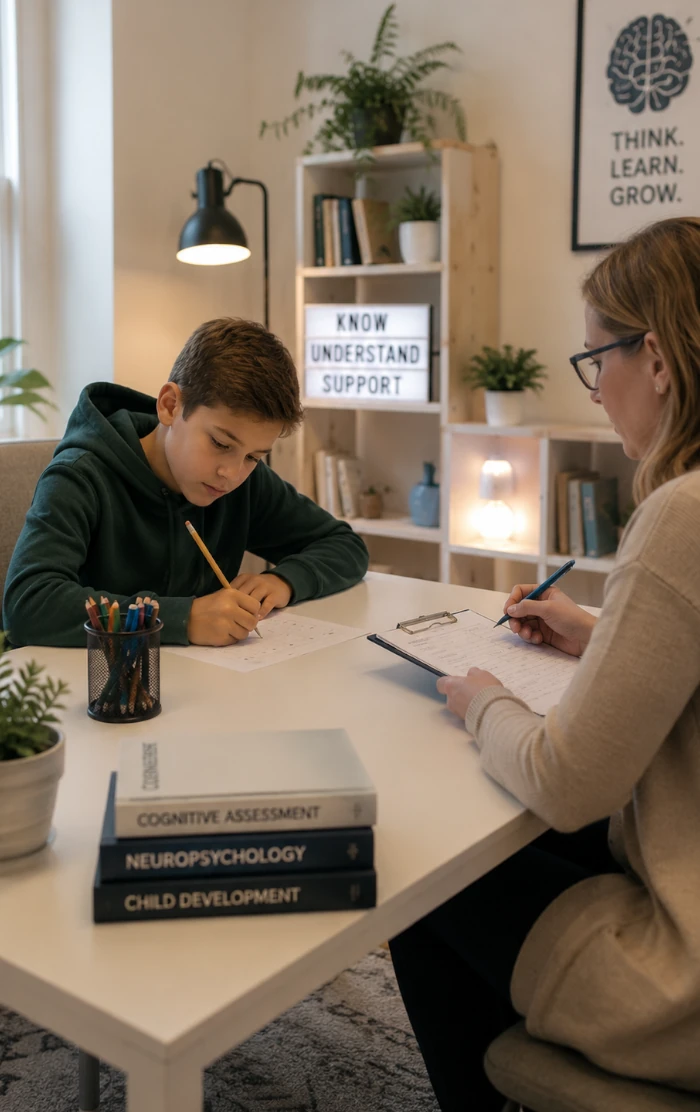
Professional child IQ testing in Hollywood, FL – whether you need an assessment for school placement, gifted program eligibility, or to understand your child's learning profile, we connect you with licensed psychologists in the Hollywood, FL area.
Last Updated: September 2026
Gifted Testing
Identify giftedness for school placement, enrichment, and talent programs using WISC-V or Stanford-Binet 5.
WISC-V Test
Wechsler Intelligence Scale for Children® Fifth Edition – the gold standard for child IQ testing.
Stanford-Binet 5
Stanford-Binet Intelligence Scales Fifth Edition – comprehensive cognitive assessment for all ages.
Full Evaluation
Combined assessment with detailed report and recommendations. Includes WISC-V or Stanford-Binet 5.
School Placement Testing
Testing for private school admission and gifted program eligibility using WISC-V or Stanford-Binet 5.
Schedule Child IQ Testing
Book your WISC-V & Stanford-Binet 5 for ages 6–16. Gifted identification, learning profiles, etc. with a licensed psychologist in Hollywood, FL today.
Child IQ Testing in Hollywood, FL: city context
Hollywood children may be referred for gifted identification, learning problems, attention concerns, developmental questions, school placement, acceleration, twice-exceptionality, or clarification of uneven achievement. Approximately 19.1% of city residents are under 18, and local families represent many languages, cultures, school histories, and immigration experiences.
A child evaluation should begin with the question being asked and the school or organization’s written requirements. The psychologist may need cognitive, achievement, attention, executive-function, language, social-emotional, adaptive, and developmental measures rather than one IQ score.
Because 52.1% of Hollywood residents speak a language other than English at home, assessment must distinguish language acquisition from disability or giftedness. Testing should use qualified bilingual methods when needed and should document language dominance, schooling, and cultural context.
Referral questions should be concrete. “How smart is my child?” is usually too broad. More useful questions include whether the child needs advanced instruction, why reading or mathematics performance is inconsistent, whether attention affects classroom work, whether a disability coexists with high ability, or what supports are needed for a transition between schools. The final report should answer the stated question and explain what the scores do and do not establish.
Records matter. Bring report cards, prior evaluations, intervention data, standardized test results, language-development history, medical records when relevant, teacher comments, work samples, and information about attendance or school changes. A score interpreted without this context can miss the difference between a skill deficit, limited instruction, anxiety, fatigue, language acquisition, and a neurodevelopmental condition.
Developmental fit matters. Young children may show more variability because of attention, rapport, sleep, illness, novelty, and rapid development. The psychologist should select an age-appropriate measure, observe behavior, and avoid overinterpreting small score differences. Retesting should follow professional practice and publisher rules rather than being repeated quickly in search of a preferred result.
Hollywood, FL School Districts and Gifted Programs
Hollywood public-school students are served primarily by Broward County Public Schools. BCPS states that gifted services extend from kindergarten through grade 12, accepts referrals from parents, teachers, staff, students, and other knowledgeable people, and universally screens second-grade students using STAR assessment results.
Florida gifted eligibility is an exceptional-student-education process. Schools consider state and district criteria, intellectual development, performance data, educational need, and multiple sources of information. Eligible students receive an Education Plan. Honors, Cambridge, AP, IB, dual enrollment, magnet, and accelerated courses may serve advanced learners but are not identical to gifted eligibility.
Ask the assigned school for current screening thresholds, Plan A and Plan B procedures, consent forms, evaluation timelines, language accommodations, EP services, transfer rules, and procedural safeguards. A private score may contribute information but does not automatically require eligibility or a specific placement.
BCPS screening versus evaluation: universal screening is designed to identify students who may need closer review; it is not the same as a complete individual evaluation. A referral can lead to consent, records review, standardized assessment, and an eligibility meeting. Parents should retain copies of notices, consent forms, score reports, and the resulting EP or eligibility decision.
Plan A and Plan B: Florida permits more than one gifted-eligibility pathway. Plan B is intended to address underrepresentation and must be applied under district criteria. Families should ask which pathway is being considered, what local evidence is required, and how language, disability, and socioeconomic factors are handled. A private examiner should not promise eligibility under either plan.
Services after identification: an Education Plan should describe the student’s present levels, goals, and services. Appropriate programming may involve differentiated curriculum, compacting, acceleration, enrichment, advanced content, consultation, cluster grouping, or specialized classes. A label without suitably challenging instruction does not resolve the educational need.
Transfers and continuity: families moving into Hollywood from another Florida district or another state should provide prior gifted records promptly and ask how continued eligibility and services will be reviewed. Course placement and gifted eligibility are related but separate decisions.
Hollywood, FL Private Schools Requiring IQ Testing
Hollywood and nearby Broward County private, religious, Montessori, and independent schools set their own admissions and placement policies. Some request school records, teacher recommendations, interviews, classroom visits, achievement tests, or standardized admissions testing; some may request cognitive testing for a particular program. There is no single citywide rule requiring an IQ test.
Before scheduling, obtain the school’s current written requirements, accepted instruments, age limits, score-report format, deadline, examiner credentials, and whether the evaluation is for admission, gifted programming, learning support, or grade placement. Do not assume a WISC, Stanford-Binet, or brief screen will be accepted.
Families should also ask how multilingual development, disability, retesting intervals, and confidential records are handled.
Admissions testing is not treatment planning. A school may want a narrow readiness or placement measure, while a parent may need a broader evaluation of learning, attention, or emotional functioning. Combining purposes can be efficient only when the psychologist knows every requirement in advance and the resulting battery remains clinically appropriate.
Confidentiality questions: ask who at the school will see the report, whether the full document or a score summary is required, how records are stored, and whether parents may submit a redacted version. A clinical report can contain sensitive family or diagnostic information that is not necessary for an admissions committee.
Score cutoffs: a rigid cutoff can create false certainty near the boundary. Confidence intervals, behavior during testing, language, uneven index scores, and other evidence should be considered. Parents should ask whether the school reviews the whole profile or only one composite.
Hollywood, FL Gifted Identification Statistics
No reliable public dataset gives a current gifted-identification rate limited to Hollywood city boundaries. BCPS publishes district procedures, while individual school enrollment and program configurations change over time.
Identification rates can be affected by universal screening, referral practices, language access, socioeconomic opportunity, prior schooling, disability, and the use of Florida’s eligibility pathways. Underrepresentation does not indicate lower ability; it can signal differences in access to screening or evidence.
Families should focus on the child’s educational need and complete profile rather than comparing one score with an estimated city percentage.
The child IQ testing process: step by step
Understanding the testing process can help parents prepare their child and reduce anxiety. Here's what to expect:
- Initial consultation (15–20 minutes): A brief phone or video call with the psychologist to discuss your child's background, concerns, and goals. This helps determine the right test and approach.
- Testing session (60–90 minutes): The child meets one-on-one with a licensed psychologist in a quiet, comfortable room. The psychologist administers the WISC-V or Stanford-Binet 5, which includes a series of subtests measuring verbal comprehension, visual-spatial reasoning, fluid reasoning, working memory, and processing speed. Breaks are offered as needed.
- Scoring and interpretation (1–2 days): The psychologist scores the test and analyzes the results. They consider the child's age, background, and any relevant medical or educational history.
- Feedback session (45–60 minutes): The psychologist meets with the parents (and the child, if appropriate) to explain the results. They discuss the Full-Scale IQ, index scores, strengths, and areas for growth. They also provide tailored recommendations for home, school, and extracurriculars.
- Comprehensive written report (5–7 days): You receive a detailed report with all scores, normative comparisons, and actionable next steps. This report can be shared with schools, doctors, or other professionals.
The full process includes intake, records review, testing, scoring, feedback, and report preparation. Timing varies with provider availability and referral complexity, so confirm deadlines before scheduling. The testing itself is non-invasive and designed to be engaging for children.
The intake should identify the referral question, people authorized to receive the report, prior testing, developmental and medical history, language exposure, school interventions, and any deadline. During testing, the examiner should follow standardized procedures while documenting breaks, accommodations, motivation, and behavior that may affect validity. Scoring should use the correct age norms and current edition.
Feedback should translate scores into understandable strengths, weaknesses, and practical recommendations. Families should receive confidence intervals, an explanation of meaningful index differences, and clear limits on interpretation. Recommendations may address instruction, accommodations, further medical or language assessment, counseling, executive-skill support, or progress monitoring. A strong report distinguishes evidence from speculation and does not promise a school placement.
Parents should review names, dates, school information, and factual history when the report arrives. Corrections to factual errors should be requested promptly, while disagreements about professional interpretation can be discussed in feedback or through a second opinion. Keep the signed report securely because schools, testing agencies, and high-IQ organizations may require an original or unaltered copy.
Before the appointment: explain that the child will meet someone who wants to learn how they solve different kinds of problems. Do not call it an exam that must be “passed,” promise a particular score, or practice protected items. Tell the examiner about medication timing, sleep, illness, recent stress, hearing or vision needs, and the child’s communication style.
During testing: standardized administration limits the amount of help an examiner can provide. Breaks may be permitted, but excessive prompting, parental presence, coaching, or use of unauthorized devices can invalidate results. Behavioral observations—persistence, impulsivity, frustration tolerance, self-correction, language use, and response to structure—are part of interpretation.
After testing: feedback should explain index and subtest patterns, confidence intervals, limitations, and recommendations in plain language. Ask which conclusions are well supported, which remain uncertain, and what data would be needed to answer unresolved questions. A useful report connects findings to classroom instruction, accommodations, intervention, enrichment, and follow-up.
What is the WISC-V test?
The WISC-V (Wechsler Intelligence Scale for Children® – Fifth Edition) is the most widely used IQ test for children aged 6:0–16:11. It provides a Full-Scale IQ and five primary index scores: Verbal Comprehension, Visual-Spatial, Fluid Reasoning, Working Memory, and Processing Speed. The test is administered one-on-one by a trained psychologist and takes about 60–90 minutes.
The WISC-V is normed on a large, representative sample of U.S. children and is updated regularly to ensure accuracy. It is the gold standard for gifted identification, learning disability diagnosis, and school placement.
The WISC-V is designed for children ages 6 through 16 and provides a Full-Scale IQ plus primary index scores in Verbal Comprehension, Visual Spatial, Fluid Reasoning, Working Memory, and Processing Speed. Additional subtests and ancillary indices may be used when they answer a specific referral question.
Verbal Comprehension samples word knowledge and verbal concept formation. It can be influenced by language exposure, schooling, and cultural experience. Visual Spatial tasks examine analysis and construction of visual information. Fluid Reasoning focuses on identifying relationships and solving novel problems. Working Memory requires holding and manipulating information. Processing Speed involves efficient visual scanning and graphomotor output under time limits.
Index differences are common and do not automatically indicate a disorder. The psychologist should determine whether differences are statistically unusual, clinically meaningful, consistent with other data, and relevant to daily functioning. Confidence intervals are more honest than treating each reported score as exact.
The WISC-V is not an achievement test, attention test, autism evaluation, or complete learning-disability assessment. It may be one component of those evaluations, but additional measures are usually necessary.
Why test your child's IQ?
IQ testing provides valuable insights into your child's cognitive strengths and weaknesses. It can help:
- Identify giftedness: For admission to gifted programs, private schools, or enrichment opportunities.
- Diagnose learning disabilities: Such as dyslexia, dyscalculia, or ADHD, which can be masked by high intelligence.
- Guide educational planning: Tailor instruction to your child's unique learning profile.
- Provide reassurance: Understand why your child is different from peers and how to support them.
Gifted and advanced-learning questions: Testing can help describe whether a child’s reasoning is broadly advanced or concentrated in particular areas. The result is most useful when paired with achievement, classroom performance, interests, and evidence about pace of learning. A high score alone does not determine which program, grade, or school is appropriate.
Unexpected academic difficulty: A child may reason well yet struggle with reading fluency, spelling, written expression, math facts, attention, organization, or test anxiety. Cognitive and achievement patterns can generate hypotheses, but diagnoses require multiple sources and evidence of functional impact.
Developmental and adaptive questions: When intellectual disability is considered, standardized cognitive testing must be combined with adaptive-behavior evidence across conceptual, social, and practical domains. An IQ number by itself is not sufficient.
Planning transitions: Families may use findings when moving from elementary to middle school, choosing advanced coursework, planning high school, or considering college accommodations. Because needs change, recommendations should identify what to monitor rather than treating a childhood score as permanent destiny.
Personal understanding: Some families want an explanation for intense curiosity, uneven development, frustration, or a mismatch between apparent potential and output. The psychologist should translate findings into specific strategies and avoid labels that increase pressure or comparison among siblings.
Hollywood, FL Gifted Testing Timeline
Start by asking the school whether the child has already been universally screened, whether a formal referral is appropriate, and what the current BCPS calendar requires. Public-school evaluation includes referral, consent, records, assessment, eligibility review, and EP planning; timelines are governed by school procedures and may differ from private evaluation schedules.
Private testing also requires lead time for intake, records, testing, scoring, feedback, and the written report. Contact the receiving school before scheduling to confirm deadlines and retesting rules.
Avoid coaching with secure test items. Normal sleep, breakfast, medication as prescribed, glasses or hearing aids, and an accurate history are more useful.
Hollywood, FL Gifted Programs by Age Group
- Early childhood: developmental observation, language-rich play, preschool records, and age-appropriate measures may be more informative than pushing for a single number.
- Elementary school: BCPS screening, referral, formal evaluation, differentiated instruction, cluster or resource services, enrichment, and an Education Plan may be relevant.
- Middle school: gifted services can combine with advanced coursework, Cambridge pathways, acceleration, electives, and subject-specific strengths.
- High school: gifted EP services may coexist with honors, AP, IB, dual enrollment, career academies, research, arts, and individualized mentorship.
Program availability varies by school and year. Placement should address pace, depth, social-emotional needs, motivation, and twice-exceptionality rather than IQ alone.
Acceleration decisions: grade or subject acceleration should consider achievement, readiness, social-emotional development, motivation, executive skills, school resources, and the child’s preferences. IQ can inform but should not dictate the decision. Trial periods, progress monitoring, and a clear support plan can reduce risk.
Twice-exceptional programming: advanced learners with dyslexia, ADHD, autism, language disorder, anxiety, or physical disability may need both access to high-level content and explicit support for areas of difficulty. Lowering challenge because of disability can be as inappropriate as withholding intervention because the child is bright.
Equity and language: families should ask whether screening and services are accessible to English learners, students with disabilities, children from low-income households, and students who entered the district after the universal-screening year. Alternative evidence can be important when standard scores do not tell the whole story.
Hollywood, FL Child ADHD and Learning Disability Assessment
ADHD, dyslexia, dysgraphia, dyscalculia, language disorders, autism, anxiety, and giftedness can overlap. A child can have high reasoning ability and still require explicit intervention or accommodations.
A comprehensive evaluation may include WISC-V or another cognitive measure, academic achievement, phonological processing, language, attention, executive function, behavior ratings, adaptive functioning, observations, and record review. IQ-achievement discrepancy alone is not a sufficient modern method for identifying every learning disability.
For school services, submit concerns in writing and ask BCPS about evaluation, MTSS/intervention data, Section 504, ESE eligibility, procedural safeguards, and independent educational evaluations. Private findings inform but do not replace the school team’s process.
Reading evaluation: when dyslexia is suspected, the battery may need word reading, decoding, fluency, spelling, phonological awareness, rapid naming, comprehension, and oral-language measures. A high verbal-reasoning score does not rule out a specific reading disorder.
Mathematics and writing: assessment may examine calculation, math fluency, problem solving, written expression, handwriting or keyboard access, language formulation, and working memory. Classroom work and intervention response help determine real-world impact.
Attention and executive function: rating scales from more than one setting, developmental history, observations, and performance measures can clarify organization, inhibition, sustained attention, working memory, and task initiation. Performance tests alone do not diagnose ADHD.
Social-emotional factors: anxiety, depression, trauma, sleep problems, bullying, family stress, and medical conditions can resemble or worsen learning and attention problems. A complete evaluation should consider them without assuming that every struggle is caused by low ability.
Hollywood, FL Summer Programs for Gifted Children
Summer enrichment may be available through BCPS, Broward County Library, Hollywood Parks and Recreation, ArtsPark, the Art and Culture Center/Hollywood, Sheridan Technical College, nearby colleges, museums, camps, and regional STEM, marine-science, aviation, arts, and language programs.
Offerings, fees, ages, and application dates change annually. Choose programs based on genuine interest, depth, safety, accessibility, and fit rather than using a child’s IQ score as the sole criterion.
Balance challenge with rest, friendships, physical activity, creative play, and unstructured time. Overscheduling can worsen anxiety or burnout.
Evaluating program quality: Ask about instructor preparation, group size, curriculum depth, safety procedures, disability access, language support, refund terms, and how the program responds when a child is either underchallenged or overwhelmed. Marketing terms such as “genius,” “brain training,” or “IQ boosting” are not evidence of educational value.
Online options: Virtual courses can expand access but require attention to screen fatigue, supervision, privacy, time zones, and whether the child actually enjoys independent online learning. A prestigious name does not guarantee good fit.
Documenting benefit: Families can observe engagement, persistence, new skills, social connection, and emotional well-being. Repeating an IQ test is generally not an appropriate way to measure whether a summer program was worthwhile.
Hollywood, FL Child Testing Costs by District
BCPS evaluations conducted as part of the public-school eligibility process are generally provided through the district rather than purchased as a private service. Private testing fees vary according to the referral question, number of measures, records, bilingual needs, feedback, report length, and whether school consultation is included.
A brief gifted evaluation costs less than a full psychoeducational or neuropsychological battery, but the least expensive option is not useful if the receiving school will not accept it. Ask for a written fee agreement listing every included service and any extra charge for expedited reports, meetings, records, or travel.
Insurance may cover medically necessary diagnostic assessment but often excludes educational placement or gifted testing. Verify benefits and authorization directly.
Questions to ask before paying: Who is the licensed supervisor? Which measures and editions are planned? How much direct time will the psychologist spend? Is achievement testing included? Will the report contain diagnoses, confidence intervals, recommendations, and score tables? Is a school meeting included? What happens if additional testing becomes necessary?
Lower-cost pathways: families may begin with the child’s BCPS school, insurance plan, pediatrician, university or training clinics, community agencies, or hospital referrals. Waitlists and scope vary, and a lower fee does not guarantee that a report will satisfy a private school, court, disability office, or out-of-state organization.
Financial consent: obtain the cancellation policy, refund terms, payment schedule, and Good Faith Estimate when applicable. Do not rely on verbal assurances that insurance “should cover” testing.
Areas we serve
We support all areas of Hollywood, FL.
Additional planning note: For any high-stakes use, give the evaluator the receiving organization’s written requirements before testing. Families should know who owns the report, whether raw data can be released, how long records are retained, and whether a follow-up consultation is available if the school interprets the findings differently.
Frequently Asked Questions
Both are excellent tests. WISC-V is more commonly used for school-age children, while Stanford-Binet 5 can be used for ages 2–85. We often recommend WISC-V for gifted identification.
The testing session often takes about 60–90 minutes for a focused measure, but broader batteries take longer. Intake, records review, scoring, feedback, and report timing vary by provider and referral complexity.
Referral requirements vary. Contact the psychologist directly and ask whether self-referral is accepted; insurance, school, or agency funding may require authorization or a formal referral.
A private report may be reviewed as one source of information, but Broward County Public Schools and each private program apply their own current eligibility, score, recency, instrument, and documentation rules. Obtain those requirements before testing; no private report guarantees admission or placement.
Some plans cover cognitive assessments when there is a clinical indication. Check with your provider.
Get a good night's sleep, eat a healthy meal, and arrive relaxed. No specific preparation is needed.
You'll receive a comprehensive report with your child's scores and tailored recommendations.
Some interview and feedback components may be available remotely, but many standardized cognitive tests require in-person administration. Confirm with the psychologist and the organization receiving the report.