
Stanford-Binet Test in Glendale

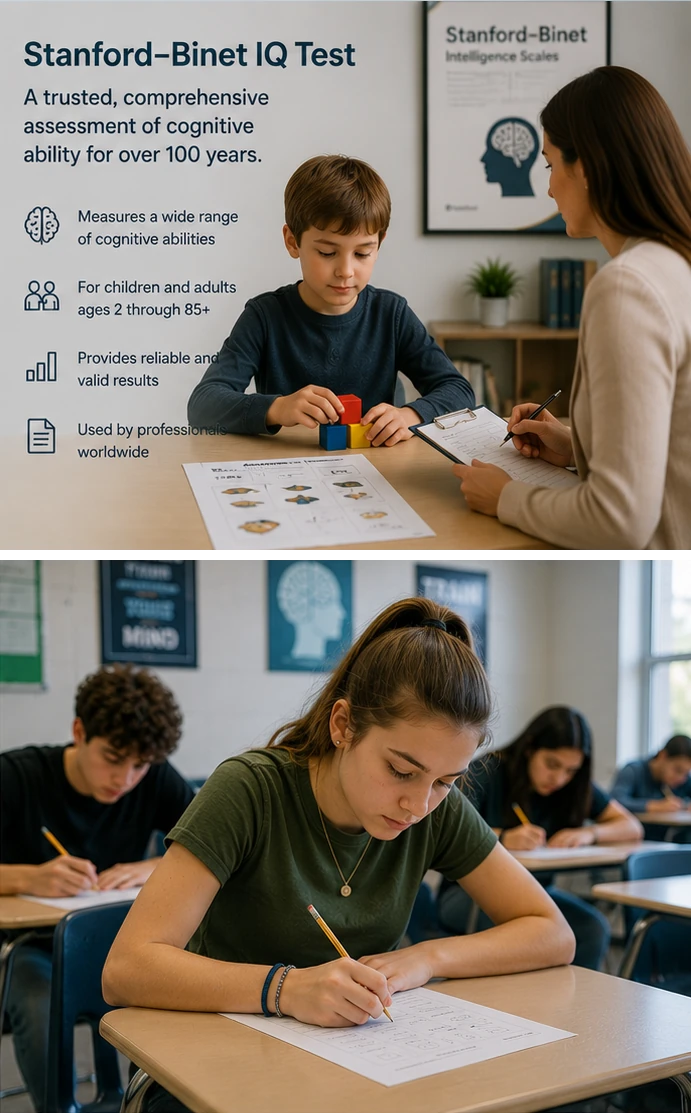
The Stanford-Binet Intelligence Scales is one of the oldest and most respected IQ tests in the world. This comprehensive guide covers the complete history of the Stanford-Binet, the key differences between SB-5 and other major IQ tests (WISC, WAIS, Mensa, and Full Evaluations), and what you need to know about testing in Glendale.
Last Updated: September 2026
Complete SB History
From Binet-Simon (1905) to SB-5 (2003) – the evolution of intelligence testing.
SB-5 vs Other Tests
Detailed comparison of Stanford-Binet vs WISC, WAIS, Mensa, and Full Evaluations.
SB in Glendale
How many people take the Stanford-Binet in Glendale and what the data tells us.
All SB Versions
Complete breakdown of subtests and scores for every Stanford-Binet version.
Why Choose SB-5?
Understanding the advantages of the Stanford-Binet and who it's best for.
Schedule SB Testing
Book your Stanford-Binet assessment with a licensed psychologist in Glendale today.
The Complete History of the Stanford-Binet
The Origins: Binet-Simon Scale (1905)
The story of the Stanford-Binet begins in France with Alfred Binet and Théodore Simon. In 1905, the French Ministry of Education commissioned Binet to develop a test to identify children who would need special assistance in school. The result was the Binet-Simon Scale, which measured memory, attention, comprehension, and judgment.
Stanford-Binet (1916)
Lewis Terman of Stanford University adapted the Binet-Simon Scale for American use in 1916. This version introduced the Intelligence Quotient (IQ) concept, which was calculated as (Mental Age ÷ Chronological Age) × 100. Terman's version became the foundation for modern IQ testing.
Stanford-Binet (1937)
This revision expanded the test to two forms (L and M) and extended the age range to cover ages 2 to adult. It was the first major revision of the SB.
Stanford-Binet (1960)
This version incorporated the best items from Forms L and M into a single Form L-M. It was the first to introduce deviation IQ scores, which are now standard in all modern IQ tests.
Stanford-Binet (1972)
A minor revision with updated norms based on the 1960s population.
Stanford-Binet (1986) – SB-IV
A major revision that introduced a multi-factor structure. It assessed four cognitive areas: Verbal Reasoning, Abstract/Visual Reasoning, Quantitative Reasoning, and Short-Term Memory. It also introduced the concept of Standard Age Score (SAS).
Stanford-Binet (2003) – SB-5
The current version, SB-5, represents the most comprehensive revision to date. It features:
- Five factors: Fluid Reasoning, Knowledge, Quantitative Reasoning, Visual-Spatial Processing, and Working Memory
- Full scale IQ score
- Ten subtests (5 verbal, 5 nonverbal)
- Age range: 2 years to 85+ years
- Administration time: 45-75 minutes
Stanford-Binet vs Other Tests: What's the Difference?
| Feature | Stanford-Binet (SB-5) | WISC-V | WAIS-IV | Mensa Test | Full Evaluation |
|---|---|---|---|---|---|
| Age Range | 2–85+ years | 6–16 years | 16–90 years | 16+ years | Varies |
| Primary Use | Gifted identification, clinical assessment, all ages | Children's IQ, school placement, gifted programs | Adult IQ, career guidance, neuropsychology | High-IQ society admission | Comprehensive cognitive & psychological assessment |
| Factors/Indices | 5 factors (Fluid Reasoning, Knowledge, Quantitative, Visual-Spatial, Working Memory) | 5 indices (VCI, VSI, FRI, WMI, PSI) | 4 indices (VCI, PRI, WMI, PSI) | Varies by test | Multiple cognitive, behavioral, and emotional domains |
| Subtests | 10 (5 verbal, 5 nonverbal) | 10 primary + 5 secondary + 5 tertiary | 10 core + 5 supplemental | Varies | Multiple tests |
| Administration Time | 45-75 minutes | 65-80 minutes | 60-90 minutes | 60-90 minutes | 2-6 hours |
| Best For | Highly gifted individuals, all ages, comprehensive assessment | Children, school placement, ADHD/LD evaluation | Adults, career guidance, Mensa, neuropsychology | Adults seeking Mensa membership | Complex cases, disability diagnosis, legal documentation |
Why Choose the Stanford-Binet?
Advantages of SB-5
- Broad age range: SB-5 can be used from age 2 to 85+, making it the most versatile IQ test available.
- Excellent for gifted identification: The extended ceiling of SB-5 makes it particularly good at identifying highly gifted individuals (IQ 145+).
- CHC theory alignment: SB-5 was designed from the ground up to align with the Cattell-Horn-Carroll (CHC) theory of cognitive abilities.
- Balanced verbal/nonverbal: The 5 verbal and 5 nonverbal subtests provide a balanced assessment of cognitive abilities.
- Strong clinical utility: Excellent for identifying learning disabilities, intellectual disabilities, and cognitive strengths.
- Less influenced by speed: Unlike WISC and WAIS, SB-5 is less affected by processing speed, making it better for individuals with ADHD or motor issues.
When to Choose Other Tests
- WISC-V: Best for children aged 6-16, especially for school placement and learning disability identification.
- WAIS-IV: Best for adults aged 16-90, especially for career guidance, neuropsychological evaluation, and Mensa.
- Mensa Test: Best if your only goal is Mensa admission and you don't need a comprehensive report.
- Full Evaluation: Best if you suspect multiple conditions (e.g., ADHD + anxiety + learning disability) or need documentation for legal purposes.
Stanford-Binet Testing in Glendale
The Stanford-Binet may be used in Glendale for gifted assessment, broad-age cognitive testing, intellectual-disability questions, school planning, clinical evaluation, and Mensa prior evidence when the score and documentation meet current requirements.
Where It May Be Used
- Banner Thunderbird Medical Center: The Glendale hospital provides acute care, neurology, behavioral health, rehabilitation, sleep medicine, pediatrics, imaging, emergency care, and other services; the appropriate pathway depends on whether the question is medical, psychiatric, developmental, or neuropsychological.
- Banner Children's Specialists: A Glendale location on West Thunderbird Road includes pediatric specialty services, including pediatric neuropsychology access through Banner providers; age range, referral, insurance, and testing scope should be confirmed.
- Abrazo Arrowhead Campus: The north Glendale hospital provides cardiovascular, surgical, women's, emergency, and residency services and may refer patients for neurological, behavioral-health, rehabilitation, or specialty evaluation when needed.
- Midwestern University Clinics: University-affiliated clinics and training programs support healthcare, behavioral-health, speech-language, dental, optometry, and other professional services; student-clinic scope and external-report acceptance should be verified.
- Private psychology and neuropsychology practices: West Valley and Phoenix-area providers offer ADHD, autism, learning, cognitive, neuropsychological, forensic, disability, presurgical, and diagnostic evaluations with different age ranges and specialties.
- Veterans: VA Phoenix Health Care operates the Northwest VA Clinic in Surprise and other central-Arizona facilities offering primary care, mental-health, and specialty pathways for eligible veterans.
- Memory and neurological resources: Banner Sun Health Research Institute in nearby Sun City and Phoenix-area neurology centers may address memory, movement, neurological, and aging questions; formal neuropsychological referrals depend on clinical need.
- Credential verification: Confirm Arizona psychologist licensure, neuropsychology or pediatric training, age range, language competence, test edition, report scope, fees, turnaround time, insurance, and receiving-institution requirements before scheduling.
School and Gifted Context
- Arizona requirement: Public school districts must identify gifted learners and provide appropriate K–12 services through a locally approved scope and sequence. Arizona guidance commonly uses performance at or above the 97th percentile in verbal, quantitative, or nonverbal areas, subject to the district's approved procedures and state-approved tests.
- Glendale Elementary School District: GESD serves pre-K through grade 8 in 12 schools and maintains gifted programming, screening, referral, and service procedures that families should verify for the current school year.
- Glendale Union High School District: GUHSD serves many Glendale high-school students through honors, Advanced Placement, dual-enrollment, career and technical education, performing arts, and other advanced pathways; placement rules vary by school and course.
- Peoria Unified School District: PUSD serves north Glendale and offers comprehensive K–12 gifted education. Copperwood Elementary's Center for Differentiated Instruction is a district gifted-magnet option, while other service models and secondary pathways vary by grade and campus.
- Deer Valley Unified and neighboring districts: Some north Glendale addresses fall within Deer Valley Unified, while nearby families may attend Phoenix-area districts. Each district has separate identification, transfer, service, and acceleration rules.
- Charter schools: Arizona charter schools are not required by the gifted statute to provide gifted services, although some choose to offer advanced programs. Admission generally cannot be based on protected characteristics, and capacity rules may apply.
- Outside evaluations: A private WISC-V, Stanford-Binet, or psychoeducational report may add useful information but does not automatically determine public-school gifted identification, course placement, acceleration, special education, or services.
- Family process: Request the current gifted scope and sequence, screening calendar, referral form, approved-test list, score report, service description, reassessment procedure, and appeal information before scheduling private testing.
Local Usage Data
- No citywide count: Glendale does not publish a verified total of Stanford-Binet administrations.
- Provider choice: Many examiners use the WISC-V for school-age children and WAIS editions for adults, while SB-5 is selected when its broad age range or verbal/nonverbal structure fits the referral.
- Acceptance: Confirm school, Mensa, disability, legal, or agency requirements before testing.
All Stanford-Binet Versions at a Glance
Frequently Asked Questions
The Stanford-Binet is the oldest continuously used intelligence test, with origins in 1905 France. Key milestones:
- Binet-Simon (1905): Developed by Alfred Binet and Théodore Simon to identify children needing special education.
- Stanford-Binet (1916): Lewis Terman adapted it for American use and introduced the IQ concept (Mental Age ÷ Chronological Age × 100).
- Stanford-Binet (1937): Two forms (L and M) with an extended age range.
- Stanford-Binet (1960): Form L-M. Introduced deviation IQ scores (the modern standard).
- SB-IV (1986): Multi-factor structure with four cognitive areas.
- SB-5 (2003): Current version with five factors (Fluid Reasoning, Knowledge, Quantitative Reasoning, Visual-Spatial Processing, Working Memory) and ages 2-85+.
The Stanford-Binet was the test used by the famous "Termite" study that followed gifted children throughout their lives.
All three are excellent IQ tests, but they have different strengths:
- Stanford-Binet (SB-5): Broadest age range (2-85+). Best for highly gifted individuals. Less influenced by processing speed. Balanced verbal/nonverbal subtests.
- WISC-V: Best for children aged 6-16. Designed for school placement and learning disability identification. Faster administration.
- WAIS-IV: Best for adults aged 16-90. Designed for career guidance, neuropsychology, and Mensa. Most widely used adult IQ test.
Choose Stanford-Binet if you need an assessment that works across all ages and is less affected by processing speed or motor issues.
Yes, Stanford-Binet is often preferred for individuals with ADHD or processing speed issues because it is less influenced by speed compared to WISC and WAIS. The SB-5's emphasis on fluid reasoning and knowledge rather than speed makes it more accessible for individuals with attention difficulties. However, like all IQ tests, SB-5 cannot diagnose ADHD on its own – it provides cognitive profile information that helps clinicians understand how ADHD might affect a person's performance.
Yes. Mensa accepts Stanford-Binet (SB-5) scores for admission. A score of 130 or above (98th percentile) is typically required for membership. We provide official documentation for Mensa applications.
SB-5 takes approximately 45-75 minutes to administer, depending on the individual's age and performance.
Yes! This is one of SB-5's biggest advantages. It covers ages 2-85+ with a single test battery, making it ideal for families who want to compare results across generations.
Typical fees range from $200 to $1,200. Some insurance plans cover testing when medically necessary. We offer sliding-scale options for qualifying individuals.
Yes, many psychologists offer Stanford-Binet testing via secure telehealth platforms. However, some subtests may require in-person administration for accurate scoring. Contact us for details.
A Full Evaluation includes multiple tests (IQ, achievement, personality, behavioral, emotional) and typically takes 2-6 hours. It provides a comprehensive picture of cognitive, academic, emotional, and behavioral functioning. A single IQ test like Stanford-Binet focuses only on cognitive abilities and takes 45-75 minutes. Full Evaluations are best for complex cases, disability diagnosis, or legal documentation.