
Child IQ Testing in Fort Collins

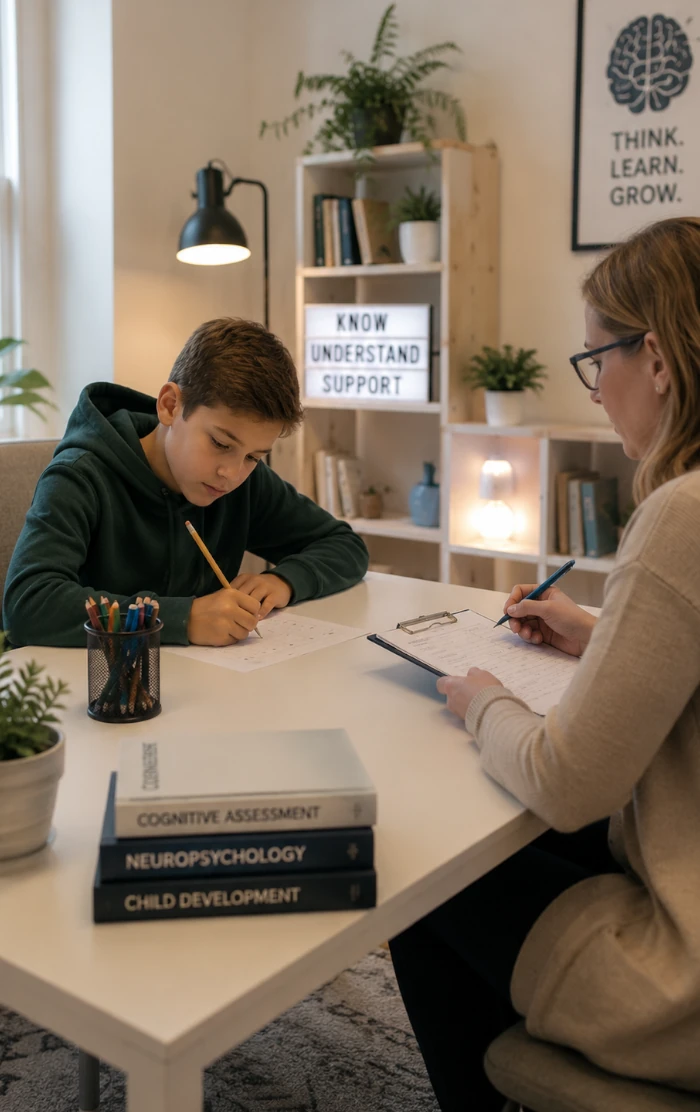
Professional child IQ testing in Fort Collins – whether you need an assessment for school placement, gifted program eligibility, or to understand your child's learning profile, we connect you with licensed psychologists in the Fort Collins area.
Last Updated: September 2026
Gifted Testing
Identify giftedness for school placement, enrichment, and talent programs using WISC-V or Stanford-Binet 5.
WISC-V Test
Wechsler Intelligence Scale for Children® Fifth Edition – the gold standard for child IQ testing.
Stanford-Binet 5
Stanford-Binet Intelligence Scales Fifth Edition – comprehensive cognitive assessment for all ages.
Full Evaluation
Combined assessment with detailed report and recommendations. Includes WISC-V or Stanford-Binet 5.
School Placement Testing
Testing for private school admission and gifted program eligibility using WISC-V or Stanford-Binet 5.
Schedule Child IQ Testing
Book your WISC-V & Stanford-Binet 5 for ages 6–16. Gifted identification, learning profiles, etc. with a licensed psychologist in Fort Collins today.
Child IQ Testing in Fort Collins: city context
Children under age 18 make up 16.5% of Fort Collins's population, or roughly 28,300 young residents. Most of the city is served by Poudre School District, while charter, private, online and homeschool programs add further choices. Attendance boundaries and program rules should always be checked using the child's exact address.
IQ testing may clarify giftedness, learning disabilities, ADHD, autism, developmental concerns, twice-exceptionality or uneven academic performance. Because 10.0% of residents age five and older speak a language other than English at home, the psychologist should document language exposure and determine whether standard English-language norms provide a valid interpretation.
IQ by gender & ethnicity (child population)
The city's population is 50.7% female and 49.3% male. Modern child IQ tests are designed so girls and boys have very similar average overall scores, although any child may show meaningful differences among verbal, visual-spatial, fluid-reasoning, working-memory and processing-speed domains.
Race and ethnicity do not determine intelligence. Fort Collins's university-connected, multilingual and economically varied population makes culturally and linguistically responsive testing important. The evaluator should examine educational opportunity, bilingual development, disability, health, motivation and testing conditions before drawing conclusions.
The child IQ testing process: step by step
- Initial consultation: parents discuss the referral question, development, language history, medical background, school performance and the receiving program's documentation rules.
- Test selection: the psychologist chooses an age-appropriate instrument such as WISC-V or Stanford-Binet and decides whether achievement, attention, behavior, memory, autism or emotional measures are also needed.
- Testing session: the child completes standardized tasks in a quiet setting with breaks appropriate to age, attention, fatigue and travel conditions.
- Scoring and interpretation: results are compared with age norms and evaluated for meaningful strengths, weaknesses and validity considerations.
- Feedback and report: parents receive an explanation and written recommendations for home, school, enrichment, accommodations or additional evaluation.
What is the WISC-V test?
The WISC-V (Wechsler Intelligence Scale for Children® – Fifth Edition) is the most widely used IQ test for children aged 6:0–16:11. It provides a Full-Scale IQ and five primary index scores: Verbal Comprehension, Visual-Spatial, Fluid Reasoning, Working Memory, and Processing Speed. The test is administered one-on-one by a trained psychologist and takes about 60–90 minutes.
The WISC-V is normed on a large, representative sample of U.S. children and is updated regularly to ensure accuracy. It is the gold standard for gifted identification, learning disability diagnosis, and school placement.
Why test your child's IQ?
IQ testing provides valuable insights into your child's cognitive strengths and weaknesses. It can help:
- Identify giftedness: For admission to gifted programs, private schools, or enrichment opportunities.
- Diagnose learning disabilities: Such as dyslexia, dyscalculia, or ADHD, which can be masked by high intelligence.
- Guide educational planning: Tailor instruction to your child's unique learning profile.
- Provide reassurance: Understand why your child is different from peers and how to support them.
Areas we serve
We support children and families throughout all areas of Fort Collins. Families should confirm Poudre School District, the receiving charter or specialized program, or an independent school's current testing and documentation rules before scheduling.
Frequently Asked Questions
Both are excellent tests. WISC-V is more commonly used for school-age children, while Stanford-Binet 5 can be used for ages 2–85. We often recommend WISC-V for gifted identification.
The test itself takes 60–90 minutes. With the consultation, feedback, and report, the entire process is about 1–2 weeks.
No, you can book directly with our psychologists. We serve both self-referred and professionally referred children.
A report may support gifted, twice-exceptional or independent-school planning, but acceptance is program-specific. Poudre School District uses a body-of-evidence process and may consider cognitive, achievement, performance and observational data; charter and independent programs set their own rules. Families should confirm the current school or program requirement before testing.
Some plans cover cognitive assessments when there is a clinical indication. Check with your provider.
Get a good night's sleep, eat a healthy meal, and arrive relaxed. No specific preparation is needed.
You'll receive a comprehensive report with your child's scores and tailored recommendations.
Some interviews, record reviews and feedback sessions may be completed remotely when permitted, but many standardized cognitive subtests require secure materials and controlled in-person administration. The psychologist should determine the valid format for the specific referral.