
IQ Testing in Fort Collins

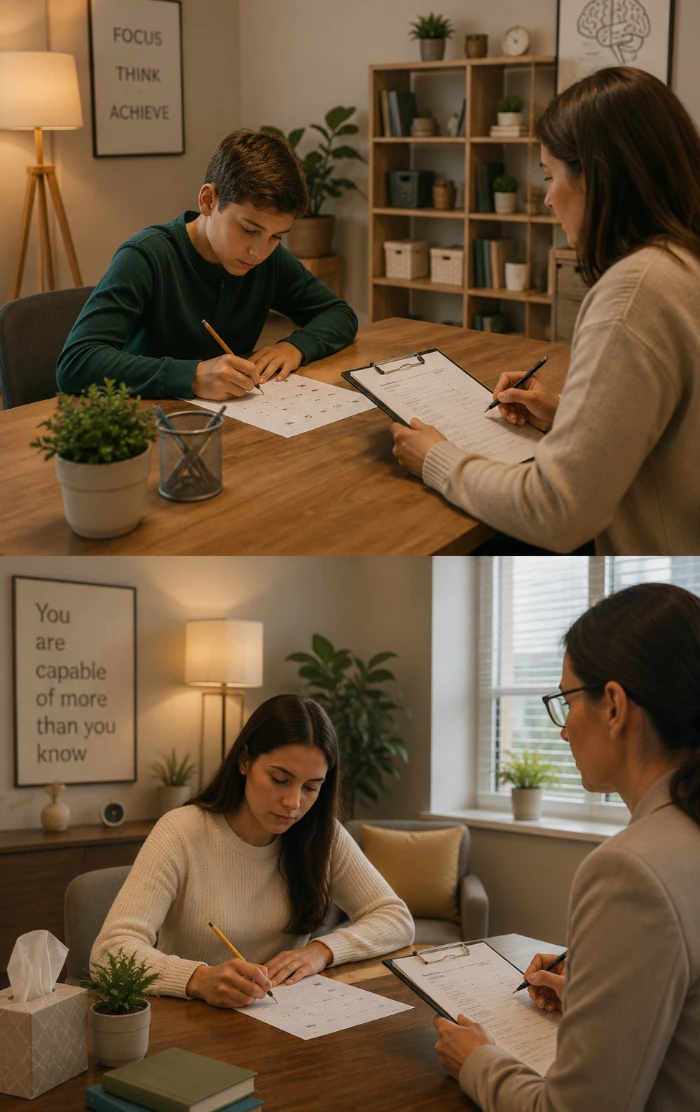
Professional IQ testing in Fort Collins – whether you need an assessment for school, employment, gifted program eligibility, or personal insight, we connect you with licensed psychologists in the Fort Collins area.
Last Updated: September 2026
Child IQ Testing
WISC-V & Stanford-Binet for ages 6–16. Gifted identification, learning profiles.
Adult IQ Testing
WAIS-IV & WAIS-5 available. Comprehensive adult cognitive assessments. Clinical & occupational.
WISC-V Test
Wechsler Intelligence Scale for Children® Fifth Edition – the gold standard for child IQ testing.
WAIS-IV & WAIS-5 Tests
Wechsler Adult Intelligence Scale® – Fourth Edition (WAIS-IV) and Fifth Edition (WAIS-5) available for adult IQ testing.
Gifted Testing
Identify giftedness for school placement, enrichment, and talent programs using WISC-V or Stanford-Binet.
Stanford-Binet 5
Stanford-Binet Intelligence Scales Fifth Edition – comprehensive cognitive assessment for all ages.
Mensa Testing
Guidance on psychologist-administered testing that may qualify as prior evidence, subject to American Mensa’s current accepted-test, score and documentation rules.
Full Evaluation
Combined assessment with detailed report and recommendations. Includes WISC-V, WAIS-IV, WAIS-5, or Stanford-Binet 5 as appropriate.
IQ Testing in Fort Collins: city context
Fort Collins is the Larimer County seat and a major Northern Colorado city along the Cache la Poudre River and the Front Range. The U.S. Census Bureau estimates 171,500 residents as of July 1, 2025, a 1.0% increase from the 2020 estimates base. The city covers 57.21 square miles of land and includes Old Town, the Colorado State University area, Midtown, established west-side and northeast neighborhoods, and growing residential and employment areas along the Harmony, Timberline and Interstate 25 corridors.
Assessment planning should reflect Fort Collins's mix of university, school-district, health-care, technology, manufacturing, public-sector and outdoor-oriented communities. Families may be navigating Poudre School District, charter, private, online and homeschool options, while adults may work locally, commute within Northern Colorado or travel toward Denver. A useful evaluation starts with the exact referral question and considers education, language, disability, medical history, testing conditions and the requirements of the school, employer, licensing body or membership organization that will receive the report.
Language and educational context: 10.0% of residents age five and older speak a language other than English at home, 97.5% of adults age 25 and older have completed high school, and 60.7% hold a bachelor's degree or higher. Standard English-language norms may not be equally valid for every examinee, so the psychologist should document language exposure, schooling and cultural background before interpreting score differences.
IQ by gender & ethnicity
Fort Collins is approximately 50.7% female and 49.3% male. Modern individually administered intelligence tests are designed so broad male and female averages are very similar. Individual differences among verbal comprehension, visual-spatial reasoning, fluid reasoning, working memory and processing speed are much more meaningful than gender-based assumptions.
Census QuickFacts reports 80.4% of residents as White alone, 1.4% as Black alone, 0.6% as American Indian or Alaska Native alone, 3.4% as Asian alone, 0.1% as Native Hawaiian or Other Pacific Islander alone and 11.6% as two or more races; 12.8% identify as Hispanic or Latino, and 6.8% are foreign-born. These categories describe population identity, not intelligence. Race and Hispanic origin partly overlap, so percentages should not be added. Ethical interpretation centers the examinee's individual history, language, educational opportunity, health, disability status and complete score profile.
What is professional IQ testing?
Intelligence quotient (IQ) testing is a standardized method to measure human cognitive abilities and intellectual potential. Professional IQ tests are administered by licensed psychologists in a controlled environment to ensure accuracy and reliability. Unlike online quizzes, clinical assessments provide a full-scale IQ score along with detailed breakdowns of verbal comprehension, perceptual reasoning, working memory, and processing speed.
In Fort Collins, IQ testing is commonly used for gifted program admission, learning disability identification, career guidance, neuropsychological evaluation, and personal development. The results are presented in a comprehensive report that includes normative comparisons, strengths and weaknesses, and actionable recommendations.
People in Fort Collins who are curious about cognitive problem-solving may begin with an online IQ test, then consult a licensed psychologist when they need standardized scores or a written report.
Who should get tested?
IQ testing can benefit children, adolescents, and adults in various situations:
- Children: Parents often seek testing for school readiness, gifted placement, or to understand learning challenges.
- Adults: Many adults take IQ tests for career advancement, graduate school applications, or personal curiosity.
- Mensa candidates: High-IQ societies require official test scores for membership.
- Clinical referrals: Psychologists may recommend testing as part of a broader neuropsychological evaluation.
Types of IQ tests
We offer the most recognized and scientifically validated intelligence tests in the field:
- WISC-V (Wechsler Intelligence Scale for Children® – Fifth Edition): The gold standard for children aged 6:0–16:11. It provides a Full-Scale IQ and five primary index scores.
- WAIS-IV (Wechsler Adult Intelligence Scale® – Fourth Edition): The most widely used adult IQ test for ages 16–90. It measures cognitive functioning across four domains.
- Stanford-Binet Intelligence Scales – Fifth Edition: A comprehensive assessment for ages 2–85, often used for gifted identification and clinical evaluations.
- Gifted Testing: Often includes the WISC-V or Stanford-Binet, plus additional creativity and achievement measures.
- Mensa-related testing: A qualifying score from an accepted, properly administered instrument may be submitted as prior evidence; American Mensa makes the admission decision under its current rules.
Child IQ Testing in Fort Collins
For children in Fort Collins, a comprehensive cognitive evaluation can clarify advanced learning needs, learning disabilities, twice-exceptionality, attention concerns and school-placement questions. Licensed child psychologists commonly use the WISC-V and Stanford-Binet 5 to assess verbal comprehension, visual-spatial reasoning, fluid reasoning, working memory and processing speed.
Most Fort Collins students attend Poudre School District, while charter, private, online and homeschool programs add further options. PSD identifies gifted learners through a body of evidence rather than one private IQ score, and it may use cognitive, achievement, performance and observational information. A private report can add useful evidence but does not automatically establish gifted identification, acceleration, special-education eligibility or course placement. Families should obtain the receiving school's current written requirements before testing.
Adult IQ Testing in Fort Collins
Adult IQ testing may support diagnostic clarification, ADHD or learning-disability evaluation, career planning, disability documentation, rehabilitation, personal insight or submission of accepted prior evidence to a high-IQ society. Fort Collins adults work across Colorado State University and education, health care, bioscience, advanced manufacturing, technology, clean energy, municipal and county government, professional services, construction, food and beverage production, tourism and the wider Northern Colorado economy, so the referral question should guide the instrument and report.
How the testing process works
- Initial consultation: Brief phone or video call to discuss your needs and match you with the right psychologist.
- Testing session: In-person or remote testing (depending on the test) with a licensed psychologist. Most sessions last 1–2 hours.
- Scoring and interpretation: The psychologist scores the test and interprets the results in the context of your background and goals.
- Feedback session: A detailed review of your results, including strengths, weaknesses, and practical recommendations.
- Comprehensive report: You receive a written report with all scores, normative comparisons, and actionable next steps.
How much does IQ testing cost in Fort Collins?
The cost of IQ testing in Fort Collins varies depending on the type of test, the psychologist's experience, and whether a comprehensive report is required. Typical fees range from $200 to $1,200 for a full assessment. Focused gifted or cognitive testing may cost less than a broad neuropsychological evaluation, while American Mensa’s supervised admission testing follows its own registration and fee structure.
Some insurance plans cover IQ testing when it's deemed medically necessary. We recommend checking with your provider for details. Ask the selected office about written fee estimates, deposits, payment arrangements and any reduced-fee options before scheduling.
Why choose a licensed psychologist?
Licensed psychologists have doctoral-level training in assessment, psychometrics, and clinical interpretation. They adhere to strict ethical standards and use only validated, norm-referenced tests. Unlike unqualified "coaches" or online quizzes, a licensed psychologist ensures that:
- The test is administered correctly and consistently.
- Results are accurate and interpretable.
- You receive a professional, legally defensible report.
- You are protected by confidentiality and professional standards.
Fort Collins transportation and access
- Major roads: Interstate 25 runs north–south along the city's eastern edge and connects Fort Collins with Loveland, Greeley-area corridors, Denver and Cheyenne. U.S. 287/College Avenue is the principal north–south urban spine. Colorado Highway 14 follows Mulberry Street east–west, while Harmony Road, Prospect Road, Drake Road, Horsetooth Road, Trilby Road, Shields Street, Lemay Avenue, Timberline Road and Taft Hill Road are important local corridors.
- Public transit: Transfort operates Fort Collins's fare-free fixed-route network, including MAX bus rapid transit along the Mason Corridor, CSU routes, the late-night Gold route and Dial-a-Ride paratransit. FLEX provides regional connections toward Loveland, Berthoud, Longmont and Boulder. Riders should verify current routes, operating days and service changes before an appointment.
- Passenger rail: Fort Collins does not currently have scheduled intercity passenger-train service. Amtrak lists a curbside bus stop at the Harmony Road Park-and-Ride, while rail itineraries generally connect through Denver Union Station. Front Range Passenger Rail and other proposed services remain planning projects, so future station locations and opening dates should not be treated as current service.
- Airport: Northern Colorado Regional Airport (FNL), jointly owned by Fort Collins and Loveland and located at 4900 Earhart Road in Loveland, supports general aviation, charters, corporate travel and aviation services. Scheduled commercial service is not currently established; Denver International Airport (DEN), about 70 miles southeast, is the primary airport for extensive domestic and international flights.
- Distance to other cities: Loveland is about 20–25 minutes away; Greeley about 35–45 minutes; Cheyenne about 45–55 minutes; Boulder about 55–70 minutes; downtown Denver roughly 1 hour 10 minutes; Denver International Airport about 1 hour 10–25 minutes; and Estes Park approximately 1 hour by car. Times vary with weather, construction, traffic and the starting point within Fort Collins.
- Walkability: Old Town, Downtown, the Colorado State University area and sections of the Mason Corridor and Midtown have many of the city's most walkable blocks. Fort Collins remains geographically spread out, so appointments outside those areas may be easier to reach by car, Transfort, bicycle, paratransit or rideshare.
- Bike infrastructure: Fort Collins maintains an extensive network of bike lanes, low-stress bikeways and paved trails, including the Poudre River Trail, Spring Creek Trail, Fossil Creek Trail, Power Trail and Mason Trail. The city retains Platinum-level Bicycle Friendly Community recognition; riders should still review current construction, weather and corridor conditions before traveling.
Fort Collins Economic Context
- Median household income: $85,070 in 2020–2024 Census estimates.
- Per-capita income: $47,458.
- Residents in poverty: 15.8%.
- Bachelor's degree or higher: 60.7% of adults age 25 and older.
- Mean travel time to work: 19.5 minutes, although Interstate 25 congestion, winter weather and trips to Loveland, Greeley, Boulder or Denver can make regional commutes longer.
- Health care and social-assistance activity: approximately $1.73 billion in 2022 receipts/revenue, reflecting hospitals, clinics, behavioral-health care, rehabilitation, senior services and related providers.
- Transportation and warehousing: approximately $110.0 million in 2022 receipts/revenue.
- Retail sales: approximately $3.73 billion in 2022.
- Accommodation and food services: approximately $708.2 million in 2022 sales.
- Regional strengths: Colorado State University and research, health care, bioscience, software and professional services, advanced manufacturing, semiconductors and electronics, clean energy and water technology, agriculture and food systems, brewing, government, construction, tourism and outdoor recreation.
Areas we serve
We support clients throughout all areas of Fort Collins, Colorado. In-person availability depends on the psychologist, and Colorado telehealth rules, test security and standardized administration requirements determine whether any part of an assessment can be completed remotely.
Frequently Asked Questions
WISC-V is for children aged 6–16, while WAIS-IV is for adults aged 16–90. Each is normed for its specific age group.
Most IQ tests take between 60 and 90 minutes, plus a feedback session. Allow 2–3 hours total.
No, you can book directly with our psychologists. We serve both self-referred and professionally referred individuals.
A qualifying score from an accepted, fully administered test may be submitted to American Mensa as prior evidence. American Mensa individually reviews the instrument, score, administration conditions and documentation, so confirm its current requirements before scheduling.
Some plans cover cognitive assessments when there is a clinical indication. Check with your provider.
Get a good night's sleep, eat a healthy meal, and arrive relaxed. No specific preparation is needed.
You'll receive a comprehensive report with your scores and tailored recommendations.
Some interviews, record reviews and feedback sessions may be completed remotely when permitted, but many standardized cognitive subtests require secure materials and controlled in-person administration. The psychologist should determine the valid format for the specific referral.