
Child IQ Testing in Corona, CA

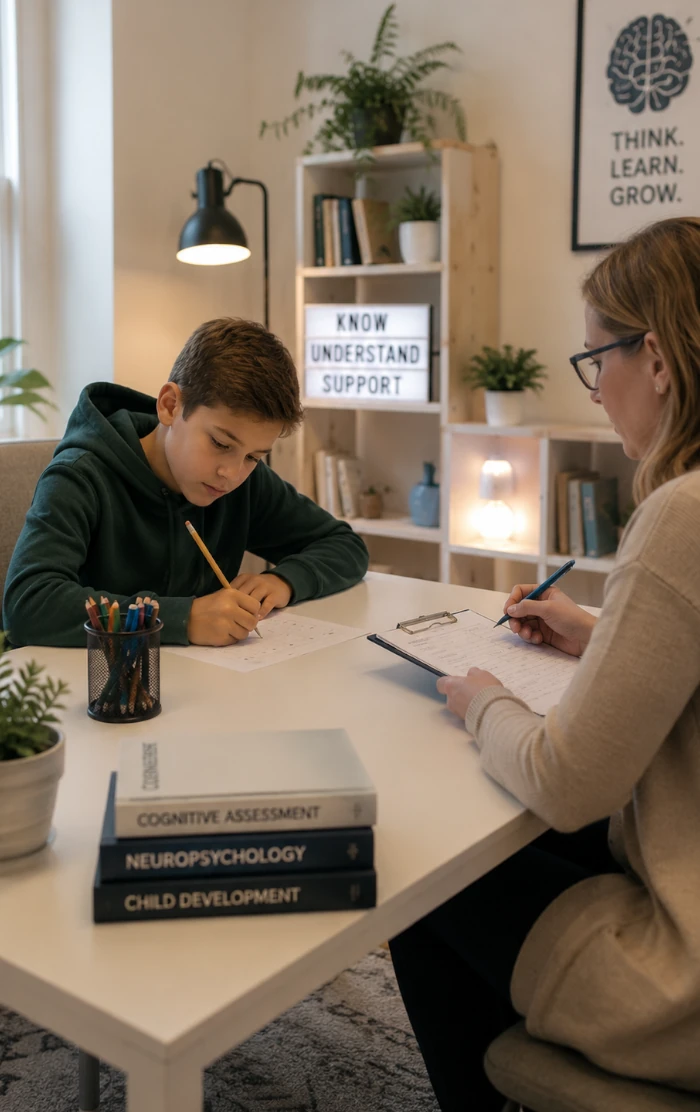
Professional child IQ testing in Corona, CA – whether you need an assessment for school placement, gifted program eligibility, or to understand your child's learning profile, we connect you with licensed psychologists in the Corona, CA area.
Last Updated: September 2026
Gifted Testing
Identify giftedness for school placement, enrichment, and talent programs using WISC-V or Stanford-Binet 5.
WISC-V Test
Wechsler Intelligence Scale for Children® Fifth Edition – the gold standard for child IQ testing.
Stanford-Binet 5
Stanford-Binet Intelligence Scales Fifth Edition – comprehensive cognitive assessment for all ages.
Full Evaluation
Combined assessment with detailed report and recommendations. Includes WISC-V or Stanford-Binet 5.
School Placement Testing
Testing for private school admission and gifted program eligibility using WISC-V or Stanford-Binet 5.
Schedule Child IQ Testing
Book your WISC-V & Stanford-Binet 5 for ages 6–16. Gifted identification, learning profiles, etc. with a licensed psychologist in Corona, CA today.
Child IQ Testing in Corona, CA: city context
Corona is a large, family-oriented city in western Riverside County with an estimated 161,734 residents in 2025. Approximately 23.2% of residents are younger than 18, so school referral, developmental assessment, gifted identification, learning support, disability documentation, and private-school placement are practical concerns for many local households. Corona covers nearly 40 square miles, and families may need to coordinate testing around school schedules, traffic on State Route 91 and Interstate 15, work hours, and travel to specialists elsewhere in the Inland Empire or Orange County.
The city is also linguistically and culturally diverse. About 25.1% of residents are foreign born, and 45.1% of people age five and older speak a language other than English at home. A responsible child evaluation should document language exposure, proficiency in each language, years and consistency of schooling, interpreter use, acculturation, sensory or motor needs, attention, health, medication, and whether the test norms are appropriate. A low verbal score in English is not automatically evidence of low reasoning ability, and a nonverbal test is not completely culture free.
Families request child cognitive assessment for different reasons: CNUSD gifted-program questions, possible dyslexia or learning disability, ADHD, autism or developmental concerns, school admissions, grade acceleration, disability accommodations, treatment planning, or a clearer picture of learning strengths and support needs. The referral question should determine the battery. A focused IQ measure may be enough for a narrowly defined purpose, while a comprehensive psychoeducational or neuropsychological evaluation may also require achievement, language, attention, executive-function, memory, behavior, adaptive-functioning, and social-emotional measures.
Corona’s median household income is comparatively high, but cost and access remain uneven. Families may face private-testing fees, insurance limitations, time away from work, long specialist waitlists, transportation demands, or difficulty locating bilingual assessment. These access differences should never be mistaken for differences in ability. School records, prior assessments, intervention history, report cards, work samples, teacher observations, developmental and medical records, and the family’s specific questions should be gathered before the appointment so the evaluator can choose an efficient and valid battery.
Child IQ scores are estimates, not permanent labels. They include confidence intervals and can be affected by fatigue, anxiety, attention, language, rapport, motivation, motor demands, hearing or vision, and unfamiliarity with the testing situation. Interpretation should emphasize the pattern of strengths and weaknesses, the quality of the testing conditions, and the decisions the results are intended to support rather than treating Full Scale IQ as a complete description of the child.
Corona-Norco Unified School District and Gifted Programs
Corona-Norco Unified School District (CNUSD) publishes annual Gifted and Talented Education identification information. Current district materials describe GATE services for qualifying students in grades 3 through 6. The district has used universal second-grade screening in its published cycle, and students identified in later elementary grades may also be considered through the district’s annual procedures. A student’s gifted designation can remain in the educational record after elementary school, while middle- and high-school programming is generally delivered through advanced coursework and other academic options rather than the same formal elementary GATE model.
CNUSD describes a comprehensive identification process rather than automatic acceptance of a privately purchased IQ score. Published information has referenced the Naglieri Nonverbal Ability Test, third edition (NNAT3), together with other student information and district review. Instruments, windows, cut scores, notification procedures, and appeal or reconsideration practices can change. Families should obtain the current calendar, consent or opt-out instructions, referral rules, eligibility criteria, service model, magnet locations, transportation requirements, transfer procedures, and contact information directly from CNUSD.
Qualifying elementary students may have access to designated GATE magnet classrooms or clustered and differentiated services at their home school, depending on current district offerings and space. A magnet assignment can involve transportation, peer-group, commute, and school-transfer decisions. Parents should ask how services differ by site, how subject acceleration is handled, whether advanced mathematics or language arts begins at a particular grade, and how the district supports students who are gifted and also have a disability, language-learning need, or social-emotional concern.
Gifted identification is separate from special-education eligibility, Section 504 accommodations, English-language development, grade acceleration, private-school admission, and clinical diagnosis. A child can need disability services without qualifying for GATE, qualify for GATE without needing clinical treatment, or be twice exceptional and require both advanced instruction and targeted support. An outside WISC-V, Stanford-Binet, achievement battery, or psychoeducational report may add useful evidence, but it does not automatically guarantee district eligibility or placement.
Families considering private testing should first ask CNUSD what outside data, if any, can be reviewed and whether a specific instrument, licensed credential, recency period, complete score page, behavioral observations, or written interpretation is required. Testing is most useful when it answers a real educational question and produces recommendations that teachers and families can implement, not when it is purchased only to chase a single cutoff.
Corona, CA Private Schools Requiring IQ Testing
There is no dependable citywide list showing that Corona private schools universally require IQ testing. Religious, independent, Montessori, college-preparatory, therapeutic, and specialty schools establish their own admission, readiness, achievement, interview, and placement procedures. Some schools may request cognitive or psychoeducational data for a particular applicant, while others rely on transcripts, teacher recommendations, classroom observation, standardized achievement tests, developmental readiness, auditions, or an internal assessment.
Before purchasing an evaluation, request written requirements from the specific school and admissions year. Confirm the accepted instrument and edition, age range, minimum examiner credential, score recency, required composites or subtests, report format, deadline, confidentiality process, and whether achievement, behavior, language, adaptive, readiness, or classroom data must accompany the IQ measure. Ask whether the school accepts a focused cognitive report or requires a full psychoeducational evaluation.
Families should also clarify how the school evaluates multilingual students, applicants with disabilities, children who use assistive technology, and students who have already taken a similar test recently. Repeating a cognitive test too soon can create practice effects and may violate the receiving school’s rules. An online quiz, abbreviated screener, or unproctored score is generally not equivalent to an individually administered standardized assessment.
The most efficient sequence is to obtain the school’s current written policy, send it to the prospective psychologist, confirm that the psychologist can meet every requirement, and receive a written fee and turnaround estimate. Do not assume that a WISC-V, Stanford-Binet, or any report from a licensed clinician will be accepted for every admissions or placement decision.
Corona, CA Gifted Identification Statistics
CNUSD does not publish a simple, permanent statistic proving that one fixed percentage of Corona children is gifted or needs private IQ testing. Identification rates can vary by screening year, grade cohort, district criteria, participation, student mobility, language background, disability status, test edition, local programming capacity, and the evidence included in the review. A city population estimate cannot be converted into a reliable count of gifted students.
Traditional psychometric discussions often associate very high cognitive scores with roughly the upper few percent of a national test distribution, but local school systems may use different definitions and multiple-measure criteria. A national percentile describes performance compared with the test’s norm group; it does not by itself establish CNUSD eligibility, appropriate grade placement, or the best instructional plan. Confidence intervals also mean that a score near a cutoff should not be interpreted as perfectly precise.
Identification patterns can be affected by who gets referred and who has access to enrichment or private evaluation. Universal screening, local norms where appropriate, nonverbal measures, careful language review, multiple opportunities, teacher training, and use of achievement, creativity, work samples, and classroom performance can reduce under-identification. Gender, race, ethnicity, family income, disability, and home language should never be treated as causes of intelligence differences in an individual child.
Families should focus on the educational decision: whether the child needs faster pacing, greater complexity, subject acceleration, enrichment, social-emotional support, disability services, or a different learning environment. The strongest interpretation combines standardized scores with developmental history, observation, school performance, interests, persistence, creativity, and response to instruction.
The child IQ testing process: step by step
Understanding the testing process can help parents prepare their child and reduce anxiety. Here's what to expect:
- Initial consultation (15–20 minutes): A brief phone or video call with the psychologist to discuss your child's background, concerns, and goals. This helps determine the right test and approach.
- Testing session (60–90 minutes): The child meets one-on-one with a licensed psychologist in a quiet, comfortable room. The psychologist administers the WISC-V or Stanford-Binet 5, which includes a series of subtests measuring verbal comprehension, visual-spatial reasoning, fluid reasoning, working memory, and processing speed. Breaks are offered as needed.
- Scoring and interpretation (1–2 days): The psychologist scores the test and analyzes the results. They consider the child's age, background, and any relevant medical or educational history.
- Feedback session (45–60 minutes): The psychologist meets with the parents (and the child, if appropriate) to explain the results. They discuss the Full-Scale IQ, index scores, strengths, and areas for growth. They also provide tailored recommendations for home, school, and extracurriculars.
- Comprehensive written report (5–7 days): You receive a detailed report with all scores, normative comparisons, and actionable next steps. This report can be shared with schools, doctors, or other professionals.
The full process includes intake, records review, testing, scoring, feedback, and report preparation. Timing varies with provider availability and referral complexity, so confirm deadlines before scheduling. The testing itself is non-invasive and designed to be engaging for children.
What is the WISC-V test?
The WISC-V (Wechsler Intelligence Scale for Children® – Fifth Edition) is the most widely used IQ test for children aged 6:0–16:11. It provides a Full-Scale IQ and five primary index scores: Verbal Comprehension, Visual-Spatial, Fluid Reasoning, Working Memory, and Processing Speed. The test is administered one-on-one by a trained psychologist and takes about 60–90 minutes.
The WISC-V is normed on a large, representative sample of U.S. children and is updated regularly to ensure accuracy. It is the gold standard for gifted identification, learning disability diagnosis, and school placement.
Why test your child's IQ?
IQ testing provides valuable insights into your child's cognitive strengths and weaknesses. It can help:
- Identify giftedness: For admission to gifted programs, private schools, or enrichment opportunities.
- Diagnose learning disabilities: Such as dyslexia, dyscalculia, or ADHD, which can be masked by high intelligence.
- Guide educational planning: Tailor instruction to your child's unique learning profile.
- Provide reassurance: Understand why your child is different from peers and how to support them.
Corona, CA Gifted Testing Timeline
CNUSD’s published GATE process operates on an annual school-year timeline and has included districtwide second-grade screening, followed by services beginning in third grade for qualifying students. Exact dates, grade-level referral opportunities, instruments, retesting limits, family notification, and placement windows can change each year, so older web pages or another family’s experience should not be treated as the current rule.
- Before the school year or early fall: Review the current CNUSD GATE page, school notices, board or district updates, consent or opt-out information, and deadlines. Ask the school’s GATE contact which students are screened automatically and which require a referral.
- Records and referral preparation: Gather report cards, work samples, prior testing, intervention history, language information, disability plans, teacher observations, and evidence of advanced performance. Submit only what the district currently permits.
- District assessment window: Students complete the district-approved screening or assessment under standardized school conditions. Families should report relevant hearing, vision, language, health, attention, medication, or accessibility needs before testing.
- Comprehensive review: The district reviews the required evidence under its current criteria. A private score may or may not be considered and generally does not override the district process.
- Notification and questions: Families receive the district’s decision and should ask about score interpretation, service options, magnet or home-school placement, transportation, reconsideration procedures, and what advanced opportunities remain available if the child is not identified.
- Private evaluation when it answers a separate question: Schedule early enough for intake, testing, scoring, feedback, and a written report, but only after confirming the receiving school’s requirements and any retest interval. Comprehensive evaluations often take longer than a focused IQ measure.
- Placement planning: Compare magnet, clustered, neighborhood-school, subject-acceleration, enrichment, and outside-program options based on the child’s complete academic and social-emotional profile rather than one number.
Families facing a private-school deadline, disability evaluation, or grade-acceleration request should work backward from the decision date and allow time for records collection, scheduling, report completion, and school review. Rush testing can increase cost and may not produce the careful interpretation needed.
Corona, CA Gifted Programs by Age Group
- Preschool and kindergarten: Emphasize play, language, curiosity, self-regulation, motor development, social interaction, and exposure to varied learning experiences. Very young children can show advanced skills, but scores may be less stable and formal labels should be used cautiously. Early assessment is most valuable when it answers a developmental or educational question.
- Grades 1–2: Classroom differentiation, reading and mathematics level, interest-based enrichment, library resources, and observation across settings may be more useful than rushing to private testing. CNUSD’s published process has included universal second-grade screening, so families should review the current district calendar and accessibility procedures.
- Grades 3–6: CNUSD’s formal elementary GATE services are described for qualifying students in these grades. Options may include designated magnet classrooms or clustered and differentiated instruction at the home school. Families should compare pace, depth, peer grouping, transportation, subject acceleration, and support for twice-exceptional or multilingual students.
- Intermediate school: After the formal elementary GATE service model, students may pursue advanced mathematics, honors or accelerated courses, enrichment, leadership, arts, STEM, clubs, competitions, and individualized subject placement. The student’s gifted designation can remain relevant, but course readiness and current performance still matter.
- High school: Options can include honors, Advanced Placement, International Baccalaureate where offered, dual enrollment, career-technical education, arts, athletics, specialized academies, independent study, research, and community-college coursework. Graduation requirements, prerequisites, workload, transportation, and college goals should guide choices.
- Outside school: Corona Public Library, City of Corona recreation, Norco College, UC Riverside, museums, arts groups, coding and robotics programs, academic competitions, community organizations, and online courses may provide enrichment. Admission rules vary and usually do not require an IQ score.
Programming matters more than a label. A child with advanced reasoning may need deeper content but also explicit support for organization, writing, anxiety, peer relationships, language development, or a learning disability. The best plan is challenging without becoming chronically overwhelming and includes the child’s interests and preferences.
Families should review progress after placement. Signs that a program fits include sustained engagement, appropriate challenge, growth, manageable stress, and opportunities to work with intellectual peers. Persistent boredom, shutdown, perfectionism, sleep loss, avoidance, or widening skill gaps may indicate that pacing, supports, or placement should be adjusted.
Corona, CA Child ADHD and Learning Disability Assessment
ADHD and learning-disability evaluation is broader than IQ testing. A comprehensive assessment may include developmental, medical, family, language, and educational history; parent, teacher, and student interviews; classroom and work-sample review; behavior rating scales; academic achievement; phonological processing; language; attention; memory; executive-function measures; and observation of effort, fatigue, and test behavior. The battery should be selected from the referral questions rather than using the same package for every child.
CNUSD can evaluate eligible students under public-school procedures when a disability is suspected and the concern affects educational access or performance. Families may also seek a private California-licensed psychologist or other properly credentialed evaluator for an independent clinical or psychoeducational assessment. These pathways are not identical. A medical diagnosis, an IEP eligibility determination, a Section 504 plan, a private-school accommodation, and an independent educational evaluation each have different legal and documentation requirements.
High reasoning ability does not rule out ADHD, dyslexia, dysgraphia, dyscalculia, developmental language disorder, autism, anxiety, depression, or other needs. Twice-exceptional students can compensate well enough that average grades hide substantial effort, or a disability can suppress performance so giftedness is missed. Large differences across cognitive, achievement, processing, and classroom measures may be more informative than Full Scale IQ alone.
Evaluation should consider alternative explanations such as inadequate instruction, interrupted schooling, English acquisition, hearing or vision problems, sleep, seizures, medication effects, chronic illness, trauma, stress, and attendance. No single attention test proves or disproves ADHD, and a low processing-speed score is not itself a diagnosis. Conclusions should integrate data from multiple settings and inform specific interventions.
Before scheduling, clarify whether the evaluator can address the intended purpose, whether school observations or teacher forms are included, which languages are supported, how records will be reviewed, and what the written report will contain. Useful recommendations are concrete: instructional methods, reading or writing intervention, classroom accommodations, assistive technology, executive-function supports, mental-health treatment, medical follow-up, and a plan for monitoring progress.
Corona, CA Summer Programs for Gifted Children
Summer opportunities may be offered through CNUSD, the City of Corona, Corona Public Library, Norco College, UC Riverside, museums, parks, arts organizations, sports programs, STEM providers, camps, academic competitions, and regional universities. Offerings, age limits, dates, fees, financial aid, transportation, and admission criteria change each year, so families should use current program materials rather than assuming a prior-year course will return.
Families should distinguish enrichment from formal gifted identification. A summer program may use interest, grade level, prerequisite coursework, teacher recommendation, an audition, a work sample, or open enrollment rather than an IQ score. A selective program may ask for school records or standardized achievement data, but that requirement does not automatically make the program a clinical or district gifted service.
Evaluate instructional quality, staff qualifications, supervision, accessibility, group size, language support, sensory demands, transportation, refund policies, technology use, and how the program handles advanced learners who also have disabilities or anxiety. A balanced summer can include challenge, creativity, physical activity, friendships, rest, and self-directed interests; more academic hours are not always better.
Corona, CA Child Testing Costs by District
Public-school assessment under applicable special-education procedures is different from privately purchased IQ, gifted, admissions, or clinical testing. When CNUSD determines that an evaluation is warranted under education law, the district’s assessment is generally provided without a direct testing fee to the family. District GATE screening and identification follow separate district procedures and should not be confused with a comprehensive disability evaluation.
Private focused IQ testing may cost several hundred dollars, while a full psychoeducational, autism, ADHD, developmental, forensic, or neuropsychological evaluation can cost substantially more. Fees vary with the number and type of instruments, record review, collateral interviews, school consultation, language or interpreter needs, scoring, feedback, travel, and the length and complexity of the written report. A low advertised testing fee may exclude feedback, school communication, or a detailed report.
Health insurance may cover portions of clinically necessary assessment but often excludes gifted identification, school admission, educational testing, or evaluations considered primarily academic. Coverage depends on diagnosis, authorization, network status, deductible, medical necessity, and benefit exclusions. School districts and private schools are not required to accept every insurance-funded or privately purchased report.
Before committing, request a written estimate showing the deposit, hourly or flat fee, included instruments, records review, feedback session, report, cancellation policy, payment plan, insurance billing, and charges for school meetings or revisions. Confirm the anticipated turnaround and whether the receiving district, school, disability office, court, or program accepts the evaluator’s license and test edition.
Families seeking lower-cost pathways can begin with the school team, pediatrician, health plan, county behavioral-health resources, university training clinics, or providers offering limited-scope consultation. Ask about wait times, supervision, language access, and whether the service actually answers the referral question; a cheaper but unusable report can cost more in the long run.
Areas we serve
Frequently Asked Questions
Both are excellent tests. WISC-V is more commonly used for school-age children, while Stanford-Binet 5 can be used for ages 2–85. We often recommend WISC-V for gifted identification.
The testing session often takes about 60–90 minutes for a focused measure, but broader batteries take longer. Intake, records review, scoring, feedback, and report timing vary by provider and referral complexity.
Referral requirements vary. Contact the psychologist directly and ask whether self-referral is accepted; insurance, school, or agency funding may require authorization or a formal referral.
A private report may be reviewed as one source of information, but Corona-Norco Unified School District and each private program apply their own current eligibility, score, recency, instrument, and documentation rules. Obtain those requirements before testing; no private report guarantees admission or placement.
Some plans cover cognitive assessments when there is a clinical indication. Check with your provider.
Get a good night's sleep, eat a healthy meal, and arrive relaxed. No specific preparation is needed.
You'll receive a comprehensive report with your child's scores and tailored recommendations.
Some interview and feedback components may be available remotely, but many standardized cognitive tests require in-person administration. Confirm with the psychologist and the organization receiving the report.