
IQ Testing in Corona, CA

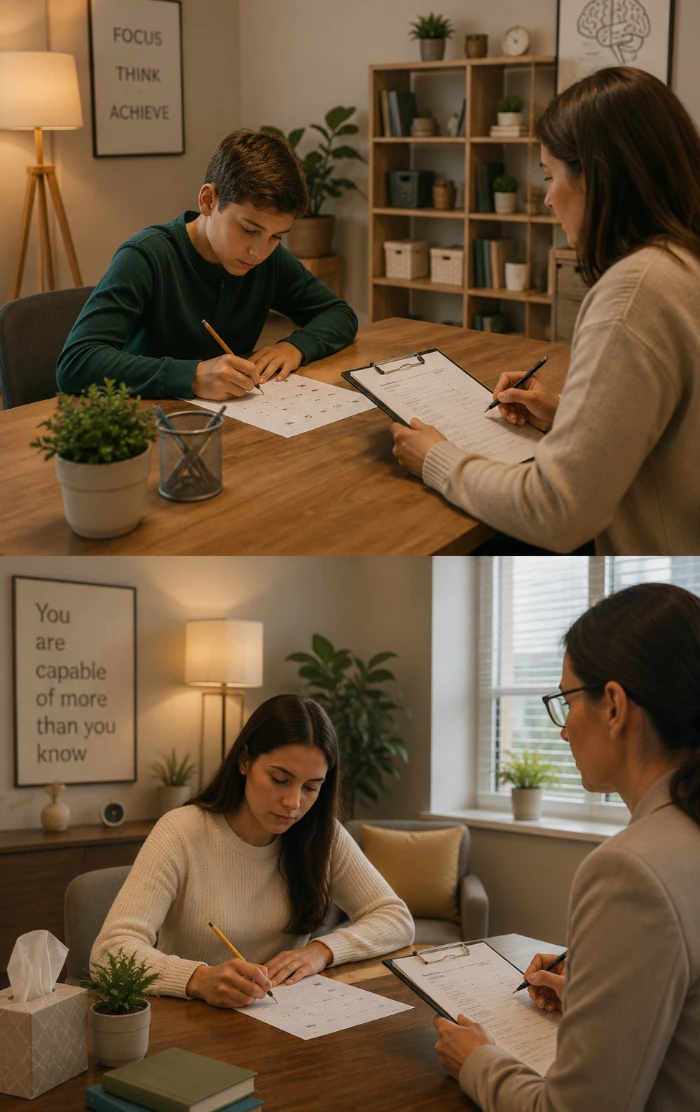
Professional IQ testing in Corona, CA – whether you need an assessment for school, employment, gifted program eligibility, or personal insight, we connect you with licensed psychologists in the Corona, CA area.
Last Updated: September 2026
Child IQ Testing
WISC-V & Stanford-Binet for ages 6–16. Gifted identification, learning profiles.
Adult IQ Testing
WAIS-IV & WAIS-5 available. Comprehensive adult cognitive assessments. Clinical & occupational.
WISC-V Test
Wechsler Intelligence Scale for Children® Fifth Edition – the gold standard for child IQ testing.
WAIS-IV & WAIS-5 Tests
Wechsler Adult Intelligence Scale® – Fourth Edition (WAIS-IV) and Fifth Edition (WAIS-5) available for adult IQ testing.
Gifted Testing
Identify giftedness for school placement, enrichment, and talent programs using WISC-V or Stanford-Binet.
Stanford-Binet 5
Stanford-Binet Intelligence Scales Fifth Edition – comprehensive cognitive assessment for all ages.
Mensa Testing
Professional cognitive testing for possible Mensa prior-evidence submission; confirm the current accepted test, edition, score, and documentation rules before scheduling.
Full Evaluation
Combined assessment with detailed report and recommendations. Includes WISC-V, WAIS-IV, WAIS-5, or Stanford-Binet 5 as appropriate.
IQ Testing in Corona, CA: city context
Corona is a large western Riverside County city at the junction of the Inland Empire and Orange County travel markets. The U.S. Census Bureau estimated 161,734 residents on July 1, 2025, compared with 157,136 counted in the 2020 Census, across approximately 39.94 square miles of land. About 23.2% of residents are under age 18, and the city’s family population, schools, healthcare system, industrial employers, and long regional commutes create varied reasons for seeking professional cognitive assessment.
Corona children and adults request testing for gifted identification, learning and attention concerns, developmental questions, disability documentation, school or college accommodations, diagnostic clarification, career planning, Mensa prior-evidence questions, and changes in memory or functioning. A valid evaluation should match the examinee’s age, referral question, language background, educational opportunity, disability status, and the documentation rules of the organization that will use the report.
City demographics describe the community, not an individual’s intelligence. Corona’s multilingual population and the wide differences in educational and occupational experience require culturally responsive assessment, careful review of language dominance and schooling history, and explicit discussion of any limits on score interpretation.
IQ by gender & ethnicity
Corona’s population is approximately 50.5% female and 49.5% male. Census QuickFacts reports that 48.1% of residents identify as Hispanic or Latino, 36.5% as White alone, 11.8% as Asian alone, 5.1% as Black alone, 1.4% as American Indian or Alaska Native alone, 0.3% as Native Hawaiian or Other Pacific Islander alone, and 20.3% as two or more races. White alone and not Hispanic or Latino accounts for 30.4%. Some categories overlap and must never be treated as biological explanations for an individual score.
Research does not support using gender, race, ethnicity, ZIP code, income, immigration status, or household language as a shortcut for intelligence. Group averages can be distorted by unequal educational access, health, poverty, test familiarity, language exposure, stereotype threat, sampling, and the cultural demands of a particular instrument. A psychologist should interpret confidence intervals, patterns across subtests, behavior during testing, and collateral records rather than reducing a person to one number.
About 25.1% of Corona residents are foreign born, and 45.1% of people age five and older speak a language other than English at home. Examiners should document the language used, proficiency in each language, interpreter involvement, and any departure from standardized procedures. Nonverbal measures can reduce some verbal demands, but they do not eliminate cultural, educational, sensory, motor, or socioeconomic influences.
What is professional IQ testing?
Intelligence quotient (IQ) testing is a standardized method to measure human cognitive abilities and intellectual potential. Professional IQ tests are administered by licensed psychologists in a controlled environment to ensure accuracy and reliability. Unlike online quizzes, clinical assessments provide a full-scale IQ score along with detailed breakdowns of verbal comprehension, perceptual reasoning, working memory, and processing speed.
In Corona, IQ testing is commonly used for gifted program admission, learning disability identification, career guidance, neuropsychological evaluation, and personal development. The results are presented in a comprehensive report that includes normative comparisons, strengths and weaknesses, and actionable recommendations.
Who should get tested?
IQ testing can benefit children, adolescents, and adults in various situations:
- Children: Parents often seek testing for school readiness, gifted placement, or to understand learning challenges.
- Adults: Many adults take IQ tests for career advancement, graduate school applications, or personal curiosity.
- Mensa candidates: High-IQ societies require official test scores for membership.
- Clinical referrals: Psychologists may recommend testing as part of a broader neuropsychological evaluation.
Types of IQ tests
Commonly requested, professionally administered IQ tests include:
- WISC-V (Wechsler Intelligence Scale for Children® – Fifth Edition): The gold standard for children aged 6:0–16:11. It provides a Full-Scale IQ and five primary index scores.
- WAIS-IV (Wechsler Adult Intelligence Scale® – Fourth Edition): The most widely used adult IQ test for ages 16–90. It measures cognitive functioning across four domains.
- Stanford-Binet Intelligence Scales – Fifth Edition: A comprehensive assessment for ages 2–85, often used for gifted identification and clinical evaluations.
- Gifted Testing: Often includes the WISC-V or Stanford-Binet, plus additional creativity and achievement measures.
- Mensa Testing: We can help clarify professional testing options, but American Mensa determines whether any test and documentation qualify under its current rules.
A professionally administered IQ test should be selected for the examinee’s age, language background, referral question, and the documentation rules of the school or organization receiving the report.
How the testing process works
- Initial consultation: Brief phone or video call to discuss your needs and match you with the right psychologist.
- Testing session: In-person or remote testing (depending on the test) with a licensed psychologist. Most sessions last 1–2 hours.
- Scoring and interpretation: The psychologist scores the test and interprets the results in the context of your background and goals.
- Feedback session: A detailed review of your results, including strengths, weaknesses, and practical recommendations.
- Comprehensive report: You receive a written report with all scores, normative comparisons, and actionable next steps.
How much does IQ testing cost in Corona, CA?
The cost of IQ testing in Corona, CA varies by the test selected, the examiner's credentials, the purpose of the evaluation, and the amount of record review and written reporting required. A focused cognitive assessment may commonly fall in the $200 to $1,200 range, while a broad psychoeducational or neuropsychological evaluation can cost substantially more.
Insurance is more likely to contribute when testing is medically necessary for a clinical question than when it is requested only for gifted placement, Mensa, admissions, or personal curiosity. Before scheduling, ask for a written estimate, what the fee includes, whether a feedback session and full report are included, cancellation terms, and whether the psychologist is in network.
Corona, California’s Intellectual History & Legacy
Corona’s history begins long before incorporation with the Luiseño, also known as Payómkawichum, and Gabrielino-Tongva peoples who lived throughout the Santa Ana River, Temescal Canyon, and surrounding valleys. The modern settlement was established as South Riverside in 1886 during Southern California’s citrus boom and was incorporated and renamed Corona in 1896.
The name means “crown” in Spanish and reflects the circular form of Grand Boulevard, which gave Corona its enduring “Circle City” identity. Citrus growing, packing, irrigation engineering, road construction, manufacturing, and the early automobile road races around Grand Boulevard all contributed to the city’s technical and entrepreneurial history. Later development brought advanced manufacturing, healthcare, education, beverage production, musical-instrument manufacturing, construction, distribution, and professional services.
Corona Public Library’s Heritage Room, the Corona Heritage Park and Museum, the Fender-related music legacy, local schools, and civic organizations preserve this history. Historical achievement provides context for education and workforce development, but it should never be used to stereotype residents. Modern cognitive assessment is most useful when it answers a defined clinical, educational, accommodation, or vocational question.
Top Employers in Corona, CA and Cognitive-Testing Context
Corona’s employment base includes public education, healthcare, municipal government, advanced manufacturing, food and beverage production, construction, logistics, retail, professional services, and small business. Major local employers and prominent sectors include Corona-Norco Unified School District, Corona Regional Medical Center, the City of Corona, Monster Beverage, Fender Musical Instruments, construction and building firms, food distributors, and industrial suppliers.
- Education: Corona-Norco Unified School District and private schools employ teachers, school psychologists, counselors, administrators, technology staff, and operations teams.
- Healthcare: Corona Regional Medical Center, Kaiser Permanente services, rehabilitation providers, clinics, behavioral-health practices, and home-care organizations support clinical and nonclinical careers.
- Manufacturing and consumer products: Beverage, musical-instrument, aerospace-support, food, metal, plastics, and specialized industrial firms require engineering, production, quality, maintenance, logistics, and business skills.
- Construction and logistics: Access to SR-91, I-15, SR-71, rail, and regional distribution networks supports construction, warehousing, transportation, and supply-chain work.
- Government, retail, and services: City departments, public safety, utilities, shopping centers, hospitality, financial services, and locally owned businesses provide diverse pathways.
Employers ordinarily use education, licenses, work samples, experience, interviews, background checks, and job-specific assessments—not clinical IQ testing—for hiring. Cognitive evaluation may support disability documentation, rehabilitation, or career counseling, but results should not be sent to an employer unless there is a clear, lawful purpose and informed consent.
Corona, CA IQ Testing by Neighborhood
Residents seek assessment from throughout Corona, including Downtown and the Grand Boulevard circle, Corona Hills, Sierra del Oro, South Corona, Dos Lagos, and other residential and commercial areas. Neighborhood, school boundary, housing type, or proximity to an office does not predict intelligence, giftedness, disability, or appropriate placement.
Choose an examiner based on California licensure, experience with the examinee’s age and referral question, access to the required instrument, cultural and linguistic competence, physical accessibility, report quality, wait time, and the receiving organization’s standards. Travel can be unpredictable around SR-91, I-15, Main Street, Lincoln Avenue, Green River Road, Ontario Avenue, and school commute periods, so confirm parking, elevator access, and session length in advance.
Corona, CA Universities and Research Institutions
Corona does not contain a large research university campus, but residents have access to a broad Southern California higher-education network:
- Norco College: A nearby Riverside Community College District campus offering transfer preparation, career education, certificates, tutoring, disability-resource services, and pathways connected to local industry.
- University of California, Riverside: A major research university with undergraduate, graduate, professional, STEM, social-science, education, and health-related programs.
- California Baptist University and La Sierra University: Riverside institutions offering undergraduate and graduate study across business, education, health, psychology, engineering, and the liberal arts.
- California State University, San Bernardino: A regional public university serving Inland Empire students through bachelor’s, credential, and graduate programs.
- Orange County institutions: Commuting access expands options at community colleges and universities in Anaheim, Fullerton, Irvine, and nearby cities.
College disability offices set their own documentation standards. Applicants should confirm required test recency, evaluator credentials, diagnostic content, functional limitations, and recommended accommodations before purchasing an evaluation.
Corona, CA Economic Context
Corona’s economy reflects its location between the Inland Empire and Orange County, its freeway and rail access, and its mix of family households, industry, healthcare, education, retail, and regional commuters. Census 2020–2024 estimates and 2022 business figures provide the following city context:
- Median household income: $109,242 in 2020–2024 estimates.
- Per-capita income: $41,703.
- Residents in poverty: 8.7%.
- High-school graduate or higher: 85.9% of adults age 25 and older.
- Bachelor’s degree or higher: 32.4% of adults age 25 and older.
- Mean travel time to work: 34.3 minutes, although SR-91 and I-15 trips toward Orange County, Riverside, San Bernardino County, or Los Angeles can take substantially longer.
- Health care and social-assistance activity: approximately $1.056 billion in 2022 receipts/revenue within the city.
- Transportation and warehousing: approximately $374.3 million in 2022 receipts/revenue.
- Retail sales: approximately $4.329 billion in 2022.
- Accommodation and food services: approximately $557.9 million in 2022 sales.
- Regional strengths: education, healthcare, advanced manufacturing, food and beverage production, construction, logistics, retail, professional services, public administration, musical-instrument manufacturing, and entrepreneurship.
These figures help explain demand for school, disability, accommodation, and career-related evaluations. They do not determine an individual’s intelligence, employability, educational potential, or appropriate occupation.
Corona, CA School District Data
Corona-Norco Unified School District (CNUSD) serves Corona and surrounding communities through elementary, intermediate, comprehensive high-school, alternative, career-technical, dual-language, Advanced Placement, International Baccalaureate, STEM, middle-college, special-education, and other programs.
CNUSD’s Gifted and Talented Education program uses an annual district assessment and a comprehensive review of student ability. District information describes universal second-grade screening in its published identification cycle, with GATE services beginning in third grade. Qualified elementary students may receive services in a GATE magnet classroom at designated schools or through clustered services and differentiated instruction at their home school. Procedures, instruments, magnet sites, timelines, and transfer rules can change, so families should use the current district notice.
Gifted identification, special-education eligibility, English-language development, course placement, and disability accommodations are separate processes. A private IQ score may contribute useful information, but it does not automatically establish GATE admission, acceleration, special-education eligibility, or accommodations. Families should obtain current referral, consent, outside-report, and appeal procedures directly from CNUSD or the relevant private school.
Local Testing Centers and Psychologists
Aaron D. Smith, PsyD is located at 4160 Temescal Canyon Road, Suite 309, Corona, CA 92883, with the local telephone number (951) 543-4003. His current professional profile states that he conducts psychological assessments, specializes in testing and evaluation, and works with children, adolescents, and adults. His listed areas of experience include intellectual disability, ADHD, autism, school issues, and neurodivergence.
Before scheduling an IQ-focused appointment, confirm the client’s age, the exact intelligence instrument and edition, whether the referral question is accepted, fees, insurance or authorization requirements, language services, report turnaround, and whether the receiving school, disability office, court, employer, or high-IQ society will accept the report. The public service descriptions do not guarantee that every referral includes WISC-V, WAIS-IV/WAIS-5, or Stanford-Binet administration.
Corona, CA Events and Conferences
Corona and western Riverside County host education, health, workforce, and cultural events through CNUSD, Norco College, Corona Public Library, the City of Corona, healthcare providers, chambers and workforce organizations, museums, parks, and professional associations. Relevant offerings may include GATE information sessions, college and career fairs, disability-resource workshops, mental-health programs, parenting events, STEM activities, and professional continuing education.
Schedules and eligibility change. Use official calendars and confirm whether an event provides general information, screening, professional training, or an actual standardized assessment; these are not interchangeable.
Transportation and Accessibility
Corona is crossed by State Route 91 and Interstate 15, with State Route 71 nearby and major local corridors including Main Street, Lincoln Avenue, Green River Road, Ontario Avenue, Magnolia Avenue, and Temescal Canyon Road. Freeway bottlenecks, express-lane conditions, construction, school traffic, and collisions can make travel time highly variable.
Metrolink serves the North Main Corona and West Corona stations. The City’s Corona Cruiser operates Red and Blue fixed routes that connect with Riverside Transit Agency services, Metrolink, civic destinations, hospitals, medical offices, shopping, and park-and-ride locations. Corona Dial-A-Ride provides curb-to-curb service for eligible seniors and riders with disabilities. Verify current schedules, fares, eligibility, transfers, and the final return trip before a multi-hour evaluation.
Ask the testing office about wheelchair access, elevators, accessible restrooms, sensory accommodations, interpreters, service animals, rest breaks, and whether intake or feedback can occur remotely while preserving in-person standardized administration when required.
Corona, CA Weather and Seasonal Considerations
Corona has hot, dry summers and generally mild, cooler winters, with strong sunshine, periodic heat waves, Santa Ana wind events, wildfire smoke, winter rain, and occasional flooding or debris-flow concerns near hillsides and drainage areas. Weather and air quality can affect travel, sleep, medication routines, school schedules, migraines, asthma, and concentration.
- Summer heat: Hydrate, avoid unnecessary outdoor waiting, and ask about air conditioning when heat may affect endurance.
- Santa Ana winds and wildfire smoke: Check air-quality and road information, especially for examinees with respiratory or sensory sensitivities.
- Winter rain: Allow extra time for freeway congestion, slick roads, localized flooding, and reduced visibility.
- Seasonal illness and allergies: Acute symptoms, poor sleep, or sedating medication can make results less representative.
Testing should be postponed when acute illness, unsafe travel, severe sleep loss, smoke exposure, or another temporary condition would materially reduce valid participation.
Areas we serve
Frequently Asked Questions
WISC-V is for children aged 6–16, while WAIS-IV is for adults aged 16–90. Each is normed for its specific age group.
Most IQ tests take between 60 and 90 minutes, plus a feedback session. Allow 2–3 hours total.
Referral requirements vary. Contact the psychologist directly and ask whether self-referral is accepted; insurance, school, court, or agency funding may require authorization or a formal referral.
Potentially. Acceptance depends on the exact test, edition, qualifying score, administration date, examiner credentials, and current Mensa documentation rules. Confirm before testing.
Some plans cover cognitive assessments when there is a clinical indication. Check with your provider.
Get a good night's sleep, eat a healthy meal, and arrive relaxed. No specific preparation is needed.
You'll receive a comprehensive report with your scores and tailored recommendations.
Some interview and feedback components may be available remotely, but many standardized cognitive tests require in-person administration. Confirm with the psychologist and the organization receiving the report.