
Child IQ Testing in Newry, Mourne and Down
Newry, Mourne and Down spans approximately 648.65 square miles of land (1,680 km²). Professional child IQ testing in Newry, Mourne and Down – whether you need an assessment for school placement, advanced-learning provision eligibility, or to understand your child's learning profile, we connect you with HCPC-registered psychologists in the Newry, Mourne and Down area.
Last Updated: October 2026
Gifted Testing
Identify giftedness for school placement, enrichment, and talent programmes using WISC-V or Stanford-Binet 5.
WISC-V Test
Wechsler Intelligence Scale for Children® Fifth Edition – the gold standard for child IQ testing.
Stanford-Binet 5
Stanford-Binet Intelligence Scales Fifth Edition – comprehensive cognitive assessment for all ages.
Full Evaluation
Combined assessment with detailed report and recommendations. Includes WISC-V or Stanford-Binet 5.
School Placement Testing
Testing for independent school admission and advanced-learning provision eligibility using WISC-V or Stanford-Binet 5.
Schedule Child IQ Testing
Book your WISC-V & Stanford-Binet 5 for ages 6–16. Gifted identification, learning profiles, etc. with a HCPC-registered psychologist in Newry, Mourne and Down today.
Child IQ Testing in Newry, Mourne and Down: city context
Newry, Mourne and Down extends across roughly 648.65 square miles of land (1,680 km²). Its listed population is 184,605, with growth of 0.41%. For children, school system, language history, travel distance and the exact educational question are more informative than treating the whole authority as one homogeneous testing market.
The most relevant local demographic reference is the 2021 Census. Demographic figures can help a psychologist understand language, schooling, migration, cultural context and access to services, but they must never be used as a shortcut for estimating an individual’s intelligence.
IQ by gender & ethnicity (child population)
Sex profile: approximately 50.4% female and 49.6% male. Modern age-normed cognitive tests do not apply a local male-versus-female correction, and there is no valid Newry, Mourne and Down-wide dataset establishing a meaningful IQ difference by sex or gender.
- White: 98.33%.
- All non-White ethnic groups combined: 1.67%.
- Individual minority ethnic categories: each below 0.5% in the 2021 district table.
These categories describe population composition, not cognitive ability. Interpretation should instead consider the individual’s primary language, educational opportunity, disability or sensory needs, health, test familiarity and the representativeness of the test norms.
Newry, Mourne and Down School Systems and High-Ability Provision
Schools follow the Northern Ireland Curriculum and Education Authority arrangements. Special educational needs assessment has its own statutory process, and families should not import English EHC-plan terminology into a Northern Ireland referral or report.
Newry, Mourne and Down state-funded education and advanced learning
- Abbey Christian Brothers’ Grammar School in Newry and Sacred Heart Grammar School in Newry illustrate the local school landscape.
- High-attaining pupils are normally supported through curriculum planning, subject challenge and enrichment rather than through a single borough-wide gifted cutoff.
Admissions, choice and specialist provision
- Admissions rules vary by school type and age. Check the institution’s published criteria before commissioning an external cognitive test.
- Specialist provision should be matched to documented need, not simply to a Full Scale IQ number.
Further and higher education pathways
- Southern Regional College in Newry provides an important local or regional progression route.
- South Eastern Regional College in Downpatrick broadens access to specialist study or research.
SEND or additional-support assessment
- Southern Health & Social Care Trust Newry & Mourne Community Adult Learning Disability Team is a Newry-based private clinical-psychology service whose published assessment menu explicitly includes intelligence and cognitive abilities.
- The Education Authority’s Educational Psychology Service supports school-age children through consultation and psychological assessment. Confirm the current school/referral pathway, whether a standardised cognitive test is appropriate, and what written evidence the service can provide for the specific educational question.
Other school options in Newry, Mourne and Down
- Families may also consider St Colman’s College in Newry and post-primary schools across Downpatrick, Newcastle and the wider district, depending on age, admissions rules and location.
- Private reports are most useful when the school has confirmed what evidence it can act on.
Newry, Mourne and Down Independent Schools and Admissions Testing
School choice in Newry, Mourne and Down includes different state-funded, specialist and independent pathways. Examples relevant to the local education landscape include Abbey Christian Brothers’ Grammar School in Newry, Sacred Heart Grammar School in Newry, St Colman’s College in Newry, post-primary schools across Downpatrick, Newcastle and the wider district. An IQ test is not automatically an entrance test: schools may use their own reasoning papers, interviews, attainment evidence, references or subject-specific assessments.
Before booking WISC-V, Stanford–Binet or another cognitive battery for admissions, ask the school in writing whether it accepts external results, which edition and examiner credentials are permitted, how recent the report must be, and whether a Full Scale IQ or specific index evidence is actually required.
Newry, Mourne and Down Gifted Identification Statistics
There is no authoritative published count of “gifted” children for the whole of Newry, Mourne and Down based on one uniform IQ threshold. School attainment datasets, selective admissions, Mensa membership and private-assessment figures measure different things and should not be merged into a fabricated local giftedness rate.
- Top 2% convention: some high-IQ organisations use approximately the top two percent on an accepted test, but this is an admission rule rather than a local prevalence survey.
- School identification: schools can identify high attainment or exceptional subject performance without administering a clinical IQ test.
- Equity: language, disability, socioeconomic opportunity and access to enrichment can influence who is referred for testing, so referral counts are not neutral estimates of ability.
The child IQ testing process: step by step
Understanding the testing process can help parents prepare their child and reduce anxiety. Here's what to expect:
- Initial consultation (15–20 minutes): A brief phone or video call with the psychologist to discuss your child's background, concerns, and goals. This helps determine the right test and approach.
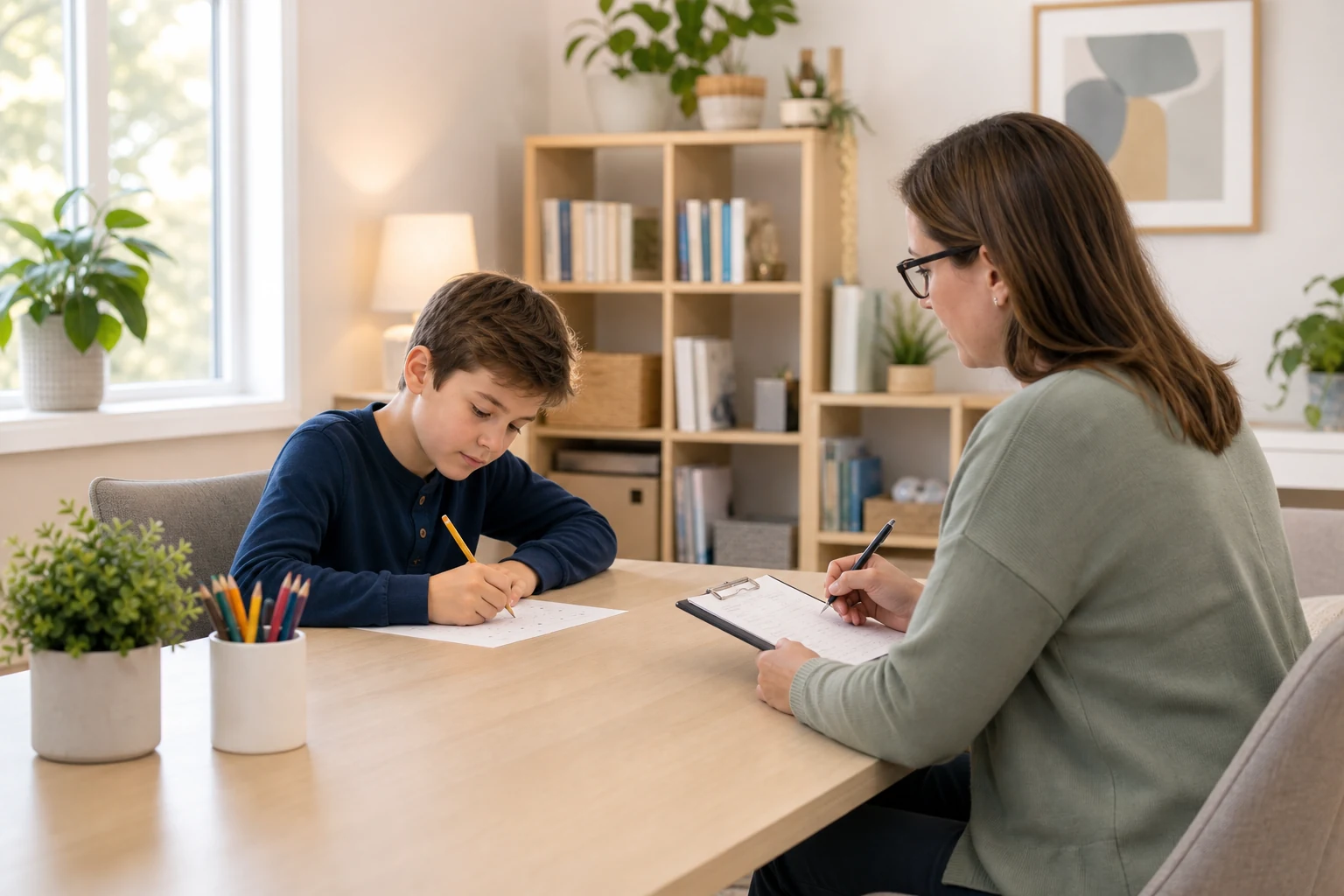
- Testing session (60–90 minutes): The child meets one-on-one with a HCPC-registered psychologist in a quiet, comfortable room. The psychologist administers the WISC-V or Stanford-Binet 5, which includes a series of subtests measuring verbal comprehension, visual-spatial reasoning, fluid reasoning, working memory, and processing speed. Breaks are offered as needed.
- Scoring and interpretation (1–2 days): The psychologist scores the test and analyses the results. They consider the child's age, background, and any relevant medical or educational history.
- Feedback session (45–60 minutes): The psychologist meets with the parents (and the child, if appropriate) to explain the results. They discuss the Full-Scale IQ, index scores, strengths, and areas for growth. They also provide tailored recommendations for home, school, and extracurriculars.
- Comprehensive written report (5–7 days): You receive a detailed report with all scores, normative comparisons, and actionable next steps. This report can be shared with schools, doctors, or other professionals.
The entire process from consultation to report usually takes 1–2 weeks, depending on scheduling. The testing itself is non-invasive and designed to be engaging for children.
What is the WISC-V test?
The WISC-V (Wechsler Intelligence Scale for Children® – Fifth Edition) is the most widely used IQ test for children aged 6:0–16:11. It provides a Full-Scale IQ and five primary index scores: Verbal Comprehension, Visual-Spatial, Fluid Reasoning, Working Memory, and Processing Speed. The test is administered one-on-one by a trained psychologist and takes about 60–90 minutes.
The WISC-V is normed on a large, representative sample of UK children and is updated regularly to ensure accuracy. It is the gold standard for gifted identification, learning disability diagnosis, and school placement.
Why test your child's IQ?
IQ testing provides valuable insights into your child's cognitive strengths and weaknesses. It can help:
- Identify giftedness: For admission to advanced-learning provisions, independent schools, or enrichment opportunities.
- Diagnose learning disabilities: Such as dyslexia, dyscalculia, or ADHD, which can be masked by high intelligence.
- Guide educational planning: Tailor instruction to your child's unique learning profile.
- Provide reassurance: Understand why your child is different from peers and how to support them.
Newry, Mourne and Down Gifted Testing Timeline
- First: define the decision the assessment must support and ask the school or programme what evidence it accepts.
- Next: identify whether the Southern Trust pathway applies; otherwise commission an appropriately registered independent psychologist whose test, age range and report scope fit the decision being made.
- Assessment day: use normal sleep, meals, medication as prescribed and an unhurried arrival; do not coach secure test items.
- After scoring: review the complete profile and confidence intervals rather than focusing only on a headline number.
- Planning: translate findings into curriculum, enrichment, wellbeing and support decisions, then revisit them as the child develops.
Newry, Mourne and Down High-Ability Provision by Age Group
- Early years: observe language, play, problem-solving and development broadly; formal IQ testing should be used only when it answers a meaningful question.
- Primary age: enrichment, reading depth, mathematics challenge and social-emotional fit may all matter alongside cognitive data.
- Secondary age: subject acceleration, examination choices, extracurricular depth and peer fit often become more useful than a broad “gifted” label.
- Post-16: Southern Regional College in Newry and other progression routes allow high-attaining students to specialise through qualifications, projects and advanced study.
- Twice-exceptional learners: high ability can coexist with ADHD, autism, dyslexia, language disorder or other needs; strengths must not be used to dismiss disability.
Newry, Mourne and Down Child ADHD and Learning Disability Assessment
Local pathways vary by age, diagnosis, funding and referral question. Relevant services and settings include:
- Daisy Hill Hospital in Newry.
- Downe Hospital in Downpatrick.
- Southern Health and Social Care Trust pathways.
- South Eastern Health and Social Care Trust pathways.
- Education Authority Educational Psychology Service.
- regional specialist neurodevelopmental services.
- Child ADHD, learning and developmental context: a cognitive battery may contribute to formulation when it answers a specific question, but it does not by itself diagnose ADHD, autism, dementia, learning disability or another condition.
- Local contact: Southern Health & Social Care Trust Newry & Mourne Community Adult Learning Disability Team, Newry, County Down BT34, 028 3025 6780. The clinic explicitly advertises intelligence and cognitive-abilities assessment; confirm the exact instrument, age range and intended report use before booking.
Newry, Mourne and Down Summer Programmes for Gifted Children
Summer enrichment in Newry, Mourne and Down is better approached through current university, college, museum, science, arts, sport and community programmes than through a fixed “gifted camp” list that can quickly become outdated.
- Newry arts and cultural programmes may create seasonal learning opportunities or related outreach.
- Southern Regional College in Newry can be checked for current youth, open-day or progression activity.
- For highly advanced pupils, subject depth and genuine interest matter more than attaching a gifted label to every activity.
Newry, Mourne and Down Child Testing Costs by Area
Private child cognitive-assessment fees in Newry, Mourne and Down vary more by psychologist time, battery, report depth and complexity than by neighbourhood. A focused UK cognitive assessment may often be in the broad planning range of £450–£900, while a broader psychoeducational or neurodevelopmental evaluation can exceed £900–£2,000.
- Newry / Downpatrick: centrality or transport convenience does not guarantee a lower fee; compare what the report includes.
- Newcastle / Kilkeel: travel charges, school liaison and extra feedback can affect the total even when the testing session price looks similar.
- Warrenpoint / Ballynahinch: in more peripheral parts of the authority, weigh travel and repeat-visit burden against the assessor’s specialist competence.
- Public pathways: council, health or education services are needs-led and eligibility-based rather than consumer alternatives to every private IQ request.
Areas we serve
This child-assessment guide is written for residents across the full Newry, Mourne and Down authority area, including its principal towns, neighbourhoods and rural communities. The footer deliberately avoids a long place-name list: service suitability depends on the assessor, referral route and required test rather than repeated geographic keywords.
Frequently Asked Questions
A focused cognitive battery often requires roughly 60–120 minutes of direct testing, while a broader evaluation can take several sessions. The psychologist should give an estimate based on age, referral question and breaks.
The Newry Trust pathway has defined eligibility and referral criteria rather than functioning as a general private clinic. For a self-funded assessment, establish the independent psychologist’s age range and test competence separately.
Possibly, but only if the exact test, edition, qualifying score, administration and documentation meet British Mensa’s current rules. Confirm those requirements before testing.
Some interviews and feedback can be remote, but many standardised cognitive tests have controlled-administration requirements. Use only a format permitted by the test publisher and accepted by the organisation receiving the report.
Prioritise normal sleep, food, prescribed medication as directed, glasses or hearing aids if used, and an unhurried arrival. Coaching on test items can undermine validity.
A good feedback session explains the score profile, limitations and practical implications. If a written report is needed, agree its intended audience and delivery date before the assessment.
Both are excellent tests. WISC-V is more commonly used for school-age children, while Stanford-Binet 5 can be used for ages 2–85. We often recommend WISC-V for gifted identification.
Direct cognitive testing often takes around 60–90 minutes, but consultation, additional measures, feedback and report preparation vary by referral question and clinician. Ask for the expected report turnaround before booking.