
IQ Testing in Victorville

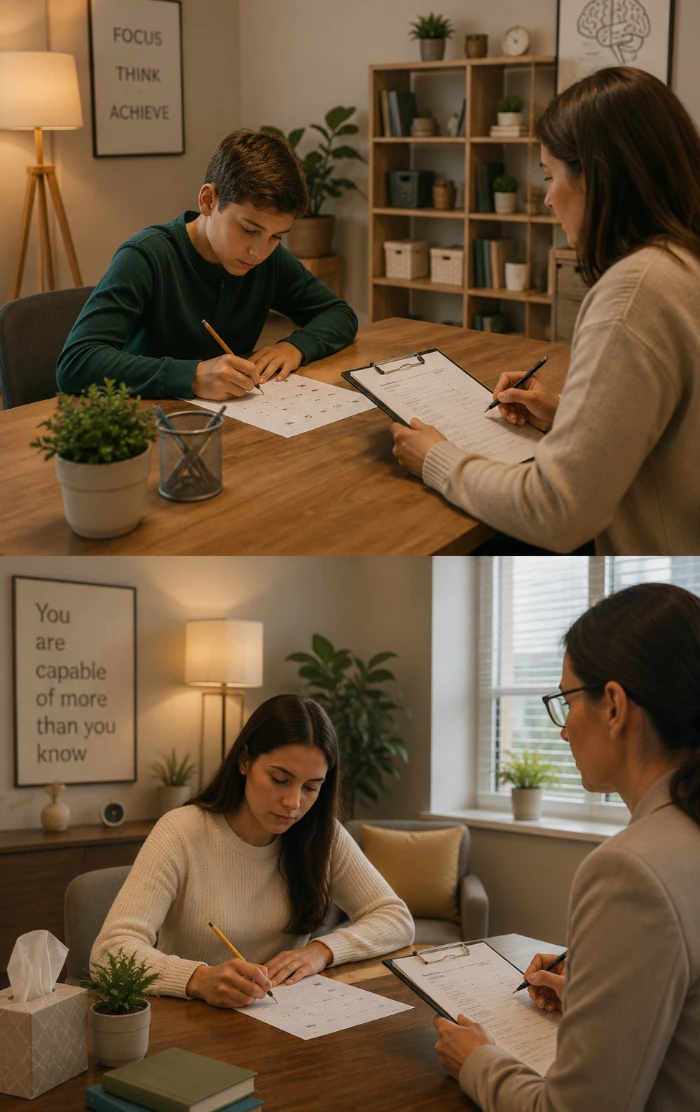
Professional IQ testing in Victorville – whether you need an assessment for school, employment, gifted program eligibility, or personal insight, we connect you with licensed psychologists in the Victorville area.
Last Updated: September 2026
Child IQ Testing
WISC-V & Stanford-Binet for ages 6–16. Gifted identification, learning profiles.
Adult IQ Testing
WAIS-IV & WAIS-5 available. Comprehensive adult cognitive assessments. Clinical & occupational.
WISC-V Test
Wechsler Intelligence Scale for Children® Fifth Edition – the gold standard for child IQ testing.
WAIS-IV & WAIS-5 Tests
Wechsler Adult Intelligence Scale® – Fourth Edition (WAIS-IV) and Fifth Edition (WAIS-5) available for adult IQ testing.
Gifted Testing
Identify giftedness for school placement, enrichment, and talent programs using WISC-V or Stanford-Binet.
Stanford-Binet 5
Stanford-Binet Intelligence Scales Fifth Edition – comprehensive cognitive assessment for all ages.
Mensa Testing
Mensa admission testing and preparation for the high-IQ society. Accepts WAIS-IV, WAIS-5, and Stanford-Binet 5 scores.
Full Evaluation
Combined assessment with detailed report and recommendations. Includes WISC-V, WAIS-IV, WAIS-5, or Stanford-Binet 5 as appropriate.
IQ Testing in Victorville: city context
Victorville is a High Desert city in San Bernardino County and a regional center for healthcare, education, retail, logistics, public service, and transportation. The Census Bureau estimated 141,395 residents in 2025, compared with 134,810 at the 2020 Census, across 73.71 square miles of land. Its location along Interstate 15 connects local families and employers with the wider Inland Empire while long commutes make provider location and scheduling especially important.
Professional cognitive assessment may support gifted or special-education questions, learning-disability and ADHD evaluation, adult diagnostic clarification, accommodations, career planning, and personal understanding. Test selection and interpretation should reflect age, education, health, disability, language history, culture, and the exact decision the report must support.
IQ by gender & ethnicity
Victorville is approximately 49.1% female. Properly normed intelligence tests are designed so broad male and female averages are similar, although individuals can show different verbal, visual-spatial, fluid-reasoning, working-memory, and processing-speed patterns. No authoritative dataset establishes separate Victorville IQ averages by sex, race, ethnicity, neighborhood, or language.
Current Victorville demographic context includes:
- Hispanic or Latino residents: 58.7%.
- Black residents: 15.5% identify as Black alone.
- Asian residents: 4.1% identify as Asian alone.
- American Indian and Alaska Native residents: 1.4% identify in this category alone.
- White, non-Hispanic residents: 18.3%.
- Two or more races: 30.1%.
- Foreign-born residents: 19.4%.
- Language other than English at home: 43.2% of residents age five and older.
- Educational attainment: 79.1% of adults age 25+ are high-school graduates or higher, and 12.8% hold a bachelor's degree or higher.
Group percentages must never be used to predict an individual's ability. A qualified psychologist considers language proficiency, schooling, developmental and medical history, behavioral observations, referral purpose, and the limits of test norms.
What is professional IQ testing?
Intelligence quotient (IQ) testing is a standardized method to measure human cognitive abilities and intellectual potential. Professional IQ tests are administered by licensed psychologists in a controlled environment to ensure accuracy and reliability. Unlike online quizzes, clinical assessments provide a full-scale IQ score along with detailed breakdowns of verbal comprehension, perceptual reasoning, working memory, and processing speed.
In Victorville, IQ testing is commonly used for gifted program admission, learning disability identification, career guidance, neuropsychological evaluation, and personal development. The results are presented in a comprehensive report that includes normative comparisons, strengths and weaknesses, and actionable recommendations.
Who should get tested?
IQ testing can benefit children, adolescents, and adults in various situations:
- Children: Parents often seek testing for school readiness, gifted placement, or to understand learning challenges.
- Adults: Many adults take IQ tests for career advancement, graduate school applications, or personal curiosity.
- Mensa candidates: High-IQ societies require official test scores for membership.
- Clinical referrals: Psychologists may recommend testing as part of a broader neuropsychological evaluation.
Types of IQ tests
We offer the most recognized and scientifically validated intelligence tests in the field:
- WISC-V (Wechsler Intelligence Scale for Children® – Fifth Edition): The gold standard for children aged 6:0–16:11. It provides a Full-Scale IQ and five primary index scores.
- WAIS-IV (Wechsler Adult Intelligence Scale® – Fourth Edition): The most widely used adult IQ test for ages 16–90. It measures cognitive functioning across four domains.
- Stanford-Binet Intelligence Scales – Fifth Edition: A comprehensive assessment for ages 2–85, often used for gifted identification and clinical evaluations.
- Gifted Testing: Often includes the WISC-V or Stanford-Binet, plus additional creativity and achievement measures.
- Mensa Testing: We provide official Mensa admission testing and preparation materials.
How the testing process works
- Initial consultation: Brief phone or video call to discuss your needs and match you with the right psychologist.
- Testing session: In-person or remote testing (depending on the test) with a licensed psychologist. Most sessions last 1–2 hours.
- Scoring and interpretation: The psychologist scores the test and interprets the results in the context of your background and goals.
- Feedback session: A detailed review of your results, including strengths, weaknesses, and practical recommendations.
- Comprehensive report: You receive a written report with all scores, normative comparisons, and actionable next steps.
How much does IQ testing cost in Victorville?
The cost of IQ testing in Victorville varies depending on the type of test, the psychologist's experience, and whether a comprehensive report is required. Typical fees range from $200 to $1,200 for a full assessment. Gifted testing and Mensa admission testing are often at the lower end, while neuropsychological evaluations may be higher.
Some insurance plans cover IQ testing when it's deemed medically necessary. We recommend checking with your provider for details. We also offer affordable payment plans and sliding-scale options for qualifying individuals.
On a quiet High Desert evening, a curious resident might try an online IQ test as a reasoning exercise, while reserving professional assessment for decisions requiring standardized, individually interpreted evidence.
Victorville's Intellectual History & Legacy
Victorville's development is tied to Indigenous history, Route 66, rail and highway transportation, George Air Force Base, High Desert settlement, and the growth of regional public services. The former base evolved into Southern California Logistics Airport, linking aviation and logistics with local workforce development.
Victor Valley College, local school districts, San Bernardino County Library services, the California Route 66 Museum, healthcare systems, and nearby university pathways contribute to education and applied learning. Regional institutions should be described as accessible from Victorville rather than falsely presented as being inside city limits.
Victorville Employment and Assessment Context
Routine employment generally does not require a clinical IQ test. Employers may use lawful skills tests, licensing examinations, safety evaluations, or job-specific aptitude measures. Clinical cognitive assessment is more commonly used for diagnosis, rehabilitation, disability documentation, accommodations, or career planning.
- Healthcare: Desert Valley Hospital, local clinics, and regional medical systems employ clinical, technical, rehabilitation, and administrative teams.
- Education and government: Local school districts, Victor Valley College, the City of Victorville, San Bernardino County, and public-safety agencies support varied professional roles.
- Logistics and aviation: Southern California Logistics Airport, distribution centers, trucking, warehousing, and Interstate 15 commerce rely on planning, safety, and technical skills.
- Retail and hospitality: Victorville is a High Desert shopping and service center.
- Construction and utilities: Population growth creates work in building, infrastructure, engineering, maintenance, and skilled trades.
IQ Testing Access Across Victorville
No credible evidence supports neighborhood-level IQ averages. Practical differences concern travel time, school district, provider availability, language access, and proximity to healthcare.
- Civic Center and central Victorville: Concentrates government, professional offices, transit connections, and community services.
- Old Town and Route 66 corridor: Established commercial and residential areas with regional bus access.
- West and southwest Victorville: Growing neighborhoods near US 395 and Interstate 15 require careful commute planning.
- Spring Valley Lake vicinity and eastern areas: Residents may compare providers in Victorville with nearby Apple Valley while verifying the exact office city.
- North Victorville and airport corridor: Logistics, aviation, and dispersed development can lengthen appointment travel.
Victorville Education and Regional Research Institutions
- Victor Valley College: A community college in nearby Victor Valley supporting transfer, career education, nursing, public safety, and workforce pathways.
- California State University, San Bernardino: A regional public university offering undergraduate and graduate programs, research, and disability-support services.
- University of La Verne High Desert programs: Program availability and location should be confirmed directly.
- Victor Valley Union High School District and local elementary districts: School psychologists evaluate eligible students through public-school procedures.
- Desert Valley Hospital and regional medical systems: Clinical services may generate referrals for cognitive or neuropsychological questions.
Victorville Economic Context
- Median household income: $74,410 in 2020–2024 Census estimates.
- Per-capita income: $28,578.
- Residents in poverty: 18.4%.
- Bachelor's degree or higher: 12.8% of adults age 25 and older.
- Mean travel time to work: 40.4 minutes, reflecting substantial regional commuting.
- Healthcare and social assistance: Approximately $978.5 million in 2022 city receipts/revenue.
- Transportation and warehousing: Approximately $407.7 million in 2022 receipts/revenue.
- Retail sales: Approximately $2.95 billion in 2022.
- Accommodation and food services: Approximately $364.7 million in 2022 sales.
- Labor-force participation: 56.9% overall and 54.5% among women age 16 and older.
- Housing: 60.6% owner occupancy, $385,600 median owner value, and $1,618 median gross rent.
- Regional strengths: Logistics, aviation, healthcare, education, government, retail, construction, transportation, utilities, public safety, and High Desert services.
Victorville School District Context
- District structure: Victorville students may attend Victor Elementary School District, Victor Valley Union High School District, Adelanto Elementary School District, Oro Grande School District, or charter/private programs depending on address and enrollment.
- Gifted and advanced learning: California districts set local identification and service procedures; one online score cannot establish placement.
- Special education: School teams evaluate suspected disabilities under applicable state and federal procedures, with parental consent and multidisciplinary evidence.
- Outside reports: Confirm whether a district accepts a private report and which examiner credentials, tests, dates, and supporting records are required.
- Language: Assessment should consider English proficiency, dominant language, instructional history, and opportunity to learn.
- Accommodations: A report may inform an IEP, Section 504 plan, college request, or testing-agency application, but the receiving organization decides eligibility.
Local Testing Centers and Psychologists
- Mischka Psychological: A licensed psychologist-led Victorville practice specializing in psychological testing. Its current official contact page lists 15428 Civic Drive, Suite 320, Victorville, CA 92392 and (760) 885-0384. Call to confirm whether the practice currently offers the precise IQ instrument, age range, report format, and documentation required for your purpose.
- Magnolia Psychological Assessment & Therapy Center: A Victorville practice advertising comprehensive psychological assessments; confirm test types and licensed supervision directly.
- Desert Valley Hospital and regional medical providers: Medical or neurological concerns may require referral through an appropriate specialty rather than stand-alone IQ testing.
- School psychologists: Local districts evaluate eligible students through school procedures when educational concerns meet referral requirements.
- Verification: Confirm California licensure, examiner qualifications, language competence, test edition, in-person requirements, fees, turnaround, and acceptance by the receiving organization.
Victorville Learning and Professional Events
- Victor Valley College: Public lectures, career programs, workshops, arts events, and student activities vary by term.
- San Bernardino County Library: Victorville-area programming may include literacy, technology, youth, and adult-learning activities.
- California Route 66 Museum: Local history and transportation exhibits support community learning.
- School-district family events: Current calendars may include special-education, college, career, and parent information sessions.
- California Psychological Association: State professional education covers assessment, ethics, neuropsychology, diversity, and practice.
- American Mensa regional activities: Verify local-group boundaries, events, and current score-documentation rules directly.
Transportation and Accessibility
- Major roads: Interstate 15, US 395, State Route 18, Route 66/D Street, Bear Valley Road, Palmdale Road, and Mojave Drive.
- Transit: Victor Valley Transit Authority operates regional bus and paratransit services; check current routes and eligibility.
- Rail: Victor Valley Transportation Center serves local and intercity connections, while schedules and operators can change.
- Airport: Southern California Logistics Airport is an aviation and logistics facility rather than a routine commercial passenger airport.
- Congestion: Interstate 15 and major arterials can slow during commuter peaks, holiday travel, crashes, construction, and severe weather.
- Accessibility: Confirm accessible parking, entrances, elevators, interpreter needs, sensory accommodations, and paratransit timing.
- Appointment planning: Allow extra time when traveling from Apple Valley, Hesperia, Adelanto, Barstow, or mountain communities.
Victorville Weather and Seasonal Considerations
- High Desert climate: Hot, dry summers, cool winters, large day-night temperature swings, low humidity, and strong sun are typical.
- Wind and dust: Strong winds and blowing dust can reduce visibility and affect respiratory comfort or travel.
- Heat: Summer heat can affect sleep, hydration, comfort, and concentration; use climate-controlled testing rooms.
- Winter: Cold mornings, occasional snow or ice, and mountain-pass conditions can disrupt regional travel.
- Wildfire smoke: Regional fires may affect air quality even when flames are distant.
- School deadlines: Gifted, accommodation, and admissions evaluations may book quickly; confirm current requirements early.
- Preparation: Adequate sleep, hydration, a normal meal, prescribed medication taken as directed, and unhurried arrival are more useful than coaching.
Areas we serve
We support all areas of Victorville.
Frequently Asked Questions
WISC-V is for children aged 6–16, while WAIS-IV is for adults aged 16–90. Each is normed for its specific age group.
Most IQ tests take between 60 and 90 minutes, plus a feedback session. Allow 2–3 hours total.
No, you can book directly with our psychologists. We serve both self-referred and professionally referred individuals.
Potentially. Acceptance depends on the exact test, edition, qualifying score, administration date, examiner credentials, and current Mensa documentation rules. Confirm before testing.
Some plans cover cognitive assessments when there is a clinical indication. Check with your provider.
Get a good night's sleep, eat a healthy meal, and arrive relaxed. No specific preparation is needed.
You'll receive a comprehensive report with your scores and tailored recommendations.
Some interview and feedback components may be available remotely, but many standardized cognitive tests require in-person administration. Confirm with the psychologist and the organization receiving the report.