
Full Evaluation in Tulsa

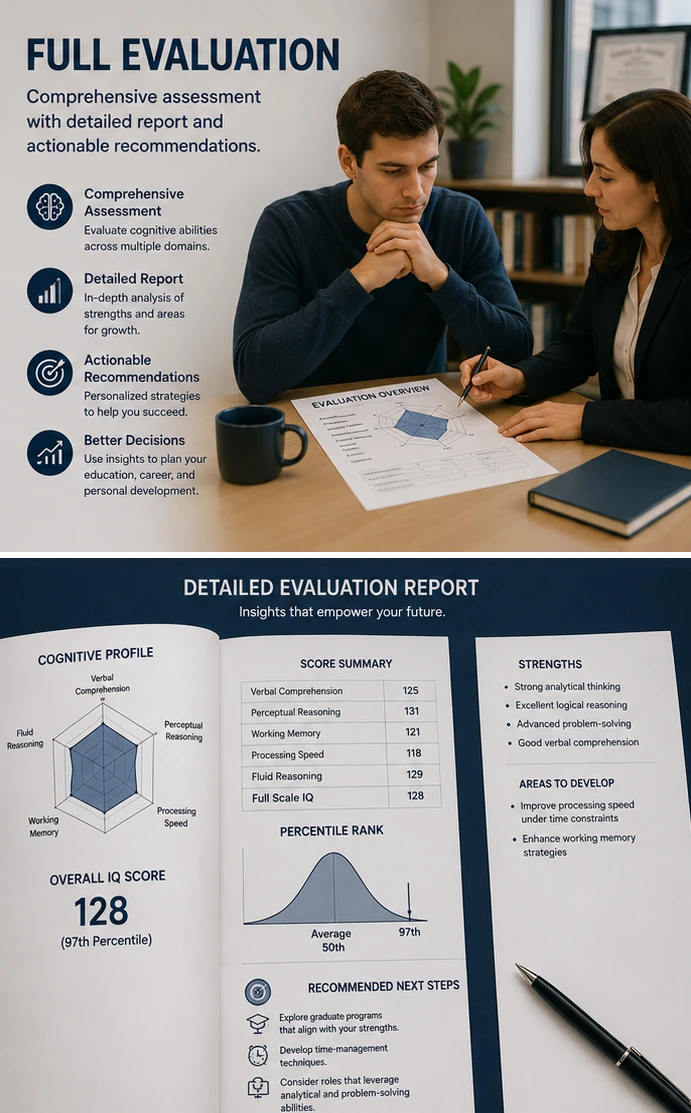
A full evaluation is a comprehensive psychological and psychoeducational assessment that goes beyond a single IQ test. It provides a detailed picture of your cognitive, academic, emotional, and behavioral functioning, with actionable recommendations for academic planning, career development, or clinical intervention.
Last Updated: July 2026
Child IQ Testing
WISC-V & Stanford-Binet 5 for ages 6–16. Gifted identification, learning profiles.
Adult IQ Testing
WAIS-IV & WAIS-5 available. Comprehensive adult cognitive assessments for clinical and occupational purposes.
WAIS-IV & WAIS-5 Tests
Wechsler Adult Intelligence Scale® – Fourth Edition (WAIS-IV) and Fifth Edition (WAIS-5) – the gold standard for adult IQ testing.
Gifted Testing
Identify giftedness for school placement, enrichment, and talent programs using WISC-V or Stanford-Binet 5.
Mensa Testing
Testing that may provide qualifying evidence for Mensa admission and preparation for the high-IQ society. American Mensa's published prior-evidence list includes WAIS-IV and Stanford-Binet 5; verify current acceptance of WAIS-5 before testing.
Schedule Full Evaluation
Book your comprehensive assessment with detailed report and recommendations for academic planning. Includes WISC-V, WAIS-IV, WAIS-5, or Stanford-Binet 5 as appropriate, with a licensed psychologist in Tulsa today.
What is a Full Evaluation?
A full evaluation is a comprehensive psychological and psychoeducational assessment that provides a complete picture of your cognitive, academic, emotional, and behavioral functioning. Unlike a single IQ test, which focuses only on cognitive abilities, a full evaluation includes multiple tests and assessments to provide a holistic understanding of your strengths and challenges.
Full evaluations are typically conducted by licensed psychologists and can take anywhere from 2 to 6 hours of testing time, often spread across multiple sessions.
What a Full Evaluation Includes
- Cognitive Assessment (IQ testing): WISC-V (children), WAIS-IV or WAIS-5 (adults), or Stanford-Binet 5 to measure intellectual abilities
- Academic Achievement Testing: Measures reading, writing, math, and other academic skills
- Behavioral and Emotional Assessment: Questionnaires and interviews to assess emotional well-being, social functioning, and behavioral patterns
- Executive Functioning Assessment: Measures attention, planning, organization, and self-regulation
- Clinical Interview: Detailed interview to understand personal history, concerns, and goals
- Comprehensive Report: Detailed findings with scores, interpretations, and actionable recommendations
Full Evaluation vs. Single IQ Test
| Feature | Full Evaluation | Single IQ Test |
|---|---|---|
| What's Measured | Cognitive, academic, emotional, behavioral | Cognitive abilities only |
| Testing Time | 2-6 hours (often multiple sessions) | 45-90 minutes |
| Tests Included | IQ test + achievement tests + emotional/behavioral assessments | Single IQ test (e.g., WISC-V, WAIS-IV, WAIS-5, SB-5) |
| Report | Comprehensive, multi-page report with detailed recommendations | Shorter report with IQ scores and basic interpretation |
| Best For | Complex cases, learning disabilities, ADHD, emotional concerns, legal documentation | Gifted identification, school placement, Mensa |
| Cost Range | $1,200-$3,000 | $200-$1,200 |
When Is a Full Evaluation Recommended?
A full evaluation is recommended in several situations:
- Learning disabilities: Suspected dyslexia, dyscalculia, dysgraphia, or other learning disorders
- ADHD: Attention deficit hyperactivity disorder diagnosis and treatment planning
- Giftedness with learning challenges (2E): Twice-exceptional children who are both gifted and have learning disabilities
- Autism assessment: Comprehensive evaluation for autism spectrum disorder
- Educational planning: For Individualized Education Programs (IEPs) or 504 plans
- Legal documentation: For court cases, disability claims, or special education advocacy
- Mental health concerns: Anxiety, depression, or other emotional challenges affecting academic or occupational functioning
- College accommodations: Documentation for accommodations on college entrance exams (SAT, ACT, GRE) or in college settings
Tulsa Hospitals and Clinical Resources Offering Evaluations
Hospital systems and private practices differ in age range, referral requirements, insurance participation, and whether they provide full neuropsychological, psychological, developmental, or educational evaluations.
Saint Francis Health System
Saint Francis provides broad adult and pediatric medical services. Neurology, rehabilitation, developmental, behavioral-health, and specialty clinics may refer for cognitive or neuropsychological assessment when medically necessary.
The Children's Hospital at Saint Francis
Pediatric specialty services can support referrals involving neurological conditions, genetic disorders, developmental differences, rehabilitation, serious illness, school functioning, or complex behavioral presentations.
Hillcrest HealthCare System
Hillcrest hospitals and specialty services may coordinate cognitive or neuropsychological referrals for neurological, rehabilitation, medical, or functional concerns.
Ascension St. John
Ascension St. John provides hospital, neurological, rehabilitation, and specialty care. Evaluation availability depends on the clinic and referral question.
OSU Medicine, Laureate, and VA Resources
OSU Center for Health Sciences, OSU Medicine, Laureate Psychiatric Clinic and Hospital, and the Ernest Childers VA Outpatient Clinic provide medical or behavioral-health services that may include assessment or referral pathways.
Private-Practice Psychologists and Neuropsychologists
Private providers may offer comprehensive ADHD, learning, autism, disability, neuropsychological, forensic, gifted, or school-placement evaluations. Verify Oklahoma licensure, specialty training, age range, report format, insurance policies, and intended-recipient requirements.
Tulsa Evaluation Costs by Provider Type
- Hospital-based neuropsychology: Often billed through medical insurance when medically necessary and authorized.
- Private comprehensive evaluation: Fees reflect interview, records, multiple tests, scoring, report writing, feedback, and coordination.
- School evaluation: Available without charge when the public-school team determines an evaluation is warranted.
- Gifted or admissions testing: Usually self-pay because the purpose is educational placement rather than medical diagnosis.
- Forensic evaluation: May require retainers, record review, collateral interviews, court testimony, and higher hourly fees.
- University or training clinics: May offer lower-cost services, but scope, waitlists, supervision, and documentation acceptance vary.
- Written estimate: Ask what is included and whether additional testing, feedback, school meetings, or record review costs extra.
Tulsa Legal and Forensic Evaluations
- Tulsa County District Court: Guardianship, competency, custody, disability, juvenile, criminal, and civil matters may require specialized evaluations.
- Federal proceedings: The Northern District of Oklahoma may involve disability, competency, employment, or other forensic questions.
- Workers' compensation and disability: Evaluators may address cognitive effects, causation, functional capacity, and records consistency.
- School disputes: Independent educational evaluations and special-education matters require knowledge of federal and Oklahoma procedures.
- Not therapy: Forensic evaluators answer legal questions and may not provide confidential treatment.
- Credentials: Use a psychologist with relevant forensic training and confirm who is retaining the evaluator and receiving the report.
Tulsa Evaluation Timeline and Process
- Referral clarification: Define the exact diagnostic, educational, medical, occupational, or legal question.
- Records: Gather school, medical, employment, prior-testing, and legal documents before testing.
- Authorization: Hospital and insurance-based evaluations may require physician referral or prior authorization.
- Testing: Comprehensive assessment may require one long day or multiple shorter sessions.
- Collateral information: Parent, partner, teacher, employer, or caregiver input may be necessary.
- Report preparation: Complex reports can take several weeks after all data are received.
- Feedback: The evaluator explains diagnoses, strengths, limitations, recommendations, and next steps.
- Deadline planning: Begin early for school, court, disability, licensing, or accommodation deadlines.
Tulsa Insurance Coverage for Evaluations
- Medical necessity: Coverage is more likely for neurological, developmental, or psychiatric diagnostic questions than for curiosity, giftedness, or admissions.
- Network status: Verify the psychologist, facility, and billing entity separately.
- Prior authorization: Ask whether referral, authorization, or utilization review is required.
- Excluded services: Educational, forensic, employment, and court-ordered evaluations are frequently excluded.
- Deductible and coinsurance: A covered service can still create substantial out-of-pocket cost.
- Superbills: Out-of-network private practices may provide documentation for reimbursement without guaranteeing payment.
Tulsa Evaluation Referrals
- Primary-care and specialty physicians: May refer for neurological, developmental, rehabilitation, or medical questions.
- Schools: Teachers, counselors, psychologists, and special-education teams may recommend school-based or private evaluation.
- Attorneys and courts: May retain forensic specialists for specific legal questions.
- Universities and testing agencies: May request updated documentation for accommodations.
- Self-referral: Many private psychologists accept direct inquiries for ADHD, learning, gifted, career, or personal questions.
- Best fit: Match the provider's specialty, age range, test battery, and report to the intended use.
Benefits of a Full Evaluation
- Complete picture: Understand the full picture of your or your child's functioning – cognitive, academic, emotional, and behavioral
- Accurate diagnosis: Receive precise diagnoses for learning disabilities, ADHD, autism, or other conditions
- Legal documentation: Obtain documentation for IEPs, 504 plans, college accommodations, disability claims, or court cases
- Personalized recommendations: Receive tailored recommendations for academic planning, career development, therapy, or treatment
- Peace of mind: Understand your or your child's strengths and challenges and how to address them effectively
- Long-term planning: Use the findings for educational, career, and personal planning
Full Evaluations in Tulsa
- Children: Giftedness, learning disabilities, ADHD, autism, developmental concerns, school placement, and twice exceptionality.
- Adults: ADHD, learning history, autism, disability, career, graduate accommodations, and diagnostic clarification.
- Neurological referrals: Brain injury, stroke, epilepsy, tumors, dementia, movement disorders, or medical treatment effects.
- Veterans: Evaluation or referral through VA resources when eligibility and clinical need are established.
- School systems: TPS, Union, Jenks, Broken Arrow, Bixby, Owasso, Sand Springs, Sapulpa, and private schools maintain different procedures.
- Clinical systems: Saint Francis, Hillcrest, Ascension St. John, OSU Medicine, Laureate, and private practices cover different scopes.
- Clinical interview: Developmental, medical, educational, occupational, family, psychiatric, sleep, and substance-use history.
- Cognitive assessment: Overall reasoning plus verbal, visual-spatial, fluid-reasoning, working-memory, and processing-speed domains.
- Academic achievement: Reading, writing, mathematics, oral language, fluency, and foundational processing skills when relevant.
- Memory: Verbal and visual learning, delayed recall, recognition, and prospective-memory tasks.
- Attention: Sustained, selective, divided, and shifting attention using history, ratings, and performance measures.
- Executive functioning: Planning, inhibition, flexibility, organization, problem solving, and self-monitoring.
- Language: Receptive, expressive, naming, fluency, and pragmatic skills when indicated.
- Visual-motor skills: Construction, fine-motor speed, graphomotor output, and visual integration when relevant.
- Adaptive behavior: Communication, daily living, socialization, community use, and practical independence.
- Autism measures: Developmental interview, observation, social communication, sensory, and restricted-interest data when indicated.
- Emotional functioning: Anxiety, depression, trauma, personality, behavioral regulation, and coping.
- Performance validity: Measures of engagement and consistency help determine whether scores are interpretable.
- Collateral interviews: Parents, partners, teachers, employers, or caregivers may provide essential context.
- Differential diagnosis: The evaluator compares competing explanations rather than assuming the referral diagnosis is correct.
- Functional impact: Diagnoses should be connected to real-world limitations at school, work, home, or in the community.
- Accommodation recommendations: Must be specific, evidence-based, and linked to documented impairment.
- Treatment planning: Reports may guide medication consultation, psychotherapy, rehabilitation, tutoring, speech-language care, or occupational therapy.
- Safety planning: Urgent psychiatric, neurological, abuse, or self-harm concerns require appropriate clinical response.
- Cultural formulation: Language, tribal identity, race, ethnicity, migration, education, and socioeconomic context affect interpretation.
- Technology: Computerized testing can supplement but does not replace clinical judgment and standardized administration.
- Telehealth limits: Remote components must comply with Oklahoma law, test-publisher rules, security standards, and the intended recipient's requirements.
- Data retention: Ask how protocols, raw data, and reports are stored and released.
- Reevaluation: Timing depends on developmental stage, condition, treatment, school transition, and documentation rules.
Frequently Asked Questions
A full evaluation typically includes cognitive testing (IQ), academic achievement testing, behavioral and emotional assessments, a clinical interview, and a comprehensive written report with recommendations.
Testing typically takes 2-6 hours, often spread across 2-3 sessions. The entire process from consultation to receiving the report usually takes 2-4 weeks.
The report includes background information, test scores, normative comparisons, interpretation of findings, diagnostic impressions (if applicable), and actionable recommendations for academic planning, treatment, or accommodations.
No. A full evaluation is much more comprehensive and includes cognitive testing, academic testing, emotional/behavioral assessments, and a clinical interview. An IQ test only measures cognitive abilities.
Some insurance plans cover full evaluations when they are deemed medically necessary. Coverage varies by plan and provider. We recommend checking with your insurance provider.
Yes. A full evaluation provides the documentation needed for college accommodations, including extended time on exams, note-taking assistance, and other academic support services.
Some components of a full evaluation can be done via telehealth, but many tests (especially cognitive and achievement tests) require in-person administration for accurate scoring. Contact us for details.
Get a good night's sleep, eat a healthy meal, and arrive relaxed. Bring any relevant documents (previous evaluations, school records, medical history). No specific preparation is needed for the tests themselves.
Fees vary widely with the scope of the evaluation, number of sessions, records reviewed, and report requirements. Insurance coverage depends on medical necessity and the plan; request a written estimate.
Yes. A full evaluation provides the comprehensive documentation needed to qualify for IEPs, 504 plans, and other educational accommodations in Tulsa Public Schools and other districts.