
Child IQ Testing in Tulsa

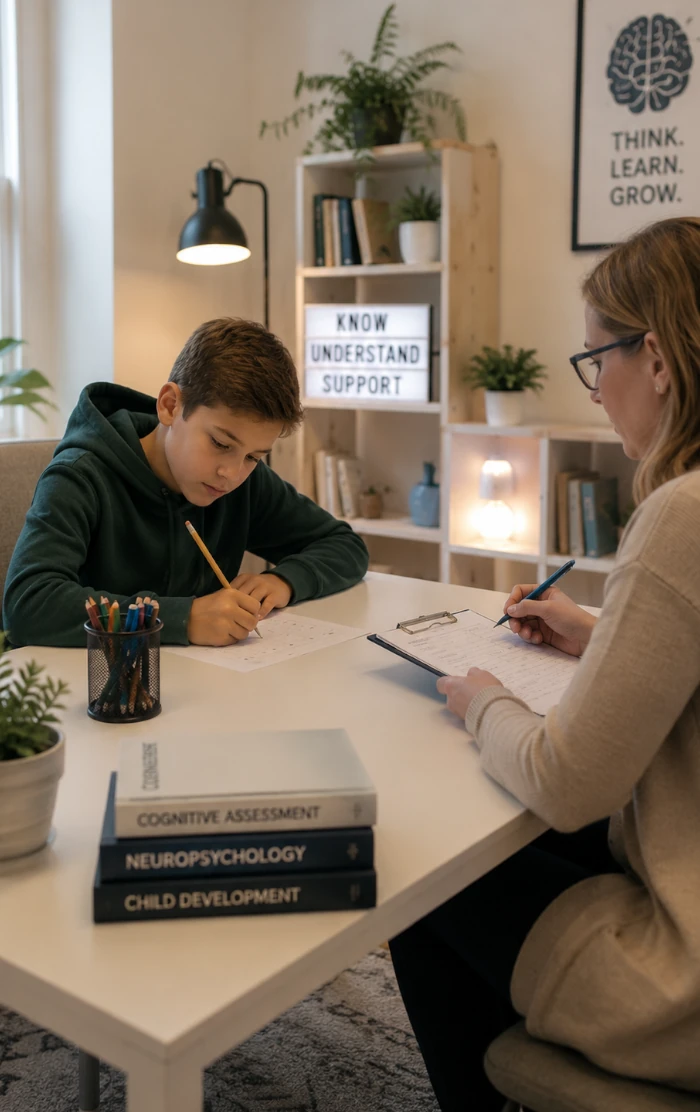
Professional child IQ testing in Tulsa – whether you need an assessment for school placement, gifted program eligibility, or to understand your child's learning profile, we connect you with licensed psychologists in the Tulsa area.
Last Updated: July 2026
Gifted Testing
Identify giftedness for school placement, enrichment, and talent programs using WISC-V or Stanford-Binet 5.
WISC-V Test
Wechsler Intelligence Scale for Children® Fifth Edition – the gold standard for child IQ testing.
Stanford-Binet 5
Stanford-Binet Intelligence Scales Fifth Edition – comprehensive cognitive assessment for all ages.
Full Evaluation
Combined assessment with detailed report and recommendations. Includes WISC-V or Stanford-Binet 5.
School Placement Testing
Testing for private school admission and gifted program eligibility using WISC-V or Stanford-Binet 5.
Schedule Child IQ Testing
Book your WISC-V & Stanford-Binet 5 for ages 6–16. Gifted identification, learning profiles, etc. with a licensed psychologist in Tulsa today.
Child IQ Testing in Tulsa: city context
Tulsa is the principal city of northeastern Oklahoma's Green Country region. The U.S. Census Bureau estimated 416,209 residents in 2025, up from 413,066 counted in 2020. The city covers approximately 197.53 square miles of land and serves as a regional center for healthcare, aerospace, energy, finance, education, logistics, advanced manufacturing, and professional services.
Local assessment resources include The University of Tulsa, Oklahoma State University–Tulsa, Oklahoma State University Center for Health Sciences, Oral Roberts University, Tulsa Community College, Saint Francis Health System, Hillcrest HealthCare System, Ascension St. John, the Ernest Childers VA Outpatient Clinic, school psychology teams, and licensed private practices. These resources support cognitive assessment, gifted identification, learning-disability evaluation, disability documentation, career guidance, and neuropsychological care.
IQ, gender, and demographic context (child population)
Professional IQ tests use age-based national norms. They are not scored against a separate Tulsa norm for men, women, racial groups, ethnic groups, or neighborhoods. Research generally finds substantial overlap in overall IQ distributions by sex, while individual profiles can differ across verbal comprehension, visual-spatial reasoning, fluid reasoning, working memory, and processing speed.
Current Tulsa Census context:
- Female residents: 50.9% of the city population.
- Children and adolescents: 24.1% of residents are under age 18, making school-based and pediatric assessment an important local need.
- Older adults: 15.3% are age 65 or older, relevant to memory, neurological, disability, and capacity evaluations.
- Racial and ethnic diversity: Census estimates report 54.4% White alone, 14.0% Black alone, 4.2% American Indian or Alaska Native alone, 3.5% Asian alone, 17.1% two or more races, and 19.8% Hispanic or Latino.
- Language context: 20.7% of residents age five and older speak a language other than English at home; evaluators should consider language dominance, interpreter needs, acculturation, and test validity.
- Foreign-born residents: 12.3%, reinforcing the importance of culturally and linguistically informed assessment.
- Educational attainment: 87.6% of adults age 25 and older are high-school graduates and 33.6% hold a bachelor's degree or higher.
- Disability context: 11.8% of residents under age 65 report a disability, a reminder that cognitive scores should be interpreted alongside adaptive functioning, health, and access needs.
No authoritative public dataset establishes valid Tulsa IQ averages by gender, race, ethnicity, or neighborhood. A psychologist interprets an individual's results in light of age, education, language, culture, disability, health, effort, and testing conditions rather than assigning ability from demographic membership.
Tulsa School Districts and Gifted Programs
Tulsa-area families must follow the rules of the district or school that will use the results. Referral windows, universal screening, accepted tests, qualifying criteria, transfer policies, service models, and appeals procedures can change.
Tulsa Public Schools Gifted and Talented Education
- Identification: TPS uses district procedures and multiple sources of evidence to identify students for gifted services.
- Referrals: Parents, teachers, students, and school teams should confirm the current referral process and deadlines.
- Services: Options may include classroom differentiation, enrichment, advanced courses, magnet/application programs, acceleration, and secondary AP or IB pathways.
- Outside testing: A private WISC-V or Stanford-Binet report may provide useful evidence but does not automatically require district placement.
- Application programs: Booker T. Washington, Carver, Edison Preparatory, and other programs maintain separate application or placement requirements.
Union Public Schools Gifted and Advanced Programs
- Service area: Union serves portions of east and southeast Tulsa as well as nearby communities.
- District rules: Identification, reassessment, transfer, acceleration, and advanced-course procedures are controlled by Union rather than TPS.
- Planning: Families should request written criteria before paying for private testing.
Jenks Public Schools Gifted and Advanced Learning
- South Tulsa access: Some south Tulsa addresses are within Jenks Public Schools.
- Advanced pathways: Gifted services, honors, AP, concurrent enrollment, and acceleration vary by grade and current district policy.
- Documentation: The district determines whether outside evaluations are accepted and how they are weighed.
Broken Arrow Public Schools Gifted Services
- Large metro district: Broken Arrow serves a substantial student population east of Tulsa.
- Separate procedures: Identification calendars, tests, service delivery, and appeals are distinct from TPS.
- Transfer students: Families moving between districts should ask how prior gifted identification is reviewed.
Bixby, Owasso, Sand Springs, Sapulpa, Berryhill, and Other Metro Districts
- Local control: Each district maintains its own gifted plan within Oklahoma requirements.
- Common evidence: Ability, achievement, classroom performance, creativity, motivation, rating scales, and other data may be considered.
- Private reports: Confirm accepted test versions, recency, psychologist credentials, and required score detail.
- Appeals and reassessment: Ask for current district procedures in writing.
Tulsa Private Schools and Testing Requirements
- Holland Hall: Independent-school admissions may include records, recommendations, interviews, visits, and school-selected measures; verify current requirements.
- Cascia Hall Preparatory School: Admissions and placement standards vary by grade and year.
- Riverfield Country Day School: Families should ask which cognitive, achievement, or developmental reports are accepted.
- Monte Cassino, Bishop Kelley, Regent Preparatory, Metro Christian, and other schools: Each school sets separate admissions and accommodation procedures.
- No universal test: There is no single IQ test accepted by every Tulsa private school.
- Best practice: Obtain the school's exact test name, age limits, report requirements, deadline, and recency rule before scheduling.
Tulsa Gifted Identification Statistics
- Child population: 24.1% of Tulsa residents are under age 18.
- No valid citywide testing rate: Public data do not show what percentage of Tulsa children receive private IQ testing.
- No neighborhood IQ averages: School and Census data cannot support neighborhood-level intelligence estimates.
- District counts change: Gifted enrollment depends on identification rules, mobility, service definitions, and annual reporting.
- Equity: Language, disability, opportunity, referral patterns, and test access can affect who is identified.
- Interpretation: A high score is one data point; educational need, achievement, creativity, motivation, and social-emotional factors also matter.
The child IQ testing process: step by step
Understanding the testing process can help parents prepare their child and reduce anxiety. Here's what to expect:
- Initial consultation (15–20 minutes): A brief phone or video call with the psychologist to discuss your child's background, concerns, and goals. This helps determine the right test and approach.
- Testing session (60–90 minutes): The child meets one-on-one with a licensed psychologist in a quiet, comfortable room. The psychologist administers the WISC-V or Stanford-Binet 5, which includes a series of subtests measuring verbal comprehension, visual-spatial reasoning, fluid reasoning, working memory, and processing speed. Breaks are offered as needed.
- Scoring and interpretation (1–2 days): The psychologist scores the test and analyzes the results. They consider the child's age, background, and any relevant medical or educational history.
- Feedback session (45–60 minutes): The psychologist meets with the parents (and the child, if appropriate) to explain the results. They discuss the Full-Scale IQ, index scores, strengths, and areas for growth. They also provide tailored recommendations for home, school, and extracurriculars.
- Comprehensive written report (5–7 days): You receive a detailed report with all scores, normative comparisons, and actionable next steps. This report can be shared with schools, doctors, or other professionals.
The entire process from consultation to report usually takes 1–2 weeks, depending on scheduling. The testing itself is non-invasive and designed to be engaging for children.
What is the WISC-V test?
The WISC-V (Wechsler Intelligence Scale for Children® – Fifth Edition) is the most widely used IQ test for children aged 6:0–16:11. It provides a Full-Scale IQ and five primary index scores: Verbal Comprehension, Visual-Spatial, Fluid Reasoning, Working Memory, and Processing Speed. The test is administered one-on-one by a trained psychologist and takes about 60–90 minutes.
The WISC-V is normed on a large, representative sample of U.S. children and is updated regularly to ensure accuracy. It is the gold standard for gifted identification, learning disability diagnosis, and school placement.
Why test your child's IQ?
IQ testing provides valuable insights into your child's cognitive strengths and weaknesses. It can help:
- Identify giftedness: For admission to gifted programs, private schools, or enrichment opportunities.
- Diagnose learning disabilities: Such as dyslexia, dyscalculia, or ADHD, which can be masked by high intelligence.
- Guide educational planning: Tailor instruction to your child's unique learning profile.
- Provide reassurance: Understand why your child is different from peers and how to support them.
Tulsa Gifted Testing Timeline
- Before referral: Ask the school for the current gifted plan, referral window, accepted evidence, and deadlines.
- Records collection: Gather report cards, achievement data, teacher observations, prior evaluations, and work samples.
- Testing date: Schedule when the child is healthy, rested, and not facing severe weather, illness, or acute stress.
- Report turnaround: Private reports may require several weeks depending on scope and provider workload.
- School review: Allow time for district committees, application-program decisions, appeals, or additional testing.
- Summer planning: Families seeking fall placement should begin well before summer closures and enrollment deadlines.
Tulsa Gifted Programs by Age Group
- Preschool: Developmental observation, early-childhood programs, private enrichment, and selective individual testing when a clear referral question exists.
- Elementary school: District gifted identification, classroom differentiation, enrichment, subject acceleration, and school-based support.
- Middle school: Advanced mathematics, language arts, science, magnet/application programs, academic teams, and enrichment.
- High school: AP, IB, honors, concurrent enrollment, career-tech, research, arts, and specialized academic pathways.
- Twice-exceptional learners: Need both advanced opportunities and support for ADHD, dyslexia, autism, anxiety, language, or another disability.
- Outside enrichment: Tulsa City-County Library, Discovery Lab, Gathering Place, museums, universities, Tulsa Tech, arts groups, and camps offer changing programs.
Tulsa Child ADHD and Learning Disability Assessment
- Cognitive testing: WISC-V or another appropriate measure may clarify strengths and weaknesses but does not diagnose ADHD or a learning disability alone.
- Achievement testing: Reading, writing, mathematics, phonological processing, and fluency measures are commonly needed.
- Attention and behavior: Parent and teacher rating scales, interviews, observations, records, and performance tasks may be included.
- Language and culture: Multilingual children require careful evaluation of language dominance and test validity.
- Medical resources: The Children's Hospital at Saint Francis, pediatricians, neurologists, developmental specialists, and behavioral-health providers may participate in complex cases.
- School evaluation: Public-school evaluation is available at no charge when the school team determines special-education assessment is warranted.
Tulsa Summer and Enrichment Programs for Advanced Learners
- Tulsa City-County Library: Reading, coding, makerspace, research, arts, and youth programs across the system.
- Discovery Lab: Hands-on STEM and design activities.
- Gathering Place: Environmental, arts, recreation, and family learning programs.
- University programs: TU, OSU–Tulsa, ORU, TCC, and OU–Tulsa offer changing camps, academies, arts, STEM, and pre-college opportunities.
- Tulsa Tech: Career exploration and technical summer programming when offered.
- Museums and arts: Philbrook, Gilcrease programming, Tulsa Air and Space Museum, Tulsa Ballet, Tulsa Opera, and community arts organizations.
- District programs: TPS and suburban districts may offer summer school, enrichment, camps, or extended learning subject to annual funding.
Tulsa Child Testing Costs and School Evaluations
Private costs depend on whether the service is a stand-alone IQ test, gifted evaluation, ADHD or learning assessment, autism evaluation, or full neuropsychological evaluation. Ask for a written estimate covering consultation, records review, testing, scoring, report preparation, feedback, and any school meeting.
- Public-school evaluation: No charge when the district determines an evaluation is warranted under special-education procedures.
- Gifted-only testing: Insurance usually does not cover testing requested solely for gifted placement or private-school admission.
- Medical necessity: Coverage is more likely when evaluation addresses a diagnosed or suspected health condition, but authorization and benefits vary.
- School acceptance: Paying privately does not guarantee placement; verify acceptance before testing.
- Financial planning: Ask about deposits, payment plans, cancellation policies, report fees, and insurance superbills.
- Referral question: A gifted-only battery is different from a dyslexia, ADHD, autism, or broad developmental evaluation.
- Age and test selection: The psychologist should choose an instrument appropriate to the child's chronological age, language, motor abilities, and referral purpose.
- Test version: Schools and agencies may reject obsolete editions; confirm the current accepted version.
- Records review: Prior IEPs, 504 plans, report cards, benchmark scores, speech-language records, and medical information can change interpretation.
- Teacher input: Classroom observations and rating scales help distinguish a stable pattern from a one-day test result.
- Multilingual assessment: English proficiency, home language, educational opportunity, and interpreter use must be considered.
- Twice exceptionality: High reasoning ability can coexist with dyslexia, ADHD, autism, anxiety, or motor and language difficulties.
- Adaptive functioning: Daily living and practical skills are essential when intellectual disability is a concern.
- Report detail: Ask whether the report includes index scores, subtests, confidence intervals, behavioral observations, diagnoses, and school recommendations.
- Feedback meeting: Parents should receive an explanation of strengths, limitations, and next steps rather than only a score sheet.
- School meeting support: Some evaluators attend eligibility or accommodation meetings for an additional fee.
- Medication: Follow the prescribing clinician's instructions; do not alter medication solely for testing without medical guidance.
- Sleep and illness: Severe fatigue, fever, pain, or acute emotional distress can reduce validity and may justify rescheduling.
- Transportation: Allow extra time for I-44, US-169, school traffic, and severe-weather delays so the child does not begin rushed.
- Follow-up: Recommendations may include tutoring, therapy, medical consultation, school supports, enrichment, or later reassessment.
Areas we serve
We support all areas of Tulsa.
Frequently Asked Questions
Both are excellent tests. WISC-V is more commonly used for school-age children, while Stanford-Binet 5 can be used for ages 2–85. We often recommend WISC-V for gifted identification.
The test itself takes 60–90 minutes. With the consultation, feedback, and report, the entire process is about 1–2 weeks.
No, you can book directly with our psychologists. We serve both self-referred and professionally referred children.
Yes, our reports are accepted by Tulsa Public Schools, private schools, and other gifted programs.
Some plans cover cognitive assessments when there is a clinical indication. Check with your provider.
Get a good night's sleep, eat a healthy meal, and arrive relaxed. No specific preparation is needed.
You'll receive a comprehensive report with your child's scores and tailored recommendations.
Remote administration may be possible only in limited circumstances. The evaluator must confirm publisher guidance, test validity, state licensing, technology requirements, and acceptance by the receiving school or organization.