
Graduate School Preparation in Seattle

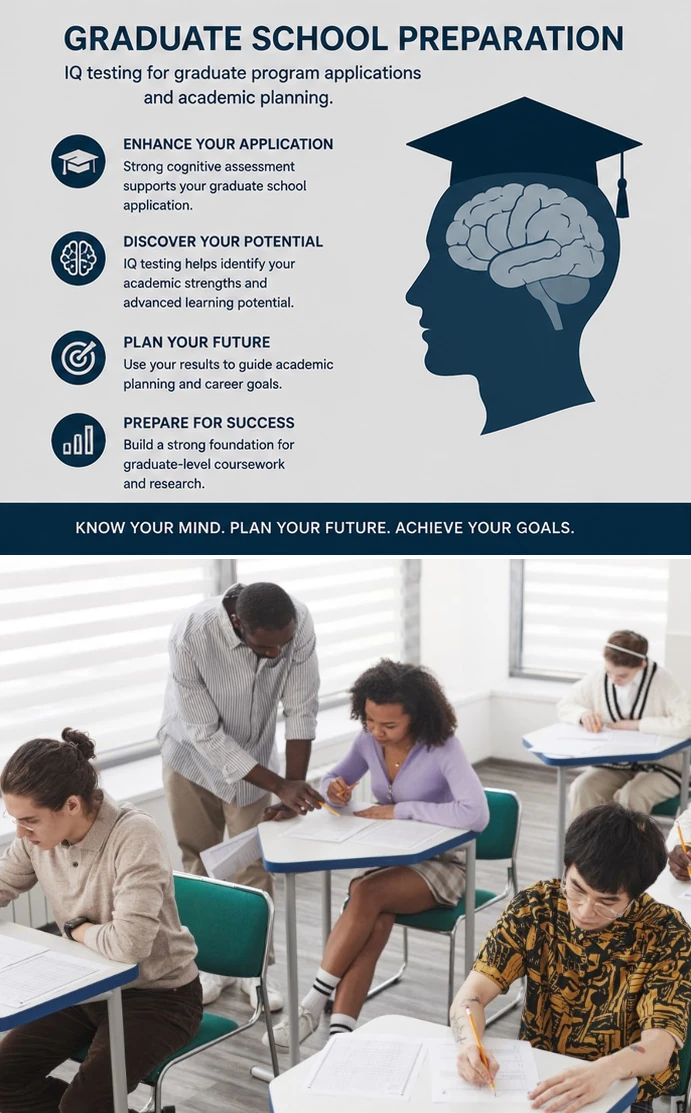
IQ testing can be a valuable tool for graduate school preparation, helping you identify your cognitive strengths, select the right program, and plan for academic success. This comprehensive guide covers how IQ testing supports graduate school applications, which tests are accepted, and how to leverage your results.
Last Updated: July 2026
Adult IQ Testing
WAIS-IV & WAIS-5 available. Comprehensive adult cognitive assessments for graduate school planning.
WAIS-IV & WAIS-5 Tests
Wechsler Adult Intelligence Scale® – Fourth Edition (WAIS-IV) and Fifth Edition (WAIS-5) – the gold standard for adult IQ testing in graduate school applications.
Career Guidance
Use IQ testing to identify career paths and graduate programs that align with your cognitive strengths.
Mensa Testing
Official Mensa testing – another way to demonstrate exceptional cognitive ability for applications. Accepts WAIS-IV, WAIS-5, and Stanford-Binet 5 scores.
Full Evaluation
Comprehensive assessment with detailed report and recommendations for academic planning. Includes WAIS-IV or WAIS-5.
Schedule Graduate School Preparation Testing
Book your graduate school preparation testing with a licensed psychologist in Seattle today.
How IQ Testing Supports Graduate School Preparation
IQ testing provides valuable insights that can help you make informed decisions about graduate school:
- Identify your cognitive strengths: Understand your intellectual profile – verbal comprehension, perceptual reasoning, working memory, and processing speed – and how these align with different graduate programs
- Select the right program: Match your cognitive abilities with program demands – for example, law school requires strong verbal reasoning, while engineering programs demand high perceptual reasoning
- Strengthen your application: Some graduate programs, particularly in clinical psychology, neuropsychology, and education, require or strongly recommend cognitive testing as part of the application process
- Academic planning: Use your cognitive profile to guide your choice of courses, research areas, and career paths
- Identify learning needs: If you have a cognitive weakness in a specific area (e.g., processing speed), you can develop strategies to compensate and succeed in graduate-level work
Graduate Programs That May Require or Recommend IQ Testing
While most graduate programs do not require IQ testing, some fields may request or benefit from cognitive assessment:
- Clinical and Counseling Psychology: Many doctoral programs in psychology require cognitive testing as part of the application or training process
- Neuropsychology: Cognitive assessment is central to the field, and programs often expect familiarity with tests like WAIS-IV and WAIS-5
- School Psychology: Programs require knowledge of cognitive assessment, including the WISC-V and WAIS-IV
- Educational Psychology: Understanding cognitive assessment is essential for careers in educational testing and evaluation
- Gifted Education: Programs in gifted education often require knowledge of IQ testing for identification
- Speech-Language Pathology: Some programs may recommend cognitive testing to understand a client's full profile
- Occupational Therapy: Cognitive assessment can be relevant for some specializations
Tests Used for Graduate School Preparation
Graduate School Preparation in Seattle
Seattle is home to world-class graduate programs, making it an ideal location for academic and career planning:
Seattle Graduate Programs
- University of Washington: Offers doctoral programs in clinical psychology, educational psychology, neuroscience, and many other fields that value cognitive assessment
- Seattle University: Offers graduate programs in education, counseling, and psychology
- Antioch University Seattle: Offers graduate programs in psychology, education, and leadership
- City University of Seattle: Offers graduate programs in education, counseling, and organizational psychology
Career Opportunities
Seattle's knowledge-based economy offers abundant opportunities for graduate degree holders, particularly in:
- Technology and software development
- Healthcare and biomedical research
- Education and educational assessment
- Business and organizational leadership
- Research and development
The Graduate School Preparation Testing Process
Step 1: Initial Consultation
A brief phone or video call with a licensed psychologist to discuss your goals, the graduate programs you're targeting, and the most appropriate tests. This helps determine the right approach for your needs.
Step 2: Testing Session
You meet one-on-one with a licensed psychologist in a quiet, comfortable room. The psychologist administers the selected test, which includes subtests measuring various cognitive abilities. Breaks are offered as needed. The testing session typically takes 60-90 minutes.
Step 3: Scoring and Interpretation
The psychologist scores the test and analyzes the results, considering your age, background, and any relevant medical or educational history.
Step 4: Feedback Session
The psychologist meets with you to explain the results, discuss your cognitive profile, and provide recommendations for graduate school planning, career paths, and academic strategies.
Step 5: Comprehensive Written Report
You receive a detailed report with all scores, normative comparisons, and recommendations. This report can be used for graduate school applications, career planning, or personal development.
Benefits of IQ Testing for Graduate School Preparation
- Self-awareness: Understand your cognitive strengths and weaknesses and how they relate to different academic and career paths
- Informed decision-making: Choose a graduate program that matches your abilities and interests
- Academic planning: Use your cognitive profile to guide your choice of courses and research areas
- Application enhancement: Some programs may value cognitive testing as evidence of your intellectual abilities
- Career guidance: Identify career paths that align with your cognitive strengths
- Personal growth: Gain insight into your intellectual potential and how to maximize it
Cost of IQ Testing for Graduate School Preparation
The cost of IQ testing for graduate school preparation varies depending on the type of test and the psychologist's experience:
- Single IQ test (WAIS-IV or WAIS-5): $200-$600
- Comprehensive cognitive assessment: $400-$1,200
- Full psychoeducational evaluation: $1,200-$3,000
Some insurance plans may cover testing when it's deemed medically necessary. We recommend checking with your provider for details.
Frequently Asked Questions
Most graduate programs do not require IQ testing. However, some programs in clinical psychology, neuropsychology, school psychology, and gifted education may recommend or require cognitive assessment. Check with your target programs for specific requirements.
WAIS-IV is the most widely used adult IQ test and is appropriate for graduate school preparation. WAIS-5 is also available for those who prefer the newest version. Both provide comprehensive cognitive profiles with index scores for verbal comprehension, perceptual reasoning, working memory, and processing speed.
Understanding your cognitive strengths can help you identify career paths that align with your abilities. For example, high verbal comprehension may indicate strength in law, teaching, or writing, while high perceptual reasoning may indicate strength in engineering, design, or technology.
The test itself takes 60-90 minutes. With the consultation, feedback, and report, the entire process is about 1-2 weeks.
The report includes Full-Scale IQ, index scores, strengths and weaknesses, normative comparisons, and recommendations for graduate school planning and career development.
Some plans cover cognitive assessments when there is a clinical indication. Graduate school preparation is often considered an educational rather than medical service, so coverage varies. Check with your provider.
Yes, WAIS-IV and WAIS-5 can be administered via secure telehealth platforms by qualified psychologists in Washington state. Contact us for details.
Get a good night's sleep, eat a healthy meal, and arrive relaxed. No specific preparation is needed. The test measures innate cognitive abilities, so studying is not necessary.
Typical fees range from $200 to $1,200 for a single IQ test, with full evaluations costing up to $3,000. Some insurance plans cover testing when medically necessary.
Mensa membership demonstrates high cognitive ability and may be a positive addition to your graduate school application. We offer official Mensa testing and documentation.