
Career Guidance in Seattle

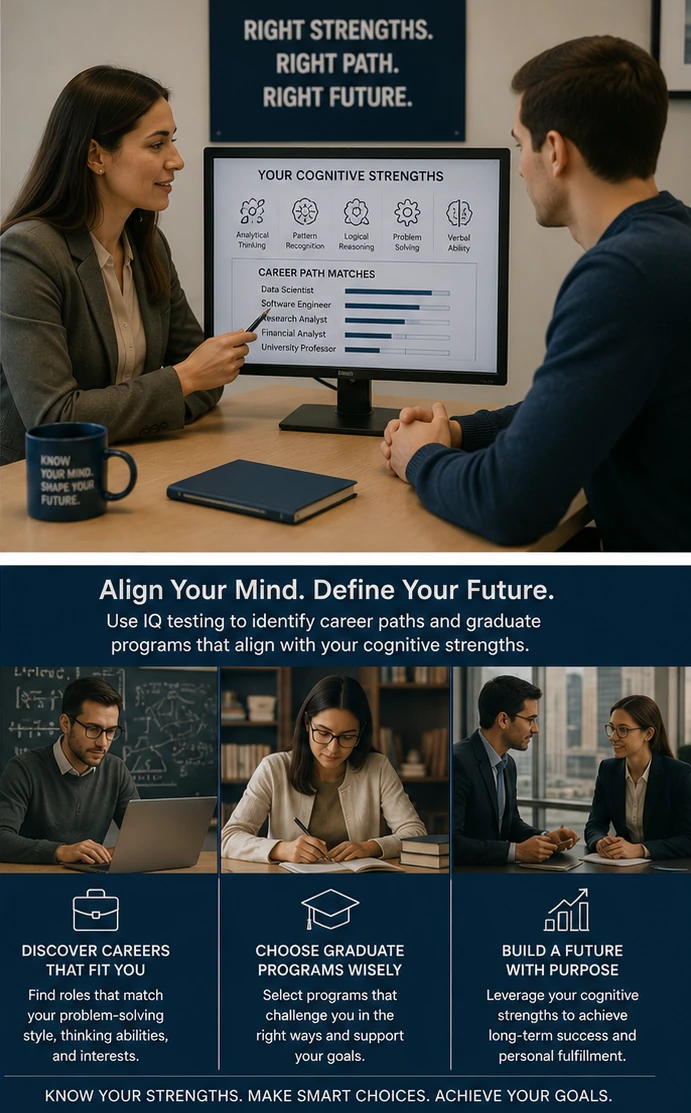
IQ testing can be a powerful tool for career guidance, helping you identify your cognitive strengths and match them with career paths where you'll excel. This comprehensive guide covers how IQ testing informs career decisions, which cognitive strengths align with different professions, and how to leverage your results for career success in Seattle.
Last Updated: July 2026
Adult IQ Testing
WAIS-IV & WAIS-5 available. Comprehensive adult cognitive assessments for career guidance and planning.
WAIS-IV & WAIS-5 Tests
Wechsler Adult Intelligence Scale® – Fourth Edition (WAIS-IV) and Fifth Edition (WAIS-5) – the gold standard for adult IQ testing in career guidance.
Graduate School Preparation Testing
IQ testing for graduate program applications and academic planning using WAIS-IV or WAIS-5.
Mensa Testing
Official Mensa testing – another way to demonstrate exceptional cognitive ability. Accepts WAIS-IV, WAIS-5, and Stanford-Binet 5 scores.
Full Evaluation
Comprehensive assessment with detailed report and recommendations for career development. Includes WAIS-IV or WAIS-5.
Schedule Career Guidance
Book your IQ testing to identify career paths that align with your cognitive strengths with a licensed psychologist in Seattle today.
How IQ Testing Supports Career Guidance
IQ testing provides valuable insights that can help you make informed career decisions:
- Identify your cognitive strengths: Understand your intellectual profile – verbal comprehension, perceptual reasoning, working memory, and processing speed – and how these align with different career paths
- Match abilities to careers: Different professions require different cognitive strengths. IQ testing helps you identify careers where you'll naturally excel
- Career change planning: If you're considering a career change, IQ testing can help you understand which new fields might be a good fit for your abilities
- Professional development: Use your cognitive profile to guide your choice of training, certifications, and professional development opportunities
- Leadership development: Understanding your cognitive strengths can help you develop leadership skills and identify areas for growth
Cognitive Strengths and Career Alignment
The WAIS-IV and WAIS-5 provide index scores that reveal your cognitive profile. Here's how each strength aligns with different career paths:
Verbal Comprehension Index (VCI)
Measures verbal reasoning, vocabulary, and knowledge. High scores indicate strong language skills and the ability to understand and communicate complex ideas.
Law & Legal Professions
Lawyers, judges, legal analysts need strong verbal reasoning for argumentation and interpretation.
Verbal ComprehensionEducation & Teaching
Teachers, professors, curriculum developers need strong verbal skills for instruction and explanation.
Verbal ComprehensionWriting & Communications
Journalists, authors, public relations professionals need strong language and communication skills.
Verbal ComprehensionPsychology & Counseling
Therapists, counselors, psychologists need strong verbal skills for understanding and communicating with clients.
Verbal ComprehensionPerceptual Reasoning Index (PRI) / Visual Spatial & Fluid Reasoning
Measures non-verbal reasoning, visual-spatial processing, and problem-solving. High scores indicate strong analytical and spatial thinking skills.
Engineering & Architecture
Engineers, architects, drafters need strong spatial reasoning for design and problem-solving.
Perceptual ReasoningTechnology & Software
Software developers, data scientists, IT professionals need strong analytical and problem-solving skills.
Perceptual ReasoningDesign & Visual Arts
Graphic designers, artists, interior designers need strong visual-spatial abilities.
Perceptual ReasoningHealthcare & Surgery
Surgeons, radiologists, dentists need strong spatial reasoning for precise procedures.
Perceptual ReasoningWorking Memory Index (WMI)
Measures attention, concentration, and the ability to hold and manipulate information. High scores indicate strong mental processing and multitasking abilities.
Executive Leadership
CEOs, managers, executives need strong working memory for complex decision-making and multitasking.
Working MemoryFinance & Accounting
Financial analysts, accountants, auditors need strong mental processing for complex calculations.
Working MemoryMedical Professions
Doctors, nurses, emergency responders need strong working memory for managing complex situations.
Working MemoryLegal & Court Proceedings
Lawyers, judges, paralegals need strong working memory for managing case details and evidence.
Working MemoryProcessing Speed Index (PSI)
Measures the speed of processing visual information and performing mental tasks. High scores indicate strong efficiency and quick thinking.
Emergency Services
Police, firefighters, paramedics need fast processing for quick decision-making under pressure.
Processing SpeedAviation & Transportation
Pilots, air traffic controllers, train operators need fast processing for safety-critical decisions.
Processing SpeedTrading & Finance
Stock traders, high-frequency traders need fast processing for real-time decision-making.
Processing SpeedJournalism & News
News reporters, broadcasters need fast processing for real-time reporting and editing.
Processing SpeedCareer Guidance in Seattle
Seattle's dynamic economy offers abundant career opportunities across multiple sectors. Understanding your cognitive strengths can help you navigate this diverse job market:
Seattle's Major Industries
- Technology: Amazon, Microsoft, Google, and thousands of startups – ideal for those with strong perceptual reasoning and working memory
- Healthcare: Seattle Children's Hospital, UW Medicine, Fred Hutchinson Cancer Center – ideal for those with strong working memory and processing speed
- Education: University of Washington, Seattle University, and numerous schools – ideal for those with strong verbal comprehension
- Finance & Business: Corporate headquarters and financial institutions – ideal for those with strong working memory and processing speed
- Creative Arts: Graphic design, architecture, music, and film – ideal for those with strong perceptual reasoning
- Law & Government: Legal firms and government agencies – ideal for those with strong verbal comprehension
Career Trends in Seattle
- Tech sector growth: Seattle is one of the fastest-growing tech hubs in the U.S., creating demand for analytical and problem-solving skills
- Healthcare expansion: Seattle's healthcare sector continues to grow, requiring professionals with strong working memory and processing speed
- Education and research: Seattle's universities and research institutions offer opportunities for those with strong verbal comprehension and intellectual curiosity
- Remote work opportunities: Seattle's tech-friendly environment supports remote work in many fields, allowing you to leverage your cognitive strengths regardless of location
The Career Guidance Testing Process
Step 1: Initial Consultation
A brief phone or video call with a licensed psychologist to discuss your career goals, challenges, and the most appropriate tests. This helps determine the right approach for your needs.
Step 2: Testing Session
You meet one-on-one with a licensed psychologist in a quiet, comfortable room. The psychologist administers the selected test, which includes subtests measuring various cognitive abilities. Breaks are offered as needed. The testing session typically takes 60-90 minutes.
Step 3: Scoring and Interpretation
The psychologist scores the test and analyzes the results, considering your age, background, and career goals.
Step 4: Feedback Session
The psychologist meets with you to explain the results, discuss your cognitive profile, and provide tailored recommendations for career paths, professional development, and next steps.
Step 5: Comprehensive Written Report
You receive a detailed report with all scores, normative comparisons, and recommendations for career planning, professional development, and personal growth.
Benefits of IQ Testing for Career Guidance
- Self-awareness: Understand your cognitive strengths and weaknesses and how they relate to different career paths
- Informed decision-making: Choose a career that matches your abilities and interests
- Professional development: Use your cognitive profile to guide your choice of training, certifications, and professional development
- Career change confidence: If you're considering a career change, IQ testing can help you understand which new fields might be a good fit
- Leadership development: Understanding your cognitive strengths can help you develop leadership skills and identify areas for growth
- Personal growth: Gain insight into your intellectual potential and how to maximize it in your career
Cost of IQ Testing for Career Guidance
The cost of IQ testing for career guidance varies depending on the type of test and the psychologist's experience:
- Single IQ test (WAIS-IV or WAIS-5): $200-$600
- Comprehensive cognitive assessment: $400-$1,200
- Full psychoeducational evaluation: $1,200-$3,000
Some insurance plans may cover testing when it's deemed medically necessary. We recommend checking with your provider for details.
Frequently Asked Questions
IQ testing helps you understand your cognitive strengths and match them with career paths where you'll excel. Different careers require different cognitive abilities, and understanding your profile can help you make informed career decisions.
Verbal Comprehension is important for law, education, and communications. Perceptual Reasoning is important for engineering, technology, and design. Working Memory is important for leadership, finance, and healthcare. Processing Speed is important for emergency services, aviation, and trading.
Yes. If you're considering a career change, IQ testing can help you understand which new fields might be a good fit for your cognitive strengths. It can also help you identify areas where you might need additional training or development.
The test itself takes 60-90 minutes. With the consultation, feedback, and report, the entire process is about 1-2 weeks.
The report includes Full-Scale IQ, index scores, strengths and weaknesses, normative comparisons, and recommendations for career planning, professional development, and next steps.
Some plans cover cognitive assessments when there is a clinical indication. Career guidance is often considered an educational rather than medical service, so coverage varies. Check with your provider.
Yes, WAIS-IV and WAIS-5 can be administered via secure telehealth platforms by qualified psychologists in Washington state. Contact us for details.
Get a good night's sleep, eat a healthy meal, and arrive relaxed. No specific preparation is needed. The test measures innate cognitive abilities, so studying is not necessary.
Typical fees range from $200 to $1,200 for a single IQ test, with full evaluations costing up to $3,000. Some insurance plans cover testing when medically necessary.
Seattle offers abundant opportunities in technology, healthcare, education, finance, law, and creative arts. The city's knowledge-based economy values cognitive abilities across all sectors.