
Stanford-Binet Test in Salinas, CA

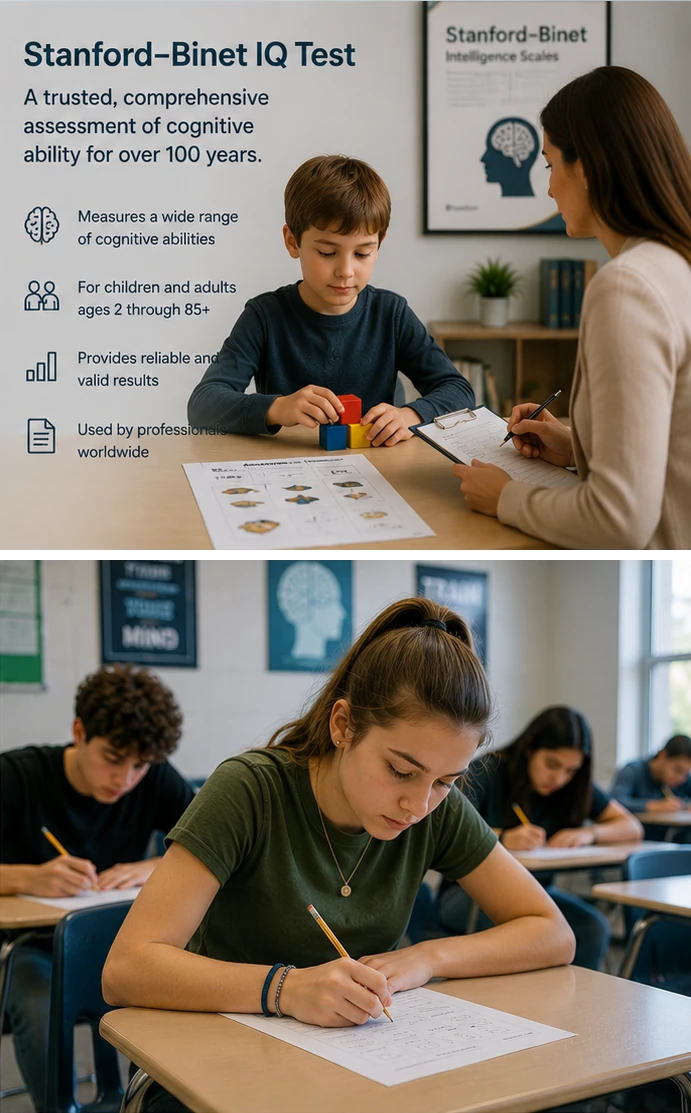
The Stanford-Binet Intelligence Scales is one of the oldest and most respected IQ tests in the world. This comprehensive guide covers the complete history of the Stanford-Binet, the key differences between SB-5 and other major IQ tests (WISC, WAIS, Mensa, and Full Evaluations), and what you need to know about testing in Salinas, CA.
Last Updated: September 2026
Complete SB History
From Binet-Simon (1905) to SB-5 (2003) – the evolution of intelligence testing.
SB-5 vs Other Tests
Detailed comparison of Stanford-Binet vs WISC, WAIS, Mensa, and Full Evaluations.
SB in Salinas, CA
How many people take the Stanford-Binet in Salinas, CA and what the data tells us.
All SB Versions
Complete breakdown of subtests and scores for every Stanford-Binet version.
Why Choose SB-5?
Understanding the advantages of the Stanford-Binet and who it's best for.
Schedule SB Testing
Book your Stanford-Binet assessment with a licensed psychologist in Salinas, CA today.
The Complete History of the Stanford-Binet
The Origins: Binet-Simon Scale (1905)
The story of the Stanford-Binet begins in France with Alfred Binet and Théodore Simon. In 1905, the French Ministry of Education commissioned Binet to develop a test to identify children who would need special assistance in school. The result was the Binet-Simon Scale, which measured memory, attention, comprehension, and judgment.
Stanford-Binet (1916)
Lewis Terman of Stanford University adapted the Binet-Simon Scale for American use in 1916. This version introduced the Intelligence Quotient (IQ) concept, which was calculated as (Mental Age ÷ Chronological Age) × 100. Terman's version became the foundation for modern IQ testing.
Stanford-Binet (1937)
This revision expanded the test to two forms (L and M) and extended the age range to cover ages 2 to adult. It was the first major revision of the SB.
Stanford-Binet (1960)
This version incorporated the best items from Forms L and M into a single Form L-M. It was the first to introduce deviation IQ scores, which are now standard in all modern IQ tests.
Stanford-Binet (1972)
A minor revision with updated norms based on the 1960s population.
Stanford-Binet (1986) – SB-IV
A major revision that introduced a multi-factor structure. It assessed four cognitive areas: Verbal Reasoning, Abstract/Visual Reasoning, Quantitative Reasoning, and Short-Term Memory. It also introduced the concept of Standard Age Score (SAS).
Stanford-Binet (2003) – SB-5
The current version, SB-5, represents the most comprehensive revision to date. It features:
- Five factors: Fluid Reasoning, Knowledge, Quantitative Reasoning, Visual-Spatial Processing, and Working Memory
- Full scale IQ score
- Ten subtests (5 verbal, 5 nonverbal)
- Age range: 2 years to 85+ years
- Administration time: 45-75 minutes
Stanford-Binet vs Other Tests: What's the Difference?
| Feature | Stanford-Binet (SB-5) | WISC-V | WAIS-IV | Mensa Test | Full Evaluation |
|---|---|---|---|---|---|
| Age Range | 2–85+ years | 6–16 years | 16–90 years | 16+ years | Varies |
| Primary Use | Gifted identification, clinical assessment, all ages | Children's IQ, school placement, gifted programs | Adult IQ, career guidance, neuropsychology | High-IQ society admission | Comprehensive cognitive & psychological assessment |
| Factors/Indices | 5 factors (Fluid Reasoning, Knowledge, Quantitative, Visual-Spatial, Working Memory) | 5 indices (VCI, VSI, FRI, WMI, PSI) | 4 indices (VCI, PRI, WMI, PSI) | Varies by test | Multiple cognitive, behavioral, and emotional domains |
| Subtests | 10 (5 verbal, 5 nonverbal) | 10 primary + 5 secondary + 5 tertiary | 10 core + 5 supplemental | Varies | Multiple tests |
| Administration Time | 45-75 minutes | 65-80 minutes | 60-90 minutes | 60-90 minutes | 2-6 hours |
| Best For | Highly gifted individuals, all ages, comprehensive assessment | Children, school placement, ADHD/LD evaluation | Adults, career guidance, Mensa, neuropsychology | Adults seeking Mensa membership | Complex cases, disability diagnosis, legal documentation |
Why Choose the Stanford-Binet?
Advantages of SB-5
- Broad age range: SB-5 can be used from age 2 to 85+, making it the most versatile IQ test available.
- Excellent for gifted identification: The extended ceiling of SB-5 makes it particularly good at identifying highly gifted individuals (IQ 145+).
- CHC theory alignment: SB-5 was designed from the ground up to align with the Cattell-Horn-Carroll (CHC) theory of cognitive abilities.
- Balanced verbal/nonverbal: The 5 verbal and 5 nonverbal subtests provide a balanced assessment of cognitive abilities.
- Strong clinical utility: Excellent for identifying learning disabilities, intellectual disabilities, and cognitive strengths.
- Less influenced by speed: Unlike WISC and WAIS, SB-5 is less affected by processing speed, making it better for individuals with ADHD or motor issues.
When to Choose Other Tests
- WISC-V: Best for children aged 6-16, especially for school placement and learning disability identification.
- WAIS-IV: Best for adults aged 16-90, especially for career guidance, neuropsychological evaluation, and Mensa.
- Mensa Test: Best if your only goal is Mensa admission and you don't need a comprehensive report.
- Full Evaluation: Best if you suspect multiple conditions (e.g., ADHD + anxiety + learning disability) or need documentation for legal purposes.
Stanford-Binet Testing in Salinas, CA
Connections Family and Behavioral Services provides therapy, assessment, and consultation from an office at 201 John Street, Suite A, Salinas, CA 93901, using the local telephone number (831) 296-0006. Its public information describes mental-health and developmental assessment for children and adults, with particular attention to autism, ADHD, developmental differences, learning concerns, school or work performance, and individualized recommendations.
The practice’s public materials do not promise that every referral includes a specific individually administered intelligence test. Before scheduling, callers should confirm that an appropriately licensed psychologist or educational psychologist is available for the examinee’s age and purpose; identify whether the required instrument is the WISC-V, WAIS-IV/WAIS-5, Stanford-Binet 5, or another measure; and verify whether achievement, attention, memory, executive-function, adaptive, social-emotional, or autism measures are included. Also confirm total fees, insurance or authorization rules, testing language, disability accommodations, report turnaround, and acceptance by the receiving school, agency, employer, court, university, licensing body, or high-IQ organization.
For school, disability, Mensa, legal, or admissions use, provide the examiner with the receiving organization’s current written criteria. Confirm the edition, norms, composites, subtests, validity statements, signatures, license details, and original-report requirements before testing.
All Stanford-Binet Versions at a Glance
Frequently Asked Questions
The Stanford-Binet is the oldest continuously used intelligence test, with origins in 1905 France. Key milestones:
- Binet-Simon (1905): Developed by Alfred Binet and Théodore Simon to identify children needing special education.
- Stanford-Binet (1916): Lewis Terman adapted it for American use and introduced the IQ concept (Mental Age ÷ Chronological Age × 100).
- Stanford-Binet (1937): Two forms (L and M) with an extended age range.
- Stanford-Binet (1960): Form L-M. Introduced deviation IQ scores (the modern standard).
- SB-IV (1986): Multi-factor structure with four cognitive areas.
- SB-5 (2003): Current version with five factors (Fluid Reasoning, Knowledge, Quantitative Reasoning, Visual-Spatial Processing, Working Memory) and ages 2-85+.
The Stanford-Binet was the test used by the famous "Termite" study that followed gifted children throughout their lives.
All three are excellent IQ tests, but they have different strengths:
- Stanford-Binet (SB-5): Broadest age range (2-85+). Best for highly gifted individuals. Less influenced by processing speed. Balanced verbal/nonverbal subtests.
- WISC-V: Best for children aged 6-16. Designed for school placement and learning disability identification. Faster administration.
- WAIS-IV: Best for adults aged 16-90. Designed for career guidance, neuropsychology, and Mensa. Most widely used adult IQ test.
Choose Stanford-Binet if you need an assessment that works across all ages and is less affected by processing speed or motor issues.
Yes, Stanford-Binet is often preferred for individuals with ADHD or processing speed issues because it is less influenced by speed compared to WISC and WAIS. The SB-5's emphasis on fluid reasoning and knowledge rather than speed makes it more accessible for individuals with attention difficulties. However, like all IQ tests, SB-5 cannot diagnose ADHD on its own – it provides cognitive profile information that helps clinicians understand how ADHD might affect a person's performance.
It may qualify as prior evidence when the exact edition, score, administration, examiner, and report meet American Mensa's current rules. Confirm the official qualifying-score table and documentation requirements before testing solely for membership.
SB-5 takes approximately 45-75 minutes to administer, depending on the individual's age and performance.
Yes! This is one of SB-5's biggest advantages. It covers ages 2-85+ with a single test battery, making it ideal for families who want to compare results across generations.
Fees vary by instrument, intake, scoring, feedback, report scope, and provider. Fees vary by assessment type and scope; insurance coverage depends on medical necessity, referral and authorization rules, network status, and plan exclusions. Ask for a written estimate before scheduling.
Yes, many psychologists offer Stanford-Binet testing via secure telehealth platforms. However, some subtests may require in-person administration for accurate scoring. Contact us for details.
A Full Evaluation includes multiple tests (IQ, achievement, personality, behavioral, emotional) and typically takes 2-6 hours. It provides a comprehensive picture of cognitive, academic, emotional, and behavioral functioning. A single IQ test like Stanford-Binet focuses only on cognitive abilities and takes 45-75 minutes. Full Evaluations are best for complex cases, disability diagnosis, or legal documentation.