
Graduate School Preparation in Portland

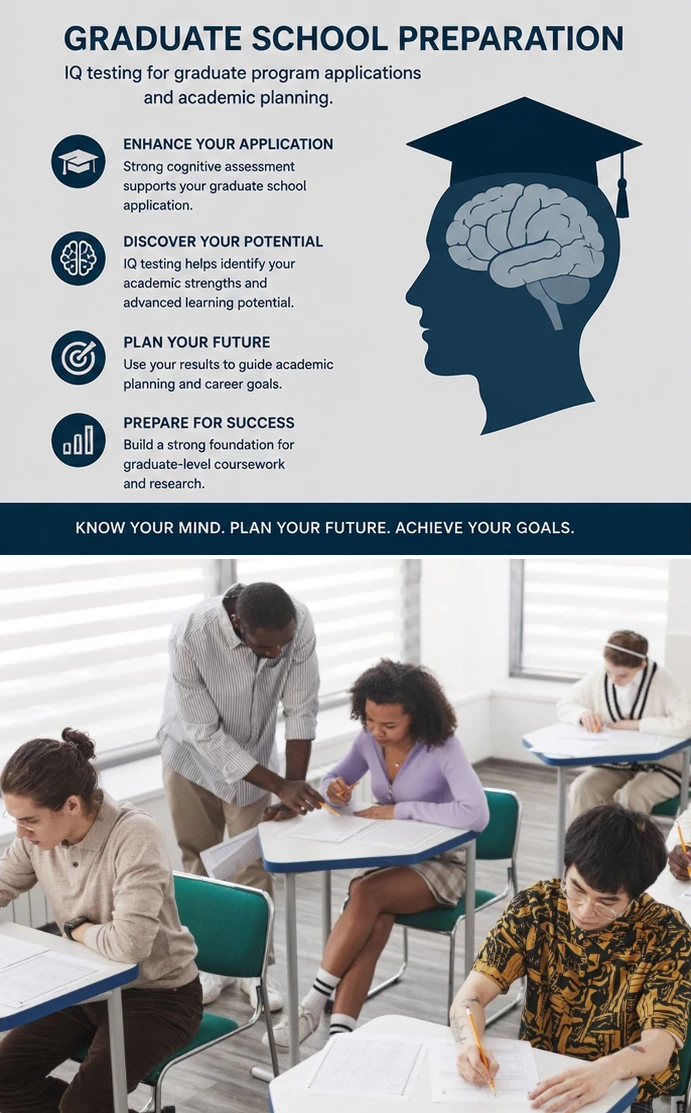
IQ testing can be a valuable tool for graduate school preparation, helping you identify your cognitive strengths, select the right program, and plan for academic success. This comprehensive guide covers how IQ testing supports graduate school applications, which tests are accepted, and how to leverage your results.
Last Updated: July 2026
Adult IQ Testing
WAIS-IV & WAIS-5 available. Comprehensive adult cognitive assessments for graduate school planning.
WAIS-IV & WAIS-5 Tests
Wechsler Adult Intelligence Scale® – Fourth Edition (WAIS-IV) and Fifth Edition (WAIS-5) – the gold standard for adult IQ testing in graduate school applications.
Career Guidance
Use IQ testing to identify career paths and graduate programs that align with your cognitive strengths.
Mensa Testing
Mensa qualification testing guidance – another way to demonstrate exceptional cognitive ability for applications. American Mensa's published prior-evidence list includes WAIS-IV and Stanford-Binet 5; verify current acceptance of WAIS-5 before testing.
Full Evaluation
Comprehensive assessment with detailed report and recommendations for academic planning. Includes WAIS-IV or WAIS-5.
Schedule Graduate School Preparation Testing
Book your graduate school preparation testing with a licensed psychologist in Portland today.
How IQ Testing Supports Graduate School Preparation
IQ testing provides valuable insights that can help you make informed decisions about graduate school:
- Identify your cognitive strengths: Understand your intellectual profile – verbal comprehension, perceptual reasoning, working memory, and processing speed – and how these align with different graduate programs
- Select the right program: Match your cognitive abilities with program demands – for example, law school requires strong verbal reasoning, while engineering programs demand high perceptual reasoning
- Strengthen your application: Some graduate programs, particularly in clinical psychology, neuropsychology, and education, require or strongly recommend cognitive testing as part of the application process
- Academic planning: Use your cognitive profile to guide your choice of courses, research areas, and career paths
- Identify learning needs: If you have a cognitive weakness in a specific area (e.g., processing speed), you can develop strategies to compensate and succeed in graduate-level work
Graduate Programs That May Require or Recommend IQ Testing
While most graduate programs do not require IQ testing, some fields may request or benefit from cognitive assessment:
- Clinical and Counseling Psychology: Many doctoral programs in psychology require cognitive testing as part of the application or training process
- Neuropsychology: Cognitive assessment is central to the field, and programs often expect familiarity with tests like WAIS-IV and WAIS-5
- School Psychology: Programs require knowledge of cognitive assessment, including the WISC-V and WAIS-IV
- Educational Psychology: Understanding cognitive assessment is essential for careers in educational testing and evaluation
- Gifted Education: Programs in gifted education often require knowledge of IQ testing for identification
- Speech-Language Pathology: Some programs may recommend cognitive testing to understand a client's full profile
- Occupational Therapy: Cognitive assessment can be relevant for some specializations
Portland Graduate Programs and Cognitive-Assessment Relevance
Portland State University
- Enrollment: 19,687 students in fall 2025, including 4,261 graduate students.
- Graduate scale: PSU offers more than 100 master's degrees, graduate certificates and doctoral offerings across psychology, counseling education, social work, education, engineering, computer science, business, public affairs, urban studies and other fields.
- Assessment relevance: Cognitive assessment is particularly relevant to applied psychology, counseling, special education, school psychology, rehabilitation, research methods and disability services.
Oregon Health & Science University
- Fall 2025 enrollment: 3,047 OHSU-registered students plus 1,290 students in joint programs.
- Schools: Medicine, nursing, dentistry, public health and pharmacy, with biomedical and clinical research pathways.
- Assessment relevance: Neuropsychology, psychiatry, neurology, pediatrics, rehabilitation, public health and clinical research use cognitive and behavioral measurement.
Lewis & Clark College
- Graduate fields: Law, education, counseling and therapy-related programs.
- Application planning: Program requirements may include prerequisites, essays, recommendations, interviews and professional experience.
University of Portland, Pacific University, and Regional Programs
- University of Portland: Graduate pathways in nursing, business, education, engineering and related fields.
- Pacific University: Health professions, psychology, education and other graduate programs in the wider metro region.
- Other options: Oregon State University Portland programs, community-college pathways and online/hybrid programs expand choices.
Most graduate programs do not require an IQ score. Testing is most appropriate when it answers a disability, accommodation, learning-strategy, career-fit or clinical question, not as a substitute for admissions criteria.
Tests Used for Graduate School Preparation
Portland Research Opportunities
- PSU: Urban studies, education, applied psychology, social work, engineering, computer science, environmental science, public health and community-engaged research.
- OHSU: Biomedical, clinical, neuroscience, population-health, child-development and health-services research.
- OHSU-PSU School of Public Health: Joint training and research linking health science with urban and community systems.
- Reed, Lewis & Clark and University of Portland: Faculty research, laboratories, capstones and community partnerships across sciences, social sciences and humanities.
- Regional industry: Technology, semiconductor, product design, healthcare, transportation and clean-energy employers may provide internships or applied projects.
- Preparation: Research fit depends on methods, statistics, writing, coding, laboratory skills, mentoring and sustained interest—not IQ alone.
Portland Graduate School Funding and Scholarships
- Assistantships: Teaching, research and graduate-assistant positions may provide tuition support or stipends, but availability differs by department.
- Health-professions funding: OHSU programs use program-specific scholarships, grants, loans, service commitments and workforce initiatives.
- Employer support: Healthcare, government, technology and nonprofit employers may offer tuition assistance for relevant degrees.
- Oregon residency: Tuition classification and regional exchange rules can materially affect cost.
- Disability accommodations: Funding and accommodations are separate processes; documentation should address functional limitations.
- Cost of living: Housing, transportation, parking, childcare and healthcare should be included in the funding plan.
Portland Graduate School Preparation Timeline
- 12–18 months before enrollment: Compare programs, prerequisites, faculty fit, licensure outcomes, cost and admissions deadlines.
- 9–12 months: Complete prerequisites, build research or professional experience, request recommendations and prepare writing samples.
- 6–9 months: Take required admissions exams if any, request transcripts and submit early applications.
- Accommodation planning: Arrange clinical evaluation early enough to meet documentation standards; an IQ test alone may be insufficient.
- Decision stage: Compare assistantships, commute, transit, clinical placements, internship access and cost of living.
- Before classes: Establish disability services, medication continuity, housing and realistic study/work schedules.
Benefits of IQ Testing for Graduate School Preparation
- Self-awareness: Understand your cognitive strengths and weaknesses and how they relate to different academic and career paths
- Informed decision-making: Choose a graduate program that matches your abilities and interests
- Academic planning: Use your cognitive profile to guide your choice of courses and research areas
- Application enhancement: Some programs may value cognitive testing as evidence of your intellectual abilities
- Career guidance: Identify career paths that align with your cognitive strengths
- Personal growth: Gain insight into your intellectual potential and how to maximize it
Cost of IQ Testing for Graduate School Preparation
Fees depend on whether the service is a single cognitive test or a broader evaluation for ADHD, a learning disorder, or accommodation documentation. Universities and testing agencies may require recent, comprehensive evidence rather than an IQ score alone.
Obtain the documentation rules first, then request a written fee estimate from the evaluator. Testing performed solely for admissions planning is often self-pay.
Frequently Asked Questions
Most graduate programs do not require IQ testing. However, some programs in clinical psychology, neuropsychology, school psychology, and gifted education may recommend or require cognitive assessment. Check with your target programs for specific requirements.
WAIS-IV is the most widely used adult IQ test and is appropriate for graduate school preparation. WAIS-5 is also available for those who prefer the newest version. Both provide comprehensive cognitive profiles with index scores for verbal comprehension, perceptual reasoning, working memory, and processing speed.
Understanding your cognitive strengths can help you identify career paths that align with your abilities. For example, high verbal comprehension may indicate strength in law, teaching, or writing, while high perceptual reasoning may indicate strength in engineering, design, or technology.
The test itself takes 60-90 minutes. With the consultation, feedback, and report, the entire process is about 1-2 weeks.
The report includes Full-Scale IQ, index scores, strengths and weaknesses, normative comparisons, and recommendations for graduate school planning and career development.
Some plans cover cognitive assessments when there is a clinical indication. Graduate school preparation is often considered an educational rather than medical service, so coverage varies. Check with your provider.
Remote administration may be possible in limited circumstances, but the psychologist must confirm publisher guidance, standardization, Oregon licensure, technology requirements, and acceptance by the receiving institution.
Get a good night's sleep, eat a healthy meal, and arrive relaxed. No specific preparation is needed. The test measures innate cognitive abilities, so studying is not necessary.
Fees vary by provider, test battery, report detail, records review, and turnaround time. Insurance coverage depends on medical necessity and the plan; request a written estimate before testing.
Mensa membership may be listed as an activity, but graduate admissions decisions primarily depend on academic preparation, program fit, research or professional experience, recommendations, and required application materials. Verify Mensa qualification routes directly with American Mensa.