
Full Evaluation in Portland

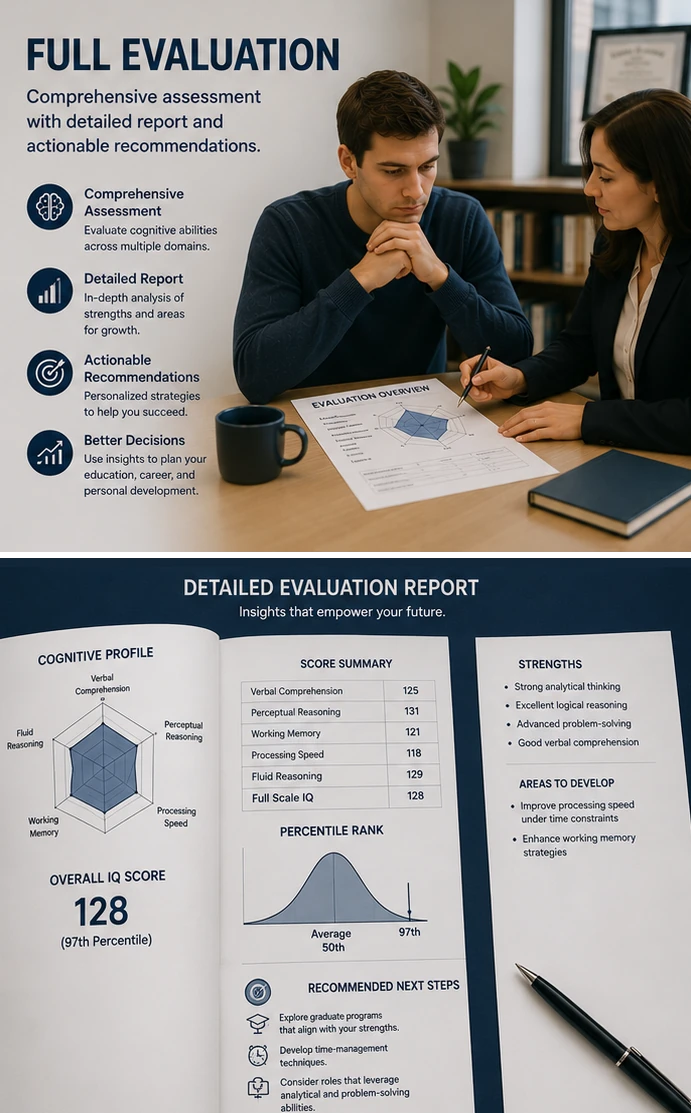
A full evaluation is a comprehensive psychological and psychoeducational assessment that goes beyond a single IQ test. It provides a detailed picture of your cognitive, academic, emotional, and behavioral functioning, with actionable recommendations for academic planning, career development, or clinical intervention.
Last Updated: July 2026
Child IQ Testing
WISC-V & Stanford-Binet 5 for ages 6–16. Gifted identification, learning profiles.
Adult IQ Testing
WAIS-IV & WAIS-5 available. Comprehensive adult cognitive assessments for clinical and occupational purposes.
WAIS-IV & WAIS-5 Tests
Wechsler Adult Intelligence Scale® – Fourth Edition (WAIS-IV) and Fifth Edition (WAIS-5) – the gold standard for adult IQ testing.
Gifted Testing
Identify giftedness for school placement, enrichment, and talent programs using WISC-V or Stanford-Binet 5.
Mensa Testing
Testing that may provide qualifying evidence for Mensa admission and preparation for the high-IQ society. American Mensa's published prior-evidence list includes WAIS-IV and Stanford-Binet 5; verify current acceptance of WAIS-5 before testing.
Schedule Full Evaluation
Book your comprehensive assessment with detailed report and recommendations for academic planning. Includes WISC-V, WAIS-IV, WAIS-5, or Stanford-Binet 5 as appropriate, with a licensed psychologist in Portland today.
What is a Full Evaluation?
A full evaluation is a comprehensive psychological and psychoeducational assessment that provides a complete picture of your cognitive, academic, emotional, and behavioral functioning. Unlike a single IQ test, which focuses only on cognitive abilities, a full evaluation includes multiple tests and assessments to provide a holistic understanding of your strengths and challenges.
Full evaluations are typically conducted by licensed psychologists and can take anywhere from 2 to 6 hours of testing time, often spread across multiple sessions.
What a Full Evaluation Includes
- Cognitive Assessment (IQ testing): WISC-V (children), WAIS-IV or WAIS-5 (adults), or Stanford-Binet 5 to measure intellectual abilities
- Academic Achievement Testing: Measures reading, writing, math, and other academic skills
- Behavioral and Emotional Assessment: Questionnaires and interviews to assess emotional well-being, social functioning, and behavioral patterns
- Executive Functioning Assessment: Measures attention, planning, organization, and self-regulation
- Clinical Interview: Detailed interview to understand personal history, concerns, and goals
- Comprehensive Report: Detailed findings with scores, interpretations, and actionable recommendations
Full Evaluation vs. Single IQ Test
| Feature | Full Evaluation | Single IQ Test |
|---|---|---|
| What's Measured | Cognitive, academic, emotional, behavioral | Cognitive abilities only |
| Testing Time | 2-6 hours (often multiple sessions) | 45-90 minutes |
| Tests Included | IQ test + achievement tests + emotional/behavioral assessments | Single IQ test (e.g., WISC-V, WAIS-IV, WAIS-5, SB-5) |
| Report | Comprehensive, multi-page report with detailed recommendations | Shorter report with IQ scores and basic interpretation |
| Best For | Complex cases, learning disabilities, ADHD, emotional concerns, legal documentation | Gifted identification, school placement, Mensa |
| Cost Range | $1,200-$3,000 | $200-$1,200 |
When Is a Full Evaluation Recommended?
A full evaluation is recommended in several situations:
- Learning disabilities: Suspected dyslexia, dyscalculia, dysgraphia, or other learning disorders
- ADHD: Attention deficit hyperactivity disorder diagnosis and treatment planning
- Giftedness with learning challenges (2E): Twice-exceptional children who are both gifted and have learning disabilities
- Autism assessment: Comprehensive evaluation for autism spectrum disorder
- Educational planning: For Individualized Education Programs (IEPs) or 504 plans
- Legal documentation: For court cases, disability claims, or special education advocacy
- Mental health concerns: Anxiety, depression, or other emotional challenges affecting academic or occupational functioning
- College accommodations: Documentation for accommodations on college entrance exams (SAT, ACT, GRE) or in college settings
Portland Hospitals and Clinical Resources Offering Evaluations
OHSU and OHSU Doernbecher Children's Hospital
OHSU is Oregon's academic health center and provides specialty medical, neurological, psychiatric, rehabilitation and developmental services. OHSU Doernbecher Children's Hospital includes pediatric psychology and neuropsychology resources for selected medical and developmental referrals. These services are not general curiosity-only IQ-testing centers; referrals, clinical fit, insurance and waitlists matter.
OHSU Child Development and Rehabilitation Center
The Child Development and Rehabilitation Center provides multidisciplinary diagnosis, assessment, intervention, treatment planning and educational consultation for children with developmental and disability-related concerns. Depending on the referral, a team may consider cognition together with language, motor, medical, adaptive, behavioral and educational functioning.
VA Portland Health Care System
VA Portland provides mental-health, rehabilitation and clinical neuropsychology resources for eligible veterans. Access depends on VA eligibility, referral pathways and clinical need. A veteran seeking disability or cognitive documentation should clarify whether the evaluation is treatment-focused, compensation-related or intended for another agency.
Providence, Legacy Health, and Kaiser Permanente
Portland's major health systems may evaluate, treat or refer patients with neurological, developmental, psychiatric and rehabilitation needs. Availability varies by hospital, specialty, insurance network and referral question. A primary-care or specialty referral may be needed.
Private-Practice Psychologists and Neuropsychologists
Private clinicians may offer psychoeducational, ADHD, autism, learning, capacity, forensic, disability and neuropsychological evaluations. Verify Oregon licensure, age range, specialty competence, insurance status, language capacity, report turnaround and whether the evaluator will communicate with schools, physicians, attorneys or agencies.
Public-School and Educational Evaluation Teams
Portland Public Schools and neighboring districts evaluate students under special-education rules when a suspected disability affects education. A school evaluation is designed for educational eligibility and services and is not identical to a private clinical or forensic battery. Families may also seek an independent evaluation, but district consideration and reimbursement rules are separate legal questions.
Portland Evaluation Costs by Provider Type
Portland-area fees should be confirmed directly. Ask whether consultation, testing, scoring, report writing, feedback, records, forms, travel, school meetings and expedited service are included.
Portland Legal and Forensic Evaluations
Legal and forensic evaluations require specialized competence, informed-consent procedures and clear separation between treatment and forensic roles. Portland-area referrals may involve disability, capacity, guardianship, personal injury, workers' compensation, criminal or civil matters, educational disputes or professional licensing.
- Referral question: The attorney, court or agency should define the exact legal standard and records required.
- Examiner qualifications: Verify Oregon licensure and experience with the relevant legal context and population.
- Scope: A WAIS score alone rarely answers causation, capacity, malingering, disability or damages.
- Objectivity: Forensic evaluators owe their primary duty to the evaluation question and data, not to advocacy for the retaining party.
- Cross-state cases: Portland–Vancouver matters may involve Oregon and Washington law and licensure; confirm jurisdiction before testing.
Portland Evaluation Timeline and Process
- Referral clarification: Define whether the question is educational, medical, neuropsychological, employment, disability, legal or giftedness.
- Insurance and records: Obtain authorization when needed and gather school, medical, prior-testing, work and developmental records.
- Clinical interview: Review history, symptoms, language, culture, medications, sleep, education and goals.
- Testing: One or more sessions may include cognitive, achievement, attention, memory, language, behavior, emotional and validity measures.
- Scoring and integration: The evaluator compares multiple data sources rather than relying on one score.
- Feedback: Results, diagnoses when appropriate, limitations and recommendations are explained.
- Report and follow-through: Reports may take days or weeks depending on complexity; school or medical coordination may add time.
Portland weather, bridge traffic, OHSU parking and cross-metro travel can affect multi-session scheduling. Do not compress a complex evaluation into an unrealistic deadline if the receiving organization allows more time.
Portland Insurance Coverage for Evaluations
- Medical necessity: Insurance is more likely to cover testing tied to a neurological, psychiatric or developmental diagnosis than testing for curiosity, gifted placement, school admission or Mensa.
- Network rules: OHSU, Providence, Legacy, Kaiser and independent providers may have different contracts, referral requirements and prior-authorization procedures.
- Educational exclusions: Some plans exclude testing conducted primarily for academic placement or accommodations.
- Deductibles and coinsurance: “Covered” does not mean free; ask for procedure codes and an estimate.
- School rights: Insurance denial does not eliminate a public school's duty to consider an educational evaluation when a disability is suspected.
Portland Evaluation Referrals
- Primary care, neurology or psychiatry: Appropriate when symptoms may be medical, neurological or medication-related.
- School team: Appropriate when the main concern is educational performance, special-education eligibility or classroom supports.
- Private psychologist: Appropriate for psychoeducational, ADHD, gifted, diagnostic or independent-documentation questions within the clinician's scope.
- Neuropsychologist: Appropriate for complex brain–behavior questions, neurological illness, injury, memory change or differential diagnosis.
- Attorney or agency: Should specify the legal question and required expert qualifications before scheduling.
- Oregon Board of Psychology: Use the Board's verification tools to confirm current license status.
Benefits of a Full Evaluation
- Complete picture: Understand the full picture of your or your child's functioning – cognitive, academic, emotional, and behavioral
- Accurate diagnosis: Receive precise diagnoses for learning disabilities, ADHD, autism, or other conditions
- Legal documentation: Obtain documentation for IEPs, 504 plans, college accommodations, disability claims, or court cases
- Personalized recommendations: Receive tailored recommendations for academic planning, career development, therapy, or treatment
- Peace of mind: Understand your or your child's strengths and challenges and how to address them effectively
- Long-term planning: Use the findings for educational, career, and personal planning
Full Evaluations in Portland
A Portland full evaluation may be completed through a private practice, hospital system, academic medical center, VA service or public school, depending on the referral. The city has strong healthcare and educational resources, but access can be affected by waitlists, insurance, age limits, language capacity, cross-state licensure and whether the case fits a clinic's specialty.
For children, ask whether the evaluator coordinates with PPS or the relevant district and whether the battery addresses reading, writing and mathematics in addition to IQ. For adults, ask whether the report is designed for treatment, accommodations, disability, career planning, court or neuropsychological diagnosis. A comprehensive report should explain not only scores but also reliability, limitations, alternative explanations and practical recommendations.
Frequently Asked Questions
A full evaluation typically includes cognitive testing (IQ), academic achievement testing, behavioral and emotional assessments, a clinical interview, and a comprehensive written report with recommendations.
Testing typically takes 2-6 hours, often spread across 2-3 sessions. The entire process from consultation to receiving the report usually takes 2-4 weeks.
The report includes background information, test scores, normative comparisons, interpretation of findings, diagnostic impressions (if applicable), and actionable recommendations for academic planning, treatment, or accommodations.
No. A full evaluation is much more comprehensive and includes cognitive testing, academic testing, emotional/behavioral assessments, and a clinical interview. An IQ test only measures cognitive abilities.
Some insurance plans cover full evaluations when they are deemed medically necessary. Coverage varies by plan and provider. We recommend checking with your insurance provider.
Yes. A full evaluation provides the documentation needed for college accommodations, including extended time on exams, note-taking assistance, and other academic support services.
Some components of a full evaluation can be done via telehealth, but many tests (especially cognitive and achievement tests) require in-person administration for accurate scoring. Contact us for details.
Get a good night's sleep, eat a healthy meal, and arrive relaxed. Bring any relevant documents (previous evaluations, school records, medical history). No specific preparation is needed for the tests themselves.
Fees vary widely with the scope of the evaluation, number of sessions, records reviewed, and report requirements. Insurance coverage depends on medical necessity and the plan; request a written estimate.
A full evaluation can provide useful documentation, but an IEP or Section 504 decision is made by the school team under applicable law. Confirm PPS, charter or private-school procedures and do not assume a private report guarantees eligibility.