
Child IQ Testing in Portland

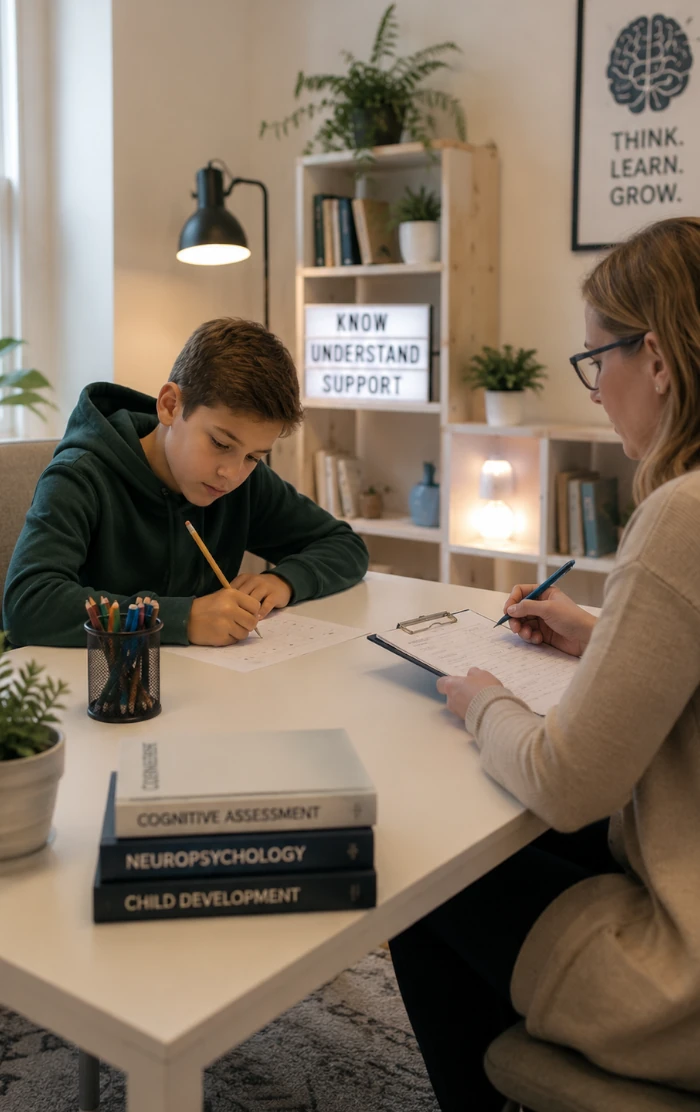
Professional child IQ testing in Portland – whether you need an assessment for school placement, gifted program eligibility, or to understand your child's learning profile, we connect you with licensed psychologists in the Portland area.
Last Updated: July 2026
Gifted Testing
Identify giftedness for school placement, enrichment, and talent programs using WISC-V or Stanford-Binet 5.
WISC-V Test
Wechsler Intelligence Scale for Children® Fifth Edition – the gold standard for child IQ testing.
Stanford-Binet 5
Stanford-Binet Intelligence Scales Fifth Edition – comprehensive cognitive assessment for all ages.
Full Evaluation
Combined assessment with detailed report and recommendations. Includes WISC-V or Stanford-Binet 5.
School Placement Testing
Testing for private school admission and gifted program eligibility using WISC-V or Stanford-Binet 5.
Schedule Child IQ Testing
Book your WISC-V & Stanford-Binet 5 for ages 6–16. Gifted identification, learning profiles, etc. with a licensed psychologist in Portland today.
Child IQ Testing in Portland: city context
Portland serves a diverse school-age population across Portland Public Schools and surrounding districts. The Census Bureau estimates that 16.3% of Portland residents are under age 18. Families seek child testing for TAG identification, ACCESS Academy questions, acceleration, independent-school planning, learning concerns, disability documentation, twice-exceptional profiles or a clearer understanding of cognitive strengths.
Local resources include PPS, nearby public districts, independent schools, OHSU Doernbecher Children's Hospital, the Child Development and Rehabilitation Center, university and community clinics, and licensed child psychologists and neuropsychologists.
IQ, gender, language, and demographic context
Child IQ tests such as the WISC-V and Stanford-Binet 5 use national age-based norms. They do not use separate Portland norms for boys and girls, and overall IQ distributions overlap substantially by sex. Individual children may show meaningful differences among verbal, visual-spatial, fluid-reasoning, working-memory and processing-speed abilities.
- Residents under age 18: 16.3% of Portland's population.
- Female residents: 50.3% of the total city population.
- Hispanic or Latino: 12.0%.
- Black or African American alone: 5.7%.
- American Indian and Alaska Native alone: 0.8%.
- Asian alone: 8.1%.
- Native Hawaiian and Other Pacific Islander alone: 0.6%.
- Two or more races: 12.7%.
- Language other than English spoken at home: 17.5% of residents age five and older.
No valid local source supports assigning IQ averages to Portland children by gender, race, ethnicity, school district or neighborhood. Equitable assessment considers language exposure, educational opportunity, disability, culture, health and the appropriateness of the selected test.
Portland School Districts and Gifted Programs
Portland Public Schools Talented and Gifted Services
- Universal screening: PPS states that all students are screened for TAG services in second grade.
- Referral: Students may be referred for screening and services at any time, so families should ask the school TAG coordinator about current procedures and deadlines.
- Service model: TAG services are available at all PPS schools and focus on instruction matched to the student's assessed level and rate of learning, subject acceleration and other supports.
- ACCESS Academy: A grades 2–8 accelerated program for highly gifted students. Current eligibility guidance references the 99th percentile on a nationally normed test plus additional requirements and available-space procedures.
Oregon Identification Rules
- Multiple evidence: Oregon requires local district procedures and a team decision; no single test, measure or score should be the sole criterion.
- Areas: Districts identify intellectual giftedness and academic talent and may identify creative, leadership or visual/performing-arts talent under local policy.
- Equity: Districts must make efforts to identify students from historically underidentified groups, including students with disabilities and culturally or economically diverse students.
Beaverton School District
- District testing: Beaverton maintains its own TAG screening and identification procedures.
- Private reports: The district states that it does not accept private testing for TAG identification.
- Programs: Families should review current school-based services and Summa options directly with the district because grade configuration and placement procedures can change.
Other Portland-Metro Districts
- East and central metro: David Douglas, Parkrose, Centennial, Reynolds, Gresham-Barlow and North Clackamas maintain separate TAG plans.
- South and west metro: Lake Oswego, Tigard-Tualatin, West Linn-Wilsonville, Hillsboro and other districts use their own identification, portability and service rules.
- Action step: Obtain the current district plan before arranging private testing; acceptance of outside scores differs.
Portland Private Schools and Testing Requirements
Oregon Episcopal School
Independent PreK–12 school in Southwest Portland. Admissions may use records, recommendations, interviews, observations and school-selected assessments; verify current grade-specific requirements.
Catlin Gabel School
Independent school serving preschool through grade 12. Confirm current admissions, testing and financial-aid procedures directly with the school.
Jesuit High School
Catholic college-preparatory school in the Beaverton area. Entrance and placement procedures are school-specific and may change by application year.
St. Mary's Academy
Catholic college-preparatory high school in downtown Portland. Families should confirm current entrance testing, records and interview requirements.
Central Catholic High School
Catholic secondary school in Southeast Portland with its own admissions and placement process.
Northwest Academy
Independent middle and high school emphasizing academics and arts. Confirm whether outside cognitive testing is requested or merely supplemental.
International School of Portland
Language-immersion elementary program. Language background and program fit require school-specific review rather than assumptions based on IQ alone.
Other Independent Schools
French American International School, Valley Catholic, Portland Jewish Academy and other schools maintain separate application and accommodation practices.
Do not assume that an independent school requires or accepts a WISC-V or Stanford-Binet report. Ask for the exact accepted test, examiner credentials, report format, testing window and whether the school prefers its own admissions measure.
Portland Gifted Identification Statistics
Portland does not publish a valid citywide “average IQ,” and the number of children receiving TAG services depends on district boundaries, identification methods, student mobility, referral practices and state reporting definitions. PPS's universal second-grade screening is designed to broaden access, but screening does not mean every student receives an individual clinical IQ test.
- Screening versus evaluation: Group screeners identify students who may need further review; a WISC-V or Stanford-Binet is an individual clinical assessment.
- 97th percentile context: Oregon rules historically reference the 97th percentile for intellectual or academic evidence while also requiring team review and pathways for demonstrated potential.
- 99th percentile context: PPS ACCESS Academy uses more selective eligibility guidance than general TAG identification and includes additional program requirements.
- Underidentification: Multilingual learners, students with disabilities, low-income students and children whose advanced ability is masked by behavior or inconsistent achievement may require broader evidence.
- No gender quota: Boys and girls are not assigned different IQ standards; differences in referral patterns should not be mistaken for biological differences in intelligence.
The child IQ testing process: step by step
Understanding the testing process can help parents prepare their child and reduce anxiety. Here's what to expect:
- Initial consultation (15–20 minutes): A brief phone or video call with the psychologist to discuss your child's background, concerns, and goals. This helps determine the right test and approach.
- Testing session (60–90 minutes): The child meets one-on-one with a licensed psychologist in a quiet, comfortable room. The psychologist administers the WISC-V or Stanford-Binet 5, which includes a series of subtests measuring verbal comprehension, visual-spatial reasoning, fluid reasoning, working memory, and processing speed. Breaks are offered as needed.
- Scoring and interpretation (1–2 days): The psychologist scores the test and analyzes the results. They consider the child's age, background, and any relevant medical or educational history.
- Feedback session (45–60 minutes): The psychologist meets with the parents (and the child, if appropriate) to explain the results. They discuss the Full-Scale IQ, index scores, strengths, and areas for growth. They also provide tailored recommendations for home, school, and extracurriculars.
- Comprehensive written report (5–7 days): You receive a detailed report with all scores, normative comparisons, and actionable next steps. This report can be shared with schools, doctors, or other professionals.
The entire process from consultation to report usually takes 1–2 weeks, depending on scheduling. The testing itself is non-invasive and designed to be engaging for children.
What is the WISC-V test?
The WISC-V (Wechsler Intelligence Scale for Children® – Fifth Edition) is the most widely used IQ test for children aged 6:0–16:11. It provides a Full-Scale IQ and five primary index scores: Verbal Comprehension, Visual-Spatial, Fluid Reasoning, Working Memory, and Processing Speed. The test is administered one-on-one by a trained psychologist and takes about 60–90 minutes.
The WISC-V is normed on a large, representative sample of U.S. children and is updated regularly to ensure accuracy. It is the gold standard for gifted identification, learning disability diagnosis, and school placement.
Why test your child's IQ?
IQ testing provides valuable insights into your child's cognitive strengths and weaknesses. It can help:
- Identify giftedness: For admission to gifted programs, private schools, or enrichment opportunities.
- Diagnose learning disabilities: Such as dyslexia, dyscalculia, or ADHD, which can be masked by high intelligence.
- Guide educational planning: Tailor instruction to your child's unique learning profile.
- Provide reassurance: Understand why your child is different from peers and how to support them.
Portland Gifted Testing Timeline
- Clarify the receiving program: Contact PPS, ACCESS Academy, another district or an independent school before testing.
- Request current criteria: Ask about accepted tests, percentiles, age limits, outside reports, required achievement data, deadlines and retest intervals.
- Review school screening: PPS screens all students in second grade; referral remains possible at other times.
- Choose the right scope: Select stand-alone cognitive testing only when sufficient; use a full psychoeducational evaluation for learning, attention or twice-exceptional questions.
- Schedule early: Allow time for consultation, records, testing, scoring, report preparation, feedback and any district review before application deadlines.
- Plan for fatigue and travel: Avoid testing after poor sleep, illness, long cross-metro travel or a demanding school day.
- Submit only what is requested: Protect the child's privacy and send the complete report only to authorized recipients.
Portland Gifted Programs by Age Group
Early Childhood and Kindergarten
- Young children may be assessed with the Stanford-Binet 5 or another developmentally appropriate measure when there is a clear referral question.
- Preschool enrichment, libraries, OMSI, arts programs and play-based learning may be more useful than premature labeling.
- School-readiness and early-entry rules are separate from general gifted identification.
Elementary School
- PPS universal second-grade screening and school referrals are central routes for TAG review.
- Services may include differentiated instruction, subject acceleration and adjusted pace within the neighborhood school.
- ACCESS Academy serves highly gifted students in grades 2–8 under current eligibility and space rules.
Middle School
- Advanced mathematics, compacted curriculum, ACCESS, electives and high-school-level coursework may be available depending on school and district.
- Social-emotional fit, executive function and twice-exceptional needs become increasingly important.
High School
- AP, IB, dual credit, career-technical education, arts pathways, early college and subject acceleration vary by school.
- Benson Polytechnic, Jefferson Middle College, Metropolitan Learning Center, Alliance and other focus or alternative programs have distinct missions and admissions procedures.
- A clinical IQ score rarely determines high-school course placement by itself.
Portland Child ADHD and Learning Disability Assessment
Child ADHD and learning-disability assessment should be broader than an IQ test. A full evaluation may include WISC-V or Stanford-Binet testing, reading/writing/math achievement, attention and executive-function measures, behavior ratings, interviews, observation, records and language or motor assessment when indicated.
- School evaluation: Parents may request an evaluation through the public school when a disability is suspected. Eligibility is determined under educational rules and is not identical to a private diagnosis.
- OHSU and specialty care: Doernbecher pediatric neuropsychology and the Child Development and Rehabilitation Center address selected complex developmental and medical referrals.
- Twice-exceptionality: High reasoning can mask dyslexia, ADHD, autism or other disabilities, while disability can suppress Full-Scale IQ. Index and subtest patterns require careful interpretation.
- Language and culture: Multilingual development and educational history should be evaluated before interpreting verbal or achievement differences.
- Report utility: Recommendations should identify concrete classroom supports, not simply provide labels and scores.
Portland Summer and Enrichment Programs for Advanced Learners
- OMSI: Science, technology, engineering and hands-on learning programs subject to current schedules and age requirements.
- Saturday Academy: Regional STEM and enrichment programming for youth, with offerings that change by season.
- Libraries: Multnomah County Library and neighboring systems offer reading, maker, coding and cultural programs.
- Universities and colleges: PSU, OHSU, Reed, Lewis & Clark, University of Portland and community partners may offer camps, lectures or youth programs.
- Arts and nature: Portland Art Museum, Oregon Zoo, World Forestry Center, parks, outdoor schools, music organizations and theater programs support strengths beyond traditional academics.
- Program fit: Enrichment should match interests, maturity, sensory needs, transportation and social-emotional readiness rather than being selected only from an IQ score.
Portland Child Testing Costs and School Evaluations
Private fees vary by clinician, referral question, test battery, records review, report length and feedback. A stand-alone cognitive assessment generally costs less than a full psychoeducational or neuropsychological evaluation. Request a written estimate covering consultation, testing, scoring, report preparation, feedback and any school meeting.
- Public-school evaluation: When a disability is suspected and the school agrees an evaluation is warranted, eligible educational evaluation is provided through the district rather than billed as private testing.
- TAG screening: District screening and identification procedures are separate from private psychologist fees.
- Insurance: Coverage is more likely when testing is medically necessary than when requested solely for gifted placement or school admission.
- Outside-test acceptance: Beaverton states that it does not accept private testing for TAG identification; other districts and schools have different rules.
- Travel cost: Parking at OHSU or central-city locations, bridge travel and missed work or school may add practical expense.
Areas we serve
Child IQ testing resources serve Portland neighborhoods and families throughout the Oregon side of the metro area, including Beaverton, Hillsboro, Tigard, Tualatin, Lake Oswego, Milwaukie, Happy Valley, Oregon City, West Linn, Gresham, Troutdale, Fairview and surrounding communities.
- District boundaries matter: A Portland mailing address does not always mean Portland Public Schools.
- Washington families: Vancouver-area families should use a clinician licensed where the child is located and verify Washington school rules separately.
- Before testing: Obtain written criteria from the receiving district, ACCESS Academy or independent school.
Frequently Asked Questions
Both are excellent tests. WISC-V is more commonly used for school-age children, while Stanford-Binet 5 can be used for ages 2–85. We often recommend WISC-V for gifted identification.
The test itself takes 60–90 minutes. With the consultation, feedback, and report, the entire process is about 1–2 weeks.
No, you can book directly with our psychologists. We serve both self-referred and professionally referred children.
A report may be considered, but acceptance is never automatic. Confirm PPS, charter, private-school or program requirements before testing.
Some plans cover cognitive assessments when there is a clinical indication. Check with your provider.
Get a good night's sleep, eat a healthy meal, and arrive relaxed. No specific preparation is needed.
You'll receive a comprehensive report with your child's scores and tailored recommendations.
Remote administration may be possible only in limited circumstances. The evaluator must confirm publisher guidance, test validity, state licensing, technology requirements, and acceptance by the receiving school or organization.