
IQ Testing in Peoria
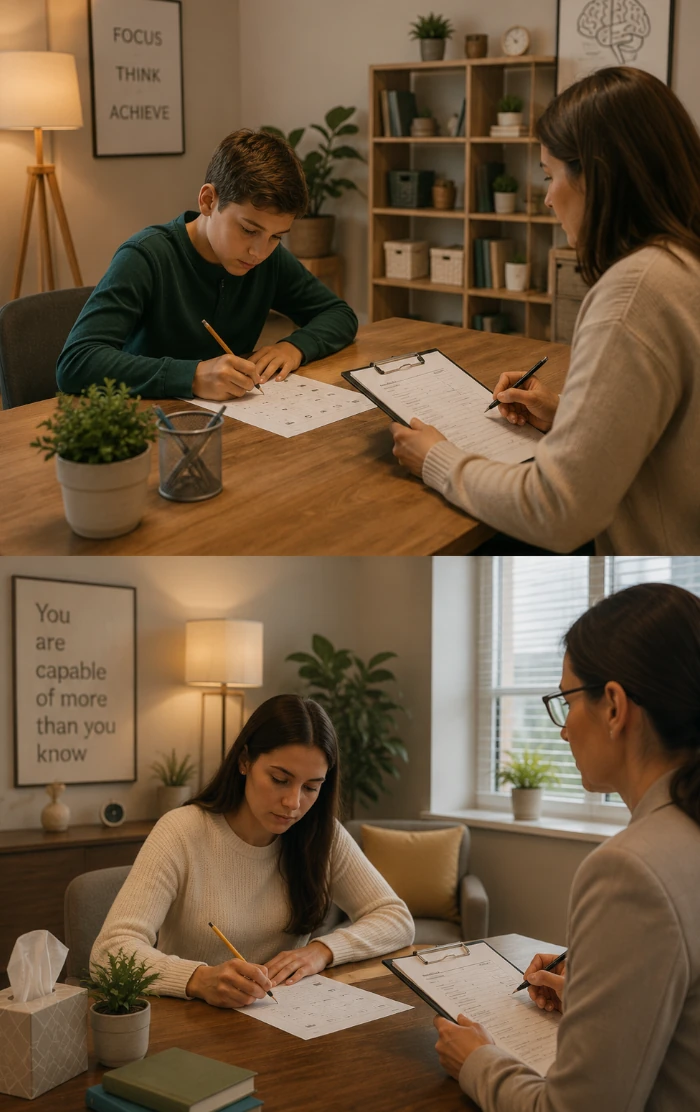
Professional IQ testing in Peoria – whether you need an assessment for school, employment, gifted program eligibility, or personal insight, we connect you with licensed psychologists in the Peoria area.
Last Updated: September 2026
Child IQ Testing
WISC-V & Stanford-Binet for ages 6–16. Gifted identification, learning profiles.
Adult IQ Testing
WAIS-IV & WAIS-5 available. Comprehensive adult cognitive assessments. Clinical & occupational.
WISC-V Test
Wechsler Intelligence Scale for Children® Fifth Edition – the gold standard for child IQ testing.
WAIS-IV & WAIS-5 Tests
Wechsler Adult Intelligence Scale® – Fourth Edition (WAIS-IV) and Fifth Edition (WAIS-5) available for adult IQ testing.
Gifted Testing
Identify giftedness for school placement, enrichment, and talent programs using WISC-V or Stanford-Binet.
Stanford-Binet 5
Stanford-Binet Intelligence Scales Fifth Edition – comprehensive cognitive assessment for all ages.
Mensa Testing
Mensa admission testing and preparation for the high-IQ society. Accepts WAIS-IV, WAIS-5, and Stanford-Binet 5 scores.
Full Evaluation
Combined assessment with detailed report and recommendations. Includes WISC-V, WAIS-IV, WAIS-5, or Stanford-Binet 5 as appropriate.
IQ Testing in Peoria: city context
Gender, age and demographic statistics
Peoria had an estimated 200,881 residents on July 1, 2025. Census 2020–2024 estimates report that 51.5% of residents are female, 22.7% are under age 18, and 19.6% are age 65 or older. The city is 70.3% White alone, 3.4% Black alone, 1.0% American Indian or Alaska Native alone, 5.4% Asian alone, 0.1% Native Hawaiian or Other Pacific Islander alone, 14.0% reporting two or more races, and 20.7% Hispanic or Latino; race and Hispanic-origin categories are not mutually exclusive.
These figures describe community context, not intelligence. IQ scores must be interpreted individually in light of age, education, disability, health, culture, language exposure, and testing conditions. In Peoria, 17.4% of residents age five and older speak a language other than English at home, and 11.2% are foreign-born. Bilingual history, schooling in each language, interpreter needs, and limits on verbal-score interpretation may therefore be important.
- Female residents: 51.5%.
- Children and teens: 22.7% are under 18.
- Older adults: 19.6% are 65 or older.
- Language context: 17.4% speak a language other than English at home.
- Educational context: 92.2% of adults age 25+ completed high school and 36.3% hold a bachelor’s degree or higher.
- Interpretation: No gender, racial, ethnic, immigration, age, or language group should be presumed to have a particular IQ profile.
What is professional IQ testing?
Intelligence quotient (IQ) testing is a standardized method to measure human cognitive abilities and intellectual potential. Professional IQ tests are administered by licensed psychologists in a controlled environment to ensure accuracy and reliability. Unlike online quizzes, clinical assessments provide a full-scale IQ score along with detailed breakdowns of verbal comprehension, perceptual reasoning, working memory, and processing speed.
In Peoria, IQ testing is commonly used for gifted program admission, learning disability identification, career guidance, neuropsychological evaluation, and personal development. The results are presented in a comprehensive report that includes normative comparisons, strengths and weaknesses, and actionable recommendations.
Who should get tested?
IQ testing can benefit children, adolescents, and adults in various situations:
- Children: Parents often seek testing for school readiness, gifted placement, or to understand learning challenges.
- Adults: Many adults take IQ tests for career advancement, graduate school applications, or personal curiosity.
- Mensa candidates: High-IQ societies require official test scores for membership.
- Clinical referrals: Psychologists may recommend testing as part of a broader neuropsychological evaluation.
Types of IQ tests
We offer the most recognized and scientifically validated intelligence tests in the field:
- WISC-V (Wechsler Intelligence Scale for Children® – Fifth Edition): The gold standard for children aged 6:0–16:11. It provides a Full-Scale IQ and five primary index scores.
- WAIS-IV (Wechsler Adult Intelligence Scale® – Fourth Edition): The most widely used adult IQ test for ages 16–90. It measures cognitive functioning across four domains.
- Stanford-Binet Intelligence Scales – Fifth Edition: A comprehensive assessment for ages 2–85, often used for gifted identification and clinical evaluations.
- Gifted Testing: Often includes the WISC-V or Stanford-Binet, plus additional creativity and achievement measures.
- Mensa Testing: We provide official Mensa admission testing and preparation materials.
How the testing process works
- Initial consultation: Brief phone or video call to discuss your needs and match you with the right psychologist.
- Testing session: In-person or remote testing (depending on the test) with a licensed psychologist. Most sessions last 1–2 hours.
- Scoring and interpretation: The psychologist scores the test and interprets the results in the context of your background and goals.
- Feedback session: A detailed review of your results, including strengths, weaknesses, and practical recommendations.
- Comprehensive report: You receive a written report with all scores, normative comparisons, and actionable next steps.
How much does IQ testing cost in Peoria?
Fees depend on age, referral question, test battery, records, report length, and whether the service is a focused IQ assessment or a full psychoeducational or neuropsychological evaluation. A focused cognitive assessment may cost several hundred dollars; comprehensive evaluations can exceed $1,500–$3,000. Ask for a written estimate covering intake, testing, scoring, report, feedback, school or physician consultation, cancellation, and rush fees. Insurance is more likely to cover medically necessary diagnostic testing than gifted, school-admission, career, Mensa, or personal-interest testing.
Peoria’s Intellectual History & Legacy
Peoria grew from an agricultural settlement into a large West Valley city connected to the Phoenix metropolitan economy. Its contemporary knowledge economy combines healthcare, semiconductor packaging, advanced manufacturing, sports and tourism, digital media, public service, construction, and education.
- Technology and manufacturing: Amkor Technology’s planned advanced semiconductor packaging and testing campus, proximity to TSMC’s north Phoenix fabs, automation, engineering, quality, cleanroom operations, and supplier development.
- Healthcare and human services: HonorHealth, Banner Health, Cigna-related operations, outpatient systems, behavioral health, rehabilitation, senior care, and regional specialty referrals.
- Sports, culture, and environment: Peoria Sports Complex, P83, Lake Pleasant Regional Park, libraries, theaters, arts programs, desert recreation, and community events.
- Education and workforce: Peoria Unified, Huntington University Arizona, Glendale Community College, West-MEC, ASU’s West Valley campus, and regional training programs.
- Assessment principle: A city’s employers, schools, or economic reputation describe opportunity—not any resident’s individual intelligence.
Top Employers in Peoria Requiring Cognitive Skills
Peoria’s economy includes healthcare, semiconductor packaging, advanced manufacturing, education, public administration, retail, hospitality, sports, construction, logistics, and professional services. IQ results should never be a stand-alone hiring screen, but a cognitive profile may support career counseling or accommodation planning.
- Healthcare: HonorHealth, Banner Health, medical groups, behavioral-health providers, senior-care systems, rehabilitation, pharmacies, and insurance operations employ clinical, technical, administrative, and analytical staff.
- Semiconductors and advanced manufacturing: Amkor’s planned Peoria campus and the regional TSMC ecosystem create demand for engineering, process control, quality, facilities, automation, data, logistics, cybersecurity, and skilled trades.
- Education and public service: Peoria Unified, the City of Peoria, libraries, public safety, recreation, Maricopa County, and nearby colleges employ teaching, planning, data, communication, and operational skills.
- Sports, tourism, hospitality, and retail: Peoria Sports Complex, P83, Arrowhead-area commerce, resorts, restaurants, entertainment, and Lake Pleasant recreation require customer service, scheduling, event operations, marketing, and management.
- Construction, real estate, and logistics: Rapid growth in northern Peoria supports planning, design, engineering, construction management, supply chains, warehousing, utilities, and environmental compliance.
Career decisions should combine cognitive data with interests, values, education, personality, credentials, work samples, disability needs, ethics, teamwork, and current labor-market evidence.
Peoria IQ Testing by City Area
- Old Town and central Peoria: Peoria Avenue, Grand Avenue, 83rd Avenue, city services, libraries, schools, and local transit provide access to central neighborhoods.
- P83 and Peoria Sports Complex: Loop 101, Bell Road, 83rd Avenue, hotels, restaurants, medical offices, entertainment, and spring-training traffic shape appointment planning.
- Arrowhead and Plaza del Rio corridors: Medical campuses, Banner and HonorHealth services, office buildings, Thunderbird Road, Union Hills Drive, and Loop 101 connect many healthcare and assessment referrals.
- North Peoria, Vistancia, and Lake Pleasant: Loop 303, Happy Valley Road, Lake Pleasant Parkway, and longer cross-city trips require extra travel time; public transit is more limited than in central Peoria.
- West and south Peoria: Olive Avenue, Northern Avenue, 91st and 99th avenues, U.S. 60, and neighboring Glendale connections serve established residential and commercial areas.
- Selection principle: Choose an evaluator for credentials, instrument, scope, language access, report quality, and fit—not repeated neighborhood keywords.
Peoria Universities and Research Institutions
- Huntington University Arizona: Peoria campus programs emphasize film, animation, broadcast media, and digital production, with undergraduate and related professional pathways.
- Glendale Community College: Serves the West Valley with transfer, health, business, STEM, technical, arts, and workforce programs at main and north campuses.
- Arizona State University West Valley: Offers undergraduate and graduate education in business, education, forensics, interdisciplinary arts and sciences, psychology-related fields, and public service within the broader northwest metro.
- Midwestern University: Nearby Glendale health-professions campus supports medicine, pharmacy, dentistry, psychology, occupational therapy, optometry, and clinical training.
- Grand Canyon University, University of Arizona College of Medicine–Phoenix, and Maricopa colleges: Expand graduate, healthcare, research, teacher preparation, and prerequisite options across the metro.
- Industry research: Semiconductor packaging, materials, bioscience, medical technology, water, heat resilience, autonomous systems, and advanced manufacturing create applied research and workforce-development opportunities.
Peoria Economic Context
- Median household income: $95,815 in 2020–2024 Census estimates.
- Per-capita income: $47,834.
- Residents in poverty: 8.4%.
- Bachelor’s degree or higher: 36.3% of adults age 25 and older.
- Mean travel time to work: 28.2 minutes, though Phoenix-metro commuting, Loop 101/303 congestion, construction, heat, and event traffic can lengthen trips.
- Health and social-assistance activity: Approximately $1.35 billion in 2022 receipts/revenue within the city.
- Transportation and warehousing: Approximately $114.0 million in 2022 receipts/revenue.
- Retail sales: Approximately $4.91 billion in 2022, or $24,822 per capita.
- Accommodation and food services: Approximately $668.5 million in 2022.
- Regional strengths: Healthcare, semiconductor packaging and the broader chip supply chain, advanced manufacturing, bioscience, aerospace and defense, sports and tourism, hospitality, retail, construction, public service, education, logistics, and professional services.
Economic statistics describe access to education, employment, healthcare, housing, and transportation; they do not determine any individual’s intelligence. Evaluators should consider whether work schedules, financial stress, heat exposure, health access, housing instability, or unequal educational opportunity affected background or testing conditions.
An online IQ test offers Peoria residents a convenient way to explore reasoning questions, whereas school placement, accommodations, or clinical decisions require professionally administered testing.
Peoria Public Schools Data
Peoria Unified and district boundaries
Most Peoria students attend Peoria Unified School District, while portions of the city are served by Deer Valley Unified, Nadaburg Unified, or Wickenburg Unified. Families should verify the assigned district and school because city boundaries and school-district boundaries are not identical.
Arizona identification framework
Arizona districts must identify at least students who score at or above the 97th percentile on national norms in verbal, nonverbal, or quantitative reasoning on a State Board-approved test. Districts may use additional criteria and must verify outside results. A private Full Scale IQ alone is not automatically the required state score.
Peoria Unified gifted services
Peoria Unified permits referrals by parents, teachers, or administrators. Its published continuum includes a multi-age pull-out enrichment model for at least 90 minutes per week, K–2 Advanced Gifted Accelerated classrooms, and the self-contained Advanced Gifted Academy at Apache Elementary for grades 3–8. Current campus, testing, transportation, and placement rules should be confirmed directly.
Advanced secondary pathways
High-school planning may include honors, Advanced Placement, dual enrollment, advanced mathematics and science, fine arts, athletics, Career and Technical Education, West-MEC programs, internships, digital media, and subject acceleration. Course prerequisites and demonstrated achievement generally matter more than one IQ score.
Responsible use of results
A psychological report should explain the student’s cognitive profile, validity, language history, disability needs, educational implications, and practical recommendations. It should not promise placement or substitute for the receiving school’s formal decision process.
Local Testing Centers and Psychologists
- RONIC Psychological Services L.L.C.: 13128 N. 94th Drive, Suite 203, Peoria, AZ 85381; (623) 977-1869. The practice lists comprehensive psychological, neuropsychological, developmental, and forensic evaluations that may include intelligence testing and assessment of intellectual functioning. Confirm the exact instrument, age range, purpose, report format, fees, insurance, and current availability.
- Dr. Howe Psychology: Provides psychological testing and cognitive evaluations for children, adolescents, and adults in the Peoria area. Confirm the physical appointment location, phone area code, and whether the requested WISC, WAIS, Stanford-Binet, gifted, or school report is offered.
- Arizona Child Psychology and regional gifted-testing practices: Phoenix-area specialists may offer child gifted, psychoeducational, ADHD, autism, and learning evaluations. Verify distance, instrument, state-approved score requirements, and whether the report is accepted by the receiving district.
- HonorHealth, Banner Health, Phoenix Children’s, Barrow, and Mayo Clinic: Medical, developmental, rehabilitation, neurological, and neuropsychological referrals may be appropriate when cognitive concerns follow injury, illness, epilepsy, stroke, cancer treatment, developmental change, or memory decline.
- Peoria Unified and other school districts: Public-school evaluations follow education law and district procedures and are not replaced by a privately purchased score.
- Selection checklist: Verify Arizona licensure, examiner qualifications, test edition, age range, language procedures, report recipient, accommodations, fees, insurance, turnaround, and whether results meet school, Mensa, disability, legal, clinical, or workplace requirements.
Peoria Events and Conferences
Educational and professional-development opportunities are available through Peoria Unified, Huntington University Arizona, Glendale Community College, ASU, Midwestern University, libraries, healthcare systems, chambers, and regional professional associations.
- Education and career events: College fairs, employer events, semiconductor-workforce programs, STEM showcases, digital-media screenings, university open houses, and West-MEC career events.
- Healthcare and psychology: Continuing education, public lectures, parent workshops, disability resources, hospital programs, and regional clinical conferences.
- Gifted-family enrichment: Coding, robotics, math, science, writing, music, visual arts, libraries, parks, desert ecology, Lake Pleasant programs, and university youth opportunities.
- Travel planning: Spring training, concerts, sports tournaments, holiday events, P83 crowds, road construction, and extreme heat can affect parking and travel.
Transportation and Accessibility
- Major roads: Loop 101/Agua Fria Freeway serves eastern and central Peoria; Loop 303 serves northern and western growth areas; U.S. 60/Grand Avenue is a major southeast corridor; Arizona State Route 74 connects the far north; and Bell Road, Peoria Avenue, Thunderbird Road, Olive Avenue, Happy Valley Road, Lake Pleasant Parkway, and 83rd, 91st, and 99th avenues carry important local traffic.
- Public transit: Peoria and Valley Metro operate fixed-route bus service, including service along 67th Avenue, 83rd Avenue, Peoria Avenue, Thunderbird Road, and Grand Avenue. The Peoria Transit Center connects multiple routes. Schedules and route numbers can change, so verify the current trip in Valley Metro’s planner.
- On-demand and paratransit: Peoria On-Demand provides shared-ride trips within the city. Valley Metro ADA paratransit and RideChoice may support eligible riders. Confirm certification, reservation windows, pickup zones, fares, and visitor eligibility before testing day.
- Airport: Phoenix Sky Harbor International Airport (PHX) is generally about 25–35 miles southeast of Peoria, depending on the starting point. Phoenix Deer Valley Airport and Glendale Municipal Airport support general aviation closer to the West Valley.
- Distance to other cities: Glendale is adjacent and often 10–25 minutes away; downtown Phoenix is roughly 20–30 miles or 30–50 minutes; Scottsdale is about 30–40 miles or 40–60 minutes; Mesa is about 40–50 miles or 50–75 minutes; Prescott is about 90 miles or 1.5–2 hours; Flagstaff is roughly 135 miles or 2–2.5 hours; and Tucson is about 140–155 miles or 2–2.5 hours. Heat, crashes, construction, spring-training traffic, and rush hour can substantially change travel times.
- Walkability: Old Town Peoria, the P83 entertainment district, areas around the Peoria Sports Complex, and selected mixed-use centers have the strongest concentration of nearby destinations. Most of the city remains automobile-oriented, especially northern master-planned communities and office corridors.
- Bike infrastructure: Peoria maintains more than 20 miles of city trails and multi-use paths, with additional regional, park, desert, and on-street bicycle connections. The New River Trail, Skunk Creek Trail connections, Rio Vista Recreation Center area, and Lake Pleasant-region routes support recreation and some practical trips; shade and water planning are essential in hot weather.
- Accessibility and appointment planning: Confirm accessible parking, curb cuts, elevator access, quiet waiting space, sensory conditions, and break policies. Allow extra time during spring training, major events at P83, Loop 101 or Loop 303 construction, monsoon storms, dust, and extreme-heat advisories.
Peoria Weather and Seasonal Considerations
- Extreme heat: Late-spring and summer temperatures can exceed 105°F. Dehydration, heat exposure, headaches, medication effects, and poor sleep may reduce stamina; morning appointments are often preferable.
- Monsoon storms: Summer thunderstorms can bring intense rain, lightning, high winds, flash flooding, and sudden road closures, especially near washes and low-water crossings.
- Dust storms: Blowing dust can sharply reduce visibility on Loop 101, Loop 303, U.S. 60, and arterial roads. Pull off the roadway safely rather than attempting to drive through severe dust.
- Winter conditions: Winters are generally mild, but cold mornings, rain, and occasional regional mountain snow can affect travelers coming from northern Arizona.
- Allergies and air quality: Desert pollen, dust, ozone, smoke, and seasonal allergens can affect sleep, attention, breathing, and medication use.
- Testing principle: Acute illness, unsafe travel, severe sleep loss, heat illness, storm anxiety, or major medication changes should be documented and may justify postponing testing.
Areas we serve
We support all areas of Peoria.
Frequently Asked Questions
WISC-V is for children aged 6–16, while WAIS-IV is for adults aged 16–90. Each is normed for its specific age group.
Most IQ tests take between 60 and 90 minutes, plus a feedback session. Allow 2–3 hours total.
No, you can book directly with our psychologists. We serve both self-referred and professionally referred individuals.
Some professionally administered scores may be submitted as prior evidence, but acceptance is determined solely by American Mensa under its current rules.
Some plans cover cognitive assessments when there is a clinical indication. Check with your provider.
Get a good night's sleep, eat a healthy meal, and arrive relaxed. No specific preparation is needed.
You'll receive a comprehensive report with your scores and tailored recommendations.
Interviews and feedback may be available remotely, but many standardized cognitive tests require controlled administration and may need an in-person appointment. Contact us for details.