
Child IQ Testing in Paterson, NJ

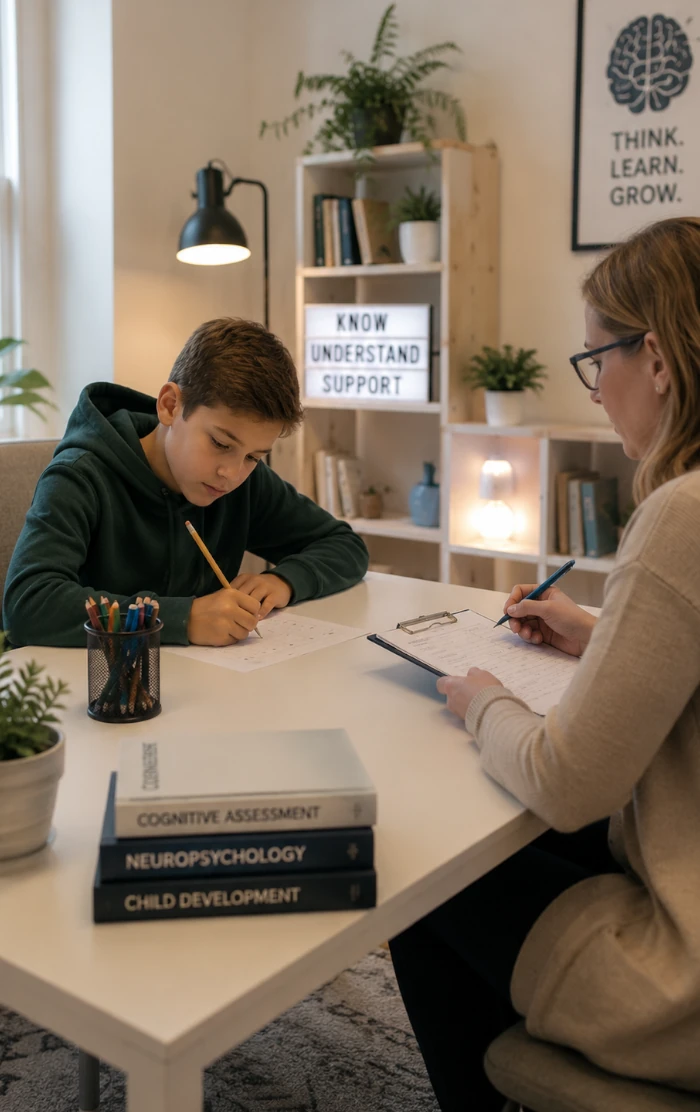
Professional child IQ testing in Paterson, NJ – whether you need an assessment for school placement, gifted program eligibility, or to understand your child's learning profile, we connect you with licensed psychologists in the Paterson, NJ area.
Last Updated: September 2026
Gifted Testing
Identify giftedness for school placement, enrichment, and talent programs using WISC-V or Stanford-Binet 5.
WISC-V Test
Wechsler Intelligence Scale for Children® Fifth Edition – the gold standard for child IQ testing.
Stanford-Binet 5
Stanford-Binet Intelligence Scales Fifth Edition – comprehensive cognitive assessment for all ages.
Full Evaluation
Combined assessment with detailed report and recommendations. Includes WISC-V or Stanford-Binet 5.
School Placement Testing
Testing for private school admission and gifted program eligibility using WISC-V or Stanford-Binet 5.
Schedule Child IQ Testing
Book your WISC-V & Stanford-Binet 5 for ages 6–16. Gifted identification, learning profiles, etc. with a licensed psychologist in Paterson, NJ today.
Child IQ Testing in Paterson, NJ: city context
Paterson is a dense and youthful Passaic County city. The Census Bureau estimated 161,793 residents in 2025, with 27.7% under age 18, within about 8.41 square miles. School referral, developmental assessment, gifted identification, learning support, and disability documentation are therefore important questions for many local families.
Paterson is also highly multilingual: 44.6% of residents are foreign born and 67.3% of people age five and older speak a language other than English at home. Child testing should document language exposure, years of schooling, interrupted education, interpreter use, sensory or motor needs, and whether scores can be validly compared with the test’s normative sample.
Families seek child cognitive assessment for gifted identification, learning differences, attention concerns, developmental or diagnostic clarification, twice-exceptionality, school placement, and private educational planning. A test should be selected for a defined question; one Full Scale IQ score cannot replace developmental history, achievement testing, classroom data, behavior ratings, and professional judgment.
Paterson’s population density was approximately 18,986 people per square mile in the 2020 Census, so families may live close to schools and clinics yet still face traffic, parking, transit, childcare, and work-schedule barriers. About 21.2% of residents live in poverty, 21.3% of people under age 65 lack health insurance, and median gross rent was $1,548 in 2020–2024 estimates. These conditions can affect access to private testing, continuity of care, sleep, nutrition, and educational opportunity, but they do not define a child’s cognitive potential.
For multilingual children, the examiner should ask which language was learned first, which is strongest now, where each language is used, whether literacy was taught in one or more languages, and whether the child has experienced interrupted schooling. An interpreter can support interviews and consent, but standardized test administration through an interpreter may invalidate norms unless the test publisher and professional standards permit it. The report should clearly state any modifications and interpretive limits.
Useful records may include report cards, attendance, NJSLA or district assessments, intervention data, IEP or Section 504 documents, English-language proficiency results, medical and developmental history, prior evaluations, work samples, and teacher observations. The best evaluation explains both strengths and needs and connects findings to practical recommendations rather than focusing only on a single composite score.
Paterson Public Schools and Gifted Programs
Paterson Public Schools operates the Paterson Academy for the Gifted and Talented at School 28 for qualifying students across the city in grades 2–8. The district describes accelerated pacing in core subjects, differentiated instruction, project-based learning, and attention to students’ academic, social, and emotional needs.
The published referral and identification process uses multiple measures that may include the Cognitive Abilities Test, NJSLA results, teacher questionnaires or recommendations, student essays, unit assessments, portfolios, grades, and attendance. Referrals may come from students, parents, teachers, or others familiar with the student’s abilities, and a trained selection committee makes final decisions.
The district states that English learners and students with IEPs or Section 504 plans should be considered, including use of nonverbal and domain-specific measures when appropriate. A private WISC-V or Stanford-Binet report may add information, but it does not automatically replace the district’s screening, selection, enrollment, or complaint procedures.
According to the district’s published process, all students not previously identified may be referred each year. Referrals can come from students, teachers, parents, or another person familiar with the child’s abilities, potential, products, or records. Screening creates a larger pool before more detailed identification, and the district may use existing NJSLA or unit-assessment information depending on grade.
The Cognitive Abilities Test is used to examine verbal, mathematical, and nonverbal reasoning. The district describes using domain scores to rank students for selection within academic areas rather than relying only on one total score. Teacher recommendations and evidence of advanced products or performance provide additional context, and the selection committee reviews the complete file.
Families transferring into Paterson should provide prior gifted records promptly. A previous district’s identification may be relevant, but the receiving district can apply its own procedures. Parents can also request information about the district’s gifted procedural-complaint process under New Jersey’s Strengthening Gifted and Talented Education Act.
Paterson, NJ Private Schools Requiring IQ Testing
There is no reliable citywide list showing that Paterson private, charter, magnet, or religious schools universally require an individually administered IQ test. Many schools rely on prior records, achievement data, interviews, readiness measures, portfolios, placement tests, or their own admissions procedures.
Before purchasing testing, ask the school in writing which test and edition it accepts, required score age, evaluator credentials, report sections, deadlines, language considerations, and whether the result is used for admission, class placement, gifted programming, accommodations, or scholarship review. Charter-school enrollment rules are not the same as private-school admissions.
When a school requests an evaluation, clarify whether it wants a cognitive score, an achievement profile, a psychoeducational diagnosis, readiness information, or documentation for accommodations. Those are different referral questions and may require different instruments. Ask whether the school accepts the WISC-V, Stanford-Binet 5, WPPSI, Woodcock-Johnson, Kaufman tests, or another named measure and whether it requires index scores, subtest scores, confidence intervals, behavioral observations, and recommendations.
Families should also ask who reviews the report, how confidential records are stored, whether scores affect enrollment or only placement, whether retesting is permitted, and what happens when language, disability, or cultural factors limit interpretation. A school’s request should be specific enough for the examiner to design an appropriate battery.
Paterson, NJ Gifted Identification Statistics
Paterson Public Schools does not publish a simple citywide statistic showing that a fixed percentage of children is gifted. The district’s process is designed to identify high-potential students across verbal, mathematical, and nonverbal domains using multiple measures and a selection committee rather than one private IQ cutoff.
National percentile labels should not be converted into a claim about how many Paterson students qualify. Local identification depends on current district policy, grade-level screening pools, available records, committee review, program capacity, and inclusive consideration of multilingual and disabled students.
Equity matters because traditional referrals can underidentify multilingual learners, children from low-income households, students with disabilities, and children whose advanced reasoning is not reflected in grades or behavior. Multiple entry points, universal or broad screening, nonverbal measures, local norms, portfolio evidence, and trained committee review can reduce—but not eliminate—those barriers.
A score near a cutoff should be interpreted with its confidence interval, measurement error, language demands, test conditions, and consistency with other evidence. Repeating a test solely to obtain a higher number can create practice effects and may violate program rules. Families should ask how the district handles borderline profiles, domain-specific strengths, twice-exceptionality, and appeals.
The child IQ testing process: step by step
Understanding the testing process can help parents prepare their child and reduce anxiety. Here's what to expect:
- Initial consultation (15–20 minutes): A brief phone or video call with the psychologist to discuss your child's background, concerns, and goals. This helps determine the right test and approach.
- Testing session (60–90 minutes): The child meets one-on-one with a licensed psychologist in a quiet, comfortable room. The psychologist administers the WISC-V or Stanford-Binet 5, which includes a series of subtests measuring verbal comprehension, visual-spatial reasoning, fluid reasoning, working memory, and processing speed. Breaks are offered as needed.
- Scoring and interpretation (1–2 days): The psychologist scores the test and analyzes the results. They consider the child's age, background, and any relevant medical or educational history.
- Feedback session (45–60 minutes): The psychologist meets with the parents (and the child, if appropriate) to explain the results. They discuss the Full-Scale IQ, index scores, strengths, and areas for growth. They also provide tailored recommendations for home, school, and extracurriculars.
- Comprehensive written report (5–7 days): You receive a detailed report with all scores, normative comparisons, and actionable next steps. This report can be shared with schools, doctors, or other professionals.
The full process includes intake, records review, testing, scoring, feedback, and report preparation. Timing varies with provider availability and referral complexity, so confirm deadlines before scheduling. The testing itself is non-invasive and designed to be engaging for children.
What is the WISC-V test?
The WISC-V (Wechsler Intelligence Scale for Children® – Fifth Edition) is the most widely used IQ test for children aged 6:0–16:11. It provides a Full-Scale IQ and five primary index scores: Verbal Comprehension, Visual-Spatial, Fluid Reasoning, Working Memory, and Processing Speed. The test is administered one-on-one by a trained psychologist and takes about 60–90 minutes.
The WISC-V is normed on a large, representative sample of U.S. children and is updated regularly to ensure accuracy. It is the gold standard for gifted identification, learning disability diagnosis, and school placement.
Why test your child's IQ?
IQ testing provides valuable insights into your child's cognitive strengths and weaknesses. It can help:
- Identify giftedness: For admission to gifted programs, private schools, or enrichment opportunities.
- Diagnose learning disabilities: Such as dyslexia, dyscalculia, or ADHD, which can be masked by high intelligence.
- Guide educational planning: Tailor instruction to your child's unique learning profile.
- Provide reassurance: Understand why your child is different from peers and how to support them.
Paterson, NJ Gifted Testing Timeline
The district states that gifted assessment begins around mid-February each school year, with screening, identification, selection, parent communication, and program planning occurring on the district’s published timeline. New students previously identified elsewhere who miss spring sessions may be screened during the first six weeks of the school year after enrollment.
Families should obtain the current application timeline, referral form, consent requirements, records list, open-house information, and complaint process directly from Paterson Public Schools. Private testing should be scheduled early enough for a complete report, but only after confirming that outside results are accepted and useful.
- Before referral: Gather school records, work samples, language history, prior evaluations, and examples of advanced reasoning or products.
- During district screening: Confirm consent, testing dates, make-up procedures, disability accommodations, and how multilingual status will be considered.
- After selection: Request the written decision, program description, transportation information, start date, and procedures for questions or complaints.
- For private testing: Allow time for intake, records review, one or more sessions, scoring, feedback, and a final report before any school deadline.
Children should arrive rested, fed, with usual prescribed medication taken as directed unless the treating clinician says otherwise. Parents should not coach test items or use leaked materials; test security protects validity and fairness.
Paterson, NJ Gifted Programs by Age Group
- Early childhood and grade 1: Classroom observation, developmental information, language history, and broad enrichment are often more informative than premature labeling. The district’s published gifted pathway begins with grade-level referral and screening procedures.
- Grades 2–8: The Paterson Academy for the Gifted and Talented at School 28 serves qualifying students citywide with accelerated and differentiated instruction.
- High school: Paterson students may pursue Advanced Placement, International Baccalaureate, STEAM, career-technical education, dual-credit, arts, and other accelerated pathways; prerequisites vary by school and program.
- Community enrichment: Paterson Free Public Library, Paterson Museum, Great Falls National Historical Park, PCCC, arts organizations, robotics, coding, language, music, and regional university programs can supplement school services.
Program participation should be based on current eligibility rules, student readiness, interests, support needs, and family circumstances—not an assumption that one score fits every educational decision.
Acceleration can take several forms: faster pacing, subject acceleration, grade skipping, curriculum compacting, advanced projects, mentorship, dual enrollment, or extracurricular study. The right option depends on academic readiness, social-emotional development, executive functioning, attendance, transportation, family preference, and available support.
Twice-exceptional students may need advanced content and disability accommodations at the same time. A child should not be denied appropriate challenge merely because of dyslexia, ADHD, autism, anxiety, physical disability, or language-learning status, and advanced ability should not be used to dismiss genuine support needs.
Paterson, NJ Child ADHD and Learning Disability Assessment
ADHD and learning-disability evaluation requires more than an IQ score. A comprehensive process may include developmental history, interviews, school records, achievement testing, rating scales across settings, attention and executive-function measures, behavior observations, and assessment of sleep, anxiety, trauma, language development, hearing, vision, and medical factors.
Families may request a school evaluation in writing when a disability is suspected. Paterson Public Schools maintains Child Find, special-education, Section 504, intervention, multilingual, and related-service procedures. A private evaluation may add detail but does not replace the school team’s legal process, and a school evaluation is not automatically equivalent to a broad clinical diagnosis.
St. Joseph’s Children’s Hospital Child Development Center at 11 Getty Avenue, Paterson, offers developmental, cognitive, and achievement testing and can be reached at (973) 754-2510. Confirm age, referral scope, insurance authorization, language services, wait time, and report acceptance before scheduling.
Learning-disability diagnosis usually requires evidence that academic skills are significantly and persistently affected despite appropriate instruction. Cognitive-achievement discrepancies are not the only accepted method, and a high IQ does not rule out dyslexia, dyscalculia, written-expression disorder, or ADHD. Conversely, weak school performance does not automatically indicate a disorder when language acquisition, attendance, instruction, stress, or health better explains the pattern.
A strong report should identify functional impact and recommend specific supports, such as explicit reading instruction, reduced-distraction testing, extended time when justified, assistive technology, organizational coaching, language services, counseling, or medical follow-up. Schools and testing agencies decide accommodations under their own standards; a diagnosis alone does not guarantee every requested support.
Paterson, NJ Summer Programs for Gifted Children
Summer options change annually and may include Paterson Free Public Library programs, City of Paterson recreation, Great Falls and Paterson Museum activities, PCCC youth or community offerings, school-district enrichment, arts, sports, STEM, coding, language, and regional university programs.
Families should compare age range, supervision, accessibility, cost, transportation, language support, academic intensity, and whether formal gifted identification is required. Enrichment can be valuable without a clinical IQ test.
Program quality varies. Look for clear learning goals, appropriately trained staff, reasonable group size, child-safety policies, emergency procedures, accessibility, and opportunities for depth rather than only extra worksheets. For children with disabilities or medical needs, discuss medication, sensory supports, behavior plans, mobility, communication, and emergency contacts in advance.
Low-cost enrichment can include independent reading projects, museum visits, local-history research, coding with free tools, mathematics circles, writing groups, citizen science, music practice, library challenges, and mentorship through trusted community organizations. Formal identification is not required for a child to pursue challenging interests.
Paterson, NJ Child Testing Costs by District
When Paterson Public Schools evaluates a student under applicable special-education law, eligible school-based assessment is provided through the public process rather than billed as a private clinical service. Gifted screening, special-education evaluation, private testing, and medical diagnostic assessment are separate systems with different rules.
Private fees vary by the number of instruments, records reviewed, examiner time, interpretation, feedback, and report detail. Ask the district whether outside testing is needed or accepted before paying. St. Joseph’s Child Development Center does not publish one universal price for every cognitive or developmental referral; confirm insurance, authorization, copays, deductibles, noncovered services, and written estimates directly.
Private billing may separate intake, testing, scoring, feedback, report writing, school consultation, record review, and forms. Ask whether the quoted fee includes all required sessions and a complete signed report. Also ask about charges for missed appointments, expedited deadlines, interpreter services, travel, attorney contact, or attendance at an IEP meeting.
When cost is a barrier, families can start with the public-school evaluation process, insurance-covered medical referrals when clinically appropriate, university or training clinics, community health resources, or payment-plan questions. The least expensive option is not always appropriate, but families should not be pressured into an unnecessary battery when the school or agency has not specified a need.
Areas we serve
Frequently Asked Questions
Both are excellent tests. WISC-V is more commonly used for school-age children, while Stanford-Binet 5 can be used for ages 2–85. We often recommend WISC-V for gifted identification.
The testing session often takes about 60–90 minutes for a focused measure, but broader batteries take longer. Intake, records review, scoring, feedback, and report timing vary by provider and referral complexity.
Referral requirements vary. Contact the psychologist directly and ask whether self-referral is accepted; insurance, school, or agency funding may require authorization or a formal referral.
A private report may be reviewed as one source of information, but Paterson Public Schools and each private program apply their own current eligibility, score, recency, instrument, and documentation rules. Obtain those requirements before testing; no private report guarantees admission or placement.
Some plans cover cognitive assessments when there is a clinical indication. Check with your provider.
Get a good night's sleep, eat a healthy meal, and arrive relaxed. No specific preparation is needed.
You'll receive a comprehensive report with your child's scores and tailored recommendations.
Some interview and feedback components may be available remotely, but many standardized cognitive tests require in-person administration. Confirm with the psychologist and the organization receiving the report.