
IQ Testing in Pasadena

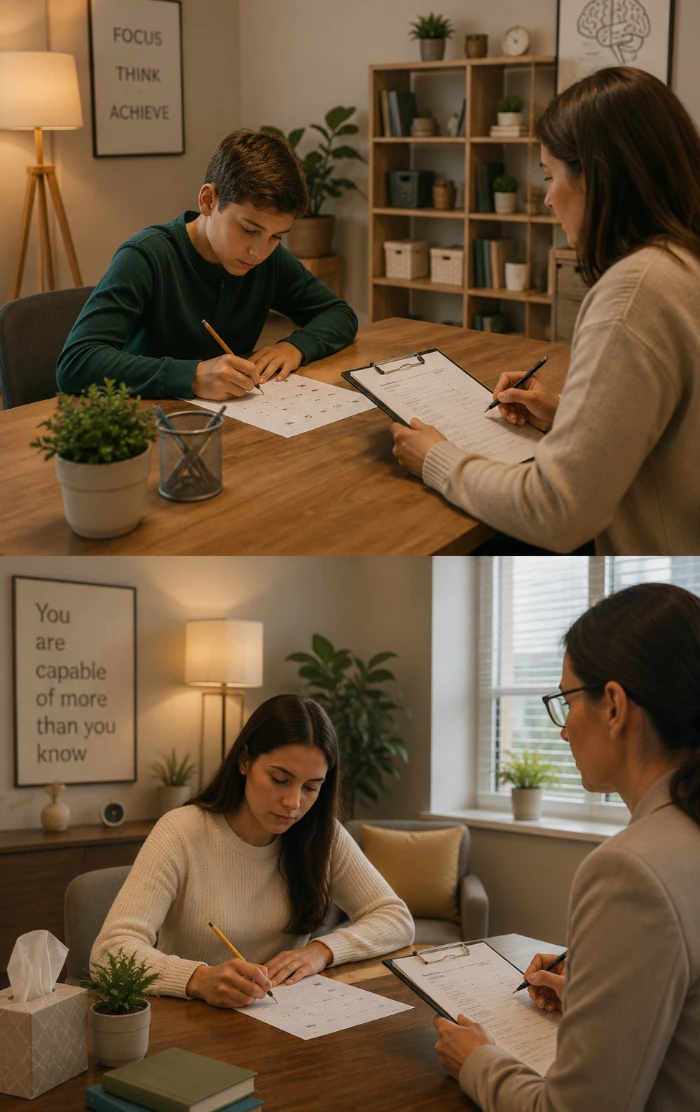
Professional IQ testing in Pasadena – whether you need an assessment for school, employment, gifted program eligibility, or personal insight, we connect you with licensed psychologists in the Pasadena area.
Last Updated: September 2026
Child IQ Testing
WISC-V & Stanford-Binet for ages 6–16. Gifted identification, learning profiles.
Adult IQ Testing
WAIS-IV & WAIS-5 available. Comprehensive adult cognitive assessments. Clinical & occupational.
WISC-V Test
Wechsler Intelligence Scale for Children® Fifth Edition – the gold standard for child IQ testing.
WAIS-IV & WAIS-5 Tests
Wechsler Adult Intelligence Scale® – Fourth Edition (WAIS-IV) and Fifth Edition (WAIS-5) available for adult IQ testing.
Gifted Testing
Identify giftedness for school placement, enrichment, and talent programs using WISC-V or Stanford-Binet.
Stanford-Binet 5
Stanford-Binet Intelligence Scales Fifth Edition – comprehensive cognitive assessment for all ages.
Mensa Testing
Mensa admission testing and preparation for the high-IQ society. Accepts WAIS-IV, WAIS-5, and Stanford-Binet 5 scores.
Full Evaluation
Combined assessment with detailed report and recommendations. Includes WISC-V, WAIS-IV, WAIS-5, or Stanford-Binet 5 as appropriate.
IQ Testing in Pasadena: city context
Pasadena is a major industrial and residential city in southeast Harris County, immediately southeast of Houston. The 2020 Census counted 151,950 residents. Its geography extends from established neighborhoods near the Houston Ship Channel to newer residential and commercial areas toward Bayport, giving residents very different travel, school-boundary, language-access, and environmental contexts.
The city includes multigenerational families, recent arrivals, skilled industrial workers, maritime and logistics professionals, students, veterans, and residents with varied cultural, linguistic, educational, and socioeconomic experiences. A qualified examiner should document language history, schooling, disability, health, sensory or motor needs, and the decision the report must support before choosing instruments.
IQ by gender & ethnicity
Pasadena's population is approximately 49.5% female. Properly normed intelligence scales are designed so broad male and female averages are similar. Individuals can nevertheless show different patterns across verbal, visual-spatial, fluid-reasoning, working-memory, and processing-speed tasks. No authoritative source publishes separate Pasadena IQ averages by gender, race, ethnicity, neighborhood, occupation, income, immigration history, or home language.
- Language: Pasadena has a substantial Spanish-speaking population; English-only testing can understate ability when English is not the examinee's strongest academic language.
- Language access: Proficiency, context of acquisition, literacy in each language, and educational opportunity should guide test selection and interpretation.
- Culture and schooling: Familiarity with test tasks, interrupted education, socioeconomic conditions, and access to instruction can affect performance.
- Individual decisions: School, clinical, disability, and employment decisions should use the full record rather than demographic assumptions.
What is professional IQ testing?
Intelligence quotient (IQ) testing is a standardized method to measure human cognitive abilities and intellectual potential. Professional IQ tests are administered by licensed psychologists in a controlled environment to ensure accuracy and reliability. Unlike online quizzes, clinical assessments provide a full-scale IQ score along with detailed breakdowns of verbal comprehension, perceptual reasoning, working memory, and processing speed.
In Pasadena, IQ testing is commonly used for gifted program admission, learning disability identification, career guidance, neuropsychological evaluation, and personal development. The results are presented in a comprehensive report that includes normative comparisons, strengths and weaknesses, and actionable recommendations.
A carefully interpreted online IQ test can offer a useful first look at reasoning skills, but decisions about school placement, diagnosis, accommodations, or Mensa documentation require an appropriately administered professional assessment.
Who should get tested?
IQ testing can benefit children, adolescents, and adults in various situations:
- Children: Parents often seek testing for school readiness, gifted placement, or to understand learning challenges.
- Adults: Many adults take IQ tests for career advancement, graduate school applications, or personal curiosity.
- Mensa candidates: High-IQ societies require official test scores for membership.
- Clinical referrals: Psychologists may recommend testing as part of a broader neuropsychological evaluation.
Types of IQ tests
Licensed psychologists may select from recognized, scientifically validated intelligence tests according to age, referral question, language, and the organization receiving the report:
- WISC-V (Wechsler Intelligence Scale for Children® – Fifth Edition): The gold standard for children aged 6:0–16:11. It provides a Full-Scale IQ and five primary index scores.
- WAIS-IV (Wechsler Adult Intelligence Scale® – Fourth Edition): The most widely used adult IQ test for ages 16–90. It measures cognitive functioning across four domains.
- Stanford-Binet Intelligence Scales – Fifth Edition: A comprehensive assessment for ages 2–85, often used for gifted identification and clinical evaluations.
- Gifted Testing: Often includes the WISC-V or Stanford-Binet, plus additional creativity and achievement measures.
- Mensa qualification: A psychologist may document results from an accepted test, but applicants should verify American Mensa's current test, edition, score, and documentation rules before scheduling.
How the testing process works
- Initial consultation: Brief phone or video call to discuss your needs and match you with the right psychologist.
- Testing session: In-person or remote testing (depending on the test) with a licensed psychologist. Most sessions last 1–2 hours.
- Scoring and interpretation: The psychologist scores the test and interprets the results in the context of your background and goals.
- Feedback session: A detailed review of your results, including strengths, weaknesses, and practical recommendations.
- Comprehensive report: You receive a written report with all scores, normative comparisons, and actionable next steps.
How much does IQ testing cost in Pasadena?
The cost of IQ testing in Pasadena varies depending on the type of test, the psychologist's experience, and whether a comprehensive report is required. Typical fees range from $200 to $1,200 for a full assessment. Gifted testing and Mensa admission testing are often at the lower end, while neuropsychological evaluations may be higher.
Some insurance plans cover cognitive assessment when it is medically necessary, while educational, employment, gifted, or personal-interest testing is often excluded. Ask the psychologist and insurer about fees, authorization, reimbursement, payment plans, and any sliding-scale policy.
Pasadena's Intellectual History & Legacy
Pasadena developed from a late-nineteenth-century farming community—once nationally associated with strawberries—into an important Gulf Coast center of petrochemicals, advanced manufacturing, maritime trade, healthcare, and technical education. Its civic story is also connected to the nearby San Jacinto Battleground, the Houston Ship Channel, Bayport, and the growth of the Houston metropolitan region.
- San Jacinto College Central: The Pasadena campus provides transfer, workforce, technical, healthcare, business, science, and continuing-education pathways tied closely to regional employers.
- Texas Chiropractic College: Founded in 1908 and based in Pasadena, the college contributes professional health education, clinical training, and community care.
- Industrial knowledge: Refining, chemical processing, instrumentation, safety, logistics, maritime operations, and environmental compliance require extensive technical training and continual learning.
- Pasadena Public Library: Library services support literacy, technology access, research, youth programming, workforce development, and lifelong learning.
- Regional science and nature: Armand Bayou Nature Center, nearby aerospace institutions, the port, and coastal ecosystems connect environmental education with engineering and public policy.
- Responsible testing: A professionally administered IQ test is useful only when the instrument, language, norms, accessibility, and report match the actual referral question.
Major Pasadena Employment Sectors and Cognitive Assessment
Most Pasadena employers do not require clinical IQ testing. Hiring usually relies on education, licenses, safety credentials, interviews, work samples, background checks, and job-specific aptitude measures. Clinical cognitive evaluation may be relevant only to a lawful accommodation, disability, rehabilitation, fitness, or diagnostic question.
- Petrochemical and refining: Ship Channel and Bayport facilities support engineering, process operations, maintenance, instrumentation, laboratory, safety, and environmental roles.
- Port, maritime, and logistics: Port Houston's Bayport activity and connected trucking, rail, warehousing, and distribution networks support international trade.
- Advanced manufacturing and construction: Fabrication, industrial services, specialty contractors, and major capital projects require technical skill and safety-sensitive training.
- Healthcare and education: HCA Houston Healthcare Southeast, clinics, Pasadena ISD, San Jacinto College, and Texas Chiropractic College employ clinical, educational, administrative, and support staff.
- Professional, retail, and hospitality services: Business services and commercial corridors broaden employment beyond heavy industry.
- Accommodation: Employees should obtain the employer's written documentation standard before testing so the evaluator addresses functional limitations rather than supplying an irrelevant score.
Pasadena IQ Testing by Travel Corridor
Access is more accurately described through travel corridors than by repeating neighborhood names. Examiner qualifications, accessibility, language competence, and report acceptance matter more than the shortest drive.
- North and central Pasadena: Southmore Avenue, Pasadena Boulevard, Richey Street, and SH 225 connect established residential areas, civic services, and the industrial corridor.
- Spencer Highway corridor: Medical offices, HCA Houston Healthcare Southeast, schools, retail, and residential areas generate frequent local traffic.
- Fairmont Parkway and Beltway 8: Southern Pasadena's commercial and residential growth is organized around Fairmont, Sam Houston Tollway, and connecting arterials.
- Bayport and SH 146: Port, industrial, nature, and waterfront destinations produce truck traffic and shift-change congestion.
- City-edge addresses: Postal labels, municipal limits, school districts, and unincorporated Harris County do not always align; verify the exact street address.
- Specialty referrals: Pediatric neuropsychology, bilingual assessment, forensic work, or complex medical evaluation may require travel elsewhere in the Houston region.
Pasadena Colleges and Regional Research Access
- San Jacinto College Central: Pasadena-based transfer, bachelor's, technical, healthcare, business, public-safety, and workforce programs serve students and regional employers.
- Texas Chiropractic College: Pasadena's professional health-sciences institution provides chiropractic education, clinical experience, and continuing education.
- University of Houston-Clear Lake: A nearby regional university offers undergraduate and graduate study in human sciences, education, business, science, engineering, and computing.
- Regional medical and research network: Houston's universities, Texas Medical Center, NASA Johnson Space Center, and specialty hospitals expand access to research and advanced clinical referrals.
- Industrial training: College-employer partnerships support process technology, instrumentation, maritime, logistics, cybersecurity, safety, and skilled trades.
- Clinical training limits: Supervised clinics and research programs may have narrow eligibility or waitlists and should not be assumed to offer routine private IQ testing.
Pasadena Economic Context
- Median household income: $64,927 in 2020–2024 Census estimates (2024 dollars).
- Per-capita income: $29,029.
- Residents in poverty: 18.9%.
- Bachelor's degree or higher: 16.2% of adults age 25 and older.
- Mean travel time to work: 26.6 minutes, although Ship Channel incidents, freight traffic, construction, and tropical weather can lengthen trips.
- Healthcare and social-assistance activity: Census business data report approximately $836.7 million in 2022 receipts/revenue within the city.
- Transportation and warehousing: Approximately $922.7 million in 2022 receipts/revenue reflects port, freight, delivery, storage, and regional logistics activity.
- Retail sales: Approximately $2.34 billion in 2022.
- Accommodation and food services: Approximately $376.1 million in 2022 sales.
- Labor-force participation: 63.4% of residents age 16 and older; female labor-force participation was 52.7%.
- Education context: 73.3% of adults age 25 and older were high-school graduates, and 53.9% of residents age 5 and older spoke a language other than English at home.
- Economic interpretation: Citywide education and income figures describe access and opportunity; they are not measures of intelligence and should never be used to predict an individual's ability.
- Regional strengths: Petrochemicals, refining, port and maritime activity, logistics, advanced manufacturing, construction, healthcare, education, professional services, retail, hospitality, and aerospace-related activity.
Pasadena School District Data
- Pasadena Independent School District: PISD serves much of the city through elementary, middle, intermediate, and high schools, career and technical education, advanced academics, dual credit, and specialized programs.
- Boundary verification: Parts of Pasadena may be served by another district; school assignment depends on the exact residence and current attendance boundary, not merely a Pasadena mailing address.
- Gifted referral: Texas districts use locally adopted identification procedures consistent with state requirements; referral does not guarantee evaluation, eligibility, placement, or a particular service model.
- Multiple measures: District teams consider approved quantitative and qualitative evidence rather than relying automatically on one privately obtained IQ score.
- Equitable interpretation: Language development, disability, educational opportunity, cultural context, and twice-exceptional profiles require careful review.
- Special education: Families may request evaluation when a disability is suspected; a multidisciplinary team determines needed domains, eligibility, and services under Texas and federal procedures.
- Private and charter schools: Each program establishes its own admissions, readiness, testing, and accommodation-documentation rules.
- Private reports: Before paying, obtain written requirements for examiner credentials, test edition, recency, score type, and supporting documentation.
Local Testing Centers and Psychologists
- Texas Behavioral Health: Its Pasadena, TX 77504 listing describes psychological testing and gives (832) 937-7586 x1. Ask whether the current clinicians provide stand-alone IQ testing for the examinee's age and intended use, which instruments are available, and whether a full report is included.
- Philip Curtis Townsend, PhD: A Texas-licensed psychologist listed at 3222 Burke Road, Suite 100, Pasadena, TX 77504; confirm directly whether cognitive or psychoeducational testing is currently offered.
- HCA Houston Healthcare Southeast: Medical, rehabilitation, behavioral-health, and specialty services may identify neurological or functional questions that need a targeted referral; routine stand-alone IQ testing should not be assumed.
- Pasadena ISD: School psychologists and multidisciplinary teams conduct educational evaluations under district, Texas, and federal procedures; gifted identification is a distinct process.
- Regional specialty services: Pediatric, neurological, developmental, rehabilitation, and bilingual practices elsewhere in Greater Houston may be appropriate for complex cases.
- Provider verification: Confirm Texas licensure, examiner role, exact address, test edition, age range, language competence, fees, insurance status, report turnaround, and receiving-organization acceptance.
Pasadena Events and Learning Opportunities
- Pasadena Strawberry Festival: The annual celebration reflects the city's agricultural heritage and combines exhibits, competitions, performances, and family activities; dates and programming change.
- San Jacinto College: Lectures, performances, exhibitions, workforce events, and continuing-education programs provide year-round learning opportunities.
- Armand Bayou Nature Center: Environmental education, guided programs, habitat interpretation, and volunteer science connect residents with prairie, forest, marsh, and bayou ecosystems.
- Pasadena Historical Museum and local heritage programs: Collections and public programs preserve the city's agricultural, civic, and industrial history.
- Pasadena Public Library: Literacy, technology, youth, language, workforce, and lifelong-learning programs provide accessible enrichment.
- Regional institutions: Space Center Houston, the San Jacinto Battleground, Houston museums, and universities broaden science, history, arts, and professional learning.
- Professional organizations: Texas psychology, education, disability, industry, and Mensa organizations maintain changing event calendars; verify dates with the organizer.
Transportation and Accessibility
- Public transportation: METRO services reach portions of the Pasadena area, but route coverage and frequency vary; check the current trip planner and any curb-to-curb eligibility before scheduling.
- Major roads: SH 225, Beltway 8, SH 146, Pasadena Boulevard, Southmore Avenue, Spencer Highway, Fairmont Parkway, Red Bluff Road, and nearby I-45 shape local access.
- Freight and shift traffic: Port, refinery, construction, rail, and truck activity can produce delays, particularly around industrial corridors and shift changes.
- Air access: William P. Hobby Airport is the nearest major passenger airport; Ellington Airport supports regional aviation activity.
- Storm and incident routing: Flooded roads, bridge or channel incidents, shelter-in-place notices, and industrial emergencies can alter routes or require rescheduling.
- City-edge travel: Clients coming from elsewhere in Harris County should allow for Houston-area congestion, toll facilities, construction, and school traffic.
- Testing-day access: Confirm parking, elevators, mobility accommodations, sensory needs, language access, and rest breaks before arrival.
Pasadena Weather and Seasonal Considerations
- Heat: Long, hot, humid seasons can affect hydration, sleep, medication tolerance, travel, and concentration.
- Tropical weather: Hurricanes, tropical storms, heavy rain, street flooding, lightning, and wind can disrupt appointments even when the center of a storm remains distant.
- Winter: Conditions are usually mild, but brief cold fronts and occasional freezes can affect roads, utilities, and health.
- Air and allergies: Pollen, mold, dust, smoke, ozone, and asthma symptoms may influence stamina or medication use.
- Regional travel: Clients arriving from elsewhere in Harris County or neighboring counties should allow time for Beltway 8 and I-45 traffic, port freight, construction, industrial incidents, and weather.
- Preparation: Sleep normally, eat, hydrate, use prescribed medications unless directed otherwise, bring glasses or hearing aids, and report illness or sleep loss.
- Rescheduling: Contact the office when severe weather, illness, or travel disruption would threaten safety or score validity.
Areas we serve
We support all areas of Pasadena.
Frequently Asked Questions
WISC-V is for children aged 6–16, while WAIS-IV is for adults aged 16–90. Each is normed for its specific age group.
Most IQ tests take between 60 and 90 minutes, plus a feedback session. Allow 2–3 hours total.
Many private psychologists accept self-referrals, but insurance plans, schools, courts, employers, and disability programs may impose separate referral or authorization rules. Confirm before booking.
Potentially. Acceptance depends on the exact test, edition, qualifying score, administration date, examiner credentials, and current Mensa documentation rules. Confirm before testing.
Some plans cover cognitive assessments when there is a clinical indication. Check with your provider.
Get a good night's sleep, eat a healthy meal, and arrive relaxed. No specific preparation is needed.
You'll receive a comprehensive report with your scores and tailored recommendations.
Some interview and feedback components may be available remotely, but many standardized cognitive tests require in-person administration. Confirm with the psychologist and the organization receiving the report.